
Add ₹999 more to unlock FREE SHIPPING!
Your sacred cart is currently empty.
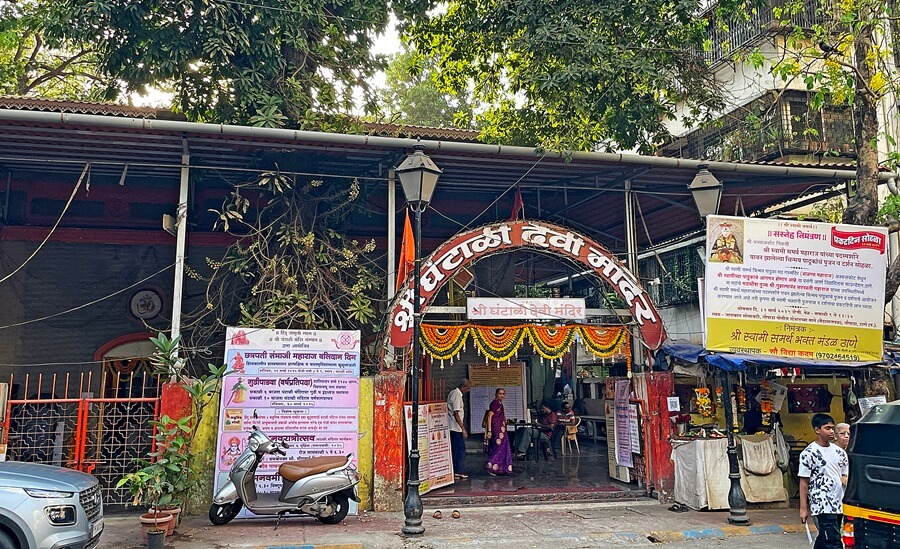
Shop Photo FramesDedicated to Goddess Ghantali, the revered Kuldevi (family deity) of the Koli and Pathare Prabhu communities, this temple is considered one of the ancient temples of Thane. Built during the British colonial era, approximately 125 to 150 years ago, the temple is situated on Ghantali Path, near Vishnu Nagar in Naupada. The name of this Swayambhu (self-manifested) Goddess is derived from the combination of the words ‘Ghanta’ (bell) and ‘Tali’ (clapping/rhythm). While every temple witnesses this sacred union, it is said that the Goddess received this resonant name because devotees offer vows by tying bells here.
The road in front of the temple was named Ghantali Path because of the Ghantali Devi Temple itself. Although now located in the heart of the city, this temple was once situated far from the main settlement, surrounded by dense foliage. Even about sixty years ago, there were only unpaved dirt roads leading to the temple, lined with traditional wadas and paddy fields. Consequently, during the monsoon, these roads would become thick with mud. Devotees would tread carefully upon stones laid in the muddy pathways to come for the darshan of Goddess Ghantali. In those days, citizens would visit to stroll under the dense shade of Bakul and mango groves. It served as a morning and evening walking spot for the residents of the Tembhi Naka area. Historically, this locality was inhabited by middle-class Marathi families.
According to legend, a pond was once hidden amidst the lush greenery of this region, on the banks of which stood a Lord Shiva temple. A devout visitor who frequented the temple received a divine revelation that a self-manifested idol of the Goddess existed behind a mango tree near the pond. Following the discovery of the idol, she was solemnly consecrated and worshipped according to sacred rituals. In an article titled ‘Exploring Thane: A Heritage Tourist Destination’ (International Journal of Innovative Science and Research Technology, July 2019) by Dr. Indrani Roy, Assistant Professor in the History Department at Joshi-Bedekar College, Thane, it is also mentioned that this was originally a temple of Lord Shiva. According to this article, exact information regarding the construction of the temple is not available, but it is said to have come into existence about 120 to 150 years ago, around the period after 1875, when Thane was under British rule. The temple finds mention in Volume 14 of the ‘Gazetteer of the Bombay Presidency’ published in 1882. The gazetteer records that the temple was located on ‘Bombay Road’ and received an annual grant (varshasan) of eight shillings—equivalent to four rupees at the time—from the British Government. Dr. Indrani Roy’s article also notes that the ancestors of Raosaheb Keshavraj Bhaskarji Kothare constructed this temple.
The original temple here was a wooden structure featuring two separate garbhagrihas (sanctum sanctorums) dedicated to Lord Shiva and Goddess Ghantali. In 1901 CE, a new sanctum was constructed between these two, wherein the idol of Lord Rama was consecrated. Records indicate that the old temple underwent renovations (jeernoddhar) in 1940 CE and 1972 CE. Later in 2013, the descendants of Keshavrao Bhaskarji Kothare handed over the temple to the Hindu Jagruthi Nyas. On the auspicious day of Dhanatrayodashi that year, the sale deed and gift deed of the temple premises were officially transferred to the Hindu Jagruthi Nyas. Today, the management of the temple is overseen by the trust.
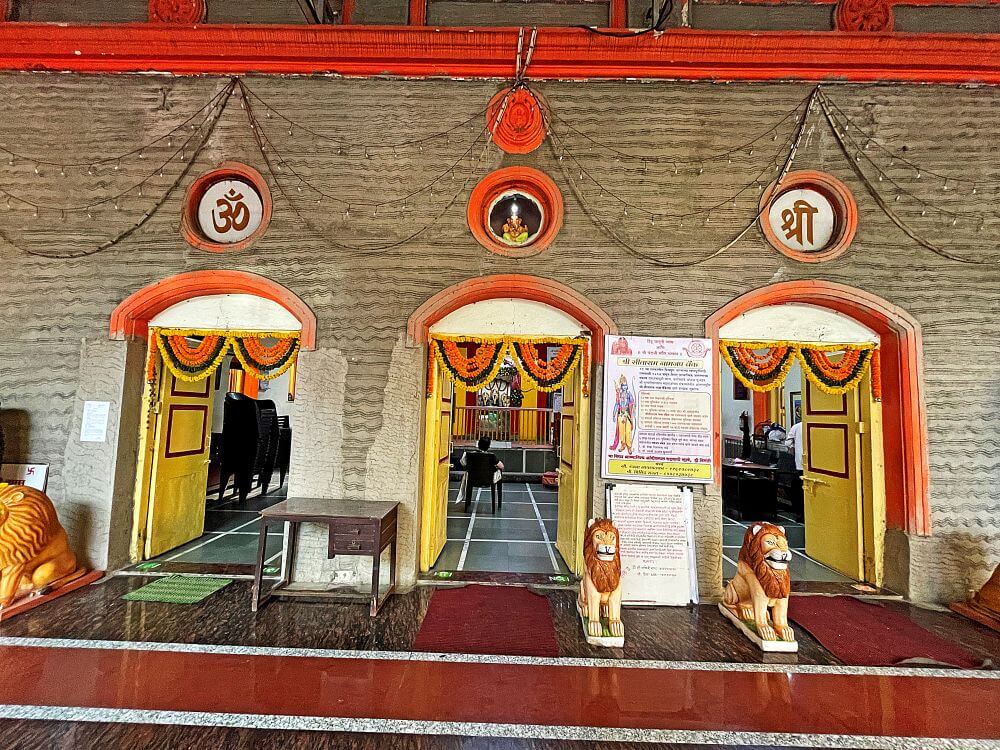
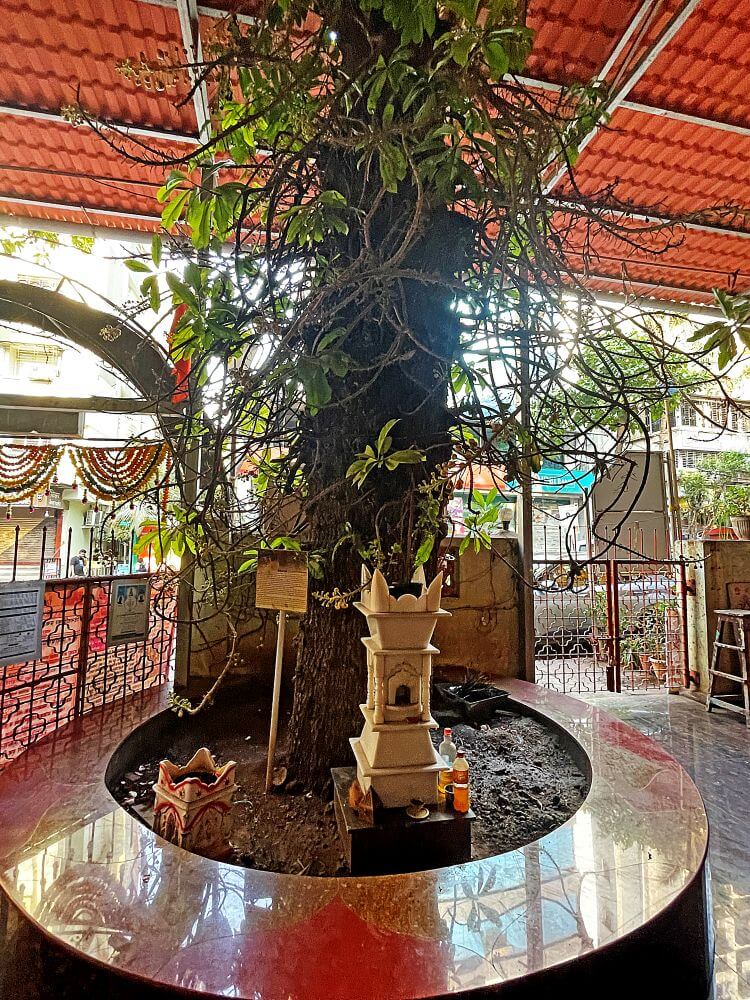
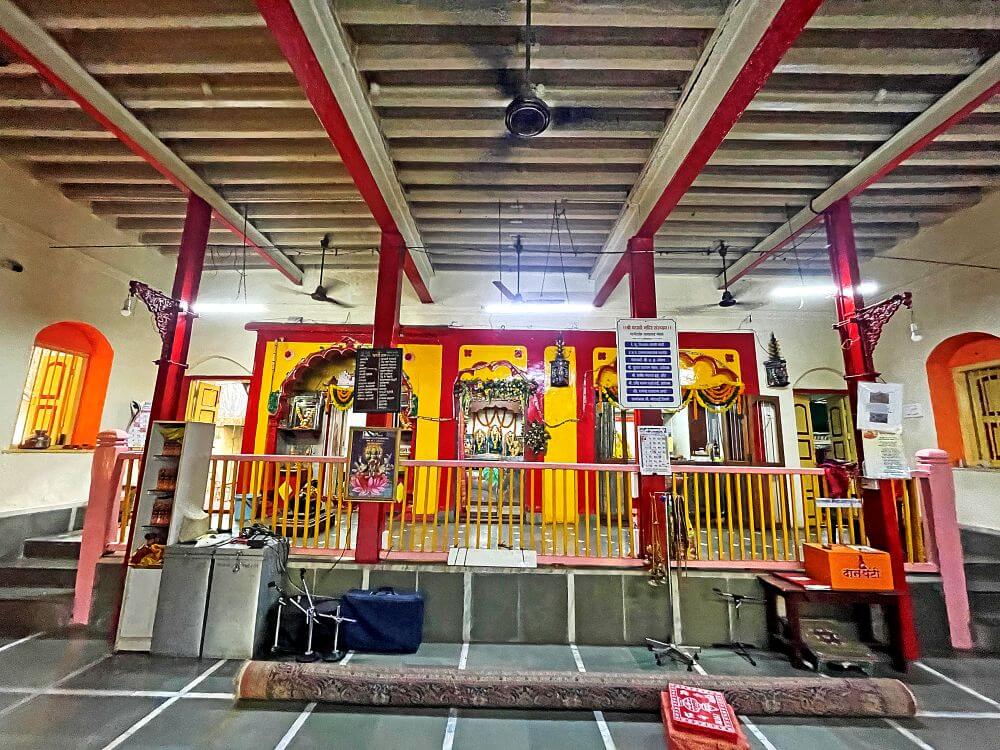
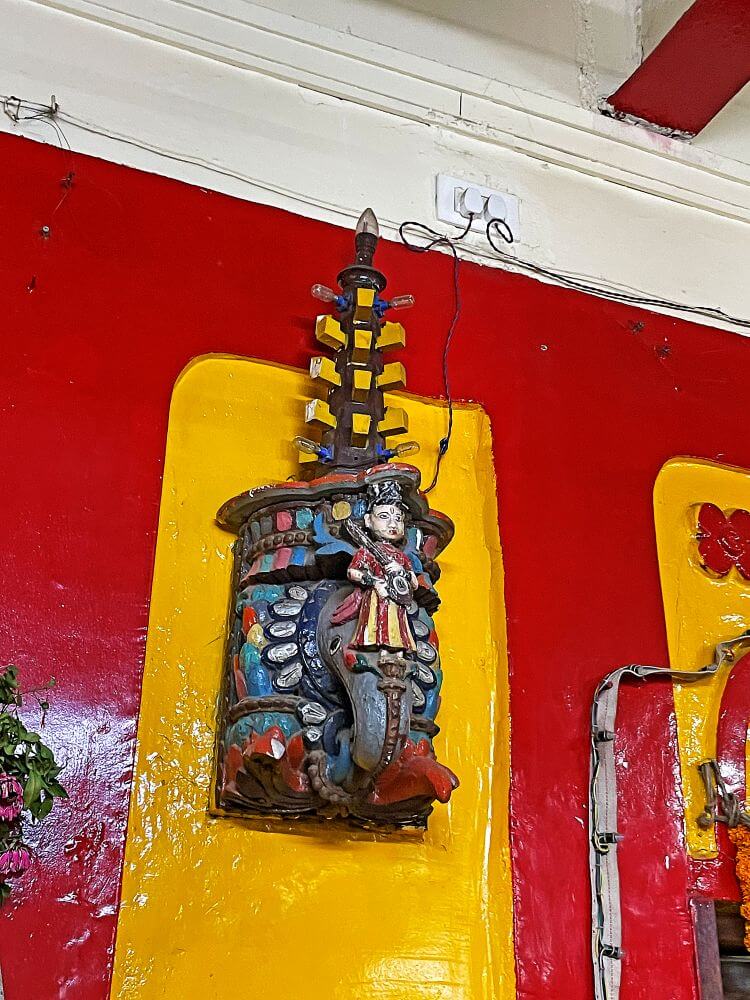
Situated beside a bustling road, the temple today stands as a harmonious blend of traditional and modern architecture. Before entering the temple, one’s eyes are drawn to two deepmalas (lamp towers) and a grand tree in the temple courtyard. This rare species of tree, known as Kailaspati (Cannonball tree), evokes the matted locks (Jata) of Lord Shiva through its canopy structure, while its fragrant blossoms resemble the Shivlinga. A tin roof over the courtyard has transformed it into a spacious Darshan Mandap. At the entrance of this hall hangs a large bell inscribed with the line: “Navas fednya ghanta bandhiti, mhanuni naam ase Ghantali” (Bells are bound to fulfill vows, hence the name Ghantali). Near the entrance of the Sabhamandap stand four lion sculptures—two large and two small. Since the temple houses three sanctums, there are three adjacent entrance doors leading inside. All three doors are identical; the central door features an idol of Lord Ganesha in the wall above it, while the other two doors bear the sacred symbols ‘Shree’ and ‘Om’. Inside lies a spacious and high-ceilinged Sabhamandap, with wooden staircases on both sides.
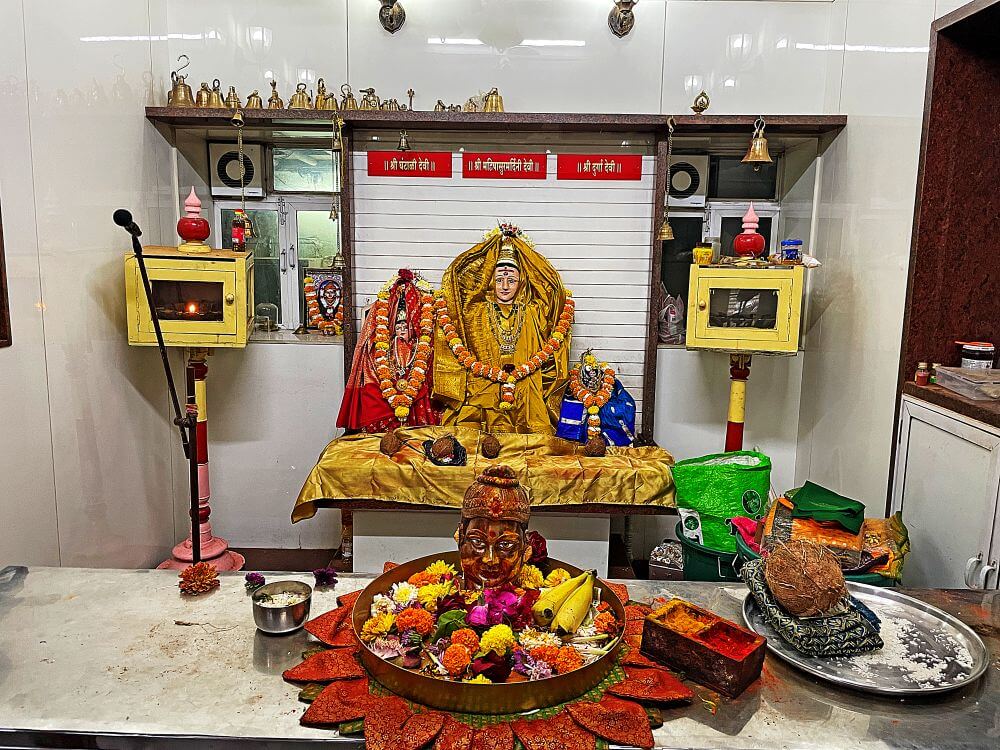
Facing the Sabhamandap are three sanctums lined up in a row. The first sanctum from the left houses the Shivlinga, with an idol of Mata Parvati enshrined behind it. The doorway of this sanctum features traditional carvings and a Kirtimukha motif. At the entrance of the central sanctum dedicated to Lord Rama, a niche on the left holds an idol of Lord Ganesha, while a niche on the right holds Panchamukhi Hanuman. Inside are the serene and graceful idols of Shri Ram, Lakshman, and Sita. The third sanctum features beautifully adorned idols of Ghantali Devi, Mahishasuramardini, and Goddess Durga. The sanctums of Lord Shiva and the Goddess are crafted entirely of stone. Adjacent to the sanctums is a room serving as the residence for the temple priests.
Devotees can seek darshan at the temple from 6:00 AM to 9:00 PM daily, except during the afternoon closure between 1:00 PM and 3:00 PM. However, these timings are revised during Navratri. Daily Aarti is performed at 6:30 PM, whereas during the Navratri festival, the night Aarti takes place at 8:30 PM. Since many Gujarati-speaking residents live in the vicinity, Aarti is performed in Gujarati as well. Festivals such as Ram Navami, Hanuman Jayanti, Navratri, and Tripurari Poornima are celebrated here with great devotion. The Goddess’s birth anniversary is celebrated on Maghi Poornima. The temple’s Navratri festival is renowned, for which special arrangements are made. On the first day of the festival, Ghatasthapana is performed at 5:00 AM followed by special rituals. Along with religious ceremonies such as Kumkumarchan, Kumarika Pujan, Bhondla, Gondhal, Homa, Havan, Bhajans, and Kirtans, various cultural programs are organized during the festival. Thousands of devotees visit the temple during this grand celebration to seek the blessings of the Goddess.
This sacred temple stands as a testament to deep spiritual devotion, ancient architectural grandeur, and rich local cultural traditions.
The sanctum sanctorum houses the divine idol consecrated according to ancient Vedic traditions, surrounded by serene courtyards and traditional temple architecture.
Navratri, Maha Shivratri, Annual Temple Jatra & Deepotsav
Compare and book flights, secure top-rated local hotels near the temple, hire reliable guides, and rent cars instantly.
Extend your pilgrimage by visiting other highly sacred temples located nearby.


Add ₹999 more to unlock FREE SHIPPING!
Your sacred cart is currently empty.
Shop Photo FramesFill in your delivery details below to place your order.
Add comment