
Add ₹999 more to unlock FREE SHIPPING!
Your sacred cart is currently empty.
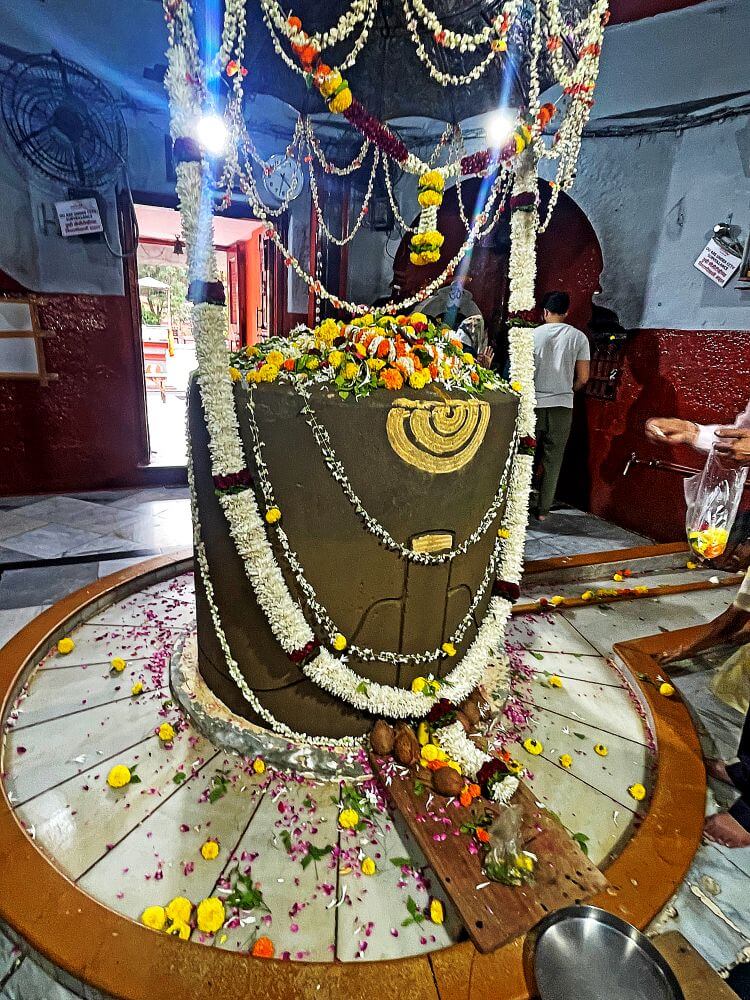
Shop Photo FramesThe city of Thane, known in ancient times as Shri-Sthanaka or Sthanikiya Patan (port), possesses a rich religious and historical tradition. The Kopineshwar Temple, the presiding deity (Gramadaivat) of this city, stands as a testament to that history and tradition. It is the revered deity of many Thane residents and a place of faith for millions of devotees. It is counted among the most ancient temples in the city. A unique feature here is the Shiva Linga housed within the temple. This Linga stands about five feet tall from its base (Shalunka). It is the firm belief of devotees that the size of this Linga increases slightly every year.
Thane city has a history spanning approximately thirteen hundred years. The first recorded mention of this city dates back to 636 CE. In those days, the city was so prosperous that the fleet of Uthman ibn Abi al-As al-Thaqafi, a commander under Caliph Umar ibn al-Khattab, attacked the city with the intent of plunder. At that time, the Chalukyas held power here. Tanah, Tabeh, and Tana are the ancient names of Thane. In the copper plate inscriptions from 997 and 1018 CE, dating back to the era of the Konkan rulers, the Shilaharas, Thane is referred to as Shri-Sthanaka. In an inscription dated Sunday, Chaitra Shuddha 15, Shaka 1107, which corresponds to March 7, 1185, by the Shilahara ruler Aparaditya (II), Thane is mentioned as ‘Sthanikiya Patan’.
Thane was the capital of these Shilahara kings of North Konkan. The Shilaharas were devotees of Shiva. Along with the famous Shivalaya in Ambernath, they built many temples in the surrounding region. Among these, Kopineshwar was renowned as an important place of worship. After the Shilaharas, many regimes changed. During the Bahmani period, Thane was part of the Gujarat Sultanate. The ‘Bombay Gazetteer’ records that the Portuguese plundered the city twice between 1530 and 1533, and the Gujarat Sultanate did so once. In the sixteenth century, the Portuguese gained control over Thane. According to the ‘Bombay Gazetteer’, after the Portuguese rule, “no trace remains of the old Hindu or Muslim Thane. The temples and mosques praised by earlier travelers were destroyed by the Portuguese (1530 to 1560) and their stones were used for churches and other religious buildings. In retaliation, the Marathas later (1737 to 1740) destroyed many churches and Christian buildings.”
In the Battle of Vasai, the Peshwas expelled the Portuguese from Vasai and Salsette Island. Ramaji Mahadev Bivalkar, one of the warriors in this campaign, was later entrusted with the responsibility of the Maratha Navy by the Peshwas. In 1757, he became the full Subhedar of Kalyan. According to the historical text ‘Subhe Kalyan’ by Vivekanand Godbole, during his tenure, Subhedar Ramaji Bivalkar built 108 Shiva temples, including the Rameshwar Temple in Kalyan and the Omkareshwar Temple in Pune. Similarly, he renovated the Kopineshwar Temple in Thane. The Bombay Gazetteer cites the year of renovation as approximately 1760. It is said that after the Portuguese fled Thane, Subhedar Bivalkar began organizing the administration of the city. At that time, he discovered a magnificent Shiva Linga partially submerged in Masunda Lake. He realized that it was the Linga from the Kopineshwar temple established during the reign of King Bimba. When the Portuguese destroyed the original temple, they had pushed the Shiva Linga into Masunda Lake. Subhedar Bivalkar built a stone temple here and re-consecrated the Shiva Linga. Later, 137 years later, in 1897, the need arose to repair the temple. At that time, thousands of people from Thane came together, collected a fund of eight thousand rupees, and renovated the temple.
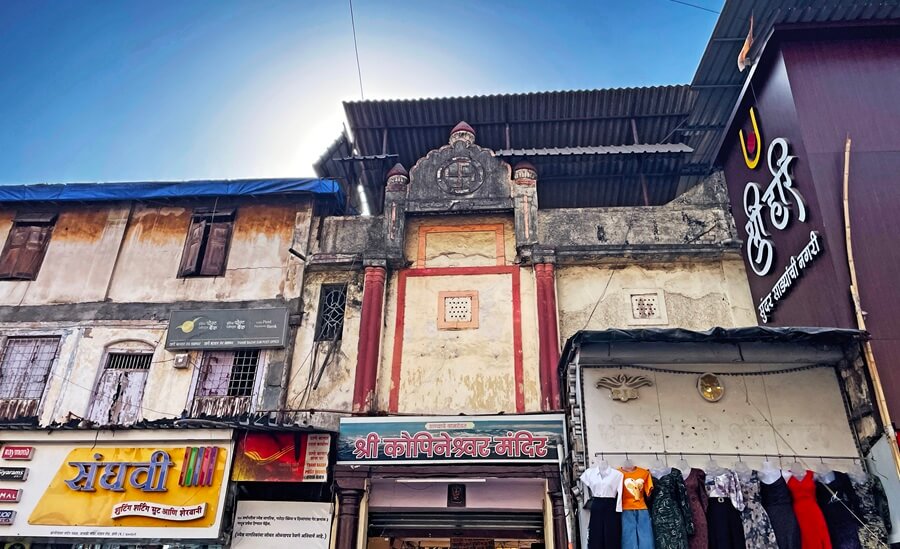
This temple is located in the present-day Jambhli Naka area of Thane city. There are many paths to reach this temple, which is situated in the heart of a bustling marketplace. The path leading through the market to the temple seems lost amidst the crowd of shops. This is the main path to the temple. The gate on this path remains open from 6:00 AM to 12:30 PM and from 3:30 PM to 10:00 PM. The two pillars flanking the entrance of this temple, which resembles an old mansion (wada) from the outside, bear witness to its antiquity. The second path is at the back of the temple. Old-timers say that the water of Masunda Lake used to reach that point in the past. The third path is along the side of the temple complex adjacent to the main temple.
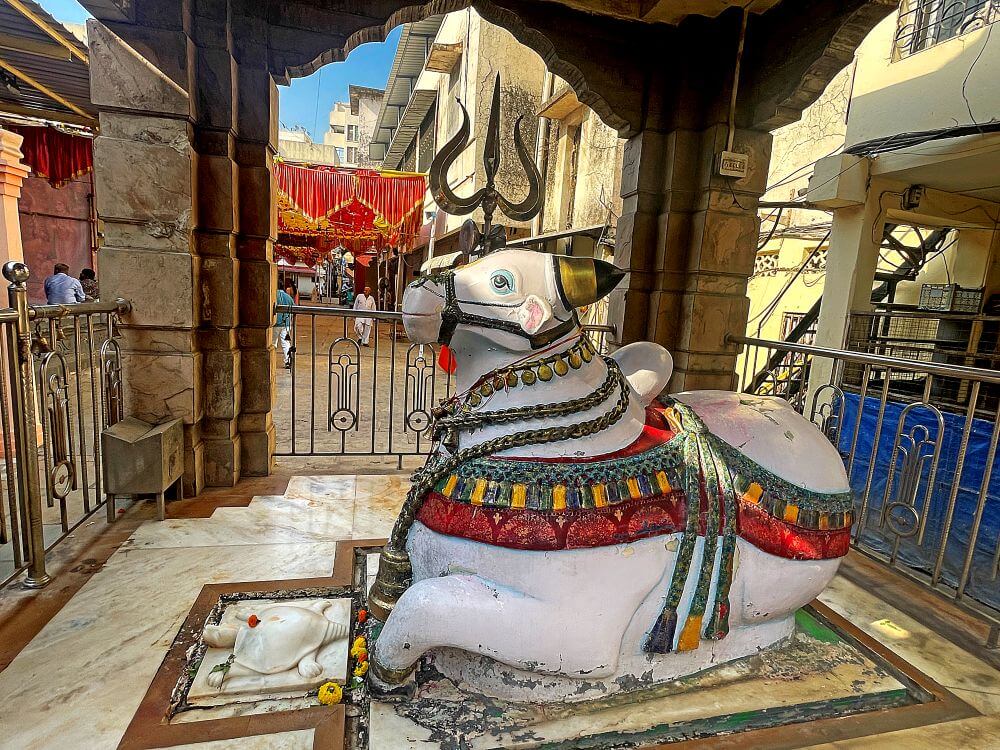
The structure of the temple consists of a Nandi Mandapa, a Sabha Mandapa, and a Garbhagriha (sanctum sanctorum). As soon as one enters through the main gate, the magnificent statue of Nandi in the Nandi Mandapa catches the eye. This Nandi must have been carved from a single monolithic rock. The craftsmanship on the body of this Nandi is worth seeing. In addition to the garland of bells around its neck, the nose ring, and the bell necklace, the craftsmanship depicting the ropes is also very distinctive. Although there are signs of recent improvements in the Nandi Mandapa, its design relates to the decoration of the main temple.
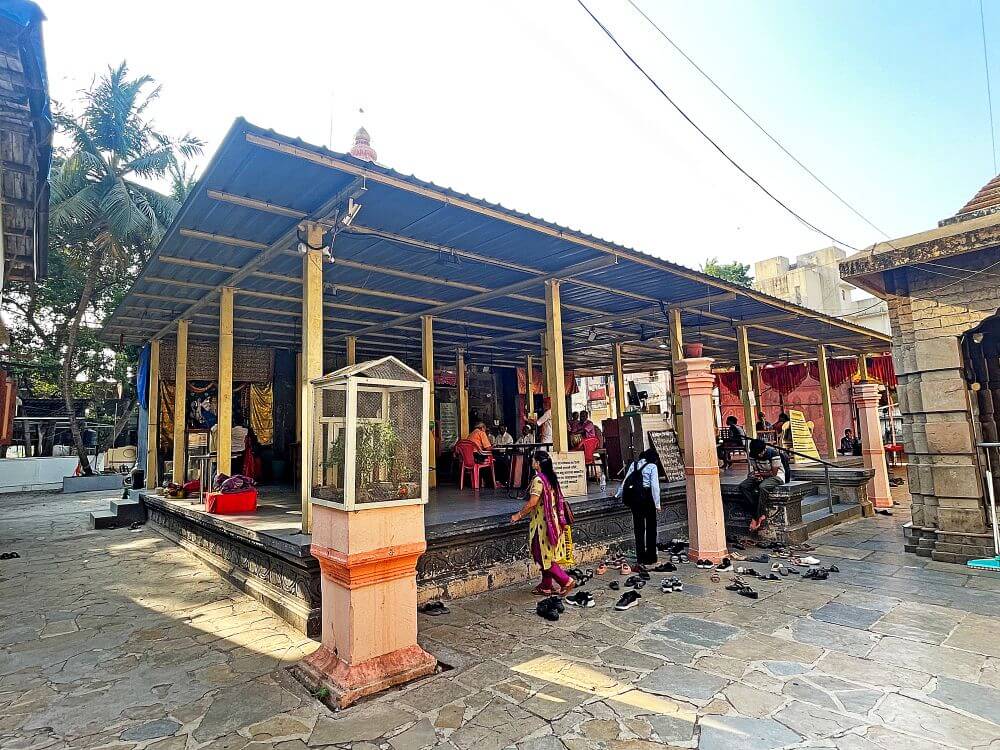
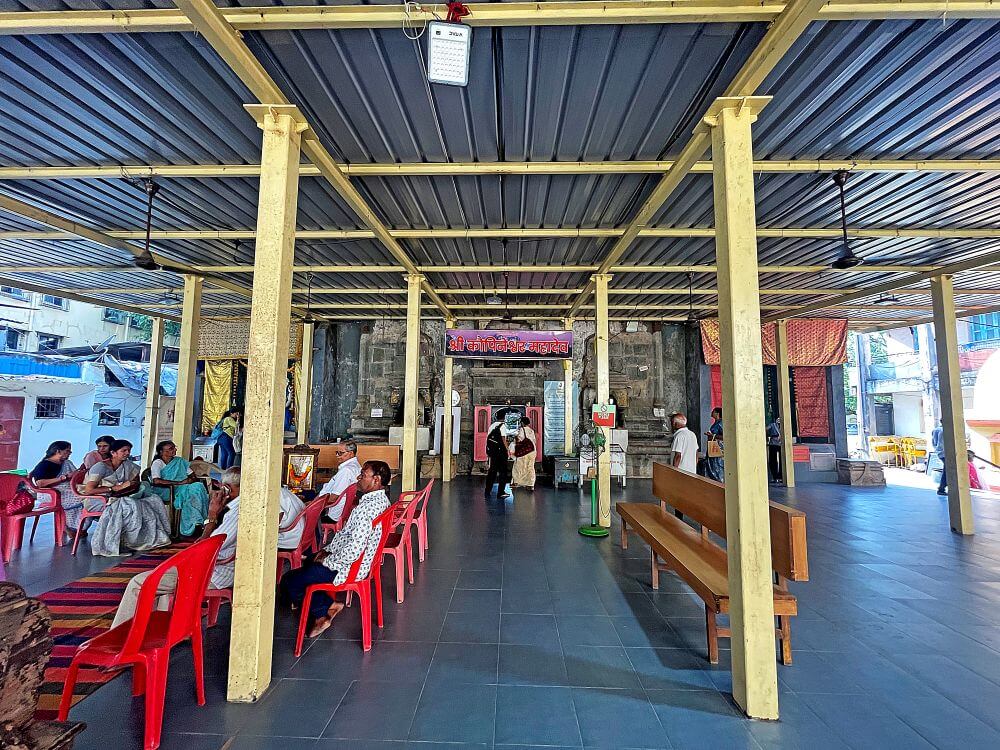
The Sabha Mandapa of the temple is open, and such a structure is referred to as a ‘Rangamandapa’. This spacious hall currently has a roof, and many programs such as Kirtans and discourses are held there. One has to climb four steps to enter the Sabha Mandapa. Nearby is a Sati Vrindavan. That Vrindavan belongs to the wife of Bubaji Naik, the Kotwal of Thane city. He was one of the brothers of Gangaji Naik of Anjur, who fought for the liberation of Vasai. After his death in 1746, his wife committed Sati. Subsequently, her Vrindavan was erected there.
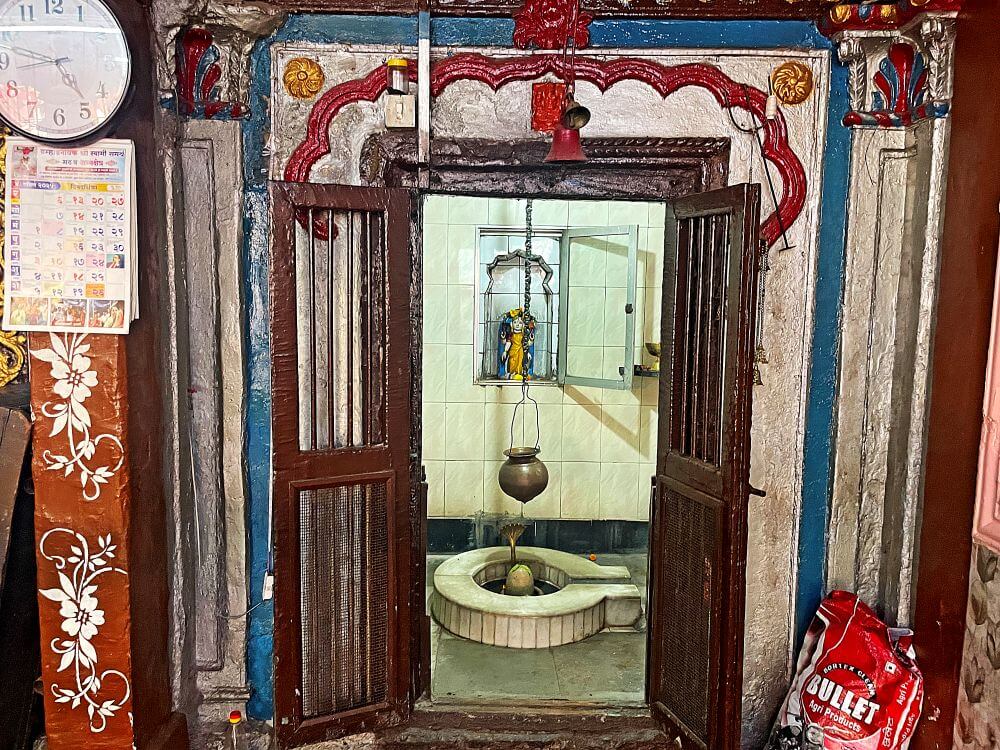
Near the wall at the entrance of the Garbhagriha are statues of Ganpati, Vishnu, and Parvati. The statues of Ganpati and Parvati are large, while the stone-carved statue of Vishnu is small. It is said that these two large statues were installed at a later period. There is a small statue of Ganpati on the lintel of this stone-carved entrance. The Garbhagriha is somewhat deep. One enters it by descending four steps. Inside is a Shiva Linga about five feet tall, carved from a single stone. There are arches in the four corners of the sanctum and some niches. In one niche, there is a stone statue of Parvati. In the corner next to it is a small Shiva Linga.
A large crowd of devotees gathers here every Monday. On Shravani Mondays and Mahashivratri, the Shiva Linga in this temple is adorned with a massive offering of flowers. A long queue of devotees forms to see this and to have the darshan of the Linga. It is required. For the past few years, ice decorations have also been made. When Lord Shiva consumed the Halahala poison that emerged during the churning of the ocean (Samudra Manthan), his body began to burn intensely. It is said that this is why the tradition of covering the Shiva Linga with ice was started here.
There are many other independent temples of various deities within the Kopineshwar Temple complex. Some of these temples are adjacent to each other, while others are separate. The independent temple of Vitthal Rukmini, located next to the main assembly hall (Sabhamandap) and the sanctum sanctorum (Garbhagriha), is small yet beautiful. To its left are the Ganpati Temple, Shitala Devi Temple, Panchmukhi Shivlila Temple, and Ram Temple. The large Shiva Linga in the Panchmukhi Shivling Temple has four additional stone faces on its upper side, while the idol of Ganpati in the Ganesh Temple is in a meditative lotus posture (Padmasana) with his trunk held in his hand. There is also a Maruti temple in front of the Ram temple. There are other Maruti temples here as well. Among them, the idol in the Dakshinmukhi (south-facing) Hanuman Temple is very beautiful. The image of Hanuman in this temple, which faces south , is three to three-and-a-half feet tall. He holds a mountain peak in his hand and has crushed a demon under his feet. To the right of this Dakshinmukhi Hanuman is another Hanuman temple. It is known as the Ganpati-Maruti Temple. This temple houses a graceful idol of Hanuman. Behind him, with its back to Hanuman, is a Swayambhu (self-manifested) idol of Ganpati. This idol is not carved, yet it gives the impression of the Omkara form of Ganpati.
To the right of this temple is a large, independent temple of Kalika Mata. In this temple, which features a spacious assembly hall, there is a tiger statue in front of Kalika Mata. To the left of the Goddess, one can see the idols of Vetal, Kalbhairav, Shankar, and Hanuman. Directly in front of this temple is the Datta Mandir. Beside it stand two large lamp towers (Deepmalas). It is said that they were erected in 1895. Between these lamp towers is a small but unique temple. It is the temple of Kamdhenu, Kalpavriksha, and Guru Vashistha. The face of Dattatreya in the Datta Mandir here is turned towards the north. In the center of the temple is the sanctum sanctorum, surrounded by a circumambulation path (Pradakshina Marg).
Festivals such as Mahashivratri, Shravani Somvar, Ashadhi Ekadashi, Ram Navami, Hanuman Jayanti, and Datta Jayanti are celebrated in this temple complex. The discourses and kirtans held here during Chaturmas remain a center of attraction for the senior citizens of Thane even today. The Kopineshwar Temple Trust started a library called ‘Dnyankendra’ here in 1977. Meetings for the preparation of the annual New Year welcome procession (Navvarsha Swagat Yatra) in Thane are held within the temple premises. This grand procession begins from the Kopineshwar Temple itself. Since ancient times, the Kopineshwar Temple has remained an important center for many historical events in Thane. It is said that many important secret meetings were held here during the freedom struggle. There is a record that in 1917, a conference of cow devotees (Gabhaktas) was held in the temple premises, which was attended by the Father of the Nation, Mahatma Gandhi.
This sacred temple stands as a testament to deep spiritual devotion, ancient architectural grandeur, and rich local cultural traditions.
The sanctum sanctorum houses the divine idol consecrated according to ancient Vedic traditions, surrounded by serene courtyards and traditional temple architecture.
Navratri, Maha Shivratri, Annual Temple Jatra & Deepotsav
Compare and book flights, secure top-rated local hotels near the temple, hire reliable guides, and rent cars instantly.
Extend your pilgrimage by visiting other highly sacred temples located nearby.


Add ₹999 more to unlock FREE SHIPPING!
Your sacred cart is currently empty.
Shop Photo FramesFill in your delivery details below to place your order.
Add comment