
Add ₹999 more to unlock FREE SHIPPING!
Your sacred cart is currently empty.
Shop Photo FramesThe tradition of worshipping guardian deities (Kshetrapal Devatas) has existed in our culture since ancient times. The protectors of villages, towns, and regions are considered incarnations of Lord Shiva. Although their idols may appear in various forms, the Nandi placed before the sanctum sanctorum confirms their identity as a Shiva incarnation. The traditions of festivals and processions for these village guardian deities have been preserved for thousands of years. One such ancient, famous, and self-manifested (Swayambhu) Mankeshwar temple in this tradition is located in the village of Peth, situated on the banks of the Krishna River in Walwa Taluka. Devotees believe that the deity here is awakened (Jagrut) and grants the wishes of those who pray with devotion.
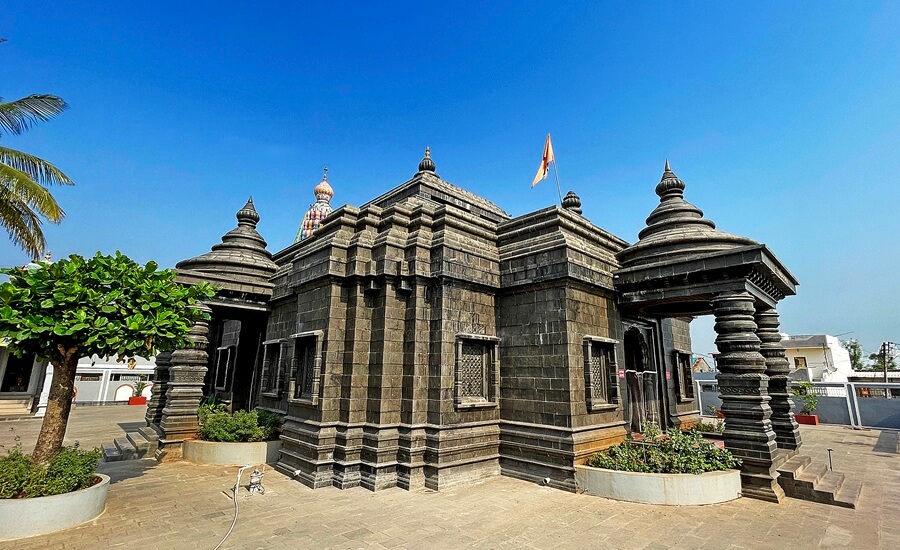
There is no definitive information available regarding how many years old this Mankeshwar shrine is. It is said to be more than one thousand years old. This Swayambhu shrine is located at some distance from the village. In ancient times, the village elders (Mankaris) appealed to the deity to come to the village to protect it. The deity then gave a vision (Drishtant) stating that he was already present at this very spot. Following that vision, when the elders searched everywhere, they found the Swayambhu stone idol of the deity at the place where the temple currently stands. Subsequently, the deity was consecrated at this location and a temple was built. Over time, a grand and beautiful temple in the Southern architectural style was constructed here. Today, this temple has become a center of attraction not only for devotees but also for tourists visiting the area.
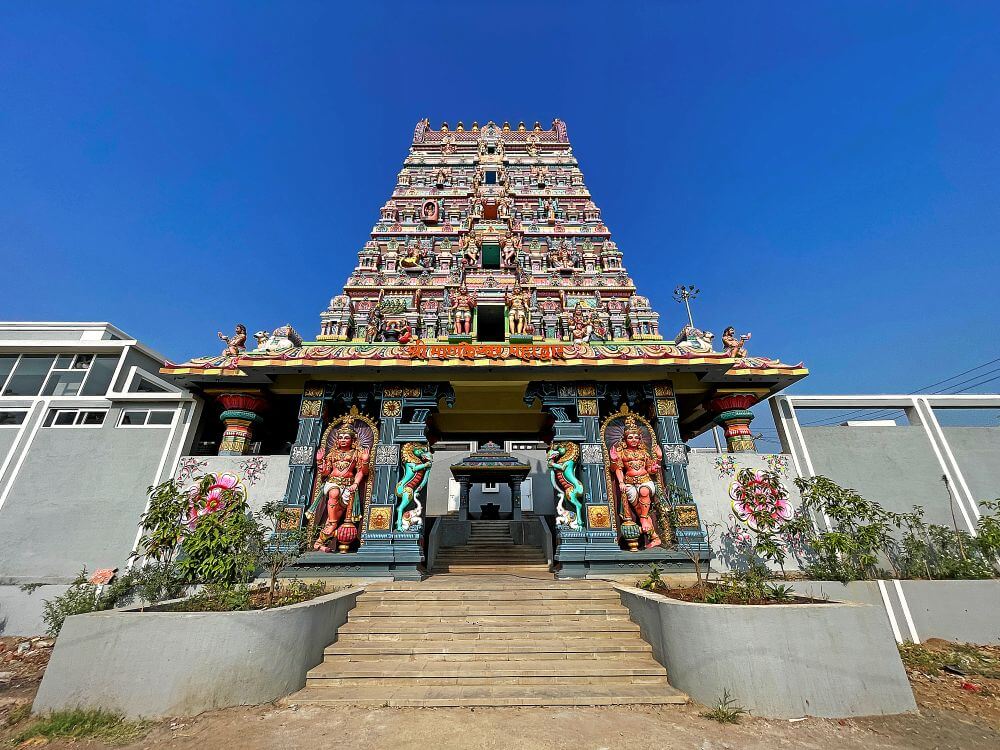
This temple, located on the outskirts of Peth village, has a strong perimeter wall. One enters the temple courtyard through a grand entrance gate on the eastern side of this wall. In the entrance, on both sides near the ornate pillars, there are Vyala sculptures and gatekeepers (Dwarpalas). On the balcony above the entrance, there is a tall, five-tiered Southern-style Gopuram. Each tier of the Gopuram features gatekeepers on both sides of the niches, along with sculptures of deities depicting various mythological events, pillars, domes, and finials. There are seven finials in a row at the top of the Gopuram.
There are entrance gates on the north and south sides of the perimeter wall. In front of each entrance, there are two ornate pillars on both sides, with mace-bearing gatekeepers in front of the pillars. There is a Shikhara (spire) on the balcony above the pillars. The Shikhara contains three niches with idols of various deities. On the north side, near the temple’s perimeter wall, is the chariot room (Rath-kaksha) of Mankeshwar. The two-story wooden chariot used during festivals is kept here.
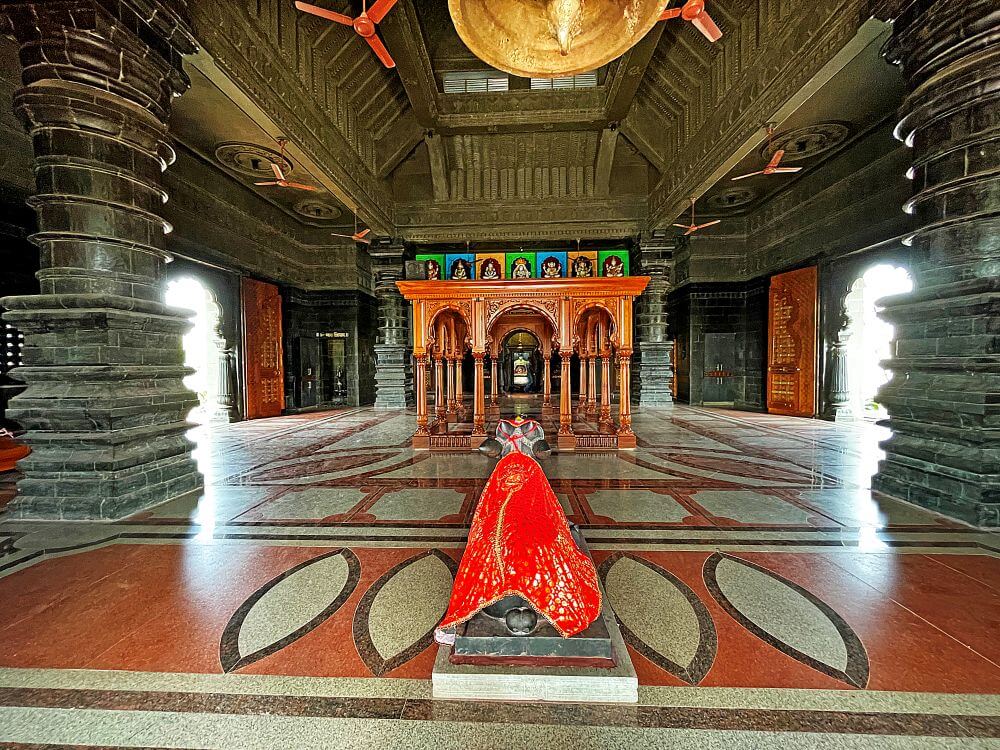
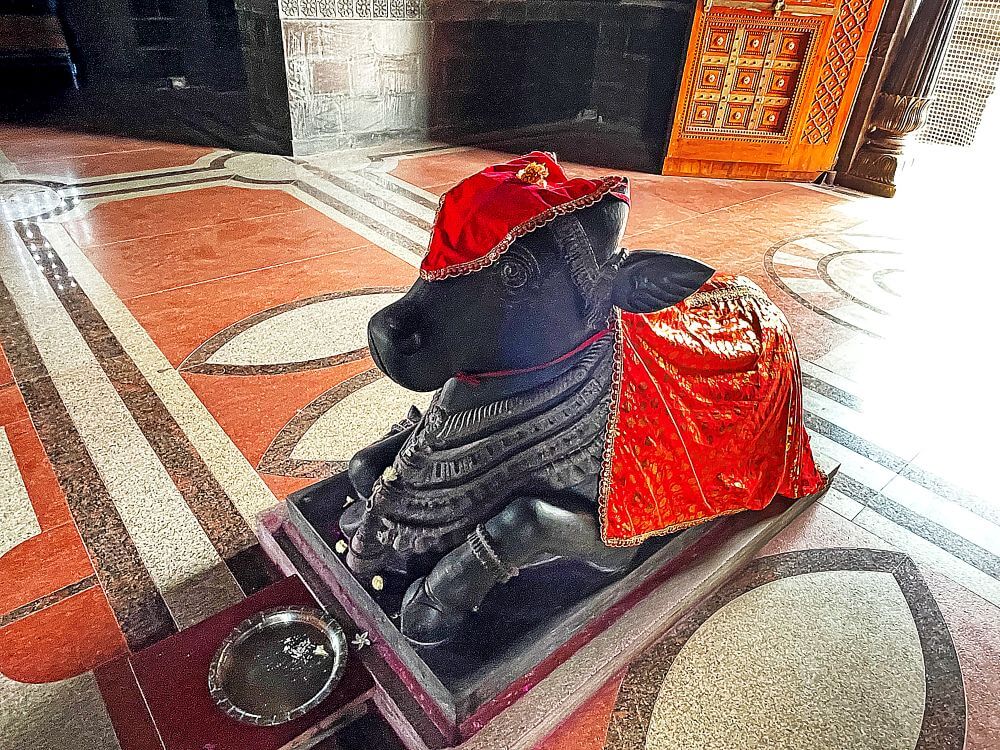
After passing through the main entrance and climbing a few steps, one reaches the temple, which stands on a high plinth (Jagati). In front of this temple is a platform with a distinctive circular lamp tower (Deepmal). From the base to the top, the entire lamp tower is decorated with intricate carvings of leaves and flowers. On the other side of the courtyard is an ornate Tulsi Vrindavan. From here, one climbs five steps to enter the temple’s assembly hall (Sabhamandap). Entering the assembly hall through the north entrance, one sees the black stone idol of Nandi on a platform. Further ahead, in front of the sanctum sanctorum, is an open hall with twelve wooden pillars. All the pillars are connected to each other by arched gateways. Devotees believe that performing a circumambulation (Parikrama) of this hall with specific rituals leads to divine experiences and removes mental and physical ailments. The enclosed assembly hall (Gudhamandap) has windows for ventilation. There are four ornate stone pillars in the four corners of the assembly hall. On the pillars are beams, and above them is the ceiling of the temple, divided into two parts—upper and lower. The walls of the assembly hall feature images of various deities.
Further ahead is the Antarala (vestibule) with two pillars and three arched gateways. Above the middle arch, on the wall, is a Nandi-mukh (face of Nandi). In the niches on the left and right sides of the Antarala are idols of Maruti and Ganpati, respectively. Between both niches is the entrance to the sanctum sanctorum. All three door-frames of the entrance have vertical carvings, and there is a Ganpati on the lintel (Lalat-bimba). The architrave is decorated with floral carvings.
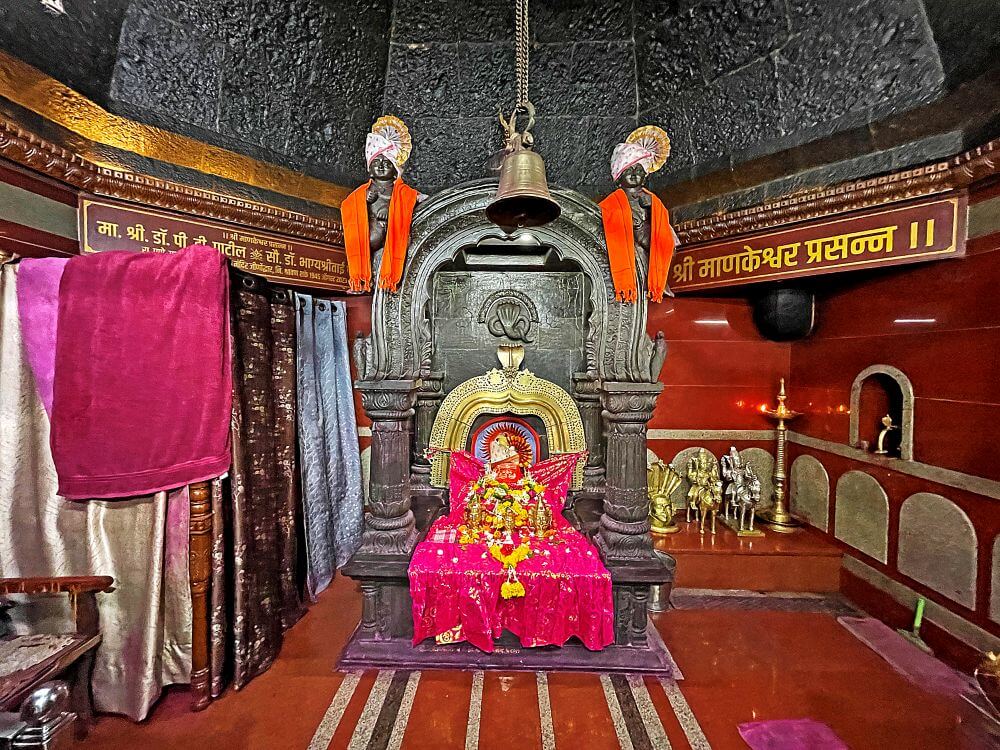
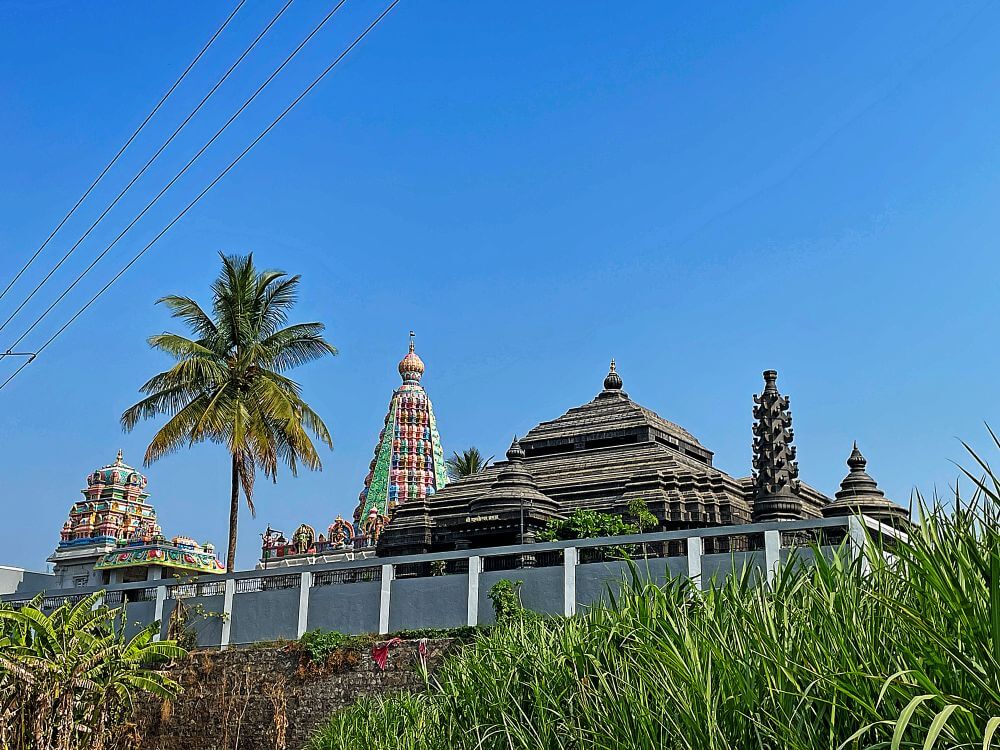
Inside the sanctum sanctorum, on a Vajra-pitha (diamond throne), there is a stone canopy with four pillars housing the Swayambhu stone idol of Lord Mankeshwar. Behind the idol is a golden halo (Prabhaval) with a serpent canopy (Nag-chhatra) in the center. On both sides of the canopy’s dome are Yaksha sculptures. On the exterior of the sanctum sanctorum, there are sculptures of Chaturanan Brahma, Shiva, Mahishasuramardini, Ganpati, Yakshini, Yaksha, etc., along with ornate pillars, cornices, and brackets. The roof of the sanctum sanctorum has a railing on all four sides, featuring sculptures of Nandi, Shiva-ganas, Nataraja, the twenty-five-headed Ravana, the ten-armed Yakshini, and others. There are a total of six Shikharas: four on the front hall (Mukhamandap), one on the assembly hall, and one on the sanctum sanctorum. The Shikhara on the assembly hall is square. The Shikhara on the sanctum sanctorum is of the Urushringa type. All four sides of the Shikhara are decorated with floral carvings. At the top of the Shikhara is an Amalaka, topped with a finial and a flag.
Behind the temple, on the left side, is the temple of Jogeshwari Devi, and on the right side is the temple of Nayakoba Deva. Both temples have five steps each. There are Shikharas and finials on the roofs. The Shikharas feature idols of various deities. In the Nayakoba temple, there is a two-armed idol of Nayakoba Deva holding a shield and sword on a Vajra-pitha. In the temple courtyard, there is a stone slab inscribed with the information that this temple was renovated in the year 1885. An annual five-day fair (Jatrotsav) starting from Mahashivratri is celebrated with great enthusiasm. During this time, the palanquins of the village deity Khandoba and Mankeshwar Deva go around the village together. Thousands of devotees from across the state participate in this palanquin procession. Devotees can have the darshan of Lord Mankeshwar in this temple daily from 5 AM to 9 PM.
The village of Peth has been blessed with a great tradition of Siddha-purushas (enlightened beings). Since the eighteenth century, many Siddha-purushas have taken living Samadhi in this village. These include Dhananjay Maharaj (1730), Ramji Kaka Maharaj (1791), Bhagwandas Maharaj (1814), Kanhoba Maharaj, Raghuvir Maharaj, Nathpanthi Maharaj 1, Nathpanthi Maharaj 2, Gangadhar Swami, Sidram Swami, and Anandmurti Pethkar. Another identity of Peth village is that it is the native village of the renowned Marathi story and novelist Shankar Patil.
This sacred temple stands as a testament to deep spiritual devotion, ancient architectural grandeur, and rich local cultural traditions.
The sanctum sanctorum houses the divine idol consecrated according to ancient Vedic traditions, surrounded by serene courtyards and traditional temple architecture.
Navratri, Maha Shivratri, Annual Temple Jatra & Deepotsav
Compare and book flights, secure top-rated local hotels near the temple, hire reliable guides, and rent cars instantly.
Extend your pilgrimage by visiting other highly sacred temples located nearby.

Add ₹999 more to unlock FREE SHIPPING!
Your sacred cart is currently empty.
Shop Photo FramesFill in your delivery details below to place your order.
Add comment