
Add ₹999 more to unlock FREE SHIPPING!
Your sacred cart is currently empty.
Shop Photo FramesIt is believed that Chilai Devi is a form of Chamunda Devi, one of the Saptamatrikas. In some places, she is worshipped as a water deity, while according to some legends, Chilai is considered to be the sister of Bhairavnath. Chilai Devi is the Kuldevi (family deity) of many families and the Gramdevata (village deity) of many villages in Maharashtra, Rajasthan, Gujarat, and the northeastern states. Consequently, there are many temples of Chilai Devi in these states. One such ancient and famous temple is located in the village of Bhatwade in Walwa taluka. Devotees believe that this is a powerful (Jagrut) shrine and that the Goddess fulfills their vows.
Chilai Mata is known as Chilay Mata in Rajasthan. She is the Kuldevi of the historically renowned Tanwar or Tomar Kshatriya Rajput clan of Rajasthan. This Goddess is also worshipped under the names Jogmaya or Yogmaya, Yogeshwari or Jogeshwari, as well as Sarund Mata or Mansa Devi. The original seat of this Kuldevi of the Tanwar Rajputs is Mayan (Balwadi) in the Rewari district of Haryana. According to mythological legend, at this place, Goddess Yogeshwari assumed the form of a white kite (Chil) to protect Jatusingh, the son of the Tomar King Jayarath. Since then, she came to be known as Chilai Mata. In Maharashtra, this Goddess is enshrined as a village deity. She is also worshipped here in the form of Chamunda, the Goddess Kali who slew the demons Chanda and Munda.
This Chilai Devi temple in Bhatwade is said to be five hundred to six hundred years old. There is a record that the renovation of this temple was carried out in the year ۱۹۷۶ through public participation. There is a tradition of organizing a feast for married women (Suvasini Pangat) at this temple. According to this tradition, when a daughter from this village is married off to another place, she must offer a meal to seven married women at this temple. There was a custom where the firstborn children of the daughters and daughters-in-law of the village were placed in a cradle, which was then lowered into the well water and pulled back out. It is said that in the past, the vessels used to cook or serve food for the feasts of married women were obtained from the well in the temple premises. Those vessels were made of gold and silver. Once the feasts were over, people would return the vessels to the well. However, once some of those vessels were stolen. Consequently, the sanctity of the well was lost, and vessels ceased to appear from it. Similar legends are also told about two other temples in Maharashtra. One is the Varadayini Mata temple in Valankondi (Taluka Mahad, District Raigad) and the other is the Bhagavati Mata temple in Dhamapur (Taluka Malvan, District Sindhudurg). It is a legend that gold and silver vessels for auspicious occasions in the homes of local citizens were obtained from the Varadayini Mata temple, while people used to receive ornaments for wedding ceremonies from the lake adjacent to the Dhamapur temple.
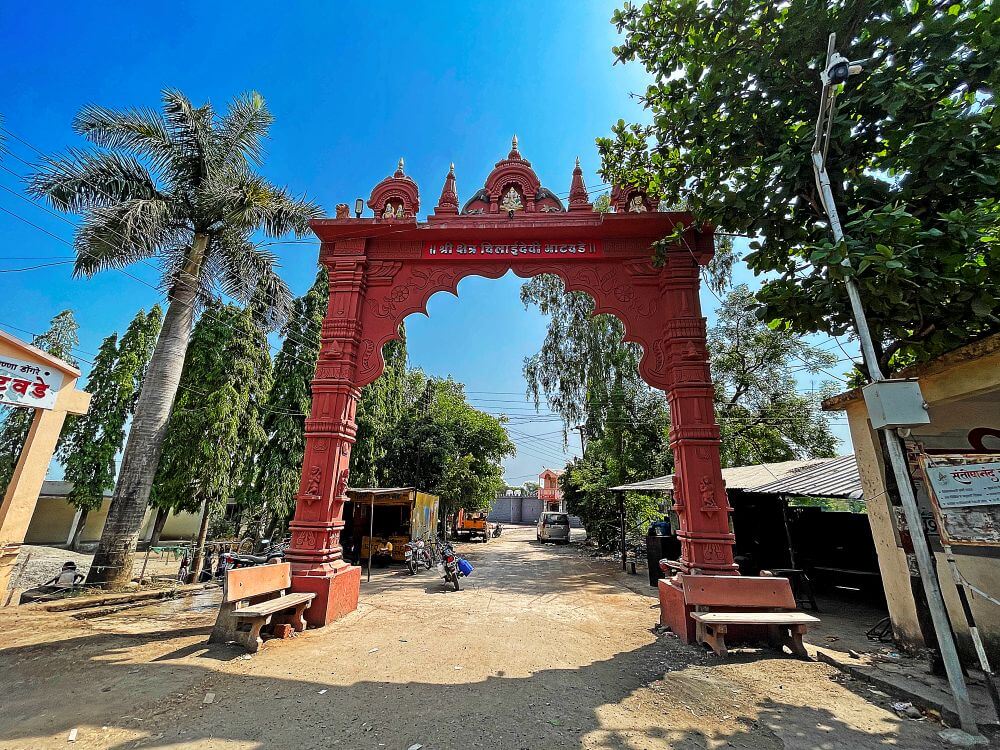
There is a welcome arch on the road leading to the Chilai Devi temple. The arch features square ornamental pillars on two pedestals on both sides of the road. Sculptures of the Vaishnava gatekeepers, Jaya and Vijaya, as well as carvings of a conch, a discus, and intricate patterns are engraved on the shafts of the pillars. The pillars are connected by a scalloped arch, and there is a balcony on the beam above. There are three domed pavilions on the balcony. On both sides of the central pavilion, which houses a sculpture of Ganapati, there are lion sculptures, and tapering spires are located beside these sculptures. In the pavilion on the left is the idol of Shiva-Parvati, and on the right is the idol of Dattatreya. There are two more lion sculptures at both ends of the balcony. Further ahead, in front of the temple entrance, is a hexagonal temple of Dattatreya. Inside the temple, on a diamond-shaped pedestal, stands the three-faced and six-armed idol of Dattatreya. There is a circumambulatory path around the temple, enclosed by a protective railing. The roof features a hexagonal shikhara, topped with an amalaka and a kalasha.
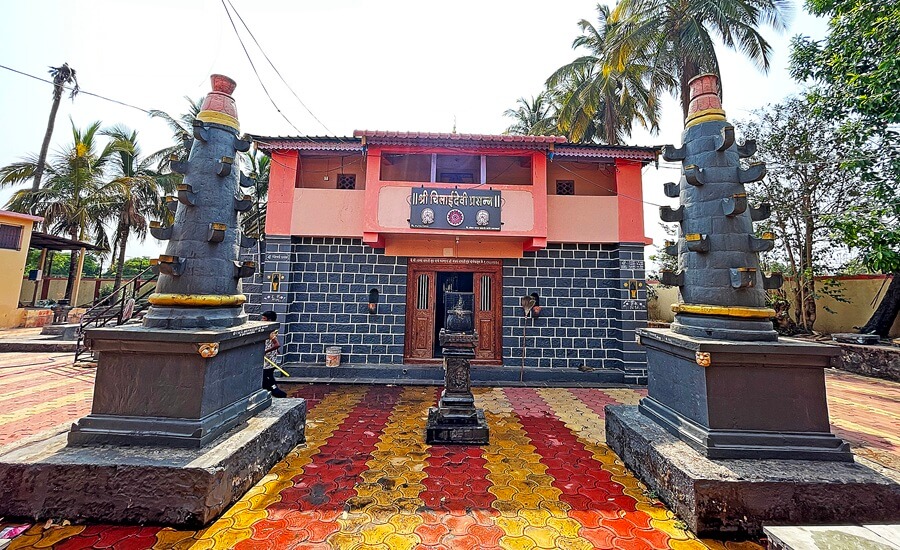
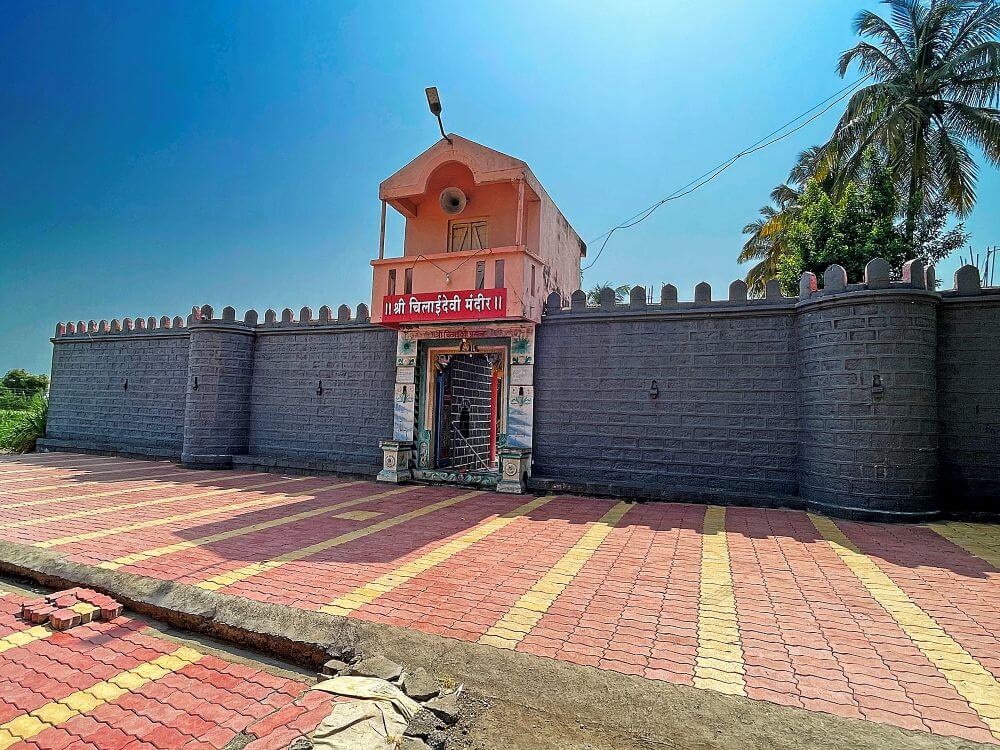
Further ahead is the temple of Chilai Devi. In front of this temple stands a twelve-foot-high fortification wall resembling a fort, adorned with a decorative railing. The fortification includes a two-story entrance gate, with a nagarkhana located on the upper floor. On both sides of the entrance are guard seats, featuring wheel motifs and lamp niches in the pillars behind them. The door frames are decorated with intricate carvings of foliage, floral vines, and creepers, with an image of Lord Ganesha on the central lintel. Above the door frames, elephant-trunk carvings appear to support the lintel. The wooden doors of the entrance are embellished with fine, artistic carvings. From here, one enters the temple courtyard.
In the courtyard, facing the entrance of the assembly hall (sabhamandapa), there are two platforms on either side, each topped with a lamp tower (deepmala). Kirtimukha sculptures are carved on all four corners of these platforms. The lamp towers feature dedicated arms for lighting the lamps. Between the two lamp towers stands a square, ornately carved Tulsi Vrindavan. The walls of the Vrindavan feature images of Ganesha, Lakshmi, and Saraswati. The temple structure consists of an assembly hall and a sanctum sanctorum (garbhagriha). The wooden entrance of the assembly hall is decorated with floral and leaf carvings on its door frames and shutters. On both sides of the entrance, there are lamp niches set into the facade walls, with projecting arms positioned in front of them. The enclosed assembly hall has windows for ventilation. Inside the assembly hall, there is a tortoise sculpture on the floor and lamp niches set into the walls.
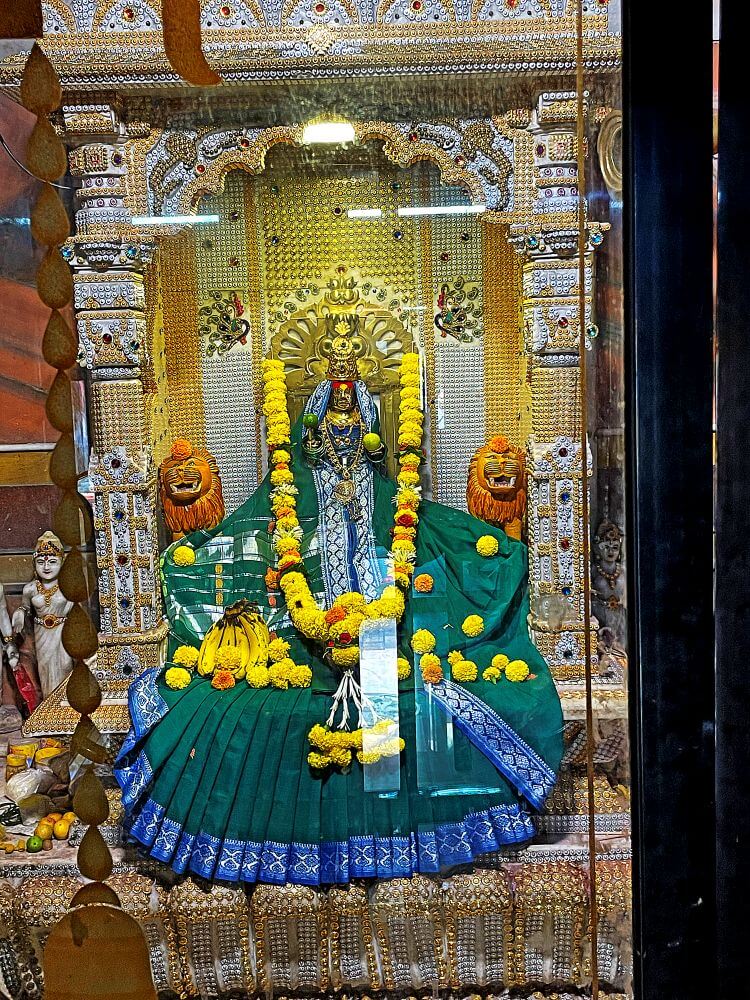
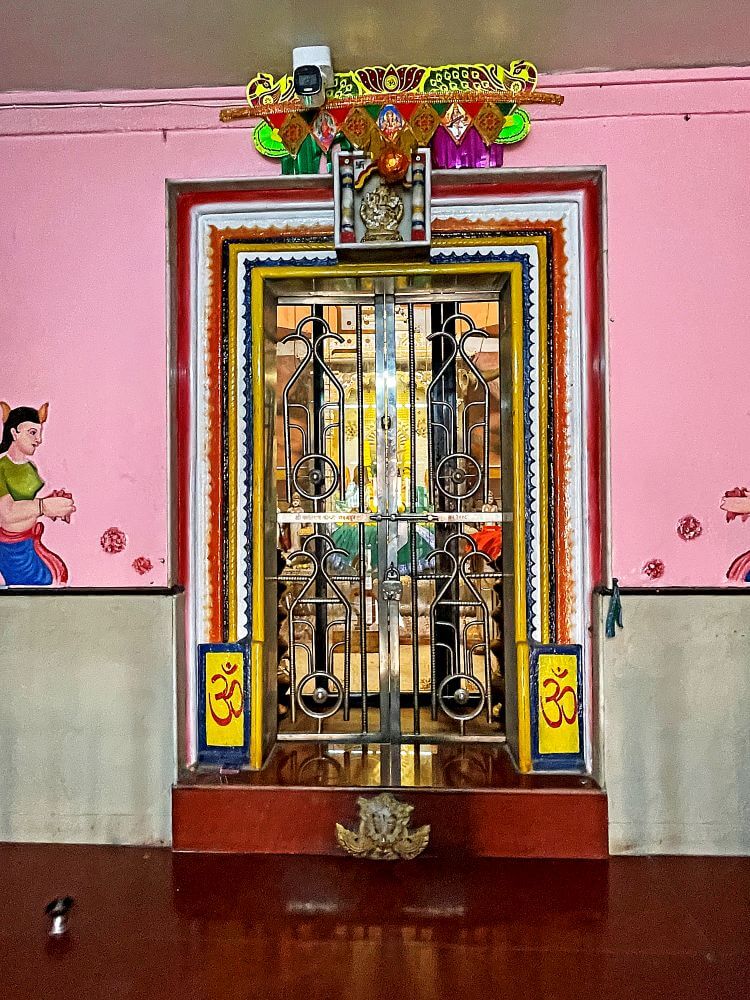
The entrance to the sanctum sanctorum is slightly elevated compared to the main assembly hall. The painted door frames of this entrance are adorned with intricate vine motifs, and an image of Lord Ganesha is carved at the center of the lintel. There is a Kirtimukha on the architrave. The entrance features ornate wooden shutters, and on the front walls on both sides, there are paintings of celestial maidens. Inside the sanctum, on a pedestal, the brass, two-armed idol of the Goddess is seated on a brass throne within a decorative shrine adorned with pearls. The Goddess, wearing a golden crown, holds a sword in one hand and a vessel of nectar in the other. The Goddess is adorned with fine garments and jewelry every day. Behind the Goddess, on the halo, there is a sun motif, and a Kirtimukha is placed at the top center. Behind the Goddess, on both sides, are two lion sculptures. The shrine is topped with a square spire crowned by a finial. Beside the pedestal are the idols of the Saptamatrikas. These seven mothers are Brahmi, Maheshwari, Kaumari, Vaishnavi, Varahi, Indrani, and Chamunda. It is said that, except for Chamunda, the other goddesses are the sisters of the presiding deity. In front of the pedestal is the Goddess’s bed. Devotees believe that the Goddess goes to rest on this bed every night.
There is a circumambulation path outside the sanctum sanctorum. In the small shrines along this path, there are idols of deities including Shiva Linga, Ganesha, and Mhasoba. There is a staircase on the right side outside to reach the upper floor of the two-story assembly hall. On the second floor of the assembly hall, there is a tiled roof divided into two sections, upper and lower. Above the roof of the sanctum sanctorum is a tall spire with vertical ridge carvings. At the top of the spire are two Amalakas placed one above the other, followed by a finial and a flag.
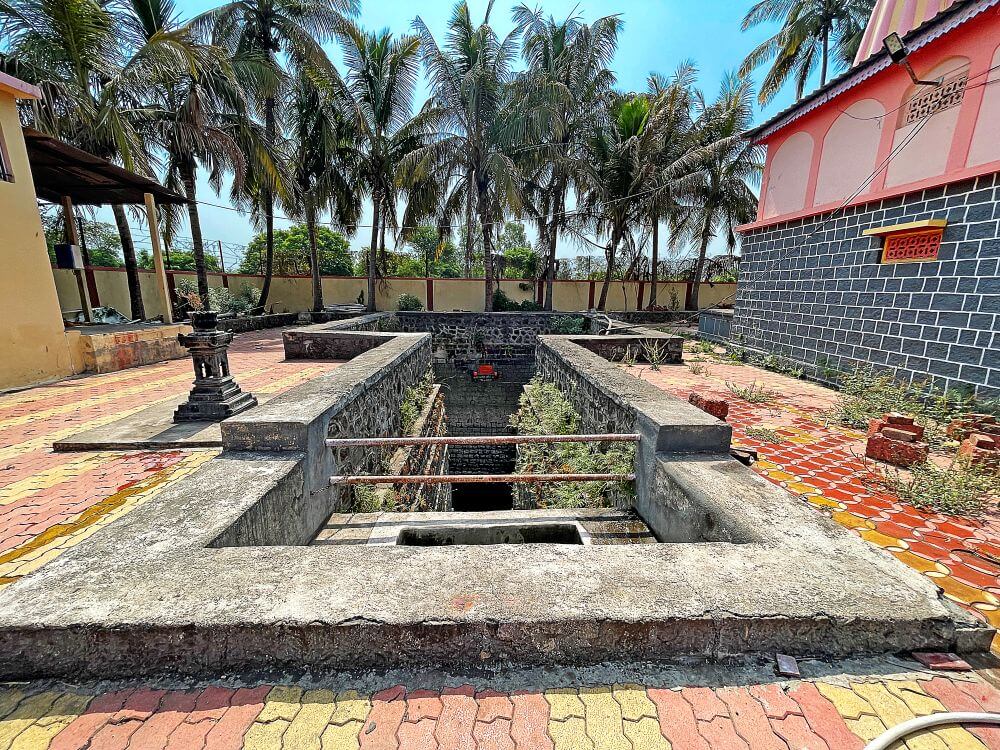
On the right side of the temple, there is a rectangular fresh-water well. On the inner wall of this well, there is a Saptamatrika panel with lion-face sculptures on both sides. There are carved steps to descend into the well. It is said that in ancient times, vessels for feasts used to emerge from this well. In the temple courtyard, there is a hall for cultural and auspicious events, a storage room, and the temple office building.
The Sharadiya Navaratri festival is the main annual celebration here. On Ashtami, at twelve o’clock at night, earthen pots are filled with water and seven young girls are worshipped. The next day, these pots are immersed in a well. On the day of Dussehra, amidst the resounding beats of drums and cymbals and the showering of gulal, the palanquin of the Goddess is taken on a procession around the village. Thereafter, the Goddess visits the homes of every dignitary and priest as if visiting her maternal home, and is re-installed in the temple on Kojagiri Purnima. A month-long festival of lights, Deepotsav, is celebrated in the temple from Kojagiri Purnima to Kartik Purnima. During this time, the temple’s lamp towers and the entire temple premises are illuminated with oil lamps. Thousands of devotees from states like Maharashtra, Karnataka, and Andhra Pradesh visit the temple during this festival for the darshan of the Goddess and to fulfill their vows. There is a special crowd of devotees at the temple every Tuesday, Friday, Ashtami, Purnima, and Amavasya. The Suvasini Pangat program, where married women are served meals, continues throughout the year at the temple.
This sacred temple stands as a testament to deep spiritual devotion, ancient architectural grandeur, and rich local cultural traditions.
The sanctum sanctorum houses the divine idol consecrated according to ancient Vedic traditions, surrounded by serene courtyards and traditional temple architecture.
Navratri, Maha Shivratri, Annual Temple Jatra & Deepotsav
Compare and book flights, secure top-rated local hotels near the temple, hire reliable guides, and rent cars instantly.
Extend your pilgrimage by visiting other highly sacred temples located nearby.

Add ₹999 more to unlock FREE SHIPPING!
Your sacred cart is currently empty.
Shop Photo FramesFill in your delivery details below to place your order.
Add comment