
Add ₹999 more to unlock FREE SHIPPING!
Your sacred cart is currently empty.
Shop Photo FramesThe self-manifested (Swayambhu) deities, Jari and Mari, in the ancient temple at Tisgaon in Kalyan, are the presiding deities of the Agri-Koli community. Jari and Mari are originally deities of fierce nature. They are worshipped as goddesses who ward off the calamities of epidemics from the village. The Jarimari temple here is also known as the Tisai Temple. It is renowned as a temple where the goddesses fulfill the vows of devotees. Consequently, during the fair held on Chaitra Purnima, the premises are filled with devotees arriving not only from Thane district but also from Raigad, Ratnagiri, Pune, Nashik, Dhule, and other regions.
According to entries in the Marathi Vishwakosh, the goddesses Mariai and Jariai are associated with diseases. In the past, they were worshipped as the personified deities of fatal epidemics. Among them, Mari is the goddess of epidemics like cholera and smallpox, while Jari is the goddess of fever-related epidemics. The shrine of Jarimari is typically located in a corner of the village or under a tree on the outskirts. Her priest is addressed as Potraj or Poturaja. They are often seen wandering from village to village carrying the shrine (devhara) of Mariai on their heads. According to popular belief, Mariai can be appeased through the Potraj, who is a devotee of the goddess. In some places, this Potraj is also called Kadaklakshmi. It is the firm belief of devotees that epidemics occur due to the wrath of Jari-Mariai, and that the crisis of disease is averted if they are appeased.
The legend of this temple in Tisgaon states that about two hundred and fifty years ago, this area was a forest. People used to bring their cattle to graze on the hill here. One day, a man named Gana Gaikwad, who was grazing cattle on the hill, was suddenly caught in a strong gust of wind. Amidst the wind, he heard the voices of the goddesses. The goddesses told him, “We are present in the form of stones in the lake here. Take us out of the lake and install us.” Gana came to the village and informed some knowledgeable people about the incident. The next day, everyone gathered near the lake. Gana then dived into the lake to search for the idols. After some time, he emerged with the idols in his hands. Thereafter, at an auspicious time, the villagers built a small tiled temple under a Peepal tree in front of the lake and consecrated the goddesses. Over time, the idols were installed at the site where the current temple stands. In 1956, the second renovation of the temple was carried out with the cooperation of the villagers through the efforts of the then-chief trustee, Madhavrao alias Bapusaheb Oak. The third renovation of the temple took place in 1996, during which the temple was marble-clad and the sanctum sanctorum was beautified. In 2011, the idols underwent Vajralepan (strengthening ritual), re-consecration, and a flag-hoisting ceremony.
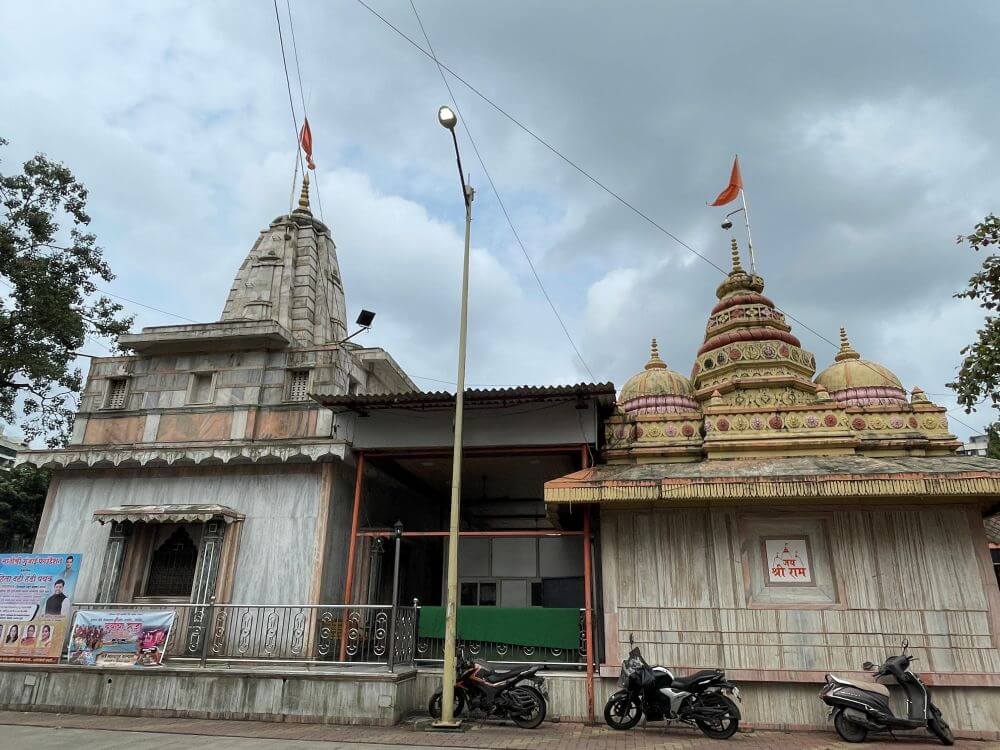
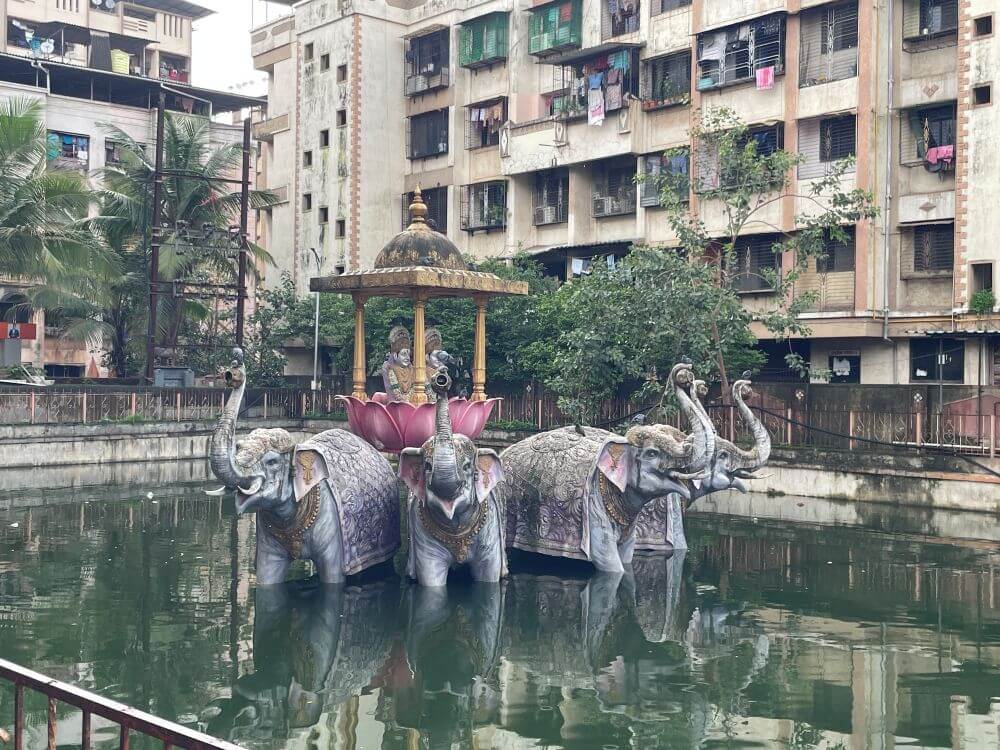
It is recorded that a very important event in the history of Kalyan and Vasai took place under the witness of this temple. According to the book ‘Subhe Kalyan’ (Vivekanand Godbole, Itihas Sanshodhan Mandal Kalyan, 1974), the Peshwas planned the Vasai campaign against the Portuguese due to the tireless efforts of Sardar Gangaji Naik Anjurkar of the Peshwa era. Shrimant Chimaji Appa set out on this campaign. Its prelude took place in the courtyard of this temple. At that time, Sardar Anjurkar came to Kalyan and, under the pretext of performing the ‘Gondhal’ ritual for Goddess Bhavani, summoned people like Namaji Deshmukh and Bhikaji Haibatrao to assign them tasks for the campaign. After walking some distance from the arch of the temple located at Tisgaon Naka in Kalyan, one reaches this temple on the left side. The temple spires feature attractive carvings. The lake where the idols of the goddesses were found is right in front of the temple. This lake was renovated and beautified in 2006. In the center of this lake are the idols of the goddesses seated on a lotus. Around this lotus are sculptures of five elephants with raised trunks.
Near the Peepal tree in front of the lake are the ‘Tandale’ (aniconic stones) of the Seven Asara goddesses. ‘Asara’ is a corrupted form of the word ‘Apsara’. They are water deities. They are always found together in a group of seven, hence they are called ‘Saat’ or ‘Saati Asara’. Their names are Matsyi, Kurmi, Karkati, Darduri, Jatupi, Sompa, and Makari. In the research book ‘The Folklore of Bombay’ by R. E. Enthoven, published in 1923, it is mentioned that in some parts, Asaras are also called ‘Mavalaya’. According to the folk beliefs of Thane district, the Seven Asaras reside near all water bodies. Some believe that they reside only in lakes where lotuses grow. These Asaras are said to trouble children and young women. Near the Tandale of the Saati Asaras, there is a small Ganesha idol. There are shops selling flower garlands and offerings here. Right in front is the attractively constructed marble Jarimari, i.e., Tisai Temple. There is an open courtyard in front of the temple. In the paver-blocked courtyard, there is the shrine of Khamdeva (Khambdeva) in front of the temple. The pillar of this deity is located here, and it is covered with a gold-plated sheet. During the fair, the goddesses are honored with the sacrifice of chickens and goats.
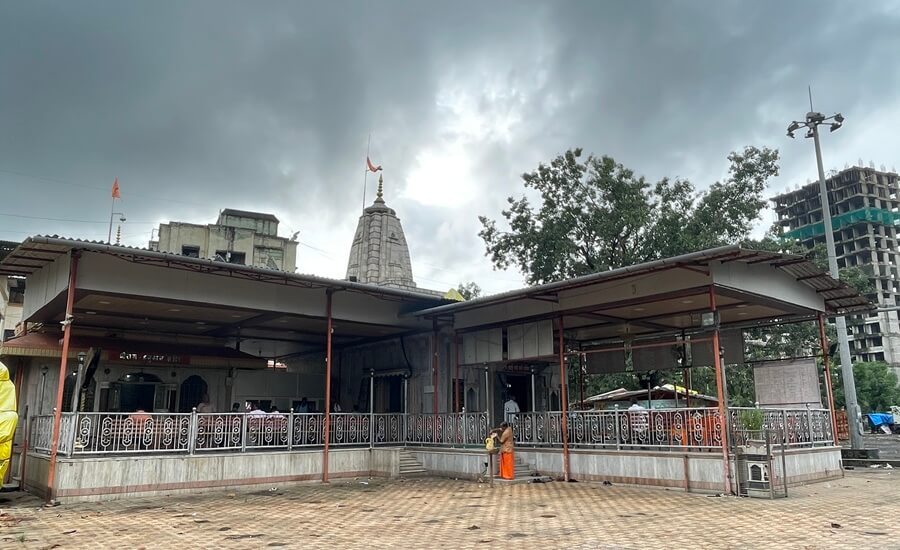
The Tisai Temple consists of a Darshan Mandap (viewing hall), Sabha Mandap (assembly hall), Garbhagriha (sanctum sanctorum), and a Pradakshina Marg (circumambulation path). There are iron benches in the Darshan Mandap for devotees to sit. There are niches on both sides of the walls of the Sabha Mandap. A Kirtimukh is carved in the center above the entrance of the Sabha Mandap. The latticed windows in the Sabha Mandap provide sufficient light and ventilation. The Garbhagriha is in the center of the Sabha Mandap. Below the entrance of the sanctum, in the center, is a Kirtimukh. There is a Ganesha idol at the lintel of the door frame, with a Kalash above it. There are Dwarapalas (gatekeepers) on both sides of the entrance pillars. The original silver-carved Makhar (shrine frame) in the Garbhagriha has been gold-plated. It features floral carvings and a Kirtimukh in the center. A Kalash is carved on the decorative Prabhavali (halo) of the Makhar. There are sun and moon motifs on the upper corners of the Makhar. Inside the Makhar, the vermilion-smeared idols of Jari-Mari are seated. Masks have been placed over the original stone idols. On the circumambulation path of the temple, the water used for the ritual bathing (Abhishek) of the idols is released through the trunk of an elephant carved into the wall adjacent to the Garbhagriha on the right.
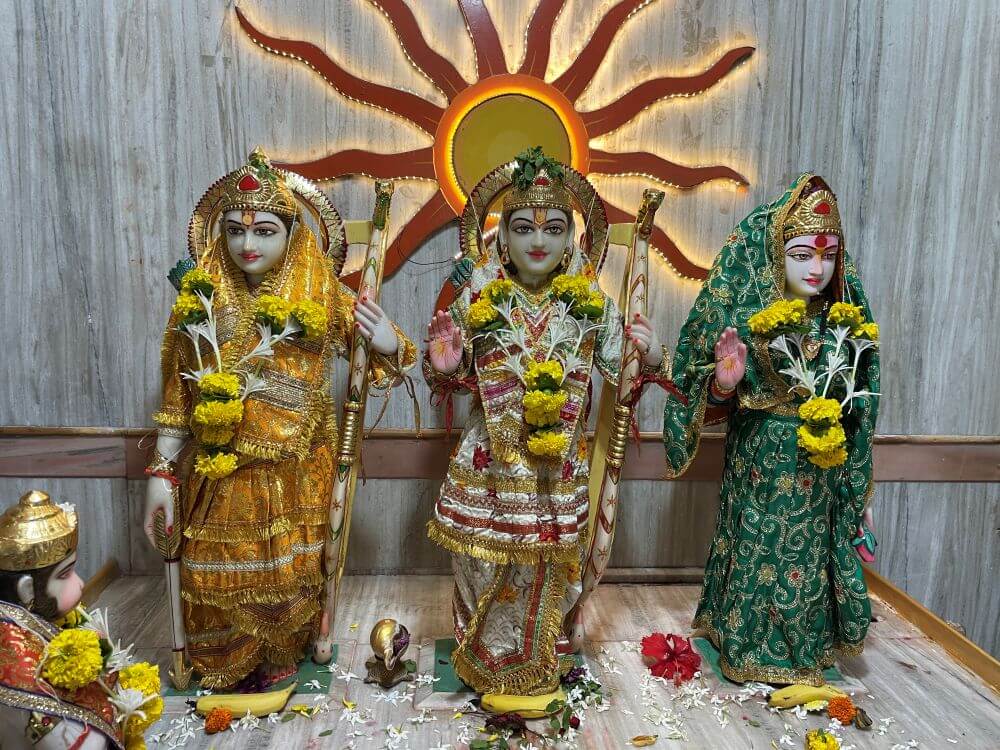
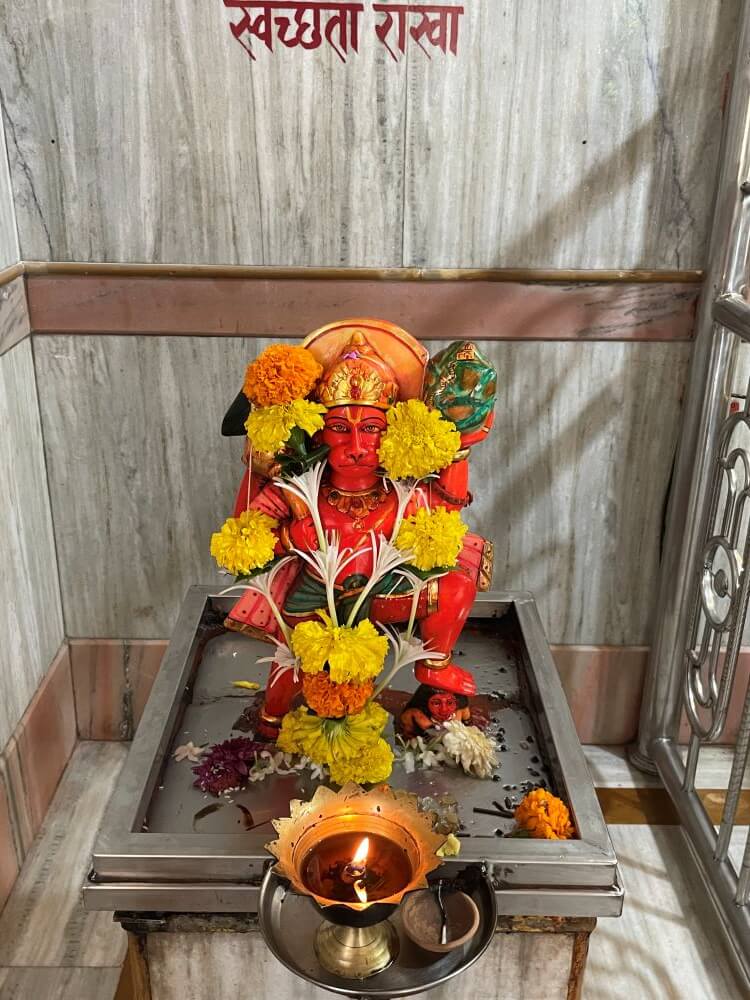
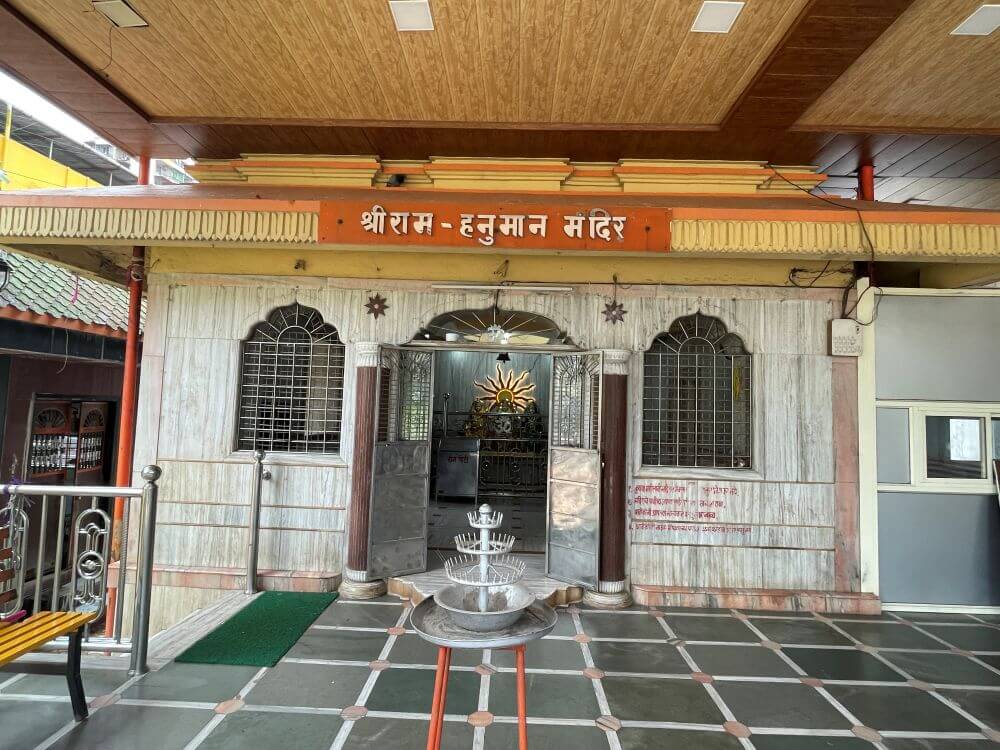
Adjacent to the sanctum sanctorum (Garbhagriha) on the left side is the Rama temple. The temple houses the idols of Shri Rama, Sita, and Lakshmana. In front of them is an idol of Hanuman seated in a posture of salutation (Namaskara Mudra). To the left of these idols, on a raised platform, stands a vermilion-anointed idol of Hanuman. In the month of January, the anniversary celebration of Chandiyaag Tejotpatti and the re-consecration ceremony takes place at the Tisai temple. In the same month, the palanquin (Palkhi) of Goddess Tisai arrives here from Karanje near Uran. Festivals such as Maghi Ganeshotsav, Mahashivratri, Ram Navami, Guru Purnima, Narali Purnima, Navaratrotsav, and Deepavali are celebrated here. During the village ‘Saath’ program held in the month of June, sweet offerings (Naivedya) are presented to the Goddesses. On this occasion, the honors of the Goddesses are observed, and Prasad is distributed. During Navaratrotsav, Ghatasthapana, Kirtan, Homa-Havan, Ghat Utthapan, and the Vijayadashami ceremony are performed.
On Chaitra Purnima, a grand two-day fair (Jatra) of the Goddess is held in the vicinity. At dawn on the day of Purnima, the Goddesses are bathed and worshipped (Abhishek-Puja). Thereafter, the Goddesses are adorned (Shringar). The sanctum sanctorum is decorated with flowers. The Goddess’s palanquin is carried through the village in the evening. The honor of carrying this palanquin rests with the Bhoi community. On the way, the palanquin is halted for a rest near a stone slab. A Tulsi Vrindavan has now been constructed at this spot. When the palanquin reaches the temple, it circumambulates the temple premises five times before the procession concludes. This procession continues until two o’clock in the morning. During the fair, the honors of the Goddesses are observed. Previously, animal offerings (cocks and goats) were made to the Goddesses here. However, for some years now, a vegetarian offering of ‘Valache Birde’ (a bean curry) or ‘Usal’ along with sweet dishes is presented to the Goddesses. Offerings of laddoos made from roasted rice flour (Bhujyache Pith) are also presented. However, at the site of Khamdev located to the east of the temple, animal sacrifices (cocks, goats, and sheep) are offered as per vows.
During the fair, there is hardly any space to step in the area. Along the road from Tisgaon Naka to the temple, both sides are lined with shops selling toys, Prasad, sweets, various goods, as well as Ferris wheels and other attractions. During the fair, grand wrestling matches (Kustya) are also held. Wrestlers from Mumbai, Thane, Pune, Kolhapur, Solapur, and other places participate in them. Special buses are provided by the Kalyan-Dombivli Municipal Transport service for devotees coming from afar for this fair.
This sacred temple stands as a testament to deep spiritual devotion, ancient architectural grandeur, and rich local cultural traditions.
The sanctum sanctorum houses the divine idol consecrated according to ancient Vedic traditions, surrounded by serene courtyards and traditional temple architecture.
Navratri, Maha Shivratri, Annual Temple Jatra & Deepotsav
Compare and book flights, secure top-rated local hotels near the temple, hire reliable guides, and rent cars instantly.
Extend your pilgrimage by visiting other highly sacred temples located nearby.

Add ₹999 more to unlock FREE SHIPPING!
Your sacred cart is currently empty.
Shop Photo FramesFill in your delivery details below to place your order.
Add comment