
Add ₹999 more to unlock FREE SHIPPING!
Your sacred cart is currently empty.
Shop Photo FramesKarveer, which holds the first position among the three and a half Shakti Peethas of the Goddess, is the abode of the primordial energy, Mahalakshmi-Ambabai. In this ‘Dakshin Kashi’, which is considered slightly superior to ‘Kashi’, there are four guardian deities: Katyayani Devi, Siddha Batukeshwar, Jyotiba, and Tryambuli Devi. Among them, Tryambuli Devi is known as Temblai. The temple of this Goddess, facing east, is situated on the Temblai hill, which is named after her. Tryambuli Devi is the companion of Mahalakshmi, and every year on Lalita Panchami, Mahalakshmi herself, accompanied by her entourage, visits this hill to meet her.
Tryambuli Devi is mentioned in the Marathi scripture ‘Karveer Mahatmya’ written by Dajiba Joshirao. In it, he states, “To the east of the region, at a distance of one Kos, resides the delightful Tryambuli for protection; such is the glory of this region.” In the ३८th chapter of the same scripture, he has narrated the legend of Tryambuli Devi. The legend of her birth is told as follows: In ancient times, there was a sage named Kaundinya. Satyavati was his wife. However, once Kaundinya felt that she was neglecting her service to him and paying more attention to the service of guests. Enraged, he cursed her, saying that she would be born as a maidservant in her next life. At that time, Satyavati made him realize the truth, yet she humbly accepted the curse given by her husband. Then, Sage Kaundinya gave her a counter-curse, saying that she would be a maidservant, but to the Mother Goddess (Jagadamba).
In the village of Mangle, there was a couple named Bhargav and Vishalakshi. Their children would not survive beyond five days after birth. They made a vow to the Mother Goddess, saying, “Let my child live, and I will offer it to you.” Upon hearing this vow, Satyavati entered the womb of Vishalakshi and was born as a beautiful daughter. She is this Tryambuli Devi. Later, as per the vow, the couple offered her to the service of the Mother Goddess.
Meanwhile, Kamaksha, the grandson of Kolhasur, was burning with the desire to avenge his death. He stole the Yogadanda from Shukracharya and, using its power, transformed all the gods, including Mahalakshmi, into goats. Upon learning this, Tryambuli decided to defeat Kamaksha and liberate the gods. She took the form of an old woman. On the pretext of helping Kamaksha lift a heavy basket, she engaged him and snatched the Yogadanda from him, and with that same Yogadanda, she turned Kamaksha into a goat. She then restored the gods to their original forms. When everyone was celebrating, no one paid attention to Tryambuli. Due to this insult, Tryambuli went to this hill and sat facing east, with her back towards the city of Karveer. After the Mother Goddess realized this, she went there herself to appease Tryambuli. At that time, Mahalakshmi told her that the pumpkin-breaking ceremony, which takes place every year in the Mukti Mandap of her temple in the name of Kolhasur, would now happen at her doorstep instead of hers. Everyone would have to come for her darshan along with hers. She would hold the authority to judge the sins and merits of the devotees. Since then, Tryambuli Devi has resided here.
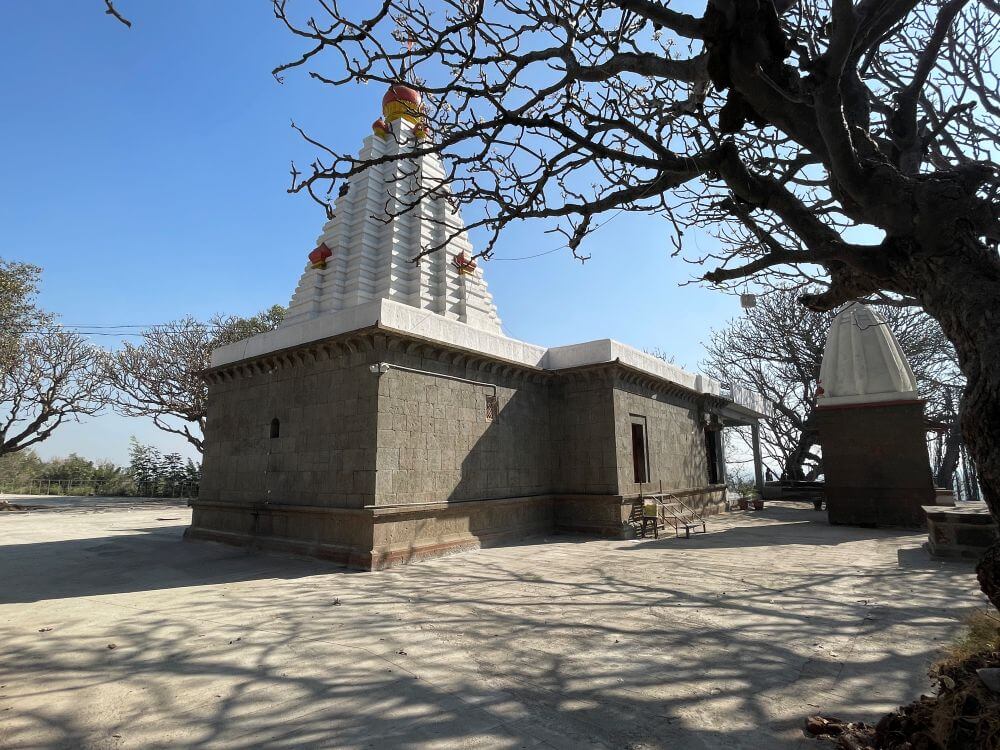
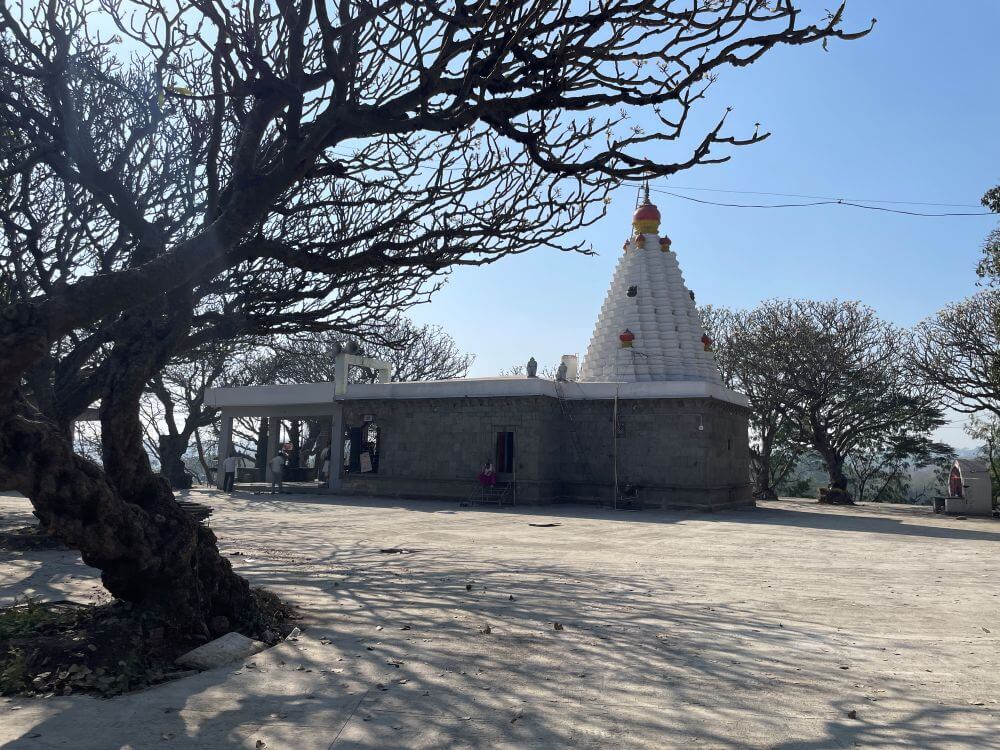
The temple of Tryambuli Devi stands on one side of a spacious courtyard on a high hill. There is a stairway to reach this hill, as well as a motorable road. Although the exact period of this temple, built in the medieval style, is unknown, it is said to be from the १७th century. This ancient temple consists of a assembly hall (Sabhamandap) and a sanctum sanctorum (Garbhagriha). In recent times, a large pavilion has been erected in front of the temple using cement concrete. In this pavilion, near a pillar, a life-size statue of a Maratha warrior (Mavala) of Chhatrapati Shivaji Maharaj is placed in the form of a gatekeeper.
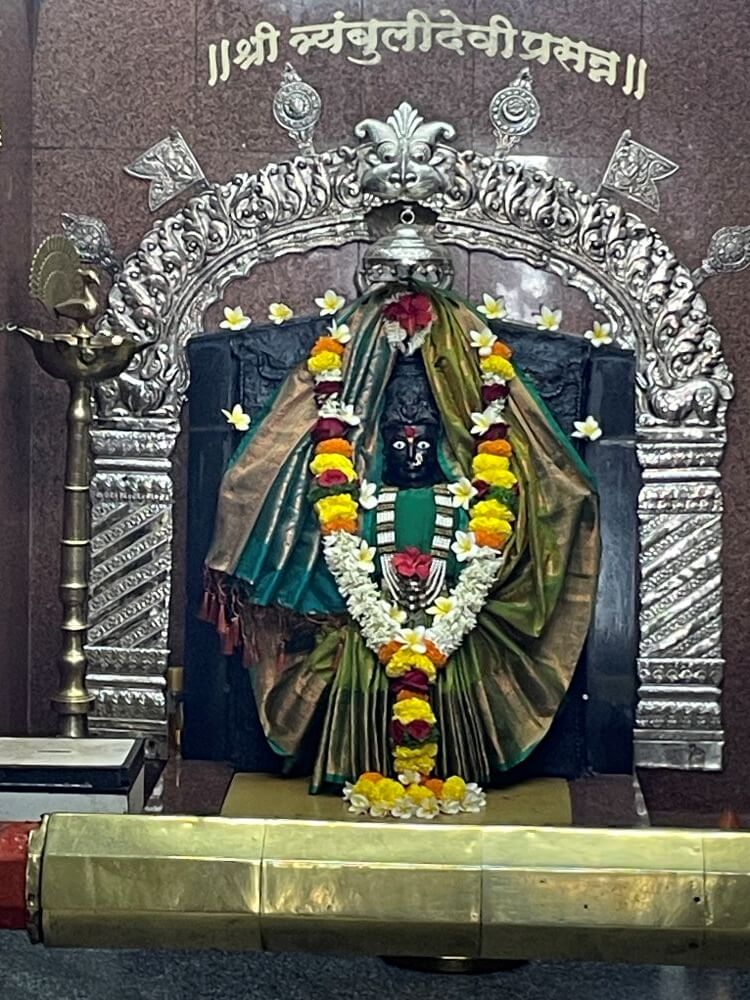
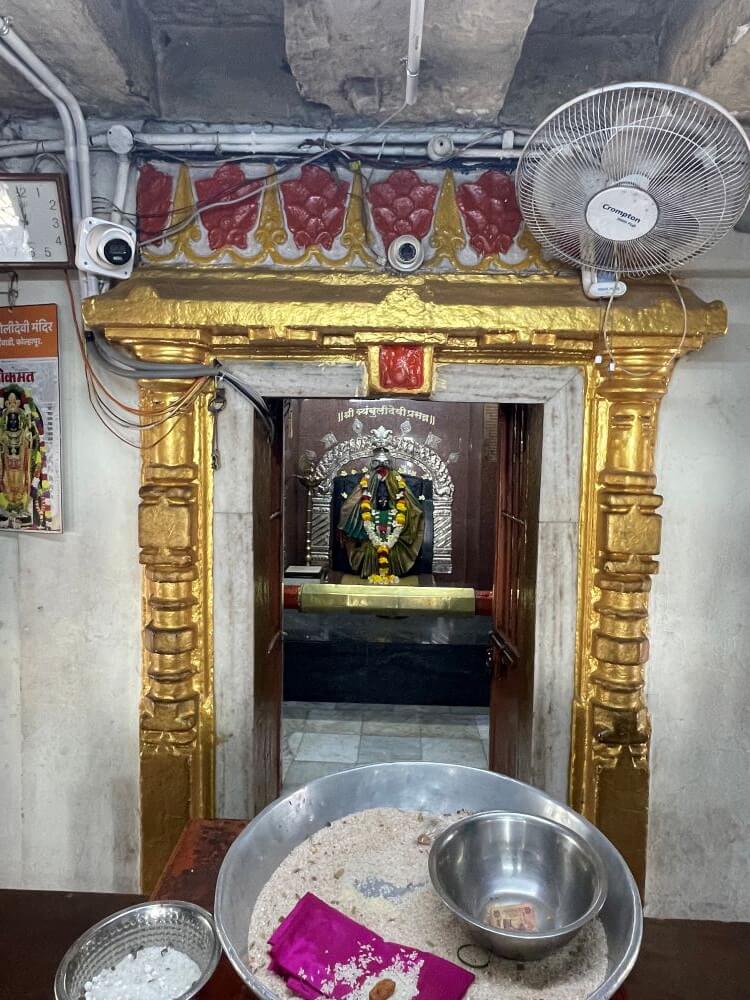
In the assembly hall of the temple, there are १६ carved stone pillars similar to those found in many old temples of Kolhapur. These sturdy pillars are square at the base, octagonal in the middle, and square at the top. The path leads from these rows of pillars towards the sanctum sanctorum in front. In the center of this hall, there is a marble image of a tortoise (Kurma). The roof of the hall is supported by large stone beams, and the floor has recently been paved with marble. The entrance to the sanctum sanctorum is made of stone. The door frame is painted in gold and is intricately carved. There is an image of Lord Ganesha on the lintel. Inside, on a high pedestal, is the stone idol of Tryambuli Mata, also known as Temblai. The idol is four-armed and holds a Yogadanda, a bow, a discus, and a sword. The idol is adorned with clothes and ornaments, so only the face of the idol is visible. On her head is a crown carved in stone. During festivals, a silver crown is placed here. On the silver arch behind the idol, a Kirtimukh is carved. There are small passages on both sides to exit after having darshan of the Goddess. Above the sanctum sanctorum is a pyramid-shaped spire. Some monkey sculptures are also visible here.
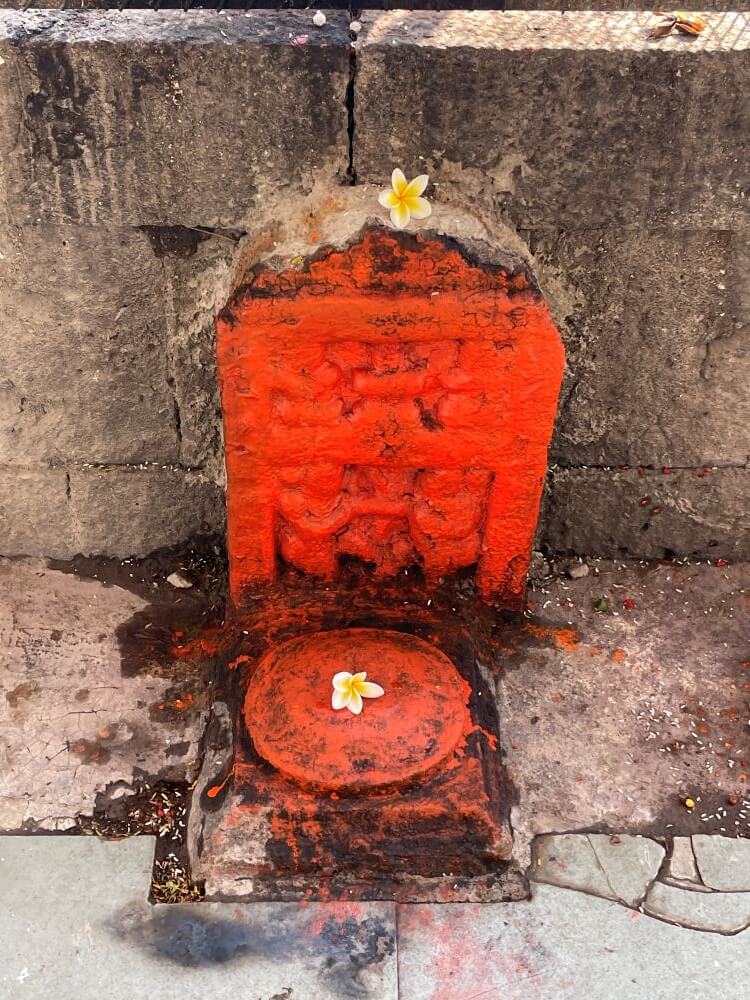
Outside the temple, on the left side near a Chafa tree, there are two ancient lamp towers (Deepmalas) on a large stone pedestal. In the middle of them is a statue of a lion. Near this pedestal is a two-framed hero stone (Veergal) which is smeared with vermilion. It is worshipped here. Near this is the pavilion of Panchanandikeshwar. In front of it is the temple of Lord Mahadeva. Inside, on the ground floor, is an ancient Shiva Linga. In front of the Linga is a partially carved stone Nandi. On the pedestal behind the Linga are small idols of Vitthal-Rukmini, Ganpati, and Dattatreya. Near the steps of this temple, hero stones smeared with vermilion can be seen. Both the pavilion of Panchanandikeshwar and the temple of Mahadeva here were built in १९५४.
Behind the Tryambuli temple is the shrine of Mhasoba. At some distance from the Goddess’s temple is the temple of Margai Devi. There is a tradition of having darshan of Margai before having darshan of Tryambuli Mata. The shrine of Margai Devi is also ancient. It is said that she is a companion of Ambabai. The temple is built of stone masonry. The temple has a stepped spire with a circular Amalaka on top. In front of the temple is a modern-style assembly hall. The main temple of Margai has a small assembly hall, and its four ancient stone pillars stand out. In the sanctum, the idol of Margai Mata is seated on a Vajrapitha inside a golden metal arch.
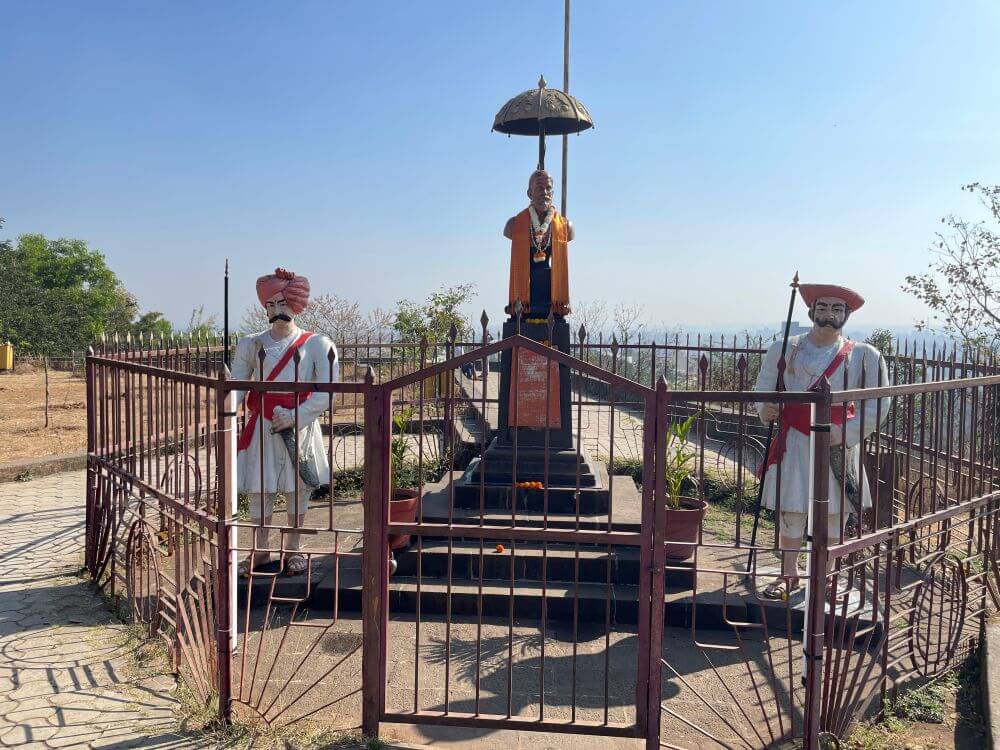
On this hill of Temblai, near the Margai temple, there is a large idol of Ganesha in a garden. The idol of the Lord, seated on a carved throne, is exquisite. Beside Him is His vehicle, the mouse. A circular tin shed has been constructed over it. Devotees gather here in large numbers for darshan during Ganeshotsav. At a short distance, in a circular arena, stands a bust of Chhatrapati Shivaji Maharaj. On both sides of the Maharaj are statues of two Mavlas. Such statues of Mavlas and farmer couples, as well as vermilion-smeared stones and Veergal (hero stones), can be seen elsewhere on this hill.
Tuesday and Friday are the days dedicated to the Goddess. On these days, there is a large crowd of devotees here. Three important festivals of Tryambuli Devi are celebrated here annually. In the month of Ashadh, a non-vegetarian offering is made to this Goddess. In Shravan, the offering consists of vegetables and bhakri. The festival of Lalita Panchami in the month of Ashwin is celebrated here with great enthusiasm. On that auspicious occasion, Goddess Mahalakshmi Ambabai Herself comes to visit Tryambuli Devi. The palanquin of the Goddess is brought here from the Mahalakshmi temple. In the sanctum sanctorum, the two Goddesses embrace. Then, a program to bless a young maiden takes place. After the Kumari Pujan, the village official Patil of Bawada strikes a pumpkin with a trident, and the pumpkin is broken. This pumpkin is a symbol of Kolhasura. The nose, ears, eyes, and mouth of Kolhasura are painted on the pumpkin, and it is adorned with a cap. Thousands of devotees come here to witness this ceremony.
This sacred temple stands as a testament to deep spiritual devotion, ancient architectural grandeur, and rich local cultural traditions.
The sanctum sanctorum houses the divine idol consecrated according to ancient Vedic traditions, surrounded by serene courtyards and traditional temple architecture.
Navratri, Maha Shivratri, Annual Temple Jatra & Deepotsav
Compare and book flights, secure top-rated local hotels near the temple, hire reliable guides, and rent cars instantly.
Extend your pilgrimage by visiting other highly sacred temples located nearby.


Add ₹999 more to unlock FREE SHIPPING!
Your sacred cart is currently empty.
Shop Photo FramesFill in your delivery details below to place your order.
Add comment