
Add ₹999 more to unlock FREE SHIPPING!
Your sacred cart is currently empty.
Shop Photo FramesKolhapur is known as Karveer Nagari. Just as it is recognized for the ancient abode of Ambabai, the Shankaracharya Peeth here is also a significant identity of Karveer. This Math was established in the sixteenth century by Vidyashankar Bharati, the Shankaracharya of the Sringeri Math in Karnataka, one of the four Maths founded by Adi Shankaracharya for the upliftment of the Hindu religion. This is the only Acharya Peeth in Maharashtra. This Math is situated on the banks of the Panchganga in Karveer. Therefore, in the titles of the Shankaracharya, it is referred to as ‘Abhinav Panchgangateeravas Kamalaniketan Karveer Sinhasanadhishwar’.
There is no consensus among scholars regarding the timeline of Adi Shankaracharya. However, his life is generally considered to be from 788 to 820 CE. He was born in a village named Kalady near the town of Aluva in Kerala. His lineage belonged to the Nambudiri Brahmin community of the Krishna Yajurveda Taittiriya Shakha. Since details such as his birth and timeline are subjects of debate, his works are considered his true biography, and his life story is summarized in the following verse: ‘Ashtavarshe chaturvedi dvadashe sarvashastravid | Shodashe kritavan bhashyam dvatrimshe munirabhyagat ||’ This means that by the age of eight, he had studied all four Vedas; by the age of twelve, he had mastered all the Shastras; by the age of sixteen, he had composed the commentaries on the Prasthanatrayi; and at the age of thirty-two, he attained Mahaprasthana. The Prasthanatrayi consists of the Shrimad Bhagavad Gita, the Upanishads, and the Brahma Sutras. Adi Shankaracharya is recognized as the great commentator on these texts, the proponent of the philosophy of Kevaladvaita—which posits that the one Nirguna Brahman alone is the Truth, the Jivatma is not different from It, and the entire world is illusory—and as a visionary Vedantin who advocated for religious reform with witty words such as, “There is no rule that one must be foolish just because their ancestor was foolish” (Nahi purvajo mudha asidityatmani mudhena bhavitavyamiti kinchidasti pramanam – Brahma Sutra 2.1.11). To ensure the unbroken continuity of our philosophical tradition, he established monasteries in all four directions of India: Badrinath, Dwarka, Jagannath Puri, and Sringeri. In addition to these four monasteries, he also established the Sumeru Math in Kashi and the Kanchi Kamakoti Peetham. Adi Shankaracharya appointed presiding pontiffs to these monasteries, a tradition that continues to this day. Among these, Shankaracharya Vidyashankara Bharati, the head of the Sringeri Math, recognizing the spiritual significance of Kolhapur as the Dakshin Kashi, established a monastery in Karveer during the sixteenth century.
In this monastery, an information board titled ‘History of the Karveer Shankaracharya Peeth’ has been installed. According to it, Adi Shankaracharya had appointed Sureshwaracharya Swami to the Shringeri Peeth. Vidyashankar Bharati Swami (Devgosavi) was the thirty-third head of this lineage. Once, Vidyashankar Bharati, along with his disciples, went to see the Himalayan cave that Adi Shankaracharya had entered at the time of concluding his avatar. At that time, he entered the cave after giving the instruction, ‘If I do not emerge from the cave within six months, one of you should take charge of the Shringeri Peeth.’ Following his command, the disciples waited at the entrance of the cave for six months. As Vidyashankar Bharati did not emerge even after that, the disciples returned and acted according to their Guru’s command. Some days later, the Guru Swami emerged. By then, there was no one at the entrance of the cave. He learned of the entire situation and, after traveling from there, he went to Sankeshwar in Karnataka. He resided at the Vallabhgad fort there. He worshipped Goddess Haridra there. At that time, King Somvanshiya Krishnaraya ruled in Kolhapur. Recognizing the authority of Vidyashankar Bharati, he requested him to establish a monastery and reside in Karveer, the Southern Kashi. Goddess Mahalakshmi also gave a similar divine command to Vidyashankar Bharati in a dream. Accordingly, he established the Karveer Peeth. The date given for this on the board is the year 1579 CE. However, by around the year 1347, the rule of the Yadavas of Devagiri here had been extinguished, and Bahmani rule had been established over Kolhapur. Therefore, the information that Krishnaraya held power here and invited Vidyashankar Bharati Swami is a distortion of history.
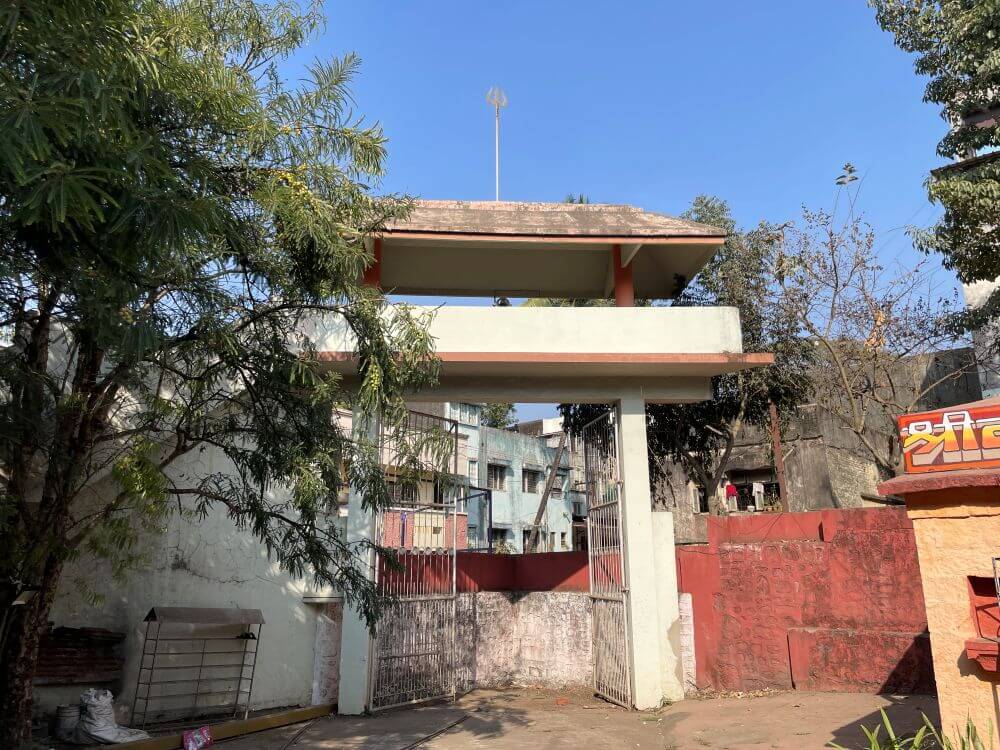
The Shankaracharya Peeth is situated in a spacious courtyard in Shukrawar Peth, on the path leading towards the banks of the Panchganga River. Upon entering the premises, the Shri Narayaneshwar Temple is located to the left. This temple, situated along the courtyard wall, is small and built of stone. Inside the sanctum sanctorum, there is a stone Lingam of Shankara. The main building of the Math is a modern, two-story structure. The building features a large, open-style veranda at the front. In front of its entrance, there are small statues of elephants on small platforms on both sides. There is a Kirtimukha on the step of the veranda, and a crescent-shaped stone slab in the center.
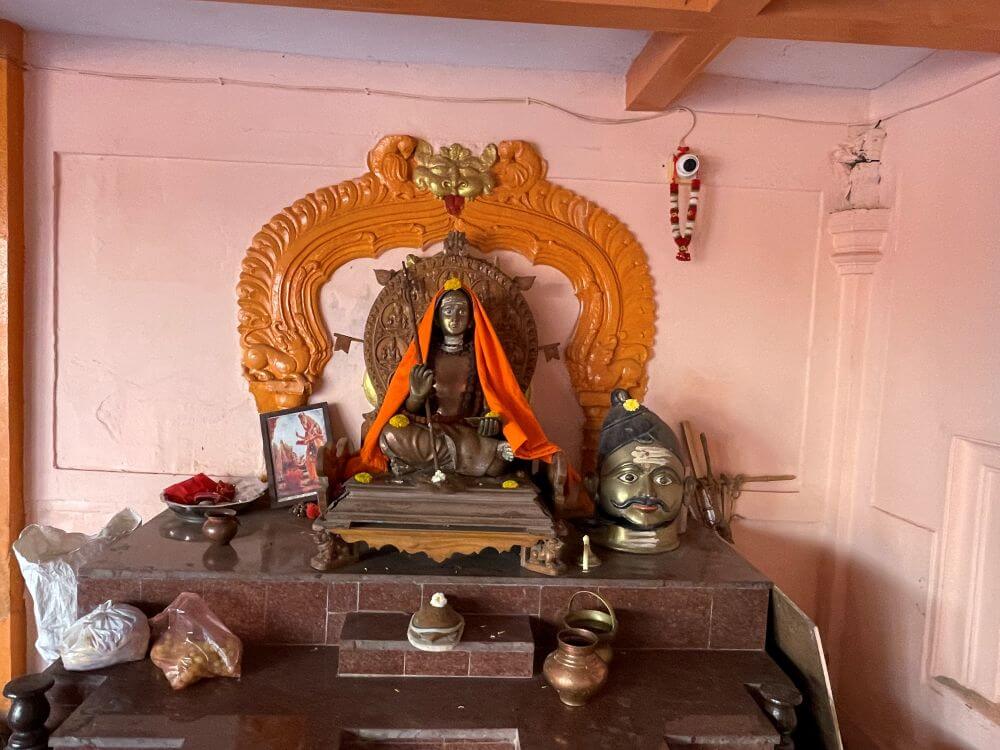
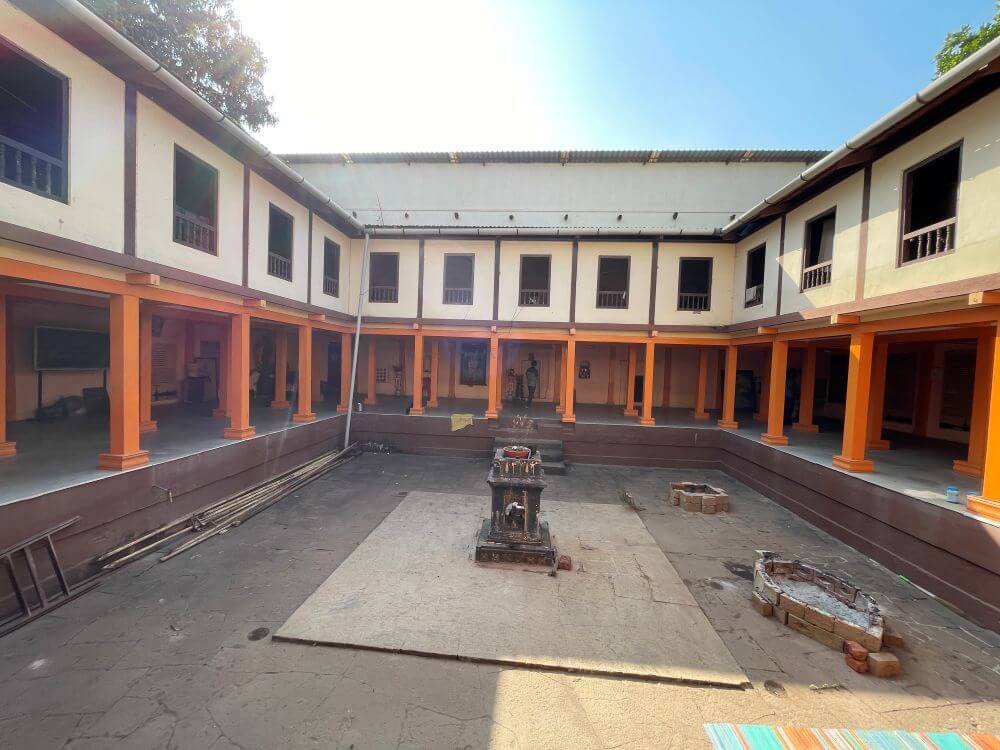
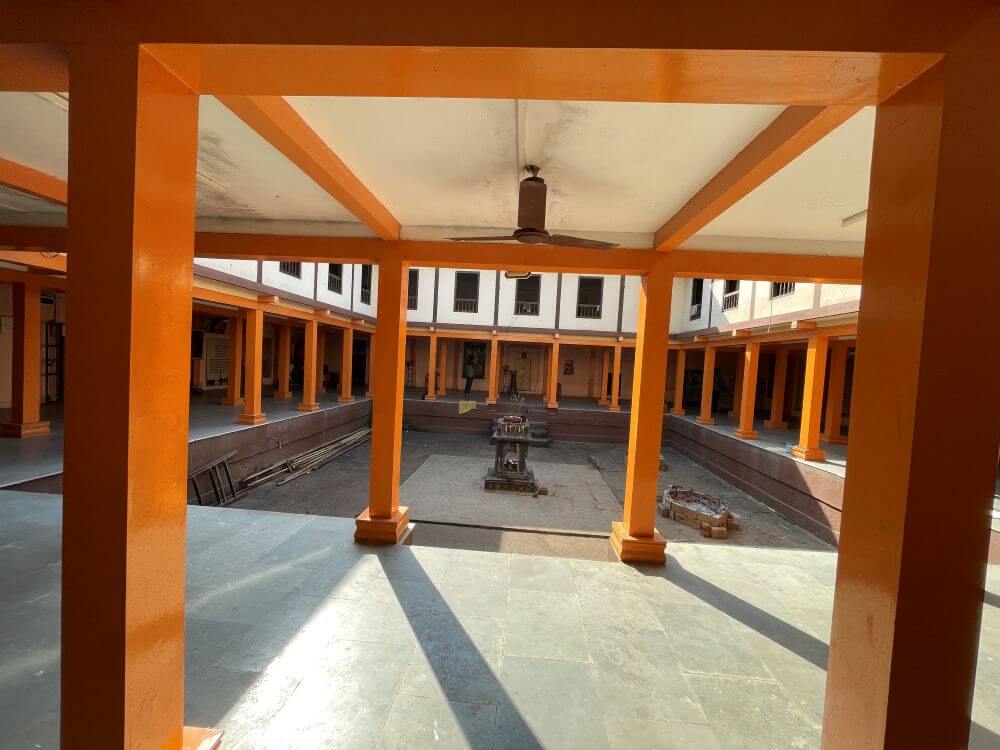
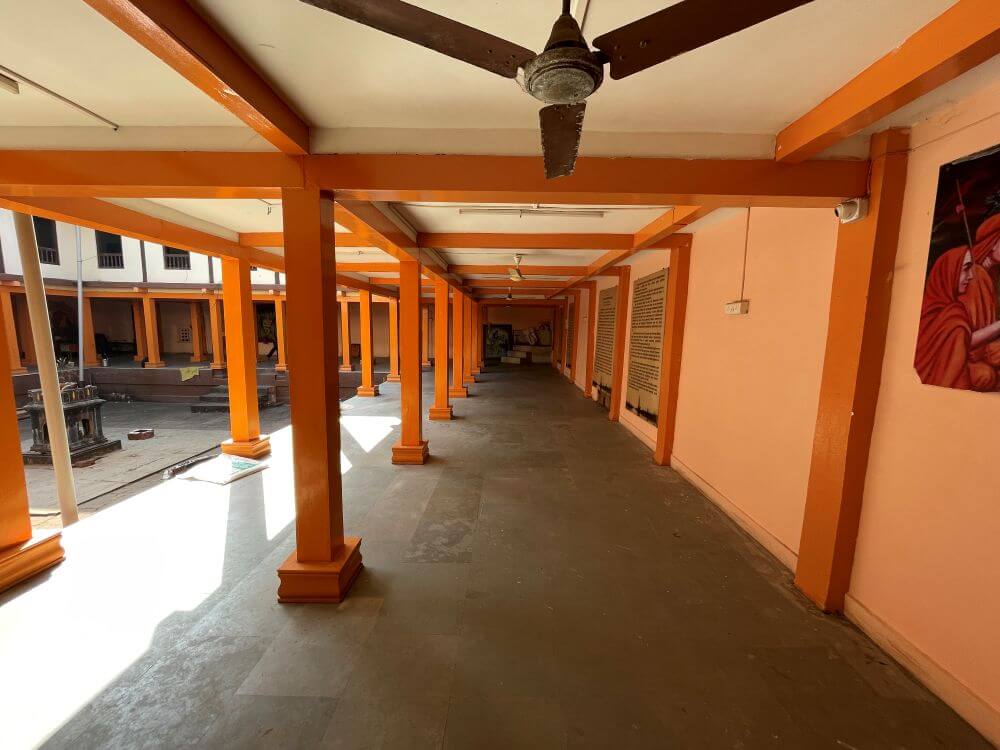
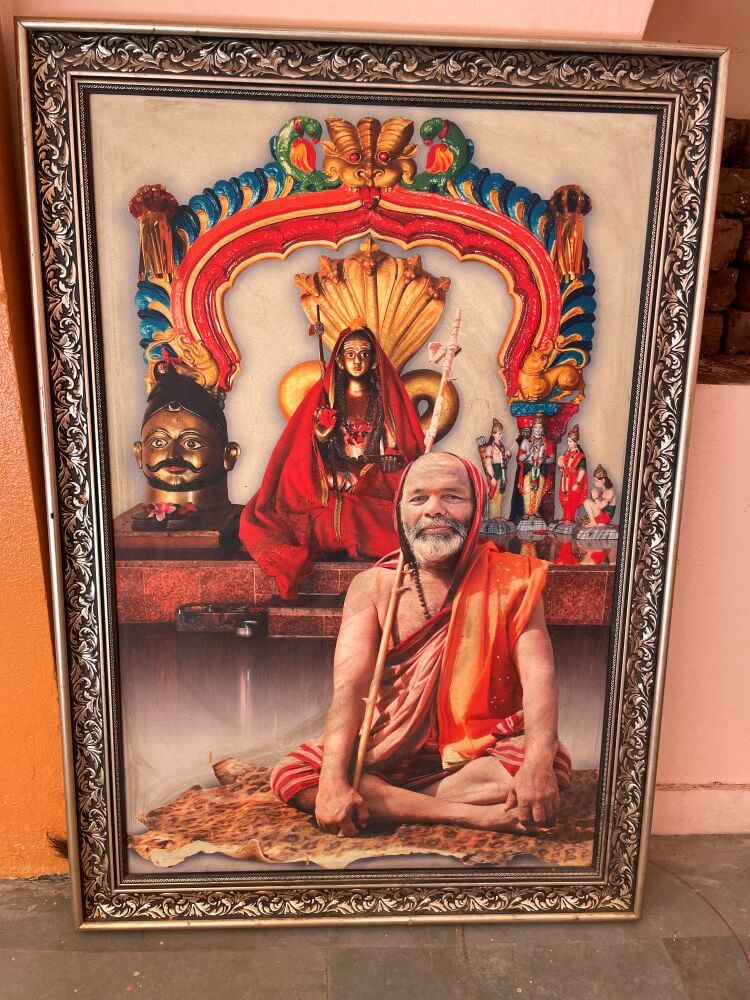
Ascending four steps from the veranda, one enters the monastery building. Near the entrance here, a large portrait of Jagadguru Vidyanrusimha Bharati Shankaracharya is displayed. Inside is a spacious veranda with wooden pillars on all four sides, The structure of this Matha resembles an old mansion, featuring an open square courtyard with paving in the center, various chambers adjacent to the veranda, and a second floor above it. In the open space in the center, there is a Tulsi Vrindavan and two Homa Kundas. In the central chamber facing the front, the seat of the Shankaracharya is located. On the front veranda, in the corner on the left side, a brass idol of Adi Shankaracharya is installed on a high pedestal. This idol was consecrated on 1 May 1993, on the occasion of Shankaracharya Jayanti. The idol is placed on a square platform, and behind the idol is a wooden Makhar. In its center is a Kirtimukha. Beside the idol is a large brass mask of Shankara. In this veranda, portraits of Adi Shankaracharya as well as Sharadamba Devi have been displayed.
The administration of the renowned Kopeshwar Temple, located at Khidrapur in the Shirol taluka of Kolhapur, was conducted by the Karveer Peeth. In the year 1706, the village of Khidrapur was granted to the Karveer Peeth as an endowment. Some of the agricultural lands here are cultivated by the farmers of Khidrapur, and the compensation for this is deposited at the Karveer Peeth in the form of rent. Similar to Khidrapur, many villages in the Karveer taluka have been granted as Dumala (the right to collect land revenue) to the Shankaracharya Peeth. The monastery receives rent amounts from those places as well.
In the Shankaracharya Math, the morning worship (Pratah-puja) takes place from 6 to 9 in the morning. Following this, the Acharya grants darshan to the devotees until 12 o’clock. The evening worship (Sayam-puja) is held here from 7:30 to 8 in the evening. Shankaracharya Jayanti, as well as other religious programs, are celebrated at the Math. The work of Vedic studies continues in this Math even today.
This sacred temple stands as a testament to deep spiritual devotion, ancient architectural grandeur, and rich local cultural traditions.
The sanctum sanctorum houses the divine idol consecrated according to ancient Vedic traditions, surrounded by serene courtyards and traditional temple architecture.
Navratri, Maha Shivratri, Annual Temple Jatra & Deepotsav
Compare and book flights, secure top-rated local hotels near the temple, hire reliable guides, and rent cars instantly.
Extend your pilgrimage by visiting other highly sacred temples located nearby.


Add ₹999 more to unlock FREE SHIPPING!
Your sacred cart is currently empty.
Shop Photo FramesFill in your delivery details below to place your order.
Add comment