
Add ₹999 more to unlock FREE SHIPPING!
Your sacred cart is currently empty.
Shop Photo FramesAfter the British established political dominance in Kolhapur in the year 1844, many tanks and ponds were filled in to create new settlements. The Kumbhar Tale (Potter’s Pond) in the Gangavesh area was one of them. Today, Shahu Udyan stands in its place. It is here that the renowned Rinamukteshwar Temple of Kolhapur is located. Humans carry various types of debts, ranging from the debt to one’s parents to financial debts. Devotees believe that by worshipping this Shiva Linga with a sincere heart, one is liberated from these debts. Consequently, there is a long queue of devotees for darshan every Monday.
The legend of this temple states that the King of Gods, Indra, killed Vritrasura. Vritrasura was a Brahmin, and by killing him, Indra incurred the sin of Brahmahatya (killing a Brahmin). He asked Sage Narada how to attain liberation from this sin. Sage Narada gave Indra a red cloth and told him to carry it to every pilgrimage site. He said that at the pilgrimage site where this cloth turned pure white, he should worship Lord Mahadeva, which would grant him liberation from his sins and settle his debts. Following this instruction, Indra visited many pilgrimage sites and bathed there. Finally, he arrived at the Karveer Kshetra. He bathed in the Rinamukteshwar Tirtha here, and the red cloth in his hand turned white. Thereafter, he worshipped Rinamukteshwar on the banks of the Tirtha, which liberated him from the sin of Brahmahatya. That Tirtha is the Kumbhar Tale, and the temple on its bank is the Rinamukteshwar Temple.
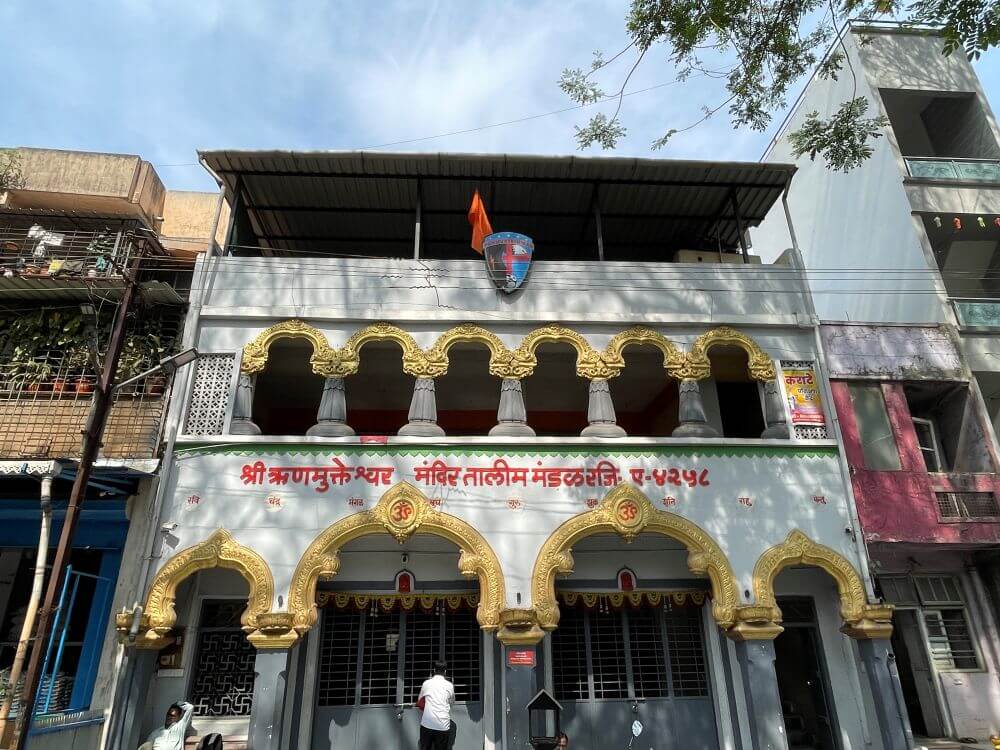
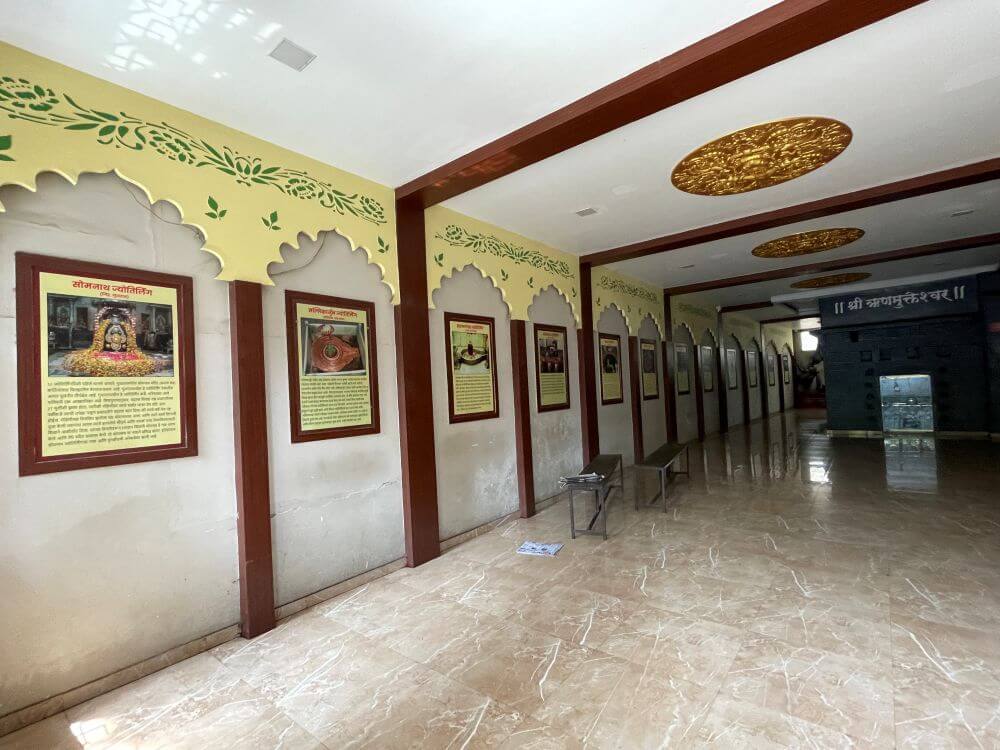
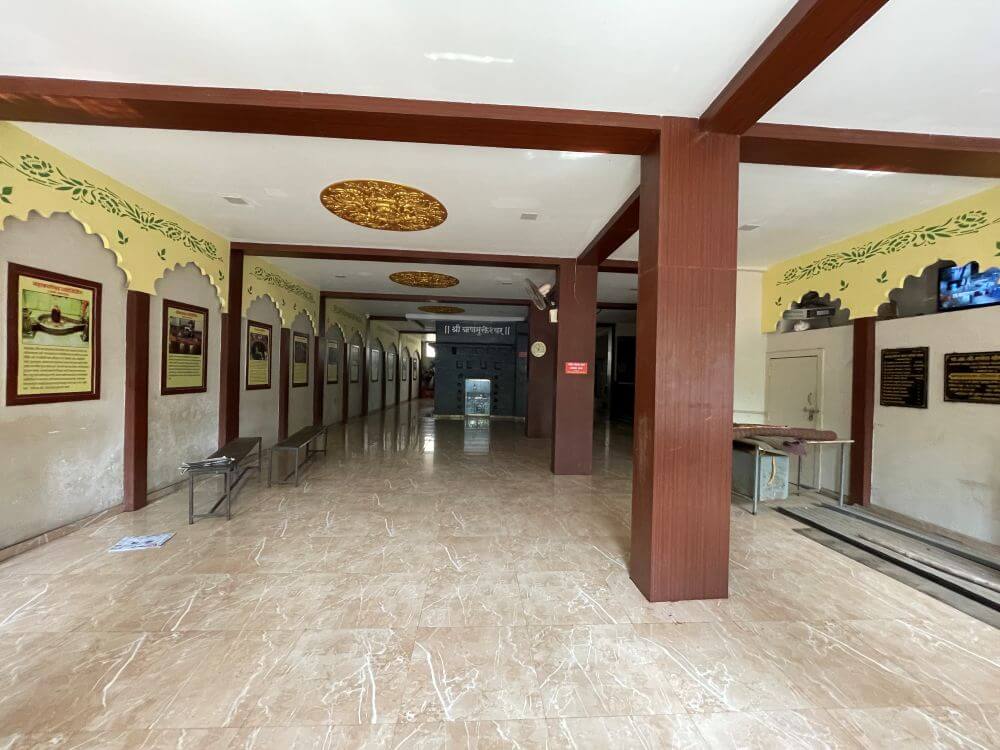
This temple is situated in a two-story mansion-like building in the Shahu Udyan area of Gangavesh. The temple attained its current form after renovations carried out in February 2023. The front porch of the temple has four arches. Upon entering through the doorway, one finds a spacious assembly hall (Sabhamandap). Granite tiles are installed throughout the interior. The walls of the assembly hall are adorned with photographs of the Jyotirlingas and information plaques. The flat ceiling features embossed carvings of floral patterns. Directly behind this assembly hall, in the center, is the stone sanctum (Gabhara) of Rinamukteshwar.
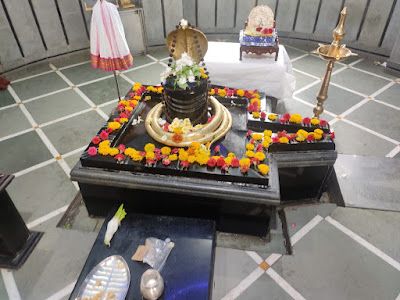
In front of the sanctum is a large stone statue of Nandi, followed by a brass turtle. A statue of Gajanana (Ganesha) is carved on the lintel of the sanctum entrance. Inside the sanctum, there is a Shiva Linga with a circular base (Shalunka) on the floor. The Linga is coiled by a brass serpent, with its hood forming a canopy over it. Above the Linga is a Galantika (an अभिषेक vessel). A tall trident stands to the side. In front of the temple, on high platforms, beautiful marble statues of Trimukhi Dattatreya and Lakshmi-Narayana are installed. Adjacent to them is a large brass Shiva mask, also sheltered by a serpent hood. An embossed carving of Panchamukhi Hanuman on one of the walls is quite distinctive. Next to this, on a platform, is an ancient statue of Hanuman.
There is a large crowd of devotees in this temple every Monday and on Shivratri. Another unique feature of this temple is that many young people in Kolhapur have entered into matrimony in the presence of Rinamukteshwar. In the past, there were no wedding halls in Kolhapur. At that time, the assembly hall of this temple was made available for wedding ceremonies for a very nominal fee, or often just in exchange for a single coconut. Many community wedding ceremonies also took place here.
The Ravaneshwar Mahadev Temple is located a short distance from the Rinamukteshwar Temple. Before the seventh or eighth century, Kolhapur was a cluster of six villages. These settlements were Brahmapuri, Uttareshwar, Kholkhandoba, Rankala, Padmala, and Ravaneshwar. After the establishment of the Mahalakshmi Temple, these six settlements merged to form the city of Kolhapur. The Ravaneshwar Temple was located in the pond of the Ravaneshwar village. In the Karveer Mahatmya, this area is referred to as Rakshasalaya. After the British established political dominance over Kolhapur, the Ravaneshwar pond was filled in after 1884. Currently, the Ravaneshwar Temple is located in the Khasbag area near Shahu Stadium.
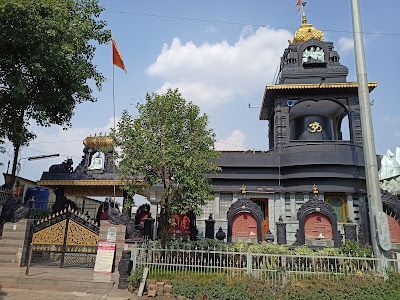
The temple, which was previously under a simple iron canopy, was renovated in 1994. A grand temple in the shape of a Shiva Linga was built here. Subsequently, a spire (Shikhara) was constructed on the temple in 2013. Marble stones and tiles have been used throughout the temple. One enters the temple through a large gateway. In the center of the gateway is a white meditative statue of Shankara, with Nandi on both sides. Below are attractive carvings of peacocks. Before entering the temple, there are beautiful embossed carvings of the twelve Jyotirlingas on the protective walls. Next to each Jyotirlinga are half-pillars of Nandi. A pair of serpents (Nagayugul) can be seen carved on a stone slab. Before entering the temple, on the left and right pillars, one can see sculptures of the Shiva attendants, Shringi holding cymbals and Bhringi holding a veena. A unique feature of these statues is that they have three legs, and if any one leg is covered, a dance posture is formed.
On the ornate wooden entrance, one can see Veerabhadra and Bhairava on glass on both sides. On the upper door frame is a statue of Ganesha. Further ahead, in the corner on the right, is a black stone statue of Goddess Ganga, seated on a lotus with a crocodile as her vehicle. Her upper two hands hold a lotus and a water pot (Kalash), while her lower two hands are in a blessing gesture. On the other side, to the left, is Goddess Gauri. This statue is also carved in black stone. A water vessel is visible in front of them. Above these statues, paintings created by the great artist Abalal Rehman before the realization of the Ravaneshwar Temple and prior to that are displayed. Further ahead, in the center on a platform, is a large black stone statue of Nandi. To the left, in a brass shrine, are beautiful statues of Hanuman, and to the right, those of Ganesha. In the sanctum, there is an east-facing Shiva Linga of Ravaneshwar on a square stone pedestal.
In front of the sanctum, a statue of Trijata is carved on a pillar. One relief sculpture catches the eye: it depicts Sita making a sand Linga, while Shri Ram, Lakshman, and Hanuman are watching. Pictures of Mahalakshmi, Tuljabhavani, Renukamata, and Saptashrungi goddesses are placed on one wall. Going straight from the outside of the sanctum to the left, one can see the Shiva Linga of Lakshmaneshwar. The Shiva Linga is coiled by a serpent deity. A replica of the Amarnath cave and the Amarnath Shiva Linga can also be seen here. Another statue of Ganesha carved on a stone slab below is also present. Exquisite carvings can be seen on the entrance and throughout the temple.
The pinnacle of this temple is characterized by its diversity. The central part is shaped like a Shiva Linga, with pillars on all four sides, and sculptures carved on a pedestal on all four sides. On the east side, Lord Mahadeva and Parvati are seated along with Kartikeya and Ganesha. To the west, Lord Mahadeva is in the form of Nateshwara. The sculpture on the north side depicts the five-faced Mahadeva, while on the south side, one can see a sculpture of Ravana worshipping Lord Mahadeva. Here, Rudrabhishek is performed daily during the month of Shravana, while Laghurudra Abhishek is performed at other times.
This sacred temple stands as a testament to deep spiritual devotion, ancient architectural grandeur, and rich local cultural traditions.
The sanctum sanctorum houses the divine idol consecrated according to ancient Vedic traditions, surrounded by serene courtyards and traditional temple architecture.
Navratri, Maha Shivratri, Annual Temple Jatra & Deepotsav
Compare and book flights, secure top-rated local hotels near the temple, hire reliable guides, and rent cars instantly.
Extend your pilgrimage by visiting other highly sacred temples located nearby.


Add ₹999 more to unlock FREE SHIPPING!
Your sacred cart is currently empty.
Shop Photo FramesFill in your delivery details below to place your order.
Add comment