
Add ₹999 more to unlock FREE SHIPPING!
Your sacred cart is currently empty.
Shop Photo FramesBirdev, the presiding deity of the Dhangar community, is also known by the names Viruba, Viroba, Birappa, Virupa, or Viranna. There are twelve major shrines of Birdev, six each in Maharashtra and Karnataka. One of these shrines is located in Vashi. This Birdev temple is a place of faith for lakhs of devotees from the states of Maharashtra, Andhra Pradesh, Karnataka, and Goa. The Jal-yatra, which takes place on Phalgun Shuddha Dwitiya and once every three years, is famous here. During this time, about six to seven lakh devotees come here for the darshan of Birdev.
The legend of the temple here is that Narayan Gawade, the priest of the Vitthal-Birdev temple in Pattankodoli, had a stepson named Donya. Later, he had three sons of his own. However, he decided to pass on his legacy as a priest to Donya. The three sons and the villagers opposed this. Then, Donya left the village. On the way, in the village of Vashi, he met a devout follower of Birdev. He sent him towards Donmulkh. On the way, in the village of Alkanur, Donya had the darshan of Karisiddha, that is, Birdev. After some time, Donya decided to go and settle in Vashi. At that time, he prayed to Birdev and requested him to accompany him. Then, Birdev came with him to Vashi in the form of a stone.
Donya installed this stone under a tree in Vashi. The shepherds here used to worship it regularly. At that time, their cattle would enter the fields and destroy the crops. Because of this, the farmers were troubled and, believing this stone to be the cause of this misfortune, they threw it into a deep pool of water. After that, a calamity befell the village and an epidemic spread. It was as if darkness had spread everywhere. At that time, some people invited a Siddha Purusha named Dhulsiddha from the village of Bhadole to the village of Vashi. The local landlords decided to test Dhulsiddha first. They brought a mare and asked him to identify whether the foal in its womb was male or female. Accepting the challenge, Dhulsiddha threw a handful of turmeric powder (bhandara) onto the mare’s belly and stated that there was a male foal inside. He added that it was black in color and had a white mark on its forehead. To verify the truth, the landlord ordered the mare’s belly to be cut open to bring out the foal. When this was done, it was confirmed that the description given by Dhulsiddha was exact. Thereafter, Dhulsiddha said to the landlord, “Driven by jealousy, you have committed this inappropriate act. You will have to perform penance for this sin. The farmers here threw the Deity into the deep pool (doh). The calamity that befell the village was due to that. I will retrieve the Deity from the pool. Everyone should worship Him.” Saying this, Dhulsiddha jumped into the pool and emerged with the stone (gunda). Everyone together installed it at a high place in the village. Some call Him Birdev, some Karisiddha, and others Avadhalkhan. After this, Birdev was pleased with Dhulsiddha and asked him to settle in Vashi itself. Furthermore, Karisiddha gave his word to Dhulsiddha that he would come to the village of Vashi to meet him every three years. The meeting between Birdev and Dhulsiddha that takes place every three years is famous here as the Jal Yatra.
The Birdev temple is located on a plateau in the village of Vashi, a short distance from the city of Kolhapur. One can reach this temple from the foothills via a flight of stairs. A few years ago, a direct motorable road was also constructed to reach the temple. Upon entering the temple premises, one notices two tall lamp pillars (deepmalas) and the high fortification wall surrounding the temple courtyard. There are large entrance gates on both sides of the front wall of this fortification. In the center is the main entrance of the temple. In front of this entrance, there is a stone samadhi and a Nandi mandapa. In this pavilion, on a high stone platform, stands a large brass idol of Nandi, sheltered by a dome-shaped canopy.
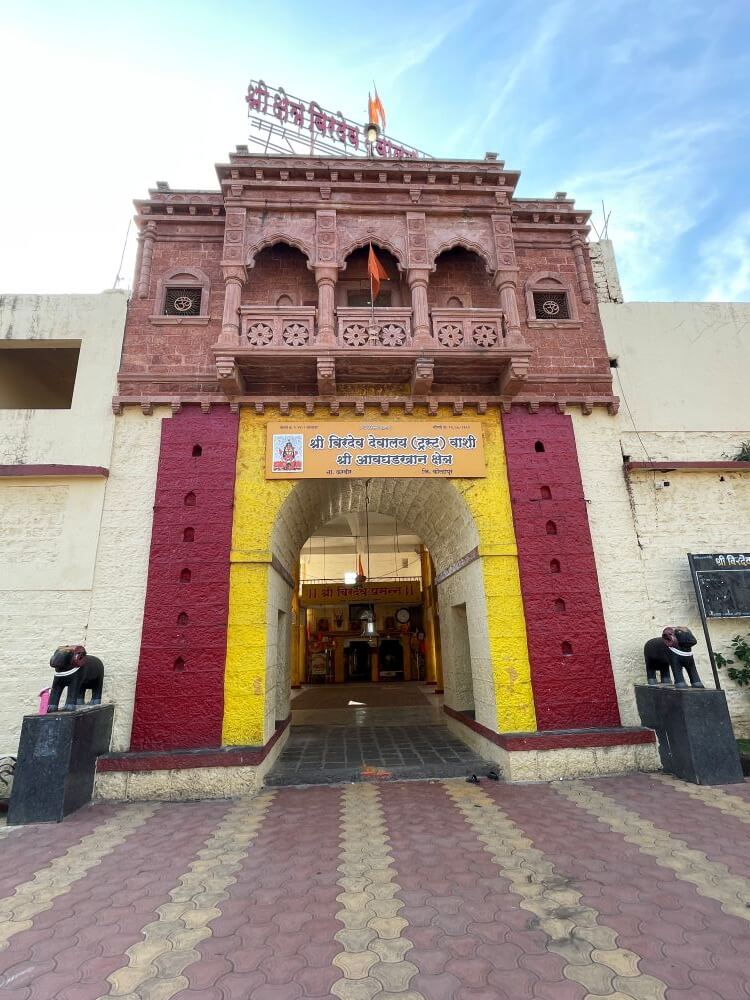
The main entrance is constructed of stone. On both sides of it, on small platforms, are sculptures of rams. The entrance is cylindrical, and on both sides, there is a vertical row of lamp niches embedded in the stone walls. On the upper floor of the entrance, there is a Nagarkhana built in red stone, reflecting the Rajasthani architectural style. Inside the entrance, on the right side, there is a large stone serpent hood (Nagaphana) placed in a shrine. Devotees offer their respects here before entering the temple. From here, one enters directly into the main assembly hall (Sabhamandapa) of the temple.
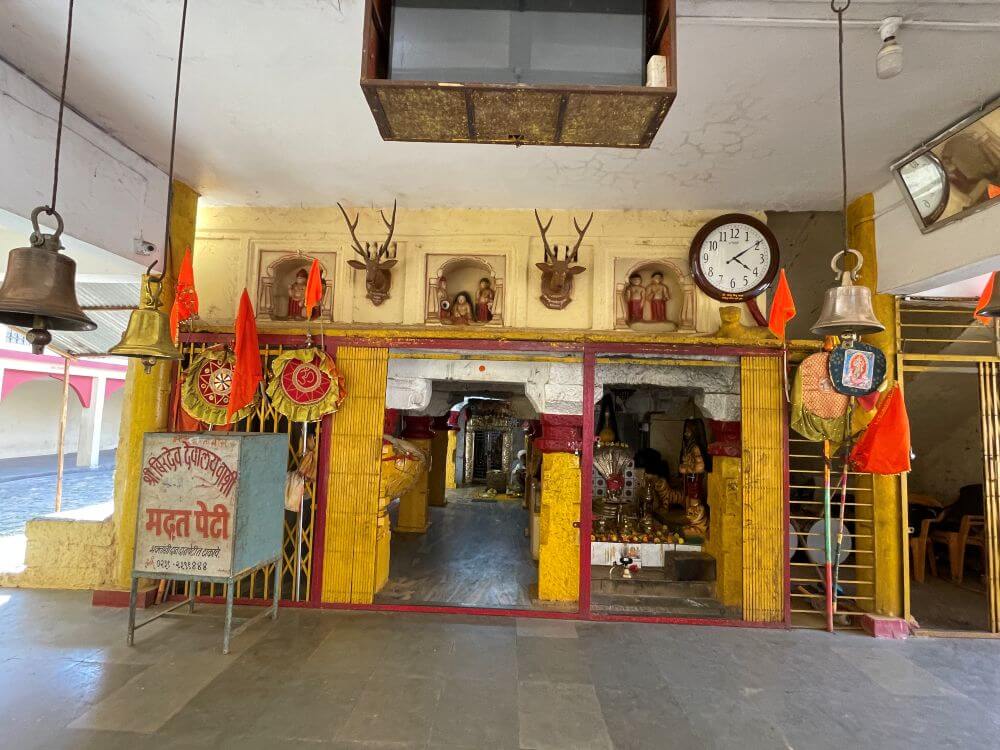
This assembly hall is two-storied and open in design. Supported by circular pillars, the second floor of this hall features a balcony capable of accommodating hundreds of devotees. The assembly hall is of modern construction and was added to the ancient temple at a later date. The ancient temple is built of stone and follows the architectural style of the medieval period. Originally, it consisted of only two parts: the assembly hall and the sanctum sanctorum (Garbhagriha). On the upper part of the wall facing the assembly hall of the original ancient temple, there are three niches. These contain sculptures depicting episodes from the life story associated with Birdev. Two heads of blackbucks are hung here. The assembly hall features simple carved stone pillars, the design of which reflects their antiquity. According to a legend, the nine stone pillars in the assembly hall belonged to a Sultan’s palace and were brought here during a renovation in the past. It is said that there is a tradition that one who sits by these pillars should not speak a lie.
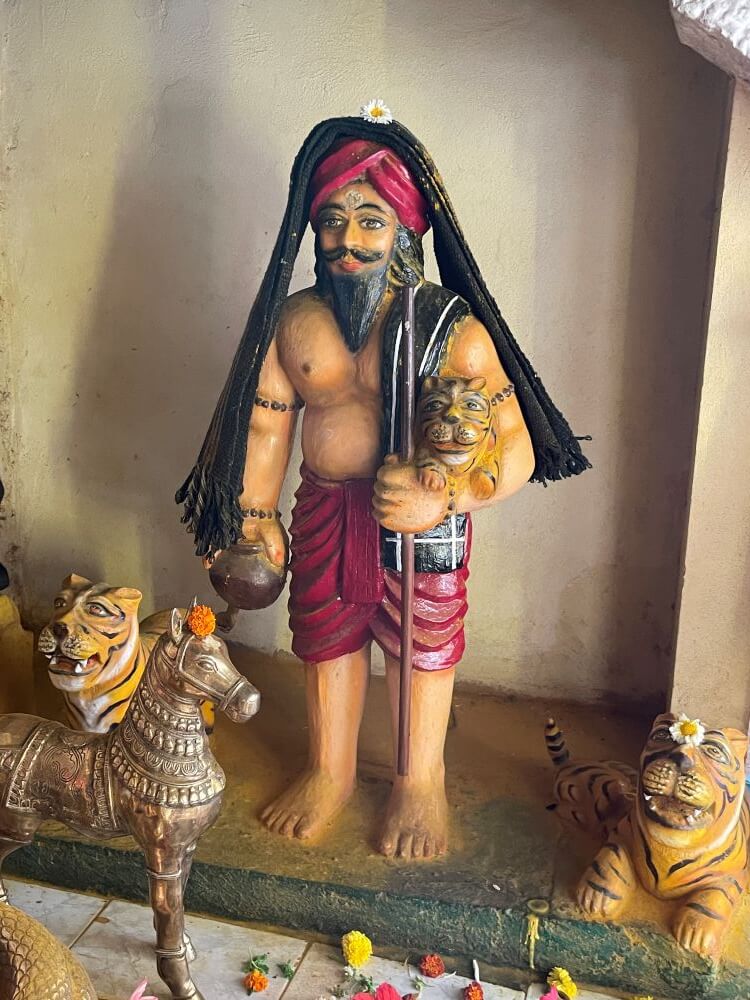
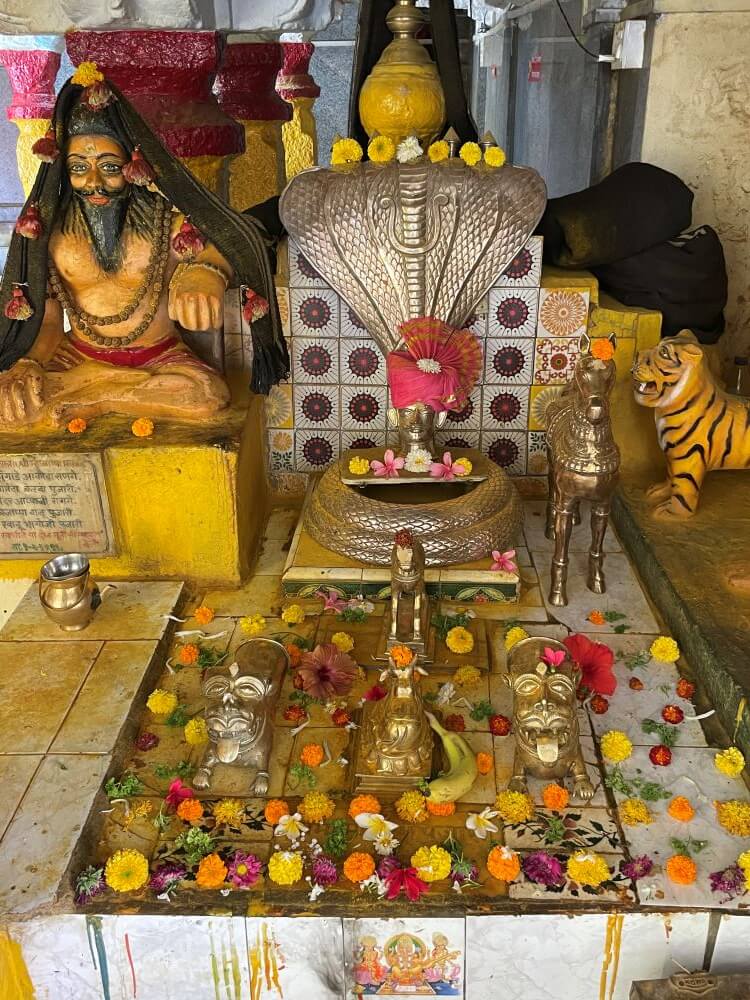
In this original assembly hall, on a platform to the right, stands the statue of Dhulsiddha. Beside it is the mask of the deity, seated upon the coils of a large silver serpent. Here, there are brass horses as well as an idol of Nandi. Two unique brass idols can be seen at this place. From the front, tiger faces are visible, but the rear part of their bodies resembles a large brass cup. Beside this platform stands a tall idol of a devotee of Birdev. In this idol, which features a tiger cub in an embrace, a large staff in one hand, a water pot in the other, and a coarse wool blanket draped over the shoulder and head, tigers reaching up to the knees are visible on both sides. A short distance ahead from here is a brass idol of a tortoise bathed in turmeric powder.
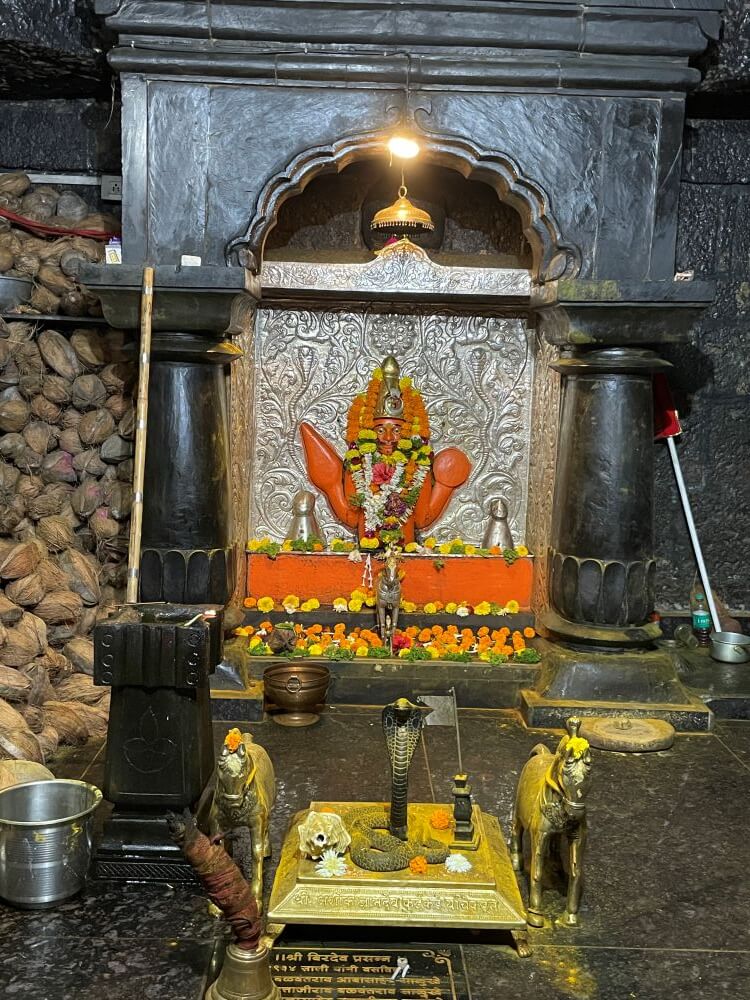
Directly in front is the entrance to the sanctum sanctorum of the temple. The stone door frame is covered with a brass sheet, upon which floral and leaf patterns are engraved. At the lintel of this frame is an idol of Lord Ganesha, with elephant sculptures carved on both sides. Inside the sanctum, the idol of Birdev is enshrined within a stone altar. This is a relief-style stone sculpture. In it, one hand of the idol resembles a spearhead, while the other hand holds a circular shield or vessel. The idol wears a tall crown on its head. Behind the idol is a silver wall engraved with floral and leaf patterns, as well as serpent images. In front of the idol is a metal statue of a horse, the vehicle of Birdev. Before that, on a silver pedestal, is a black stone idol of a serpent with its hood raised. There are also horse statues on both sides of the pedestal.
Above the sanctum sanctorum of the temple is a pyramid-shaped stone spire. On it, in the center, is a large amalaka and a pinnacle, with smaller amalakas on all four sides. To the right side of the temple is a square-shaped shrine. There, an upright idol of Birdev’s foster daughter, Bhagubai, carved in black stone and depicted in a posture of blessing, is consecrated.
In this temple, the Abhishek and Snan rituals are performed daily from 𝟓:𝟑𝟎 to 𝟔:𝟑𝟎 in the morning, followed by the Aarti of the deity. Every three years, on the day of Phalguna Shuddha Dwitiya, a grand Yatra of Birdev is held here. This five-day festival, celebrated with great fervor amidst the chants of ‘Birobachya Navan Changbhala’, the generous showering of dry dates, coconut, and turmeric powder (Bhandara), and the resonant sounds of drums and cymbals, is famous as the Jala Yatra. On the first day of the Yatra, the ceremony of the meeting between Birdev and Dhulsiddha takes place at the doorstep of the Dhangar Galli and the Range family in Vashi. Following this, the deity’s palanquin departs from the Bhanus temple towards the main temple. This palanquin is carried in a procession throughout the night. At dawn the next day, the deity is seated on the throne in the main temple. At this time, spectacular fireworks are displayed. Offerings of Ambil kalash, Vadi-bhakri, and Puran Poli are made to the deity. In the evening, programs such as the first Bhaknuk (prophecy) and Hedam dance are held.
The main attraction of the third day is the second Bhaknuk and the ceremony of taking the deity to the water. On the fourth day, there is the Chhabina procession and Bhaknuk. On this day, a salty offering is made to the deity. On the final day, the Yatra concludes after bidding farewell to Dhulsiddha. During this Yatra, about ten to fifteen thousand goats are sacrificed.
This sacred temple stands as a testament to deep spiritual devotion, ancient architectural grandeur, and rich local cultural traditions.
The sanctum sanctorum houses the divine idol consecrated according to ancient Vedic traditions, surrounded by serene courtyards and traditional temple architecture.

Navratri, Maha Shivratri, Annual Temple Jatra & Deepotsav
Compare and book flights, secure top-rated local hotels near the temple, hire reliable guides, and rent cars instantly.
Extend your pilgrimage by visiting other highly sacred temples located nearby.


Add ₹999 more to unlock FREE SHIPPING!
Your sacred cart is currently empty.
Shop Photo FramesFill in your delivery details below to place your order.
Add comment