
Add ₹999 more to unlock FREE SHIPPING!
Your sacred cart is currently empty.
Shop Photo FramesThe Karveer taluka of Kolhapur is a religious and historical treasure trove of ancient temples. Much like the Mahalakshmi Temple, which is one of the three-and-a-half Shakti Peethas, this region is home to many ancient Shiva temples. One such temple is the Hareshwar Temple. This temple is situated in the village of Are, located at the confluence of the Tulshi and Bhogawati rivers in Karveer taluka. It is considered an ancient and ‘Jagrut’ (spiritually awakened) pilgrimage site. A unique feature of this temple is that it houses what is likely the largest ‘Veergal’ (hero stone) in Maharashtra. There are also several other hero stones within the temple premises.
The history of this Hemadpanti-style temple, located near the riverbank in Are village, remains unknown. However, based on its architectural style, intricate carvings, and the design of its stone pillars, scholars estimate it dates back to the Shilahara period, approximately the 11th or 12th century. During this same era, the Shilahara King Marsimha expanded the Karveer-resident Mahalakshmi-Ambabai Temple, and his son, Gandaraditya, later added the temple spire. A hero stone dating back to the reign of King Gandaraditya has been discovered in Are village. It is believed that the Shilahara kings and the subsequent Yadava rulers built many temples, and the Hareshwar Temple is likely one of them.
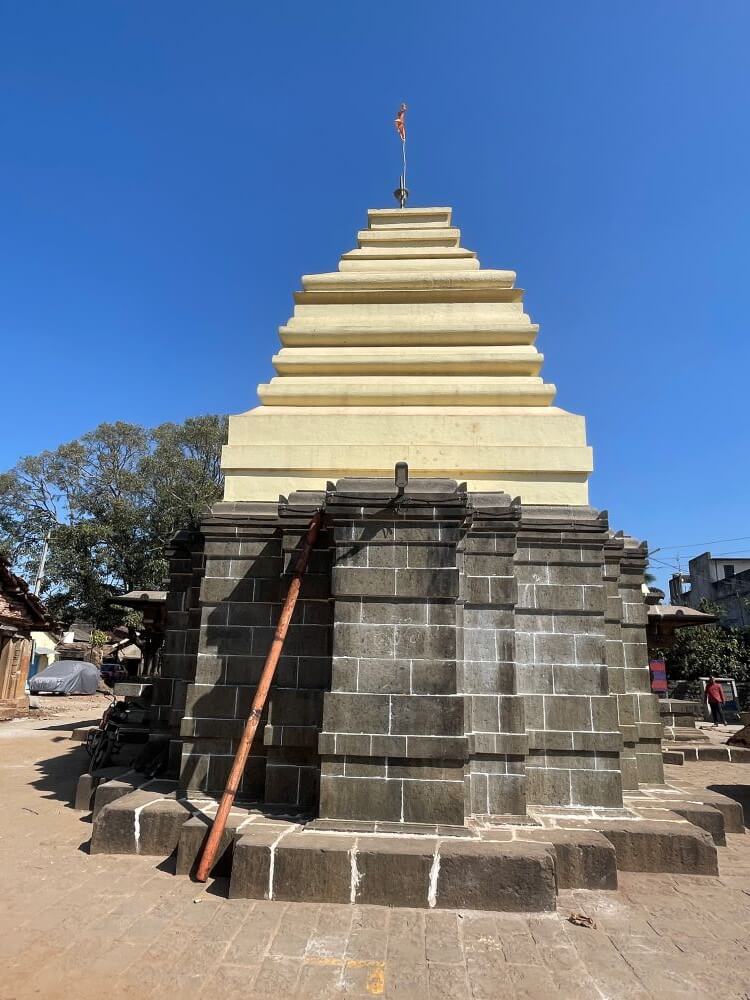
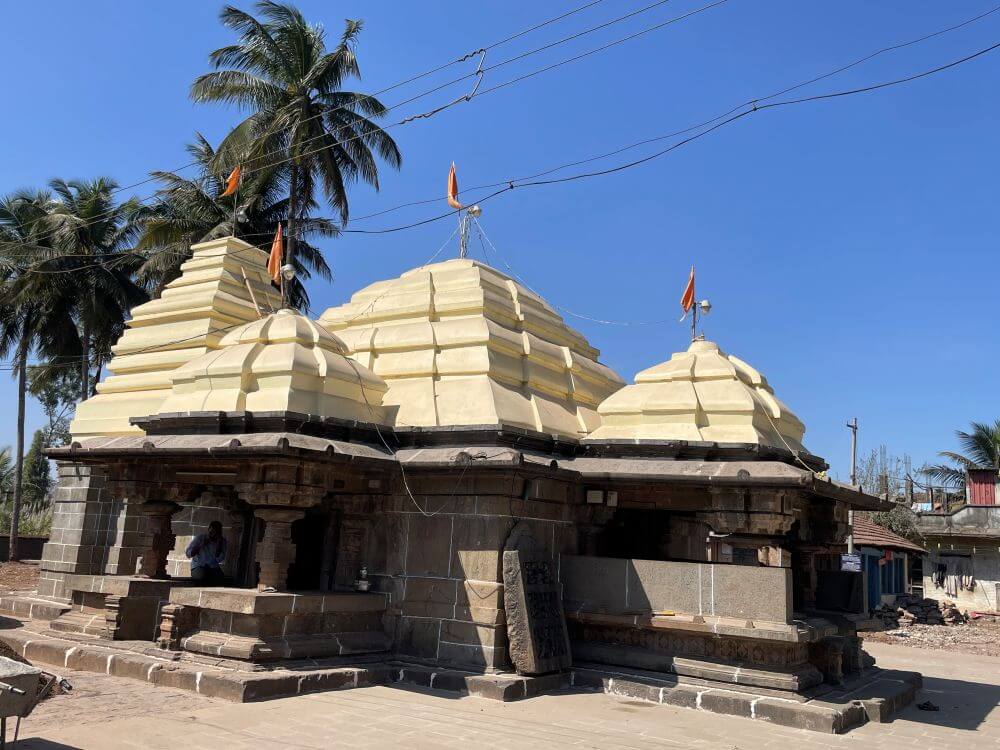
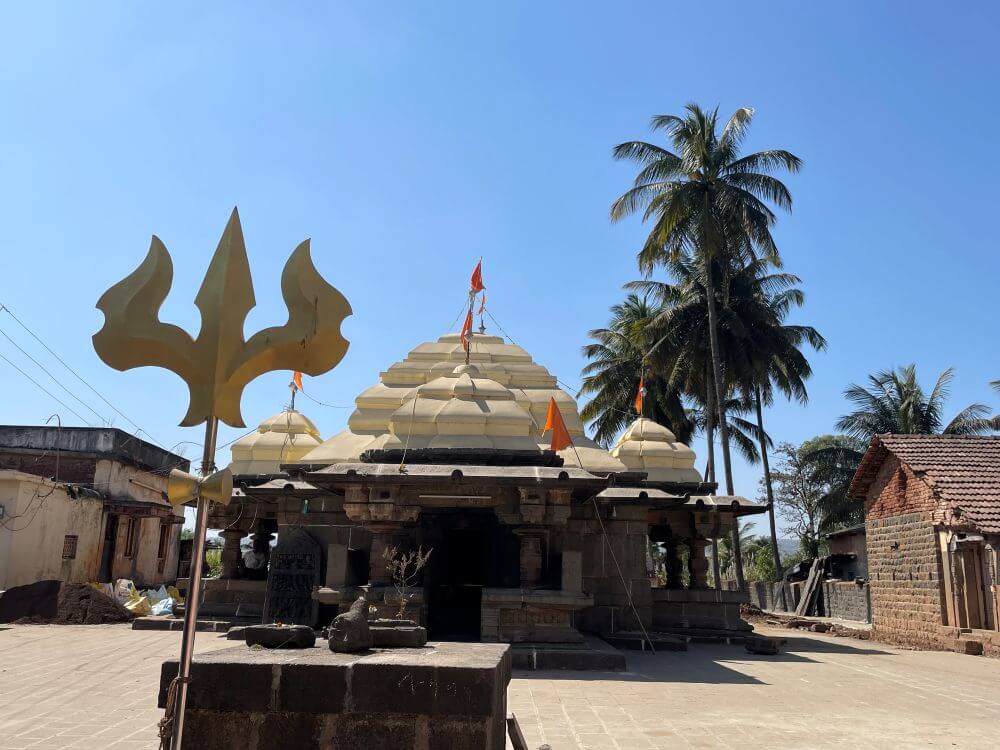
This temple of Lord Hareshwar Mahadeva faces east. The temple structure consists of a Mukh-mandapa (entrance porch), Garbhagriha (sanctum sanctorum), Antarala (vestibule), Sabha-mandapa (assembly hall), and two additional porches attached to the north and south sides. In front of the temple stands a traditional stone-built Tulsi Vrindavan. The temple’s Jagati (platform) is approximately one foot high. The main entrance to the temple is through the eastern porch, which is supported by two half-pillars and two full pillars. These pillars feature carvings of cobra hoods, and there is a popular belief that the temple is supported by Nagas (serpents).
Inside the porch, there are stone benches known as Kakshasanas. A portion of the entrance leading into the Sabha-mandapa has been lost. Kirtimukhas are carved on both sides of the threshold. Inside this hall, there is a ‘Chatushki’—a square platform slightly raised from the floor. Intricate pillars stand beside the doorway of the assembly hall. On the Lalat-bimba (lintel) of the door frame, there is an image of Lord Ganesha, though this image was installed in more recent times. The ‘Mandarak’ (threshold) features a crescent-shaped stone with Kirtimukhas on the sides, and in front of this lies a beautifully carved stone step.
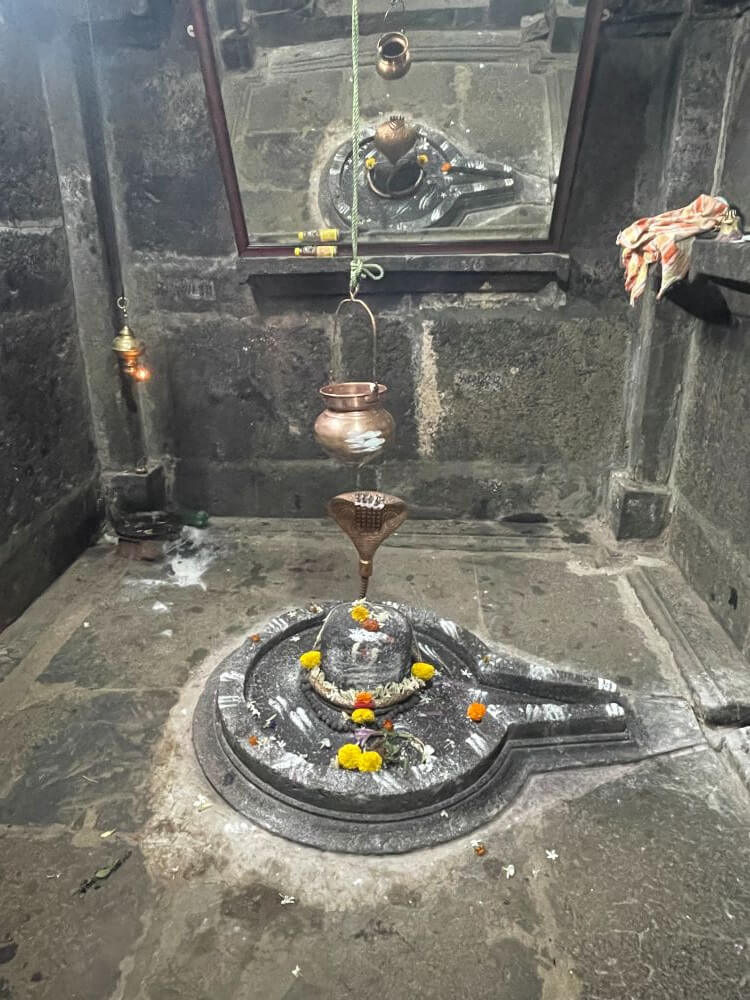
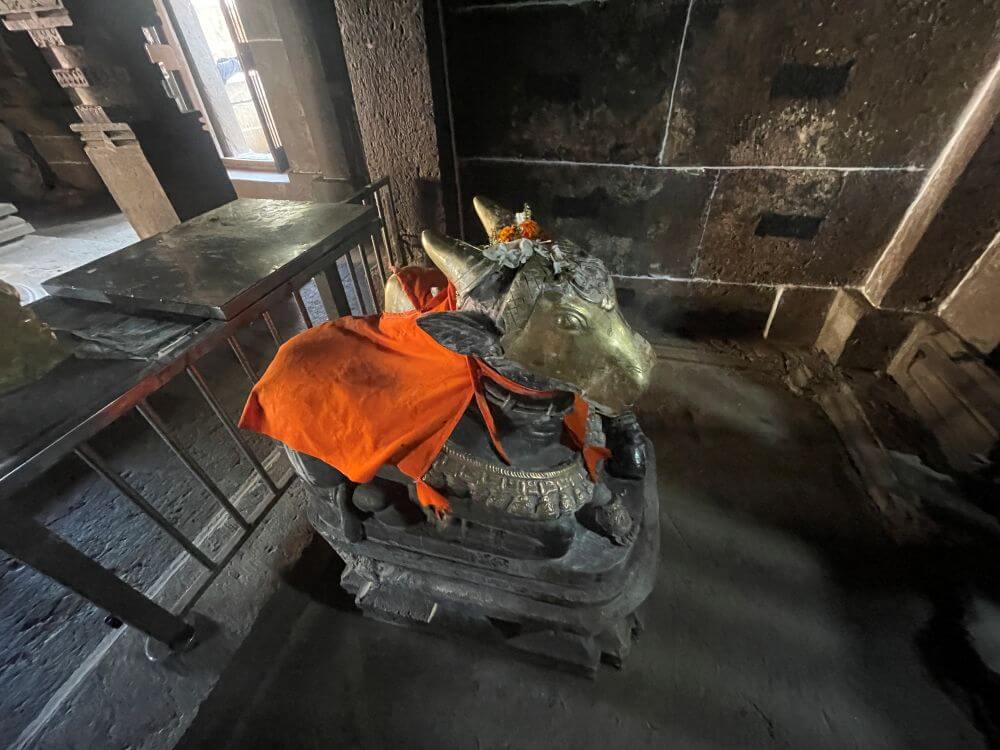
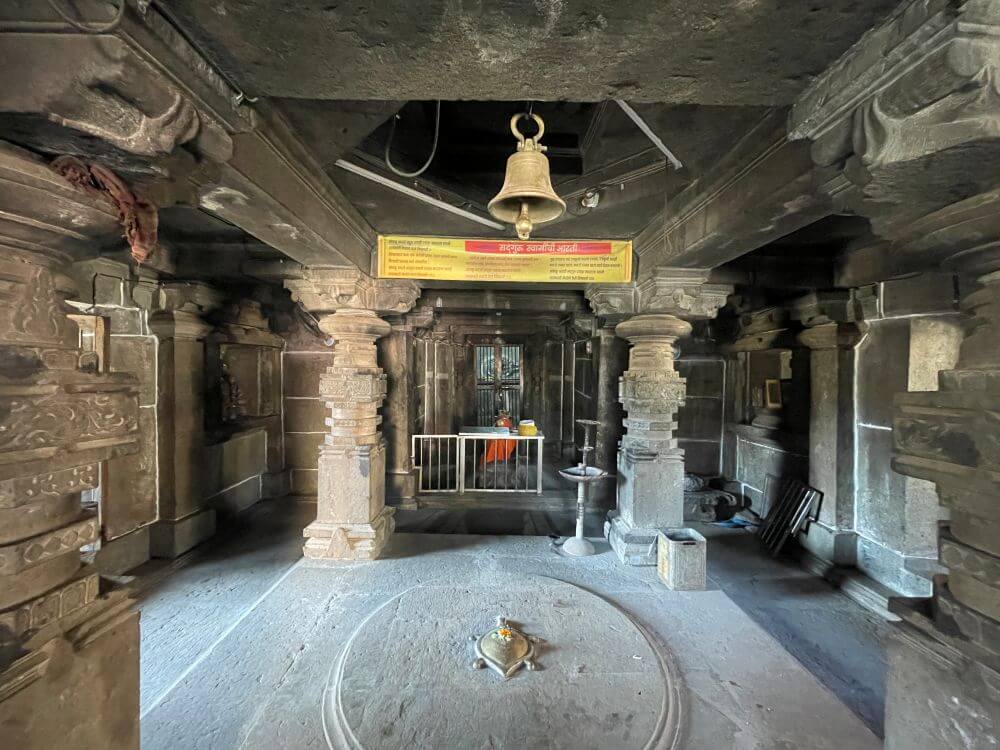
The Sabha-mandapa has entrances on the left and right sides. In the center, there are four magnificent stone pillars surrounding a ‘Rangshila’ (stage), upon which a brass turtle idol is mounted. The pillars here are square at the base, octagonal in the middle, square again above that, and topped with a circular, disc-like capital. The Antarala, which connects the Sabha-mandapa to the Garbhagriha, is somewhat dark. Here, there is a Nandi idol carved from exquisite, fine-grained black stone. The garland of bells around its neck is carved with remarkable realism. The head and horns of the Nandi are covered with brass plating. The entrance to the Garbhagriha is a simple stone structure with Kirtimukhas on its threshold. Inside the sanctum, there is a large stone Linga of Lord Hareshwar, which is slightly elevated from the ground. A copper idol of a serpent is coiled around the Linga.
In one of the temple’s niches, there is an idol of Chamunda Devi. According to the ‘Devikosha’, Chamunda Devi is described as having a fierce face, holding a sword, a noose, a strange Khatvanga (club), and a garland of human skulls; she is draped in elephant skin, has reddish eyes, and her roar fills the ten directions. It is said that she earned the name Chamunda after destroying the demons Chanda and Munda. The idol here matches this description perfectly. She is depicted as a gaunt figure with only skin and bones, possessing a fierce countenance. She wears a crown, and various ornaments are visible on her body. In her upper hand, she holds a trident, and from a vessel in another hand, she is drinking blood. In her lower left hand, she holds a demon’s head, and in the other, a dagger. She is accompanied by two attendants. Her vehicle is a corpse (Preta), upon which she stands. Nearby, a lion is also depicted.
In another niche, there is an idol of Uma-Maheshwara. Lord Mahadeva is depicted wearing a crown, a waist belt (Mekhala), anklets, armlets, and a stomach band (Udarbandha). In his left hand, he holds a three-hooded serpent, and in the other, a string of beads. Goddess Parvati is seated to his left, holding a mirror. There is another sculpture of Shiva-Parvati here, in which they are mounted on Nandi. Lord Shankara holds a trident in one hand and a sword in the other. Another niche contains an idol of a male figure in a meditative posture, with Rudraksha beads tied around his arms.
There is also an idol of Bhairavnatha. In one of his upper hands, he holds a Damaru, and in the other, a trident. Of his lower hands, one holds a sword and the other a vessel, with a demon’s head caught in one of his fingers. The idol is adorned with jewelry, and his legs are encircled by a serpent.
This Hemadpanti-style temple has been declared a ‘State Protected Monument’ and is being preserved by the Directorate of Archaeology and Museums, Government of Maharashtra. The Directorate has carried out repairs, which included the construction of spires (Shikharas) on the temple. There are spires over all three porches, the Sabha-mandapa, and the Garbhagriha. Bricks have been used in this construction.
Beside the main eastern porch of the temple stands a magnificent hero stone (Veergal). Memorial stones erected in memory of heroes who died in battle or while protecting the village or cattle are known as Veergal or Kandal. This hero stone is taller than the average. In its lowest tier, the hero is depicted fighting enemy warriors on elephants. In the second tier, Apsaras (celestial nymphs) are seen carrying him to heaven, while in the third tier, he is shown worshipping a Shiva Linga with a priest seated before him. The carvings on this hero stone remain in relatively good condition to this day. The elephants, the shield and sword in the warrior’s hand, the scabbard at his waist, and the jewelry on the Apsaras—who are shown carrying him through the sky—are all clearly visible in their anatomical detail. Another unique feature of this hero stone is an inscription in the Kannada language carved between the first and second tiers.
As you enter the spacious temple premises, several full-length hero stones (Virgal) and fragments of others are arranged along one of the walls. These feature carvings of warriors engaged in sword fighting. Within the temple courtyard, there is an ancient, broken idol of Nandi carved from black stone. The carvings of the garlands around its neck are exquisite. A short distance to the left of the Hareshwar Temple is the Maruti Temple. A large number of devotees gather at the Hareshwar Temple every Monday, as well as on the day of Mahashivratri.
This sacred temple stands as a testament to deep spiritual devotion, ancient architectural grandeur, and rich local cultural traditions.
The sanctum sanctorum houses the divine idol consecrated according to ancient Vedic traditions, surrounded by serene courtyards and traditional temple architecture.
Navratri, Maha Shivratri, Annual Temple Jatra & Deepotsav
Compare and book flights, secure top-rated local hotels near the temple, hire reliable guides, and rent cars instantly.
Extend your pilgrimage by visiting other highly sacred temples located nearby.


Add ₹999 more to unlock FREE SHIPPING!
Your sacred cart is currently empty.
Shop Photo FramesFill in your delivery details below to place your order.
Add comment