
Add ₹999 more to unlock FREE SHIPPING!
Your sacred cart is currently empty.
Shop Photo FramesKasaba Beed, an ancient village in Kolhapur district, is renowned as the ‘Village of Golden Rain’. The village is situated at the sacred confluence of the Bhogavati and Tulshi rivers. It is said that in the twelfth century, Kasaba Beed served as the capital for some time for King Bhoja of the Shilahara dynasty of Kolhapur. In the heart of the village stands the Shilahara-era temple of Mahadeva, the presiding deity of Kasaba Beed. The temple premises house a museum of ancient hero stones (Veergals). Consequently, this temple has attained both religious and historical significance.
The earlier name of Kasaba Beed was Tirwadbeed. In an inscription of the Shilahara King Bhoja (II), Kasaba Beed is mentioned as Tirwadbeed. Shilahara King Marsimha, who ruled Kolhapur from the year १०५५ to १०७०, had five sons. Tirwadbeed was the residence of his son Bhoja (I). This King Bhoja ascended the throne in the year १०९५. Prior to that, he built many structures and temples in Tirwadbeed, which was near the main capital of Kolhapur. There are also references stating that the permanent military camp of his brother Gandaraditya (period year १११० to ११४०), who succeeded him to the throne, was located at Tirwadbeed, that is, Kasaba Beed. It was during the time of Gandaraditya that this grand Mahadeva temple was erected here. This temple is also known as the Beedeshwar Temple.
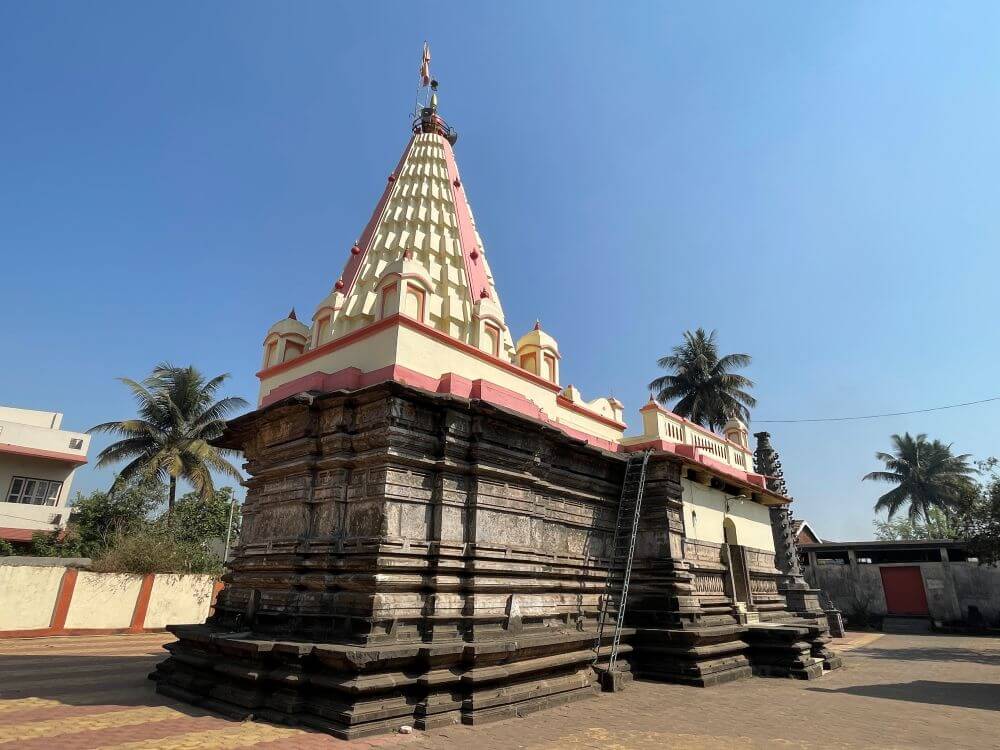
This Mahadeva temple is situated on the banks of the Tulshi river in a large courtyard. The temple is built in the Hemadpanti architectural style and faces east. The structure of the temple consists of a Sabhamandapa (assembly hall), Antarala (vestibule), and Garbhagriha (sanctum sanctorum). The upper half of the walls of the Sabhamandapa, the roof above it, and the Shikhara (spire) over the sanctum have been reconstructed in recent times using cement concrete. However, the stone structure beneath it bears witness to its antiquity. The temple stands on a total of १८ large stone pillars.
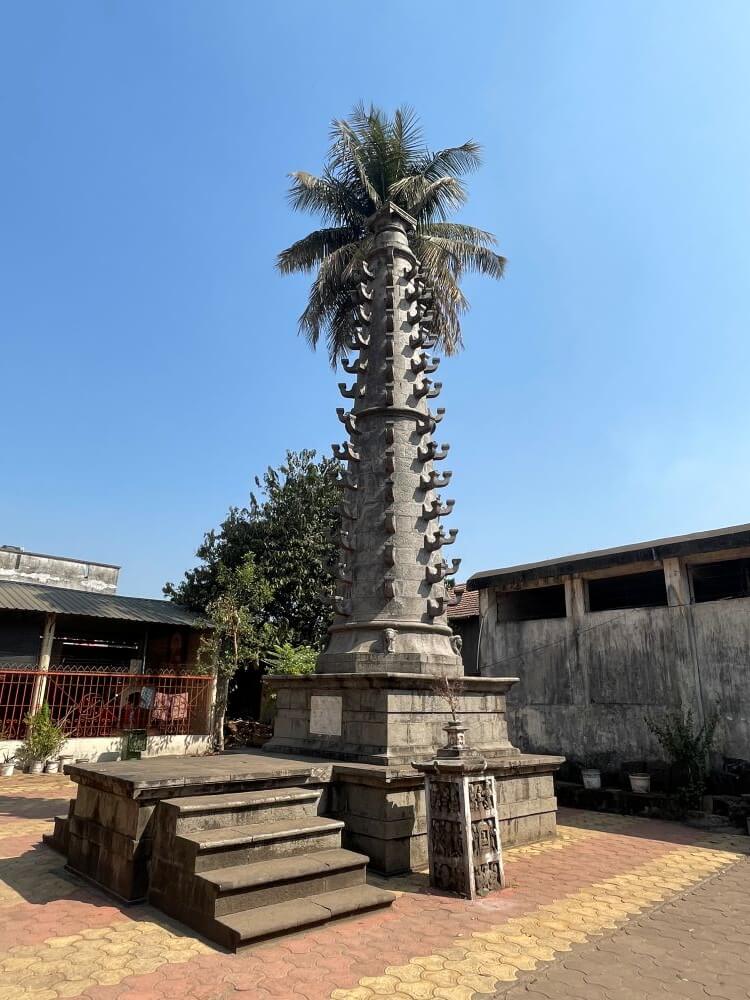
The temple courtyard is paved with paver blocks throughout. At some distance in front of the temple, there is a grand and tall stone platform. Upon it stands a tall stone Deepmala (lamp tower). This Deepmala was built in the १९th century by a person from the Gadve family of the Lingayat community in the village. Usually, there is a tradition of erecting a Deepmala or lamp pillar in front of the entrance of the Sabhamandapa. Here, however, this lamp tower is located to the south of the entrance. The reason for this is the Kiranotsav (sunbeam festival) that occurs in this temple. Similar to the Mahalakshmi-Ambabai temple in Kolhapur, a Kiranotsav takes place here every year from the २nd to the १०th of April and from the १७th to the २३rd of September. To ensure no obstruction, this lamp tower was built away from the entrance.
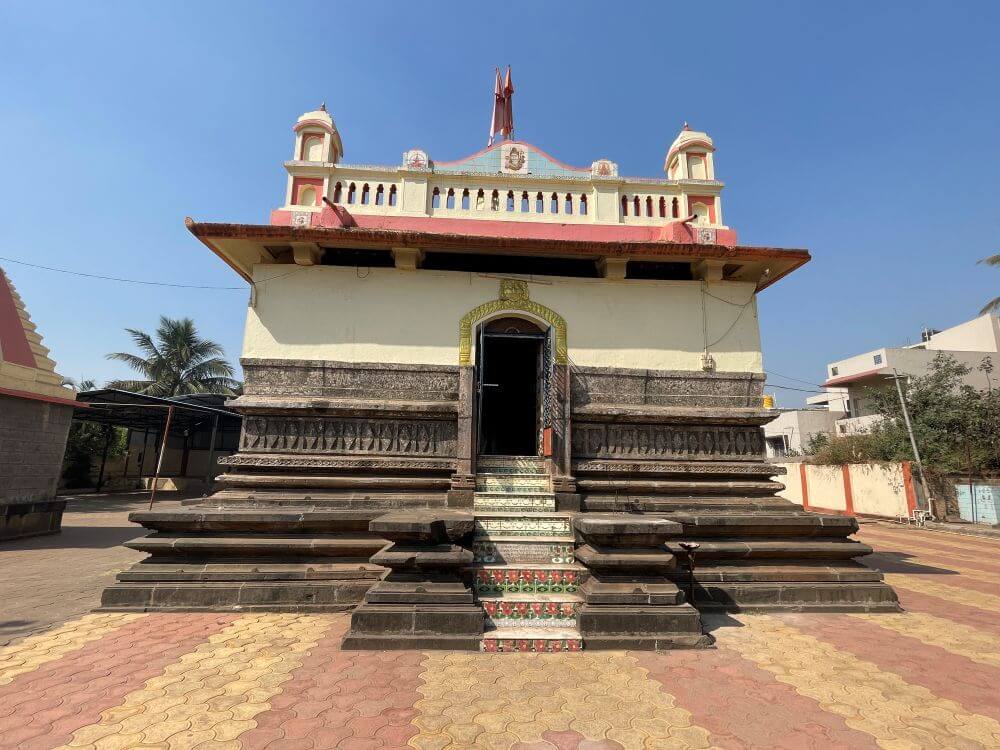
This temple is built on a high Jagati (plinth). One has to climb eight steps to enter the Sabhamandapa. The outer walls of the assembly hall feature intricate stone carvings. The entrance to the Sabhamandapa is half-old and half-new, with a Kirtimukha in its upper section. The Sabhamandapa contains large carved pillars. These pillars are designed with a square base, followed by an octagonal section, a square section in the middle, a circular section, and a disc-shaped top. On the left and right sides of the Sabhamandapa, near the walls and adjacent to the pillars, are two ancient Ganesha idols. The Sabhamandapa has two entrances, one on the left and one on the right. Marble tiles have been laid on the floor.
One must enter the Antarala through two pillars. Directly in front lies a tortoise idol. Inside the Antarala, on a stone platform, is a Nandi carved in stone with brass horns and ears. Here, in a niche, is a stone idol of Ganesha. As this idol is worn, its shape appears indistinct. In another niche here, two female figures are visible. One of the women is holding a sword and appears to be stabbing the other. On the stone slab above these figures, women are seen worshipping a Shiva Linga. From this, it seems that this sculpture might be part of a hero stone.
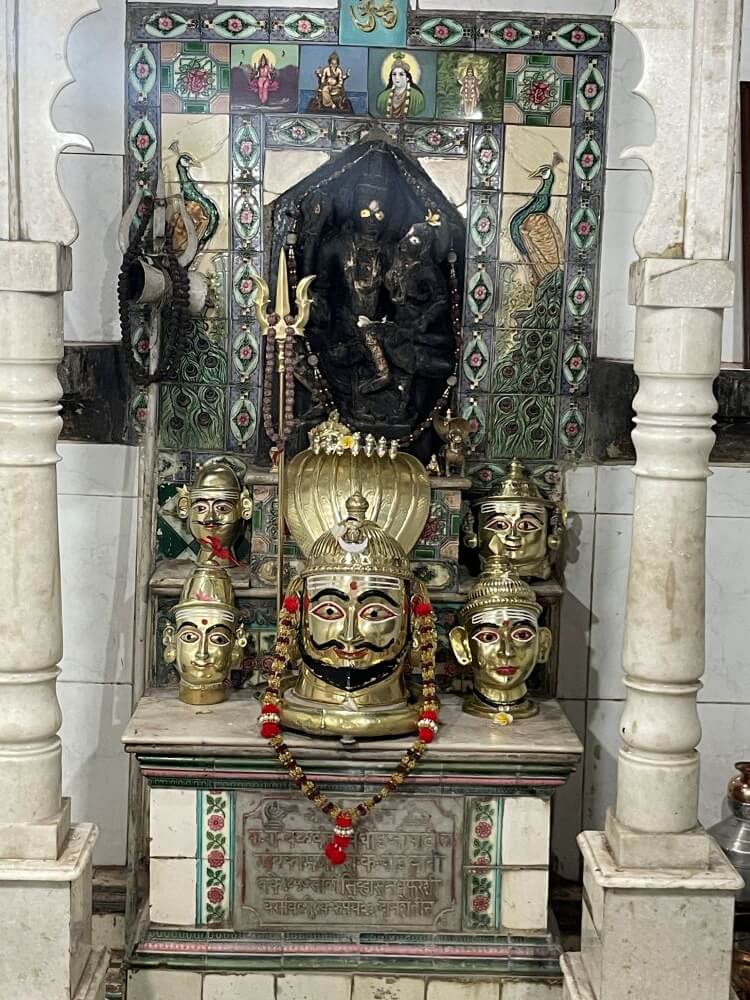
The doorway of the temple’s sanctum is adorned with carved pillars and a Torana (arch). At the center of the lintel of the door is an idol of Ganesha. Inside, marble tiles have been installed on the walls and floor, which has obscured the antiquity of the original sanctum. A marble shrine has been erected in the center of the sanctum. The large Linga of Beedeshwar Mahadeva is enshrined within it. The Shalunka (base) of this Linga is covered with a silver-embossed sheet, and in the center is the stone Linga. Behind this shrine, in a niche on the wall, is an idol of Shankara-Parvati carved in black stone. Here, Parvati is seated on the lap of Shankara. On the platform below, there are five brass masks of Mahadeva and other deities.
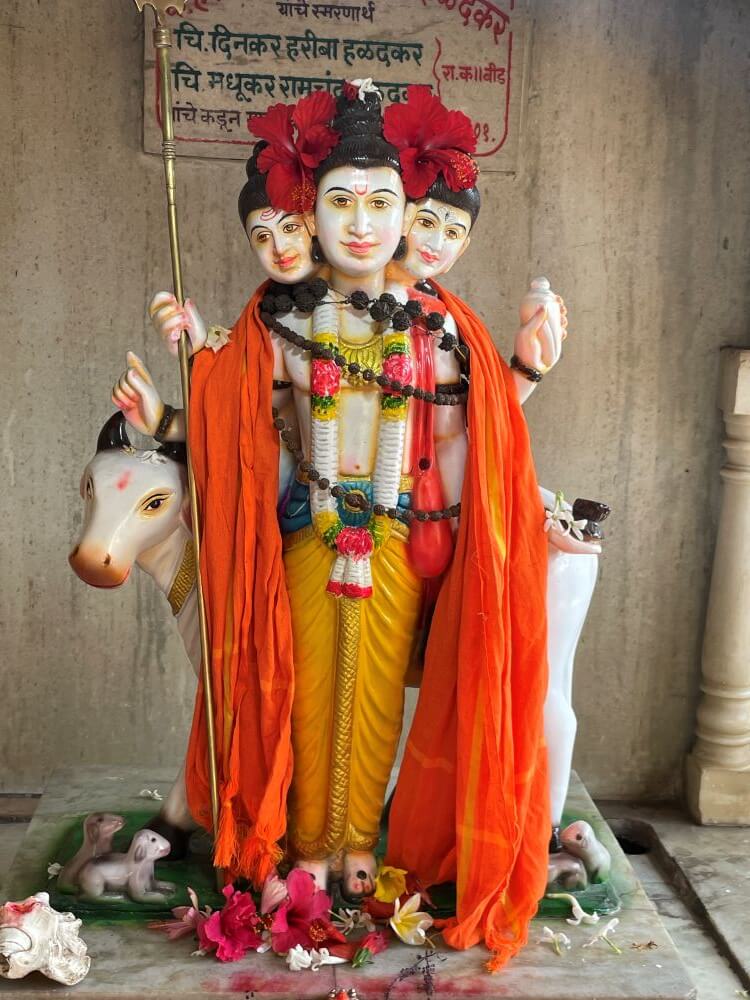
Festivals like Mahashivratri, Vijayadashami, and Datta Jayanti are celebrated with great enthusiasm in this temple. Thousands of devotees participate in them. During the period of Mahashivratri, programs such as the Dnyaneshwari Parayan, Akhand Harinam Saptah, and Mahaprasad are held here. On this day, as well as on Dussehra, the palanquin of the deity is taken in a procession to the sacred confluence of the Bhogavati and Tulshi rivers. Every Monday, and especially on Shravani Mondays, there is a large crowd of devotees for Darshan.
Just like this Shilahara-era Mahadeva temple, the village of Kasaba Beed is also famous for the gold coins and ornaments that are unexpectedly found here. This village is called the ancient Suvarnabhumi (land of gold). It is said that many people have unexpectedly found gold coins or ornaments in their fields, courtyards, or under the tiles of old houses. The size of these coins is equivalent to a split chickpea. Symbols such as the Trishula, Omkara, Belpatra, and Shivling are found on them. Some coins feature animals like snakes, horses, and elephants, as well as birds and various weapons. Kannada characters are inscribed on them. The Garuda-mudra is found on some coins, which was the royal seal of the Shilaharas. Ornaments include nose rings, earrings, and necklaces. Similarly, items such as a gold idol of Ganapati and a snake idol have also been found in the village. According to historians, these coins might have been scattered during a ceremony during the Shilahara or subsequent Yadava period, or they may have been scattered along with ornaments when the village suffered damage during a war. Over time, they were buried in the ground. They are still found today while performing agricultural work. Along with this, another specialty of this village is the large number of Sati-shilas (memorial stones for widows) and Viragals (hero stones) found here.
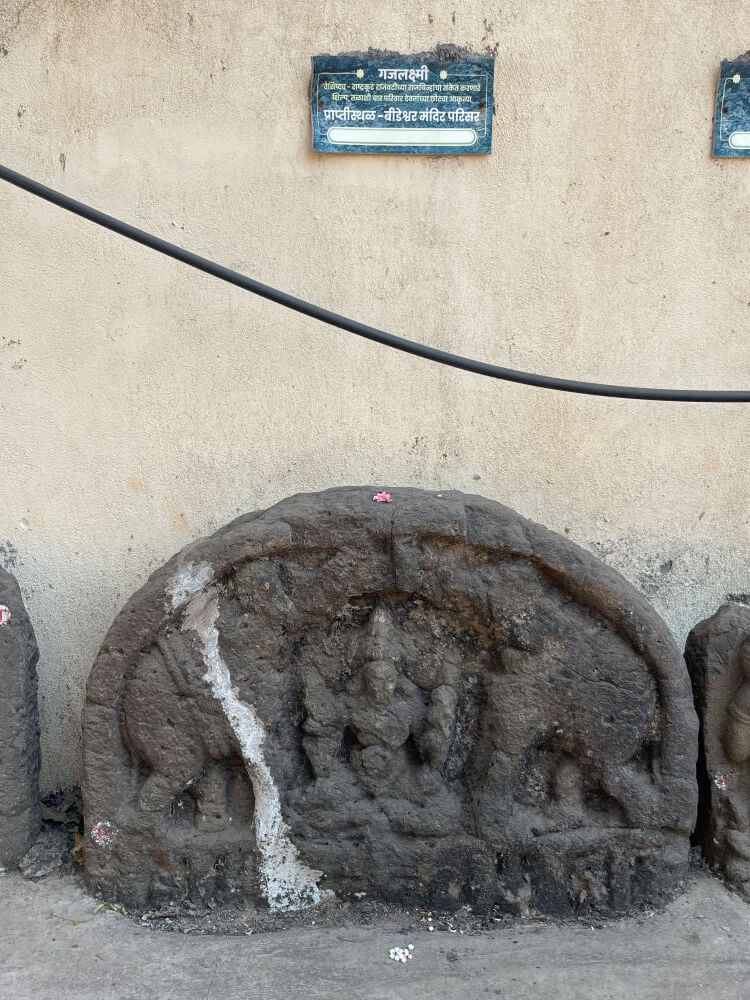
Due to the collective efforts of some history-loving youths in this village, a Viragal museum was established in the premises of the Mahadev temple in 2020. Viragals and Sati-shilas that were lying scattered in the village area and fields have been systematically arranged here. These include hero stones depicting battles, protection of cattle, and tiger hunts. Many of these Viragals and Sati-shilas are in excellent condition. Notably, in some Viragals, women are seen fighting in battles. Apart from this, it also includes some broken idols of deities such as Gajalakshmi, Bhairava, and Vishnu. Through these sculptures, light is shed on the history of Kasba Beed and Kolhapur, as well as the contemporary attire, hairstyles, and weapons of that era. Many scholars visit this place to see this museum.
This sacred temple stands as a testament to deep spiritual devotion, ancient architectural grandeur, and rich local cultural traditions.
The sanctum sanctorum houses the divine idol consecrated according to ancient Vedic traditions, surrounded by serene courtyards and traditional temple architecture.
Navratri, Maha Shivratri, Annual Temple Jatra & Deepotsav
Compare and book flights, secure top-rated local hotels near the temple, hire reliable guides, and rent cars instantly.
Extend your pilgrimage by visiting other highly sacred temples located nearby.


Add ₹999 more to unlock FREE SHIPPING!
Your sacred cart is currently empty.
Shop Photo FramesFill in your delivery details below to place your order.
Add comment