
Add ₹999 more to unlock FREE SHIPPING!
Your sacred cart is currently empty.
Shop Photo FramesThe city of Karveer in Kolhapur is known as Dakshin Kashi (the Kashi of the South). The village of Vadanage, situated in this same Karveer taluka, lies on the banks of the Panchganga River. It is said that in the past, this village had an abundance of Banyan trees (Vad), which is how it derived the name Vadanage. There are many Shiva temples located throughout the Karveer region; however, the unique feature of Vadanage village is that it houses separate temples for Lord Shankar and Goddess Parvati. A separate temple dedicated to Parvati is rarely found elsewhere. It is for this reason that this temple is renowned as Karveer Kashi. This temple is mentioned in the 32nd chapter of the scripture ‘Karveer Mahatmya’.
A local legend regarding this temple states that upon hearing of the glory of Karveer city, Shankar and Parvati left Kashi to visit Goddess Mahalakshmi. They intended to reach there before dawn. During their journey, Shankar’s Nandi reached Rankala Lake, Shankar reached near a lake in Vadanage village, and Parvati reached slightly before him. Just then, a rooster crowed, signaling the dawn; consequently, Shankar became established there in the form of a Swayambhu Shivling, and Parvati became established in the form of a Tandala (aniconic stone). Thus, while the temples of Shankar and Parvati are in different locations in Vadanage, the temple of Nandi is located near Rankala Lake in Kolhapur. Because the sites of Shankar and Parvati were determined by the crowing of the rooster, a statue of a rooster is installed on a platform in the village.
The glory of Vadanage is described in the Marathi scripture ‘Karveer Mahatmya’, composed between the years 1821 and 1837 AD, after the end of the Peshwa era, by Dajiba Joshirao of the renowned Joshirao family of Kolhapur, who were famous as scholars, poets, and astrologers. In it, he refers to this region as Uma-Tryambakeshwar and states that Sage Agastya and his wife Lopamudra visited Vadanage village while circumambulating the Karveer region. Upon arriving here, Lopamudra asked Agastya about the significance of this holy site. Agastya then explained that this region holds the same significance as Tryambakeshwar. Long ago, there was a Brahmin named Dharmasharma who had committed the five great sins. By chance, he once arrived at the Vadanage region. On one Maha Shivratri, he accidentally observed a fast and also worshipped Mahadeva by offering Bel leaves. Through this, he was liberated from all his sins, and Mahadeva took him to Kailasa in a Pushpak Vimana.
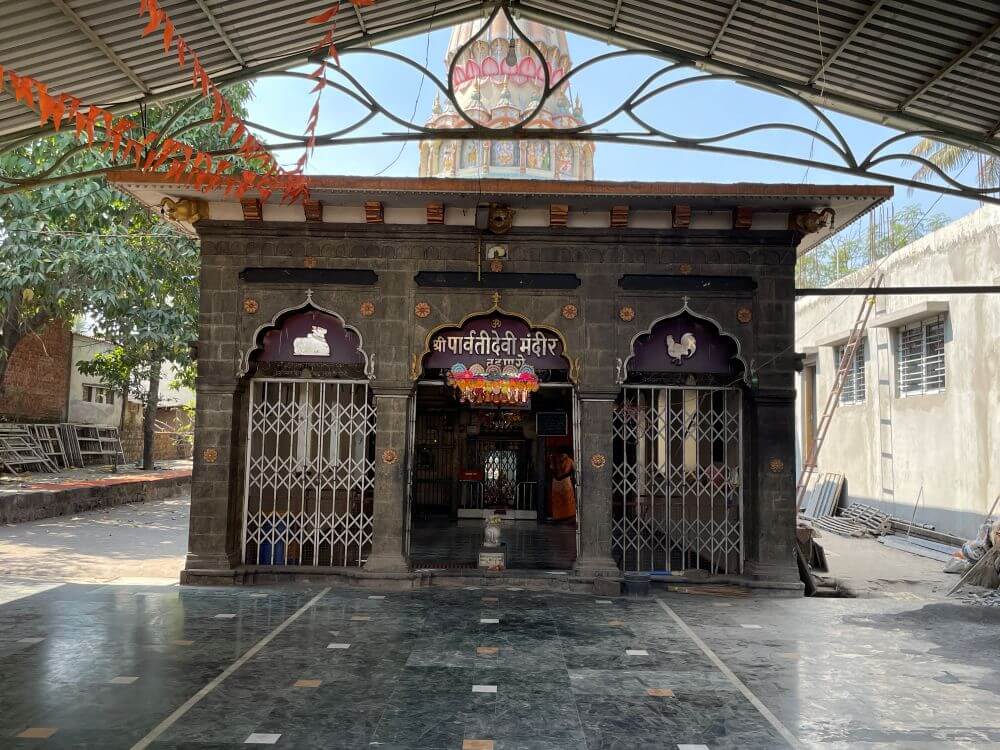
The temple of Goddess Parvati is situated in the main square of this village, which possesses such great significance. It is said that the renovation of this temple was carried out by the pious Ahilyabai Holkar. The temple was renovated again in the year 1995. The temple premises feature a large main gate (Mahadwar) constructed using local basalt stone. On either side of this tall, gateway-like structure are two smaller doors; the door on the left is for women, and the door on the right is for men. Beside this main gate stands a tall stone lamp (Samai) created in the year 1732 AD. On its base, it is inscribed: “Created by Dasdadu Kedari Powar, Shake 1654.”
Near the threshold of the main gate, two footprints are carved onto a square stone slab. The threshold features a relief sculpture of a flower resembling a cobra’s hood. From there, inside the courtyard in front of the temple, a large tin shed has been built for the convenience of devotees. The original structure of the Parvati Devi temple consists of a Sabhamandap (assembly hall), Antaral (vestibule), and Garbhagriha (sanctum sanctorum). The Sabhamandap is large and built of stone. It has three large entrance arches at the front, with entry through the middle arch. Directly ahead, there is an elegant marble statue of Nandi and a tortoise.
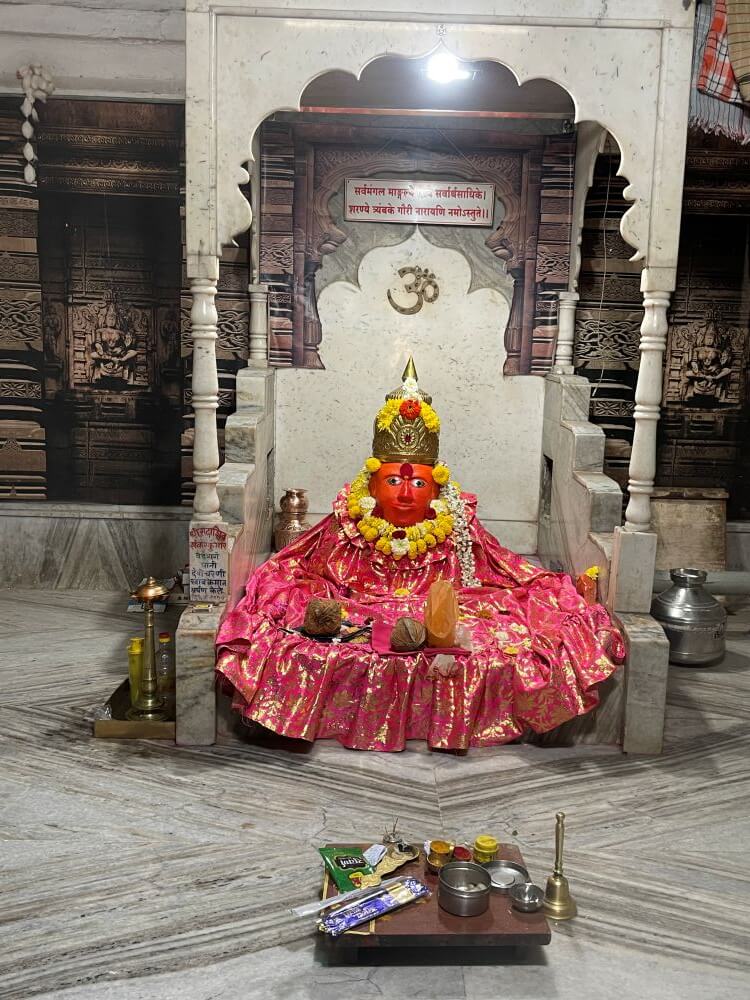
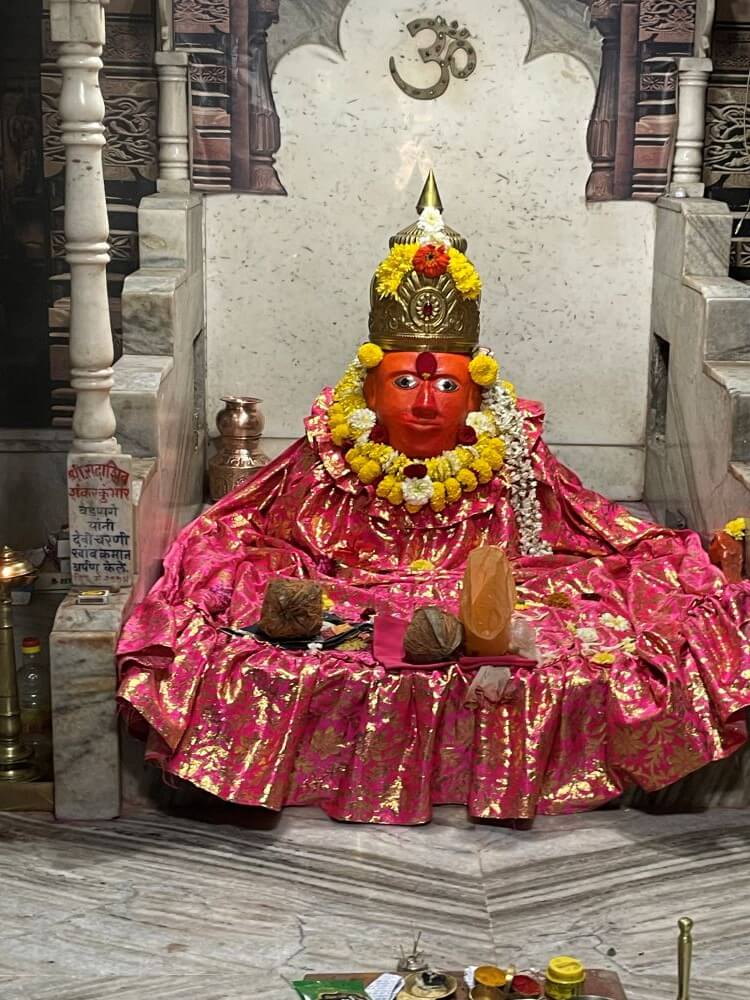
The Antaral of the temple is made of wooden frames fitted with bars. On the outer walls of the Garbhagriha, there are two niches on both sides. The niche on the left contains a marble statue of Ganesha seated on a lotus, while the niche on the right contains a serpent deity made of black stone. The entrance to the Garbhagriha is made of brass. Inside, on a marble pedestal, is the one-and-a-half-foot-tall Tandala of Goddess Parvati, which has been given a divine form. The Goddess wears a large brass crown on her head and is adorned with a sari and blouse. During festivals and celebrations, a procession of the metal processional idol of the Goddess is carried out.
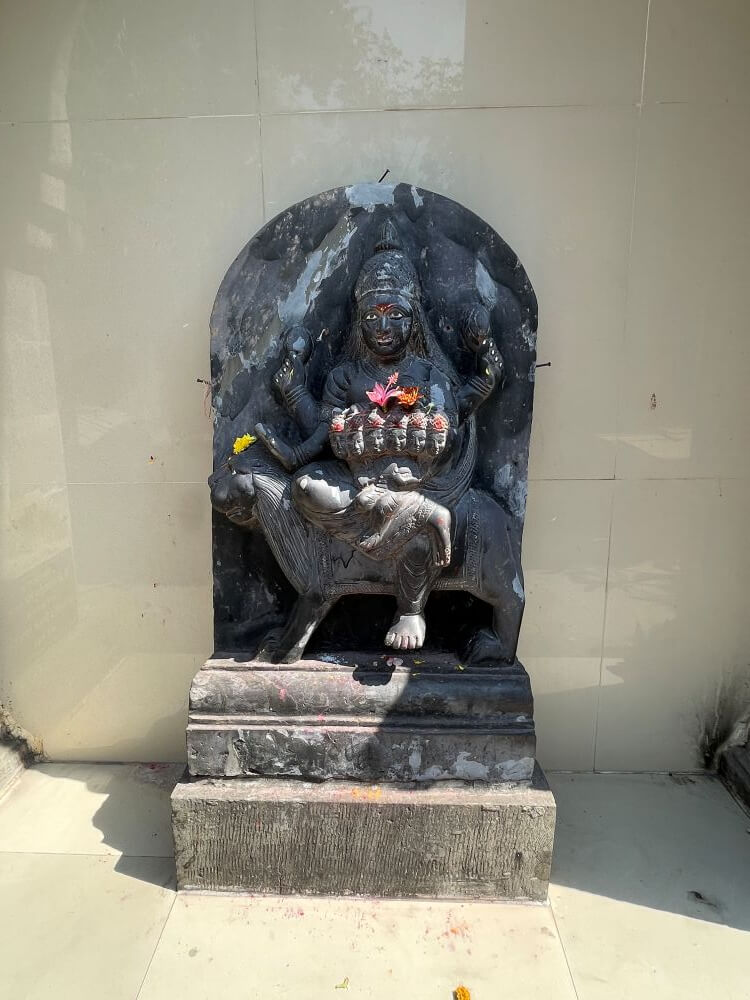
In the niches created in the outer walls of the temple, the nine forms of the Goddess are enshrined. According to the ‘Devi Saptashati’, these forms are Shailaputri, Brahmacharini, Kushmanda, Skandamata, Chandraghanta, Kushmanda, Katyayani, Kaalratri, Mahagauri, and Durgamata. Their black stone statues are installed here. The temple spire (Kalash) is four-tiered, with a square lower section, followed by lotus petal carvings, then the middle section with niches, followed by Nagara-style architecture, and an Amalaka at the top. This beautiful stone temple is a fine example of architecture. Four cloisters (Ovaryas) can be seen built within the temple premises. The tomb of the traditional priest of the Goddess is also located in the courtyard.
Along with daily worship, a grand festival is celebrated in this temple during Navratri. On the day of Maha Shivratri, the palanquin of the Goddess is taken out. A short distance from this temple, near the Tryambakeshwar lake, is the temple of Lord Mahadeva. This temple, which is the village deity, is built of ancient stone. On the day of Maha Shivratri, both temples are decorated with flowers and electric lighting. At 12:00 midnight in the Mahadeva temple, a Maha-Abhishek is performed by village dignitaries and the temple committee. After that, an Abhishek is performed for Parvati. In the afternoon, there is a palanquin procession. It circumambulates the entire village of Vadanage. After reaching the Mahadeva temple, the palanquin returns to the temple of Mother Parvati. Between the Parvati temple and the Mahadeva temple in the village, there is a stone slab on a platform with a statue of a rooster, which is also worshipped on the day of Maha Shivratri.
This sacred temple stands as a testament to deep spiritual devotion, ancient architectural grandeur, and rich local cultural traditions.
The sanctum sanctorum houses the divine idol consecrated according to ancient Vedic traditions, surrounded by serene courtyards and traditional temple architecture.


Navratri, Maha Shivratri, Annual Temple Jatra & Deepotsav
Compare and book flights, secure top-rated local hotels near the temple, hire reliable guides, and rent cars instantly.
Extend your pilgrimage by visiting other highly sacred temples located nearby.


Add ₹999 more to unlock FREE SHIPPING!
Your sacred cart is currently empty.
Shop Photo FramesFill in your delivery details below to place your order.
Add comment