
Add ₹999 more to unlock FREE SHIPPING!
Your sacred cart is currently empty.
Shop Photo FramesThe ancient shrine of Goddess Katyayani is located in the village of Balinge, near the city of Karveer, also known as Kolhapur, which holds religious significance as ‘Dakshin Kashi’. This Goddess is the presiding deity (Gramadevata) of Balinge. She is considered an assistant to Goddess Mahalaxmi-Ambabai of Kolhapur and is also regarded as a helper to Bhairava. According to the ancient tantric text ‘Vidyarnavatantra’, this Goddess is three-eyed (Trinetradhari), much like Lord Shiva. In the Marathi ‘Devi Saptashati’, it is said, “He tava saumya vadana, shobhane trilochan” (O beautiful one with the three eyes, your face is gentle). Devotees believe that Goddess Katyayani is the remover of misfortunes and the fulfiller of all desires, which is why there is always a queue for her darshan.
According to the ‘Devikosha’, the seat of Goddess Katyayani was originally at Udiyan, one of the primary Shakti Peethas along with Kamagiri, Kamakhya, and Jalandhar. However, this Peetha was largely destroyed during the era of foreign rule. There are various legends in mythological texts regarding Goddess Katyayani. Regarding her name, it is said that the sage Kat had a son named Katya. In the lineage of Katya, the great sage Katyayana was born. He was a devotee of Goddess Bhagwati and cherished the desire that the Goddess should be born as his daughter. Honoring his rigorous penance and devotion, Bhagwati was born into his household. That day was Ashvin Krishna Chaturdashi. This is considered the sixth of the nine forms of the Goddess. As the daughter of Sage Katyayana, she came to be known as Goddess Katyayani.
Various legends are also told about her origin. According to one story, Lord Kartikaswami created a woman from his own radiance to annihilate the demon Mahishasura. Since she was created by Kartikaswami, she was named Katyayani. Another story suggests that Brahma, Vishnu, and Shiva combined their respective energies to create this Goddess to destroy Mahishasura. It was this very Goddess whom Sage Katyayana had worshipped with great austerity. It was an auspicious event when the Goddess manifested in this form to slay Mahishasura. Katyayani ended the life of Mahishasura on the day of Vijayadashami, and thus she earned the title of Mahishasuramardini.
The ‘Vidyarnava Tantra’ describes the Goddess as having three eyes, four arms, holding a conch, discus, sword, and trident, and riding a lion. The ancient temple of this Katyayani Devi is located in the village of Balinge. A legend associated with this temple states that Kolhasura had appointed the demons Raktalol in the east, Raktaksha in the west, Raktabhoj in the north, and Raktabeej in the south of the Karveer region. To destroy Raktabeej, Mahalaxmi had engaged Bhairava. Bhairava summoned Goddess Katyayani for his assistance. She slew the demon Raktabeej. The Goddess revived the fallen divine beings (Devaganas) who died in that battle using water from the Amritkund (nectar pond). This pond still exists in front of the temple today.
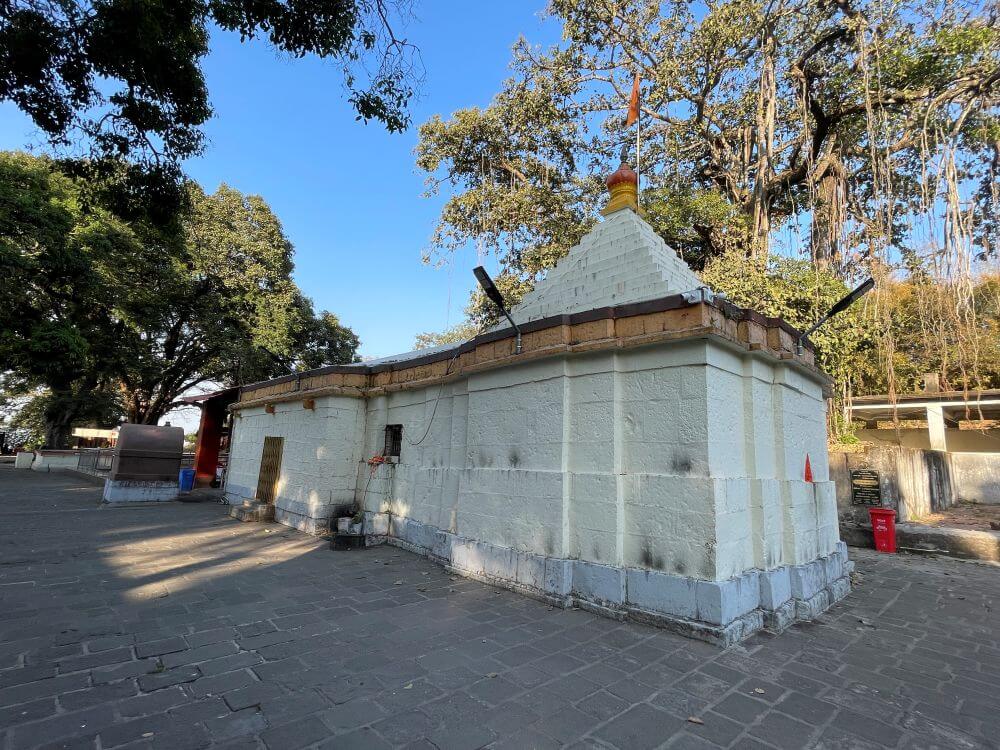
The area surrounding the Katyayani temple in Balinge village is picturesque and nestled amidst old trees. The temple complex has a simple entrance gate. The courtyard is paved with stone. Directly in front stands a lamp pillar (Deepstambha) built of black stone. Opposite it is a square-shaped stone water tank with steps, known as the Amritkund. In a small niche in the wall of this tank, there is a Shiva Linga. Similarly, near the steps, there is a Gomukh (cow-faced spout), and above it is carved an image of a serpent with one hood but two tails. Water flows continuously from there into the tank. There are many turtles in this tank. Near the tank is an old Tulsi Vrindavan.
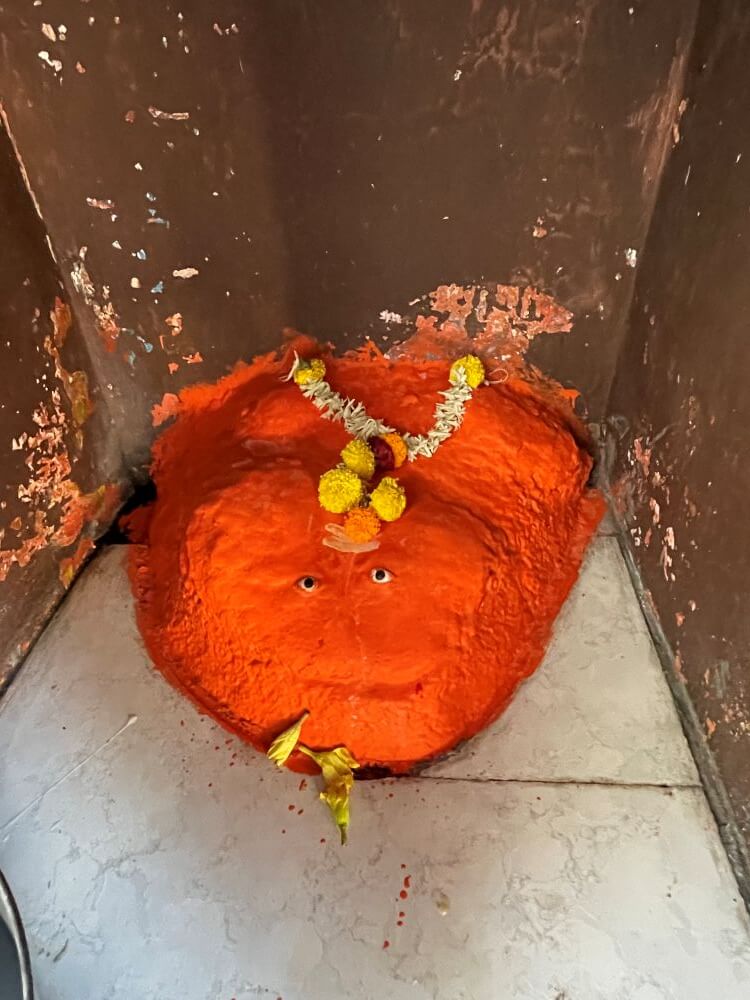
The temple is built of stone and consists of a Mukhamandapa (entrance hall), Sabhamandapa (main hall), and Garbhagriha (sanctum sanctorum). The Sabhamandapa has a sloping roof, and the Garbhagriha is topped by a small pyramid-shaped Shikhara. Near the threshold of the Sabhamandapa entrance, a brass footprint of the Goddess is installed on a small brass pedestal. It is said that this brass footprint was installed by Chhatrapati Rajaram Maharaj. Beneath this pedestal, about a foot or a foot and a half deep, lies a self-manifested (Swayambhu) footprint.
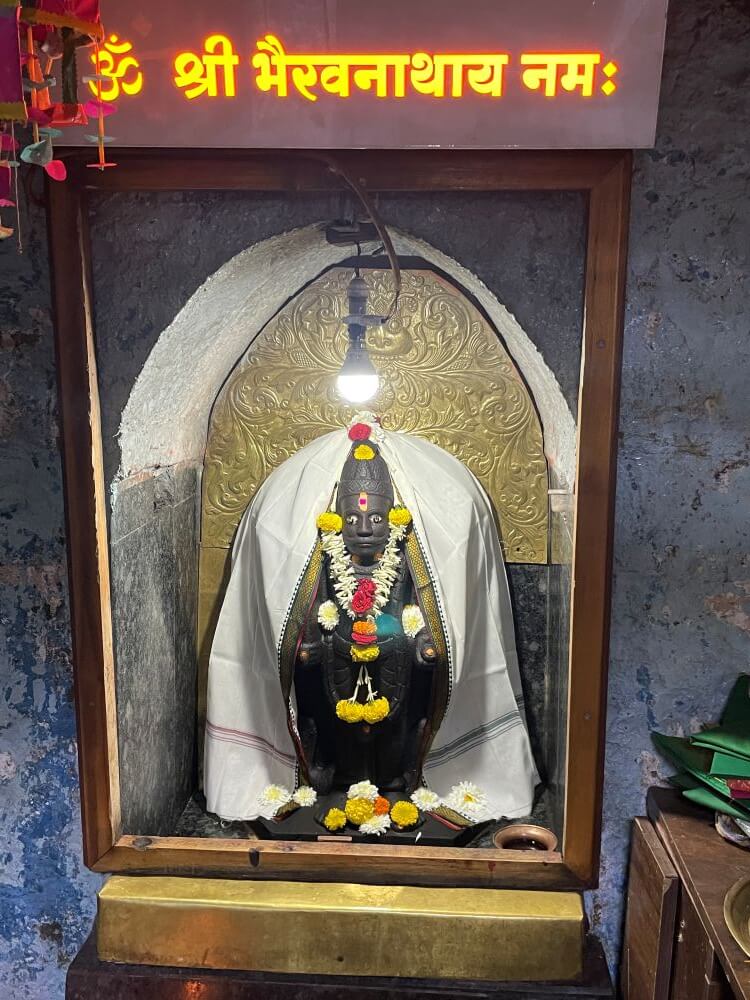
The Sabhamandapa features ancient stone pillars with simple carvings. On the right side of this hall is the shrine of Bhairava. It was to assist this Bhairava that the Goddess came here. It is customary to take darshan of Bhairava before the darshan of the Goddess.
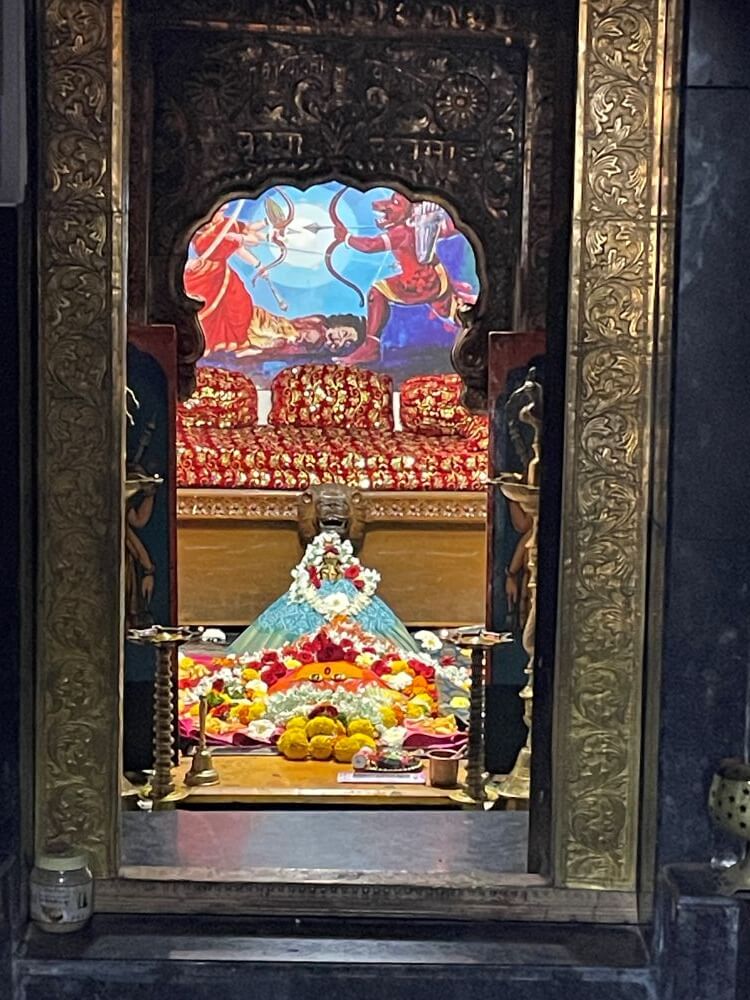
The sanctum of the temple is small. The stone door frame is covered with a golden sheet featuring intricate carvings. In the center of the sanctum is a large altar. On the pedestal sits the Tandala-style (aniconic) idol of Goddess Katyayani. The eyes and sandalwood paste markings appear to be applied from the outside. The Utsavamurti (processional idol) is also kept here at the back.
There is also a pond behind the Katyayani temple. A legend says that Parashurama, to cleanse himself of his sins, bathed in the Amritkund and worshipped Goddess Katyayani and Shri Bhairava. The Goddess then told him to create a pilgrimage site in his own name. Accordingly, Parashurama built a pond behind the temple, which is known today as the Parashurama Kund. This stone-built pilgrimage site is square-shaped, and behind it is a small temple of Goddess Renuka. In the temple premises, stone platforms have been built around some trees for the convenience of devotees to sit. There are also covered corridors (Ovarya) here.
Tuesday is the day dedicated to Katyayani, and there is a large crowd at the temple on this day. The Goddess is offered curd-rice (Dahi-Bhat) as Naivedya daily. A ghee lamp (Nanda-deep) burns continuously near the Goddess. During the nine days of Navratri, the Goddess is beautifully decorated in various ways. During Navratri and on Kartik Amavasya, the ‘Oti’ (offering of auspicious items) is performed for the Goddess. This offering includes a saree, blouse piece, flower garland, coconut, nose ring, and toe rings. Every full moon (Pournima), Tirthaprasad is distributed, and on the new moon (Amavasya), Homa-Havan rituals are conducted at the temple. On Kartik Amavasya, a Bhandara (community feast), Homa-Havan, and Mahaprasad are organized.
This sacred temple stands as a testament to deep spiritual devotion, ancient architectural grandeur, and rich local cultural traditions.
The sanctum sanctorum houses the divine idol consecrated according to ancient Vedic traditions, surrounded by serene courtyards and traditional temple architecture.


Navratri, Maha Shivratri, Annual Temple Jatra & Deepotsav
Compare and book flights, secure top-rated local hotels near the temple, hire reliable guides, and rent cars instantly.
Extend your pilgrimage by visiting other highly sacred temples located nearby.


Add ₹999 more to unlock FREE SHIPPING!
Your sacred cart is currently empty.
Shop Photo FramesFill in your delivery details below to place your order.
Add comment