
Add ₹999 more to unlock FREE SHIPPING!
Your sacred cart is currently empty.
Shop Photo FramesOn a hill in Juchandra, east of Naigaon in Vasai Taluka, stands the ancient and renowned temple of Chandika Devi. Devotees believe that the Devi, situated at an altitude of four hundred feet above sea level on a fish-shaped peak, is a living deity. Here, one can behold the combined darshan of the three Adishaktis: Chandika Devi, Kalika Devi, and Mahishasuramardini. Millions of devotees from all corners of Maharashtra and even from other states come to seek darshan at this Shaktipeeth, which has been accorded ‘C’ grade pilgrimage status. The area becomes bustling with crowds of devotees during the Devi’s Yatrotsav in the month of Chaitra and during the Sharadiya Navratrotsav.
The name Juchandra means ‘moon-shaped island’. In the local language, an island is called ‘Ju’. An anecdote regarding this temple is mentioned in Dr. Deepa Murdeshwar-Katre’s research paper ‘Sand in Our Hands’ in ‘Ruminations – The Adrian Journal of Literature २०१७’. The legend states that during their period of incognito exile, the Pandavas lived in dense forests to prevent the Kauravas from discovering their whereabouts. To reside in these forests, they would excavate caves and consecrate idols of deities in the rocks there, moving on after a few days. During this incognito period, they resided for some days in the forest east of Juchandra village. During this time, they built a temple on the hill and installed Kalika Devi, Chandika Devi, and Mahishasuramardini there. They also dug a small pond in the rocks for the Devis’ ritual baths. This pond can still be seen today.
It is said that initially, people were unaware of this temple located in the dense forest. Many years ago, the Devi appeared in the dream of a devotee living in the village. The Devi told him that Her idols in three forms were in a cave on the mountain east of the village. When the devotee informed the villagers, they began searching for the Devi. During their search, they reached a cave on the hill. There, they found these idols. Subsequently, they formally consecrated these idols.
The historical account of the Chandika temple is that on December २३, १५३४, the Portuguese captured Vasai Fort from Bahadur Shah, the King of Gujarat. This fort was made of mud. The Portuguese then built a stone fort there. Since Vasai Fort was on the coastline, stones for its construction were not available there. At that time, they transported large boulders from Chandika Devi’s mountain by sea from Juchandra port. The labourers working on that project then installed the three deities, Chandika, Kalika, and Mahishasuramardini, in the caves that were formed there. The first renovation of this temple was carried out in १९४८ by ‘Rashtra Seva Dal’, founded by Sane Guruji. The funds for this were raised by Rashtra Seva Dal through a performance of the play ‘Gurudakshina’. In १९५६, a trust board was appointed for the temple. In १९८४, the temple was newly renovated.
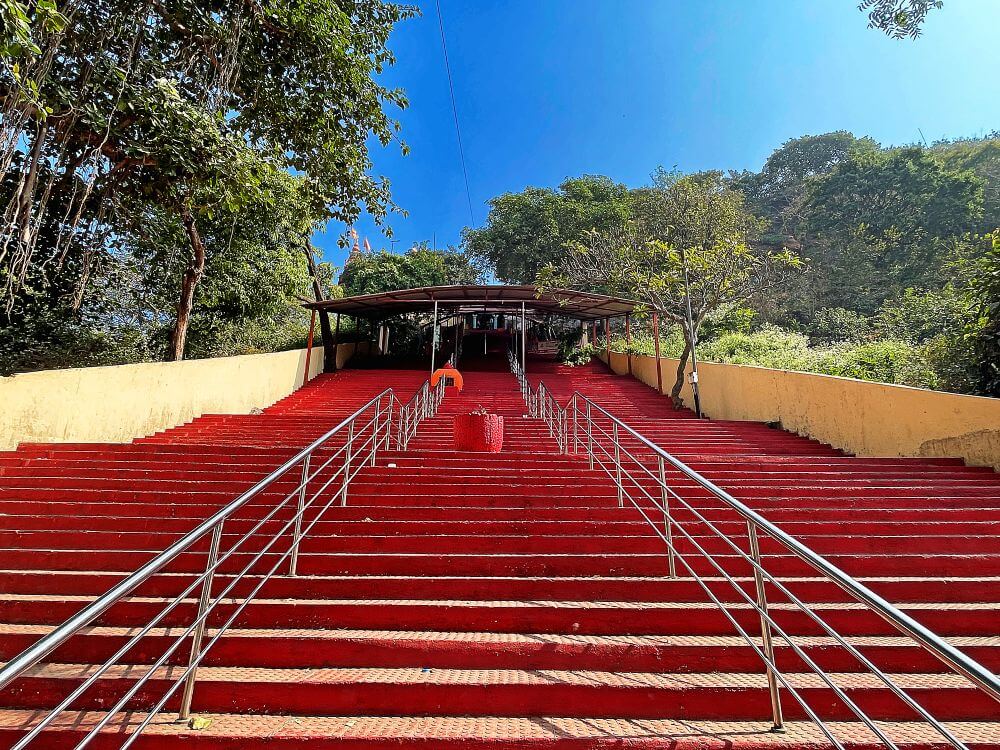
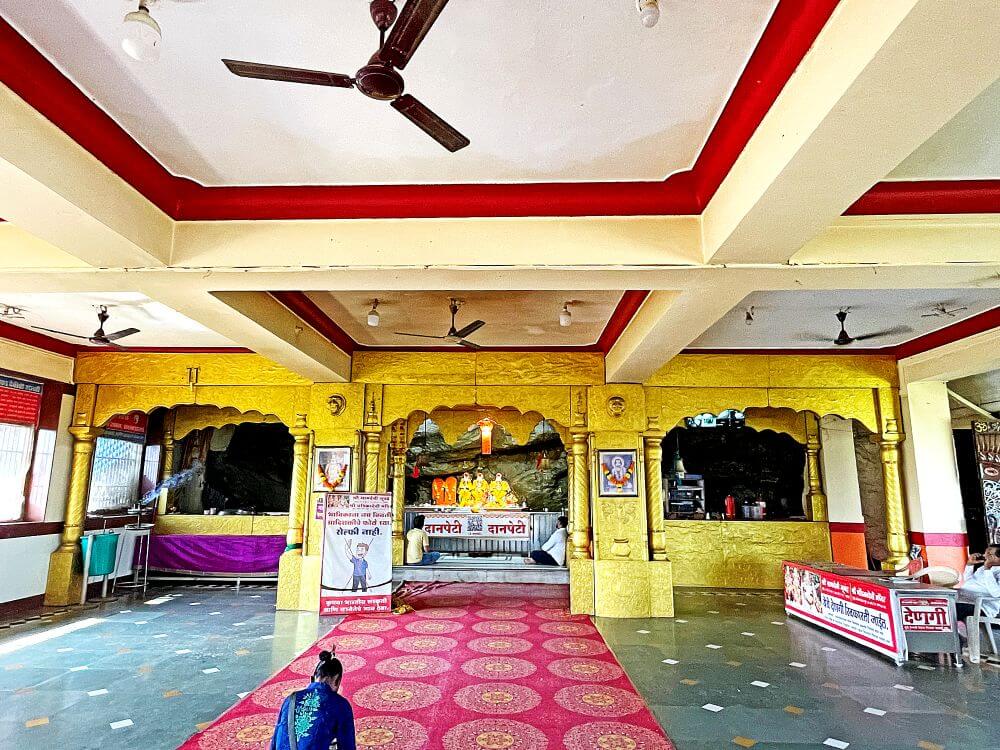
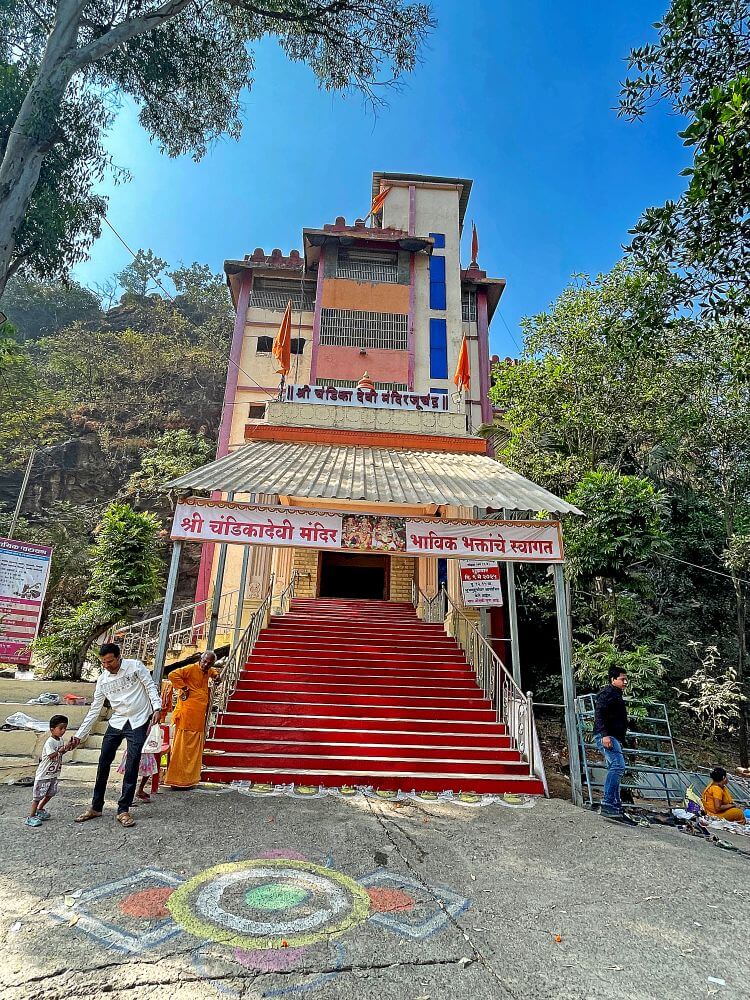
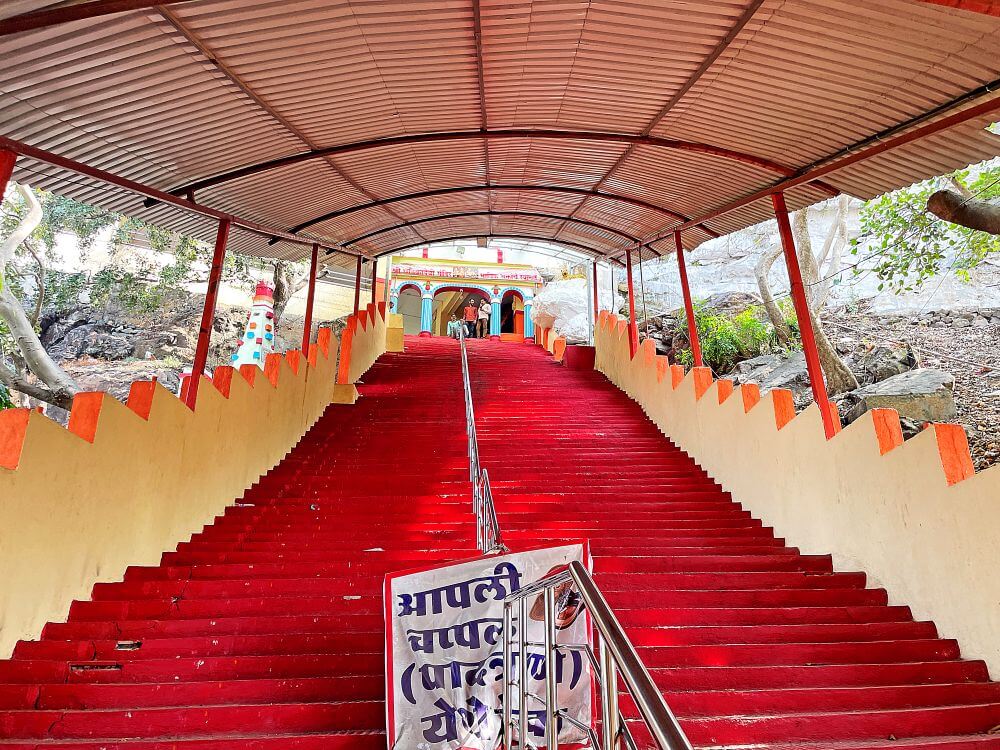
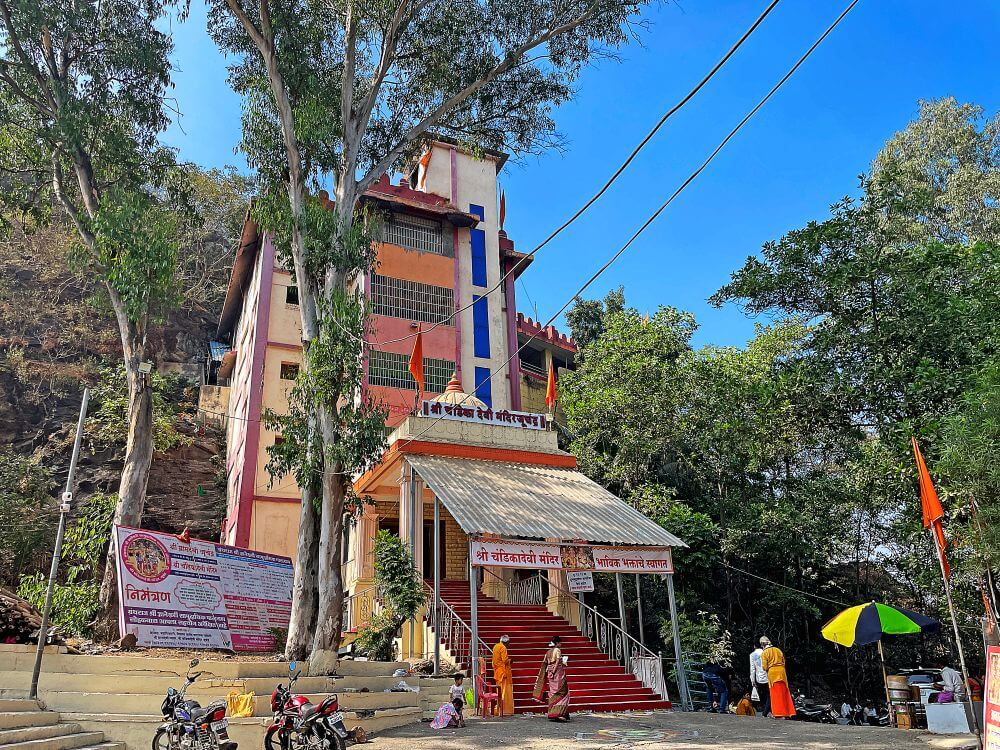
Situated on the hilltop of Juchandra, amidst picturesque surroundings, the temple’s structure resembles one rock face built upon another. In front of the entrance of this four-storey temple stands a large Deepmal (lamp pillar). Nearby is a Prasadalaya run by the temple’s trust board. To reach the temple, one has to climb about २०० steps. One can also reach the main hall of the temple directly by lift. For the convenience of devotees, there is a railing in the middle of the steps and a tin roof above. A short distance from the main entrance of the temple, to the left, is an old stone Deepmal. Near the entrance, on the upper side, are replicas of tigers. There are two entrances to the main hall. A Yagyakund (sacrificial fire pit) is located in the large main hall here.
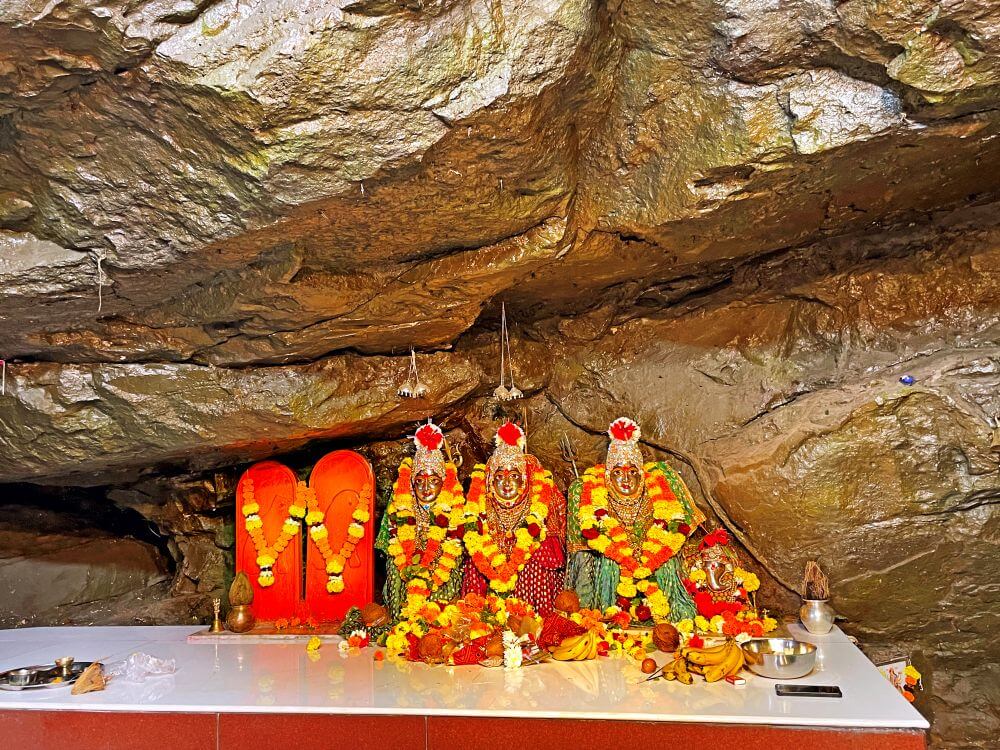
The entrance to the sanctum sanctorum of the temple is adorned with intricate carvings. Inside the sanctum sanctorum, on a platform within the cave, are three idols of the Adishaktis: Chandika Devi, Kalika Devi, and Mahishasuramardini. Beside them is a stone idol of Ganesha. The idols of the Devis wear silver crowns. Near these idols are two vermillion-smeared idols of the tiger-lion, the Devi’s mount. To the left of these idols, on a platform, is a metal sculpture of a lion, the Devi’s mount. Behind the idols, water continuously seeps from a natural spring in the rock face.
Chandika Devi is renowned as a deity who grants wishes and rushes to the aid of devotees in times of crisis. Therefore, many devotees come here for her darshan. Vows are made here for the healing of various physical ailments, for progeny, and other such matters. After the fulfillment of vows, it is customary to offer replicas of eyes, hands, feet, cradles, etc., made of gold, silver, or brass to the Devi, according to the specific vow. Devotees can have darshan at this temple from ६:३० AM to ९:०० PM. Aarti is performed daily at ८:३० AM and ७:०० PM. Tuesday is considered the day of Adishakti. On this day, a community Aarti is held at ७:०० PM. On every Purnima, a Bhandara (community feast) is held at the temple’s Prasadalaya from १०:०० AM to २:०० PM. Every year, a three-day Yatrotsav is held in the month of Chaitra. For this occasion, the temple premises are adorned with attractive lighting. On the first day of the festival, the Devi’s formal Abhishek-Puja is performed. On the second day, the Devi’s Palkhi Sohala (palanquin procession) takes place. On the third day, grand wrestling matches are held. Wrestlers from various parts of the state participate in this competition. During this festival, theatrical performances that promote social awareness are presented. A rangoli exhibition is also organized in the hall of the temple’s Prasadalaya during the festival. Thousands of devotees come for the Devi’s darshan during this festival. During this festival period, special ST bus services are made available by the State Transport Corporation from Thane, Vasai, and Palghar to Juchandra.
During the Sharadiya Navratrotsav, the temple remains open for darshan twenty-four hours a day. On Ashwin Shuddha Pratipada, Ghatasthapana is performed in the temple. Homa-Havan is performed on Navami, and Ghatavisarjan is done on Dussehra. During these nine days, various programs such as Dhuparati, Mahapuja, Bhajan, Kirtan, Haripath, Garba dance, Palkhi Sohala, etc., are held here. During Navratrotsav, devotees from even the Mumbai suburbs come here to play Garba. For devotees coming for darshan, free tea and Prasad arrangements are made by the Gramdevi Chandika Devi Nyas. The Gramdevi Chandika Devi Nyas implements various social activities in the area. In addition, the Nyas also organizes community marriage ceremonies for only १०१ rupees every year.
This sacred temple stands as a testament to deep spiritual devotion, ancient architectural grandeur, and rich local cultural traditions.
The sanctum sanctorum houses the divine idol consecrated according to ancient Vedic traditions, surrounded by serene courtyards and traditional temple architecture.
Navratri, Maha Shivratri, Annual Temple Jatra & Deepotsav
Compare and book flights, secure top-rated local hotels near the temple, hire reliable guides, and rent cars instantly.
Extend your pilgrimage by visiting other highly sacred temples located nearby.


Add ₹999 more to unlock FREE SHIPPING!
Your sacred cart is currently empty.
Shop Photo FramesFill in your delivery details below to place your order.
Add comment