
Add ₹999 more to unlock FREE SHIPPING!
Your sacred cart is currently empty.
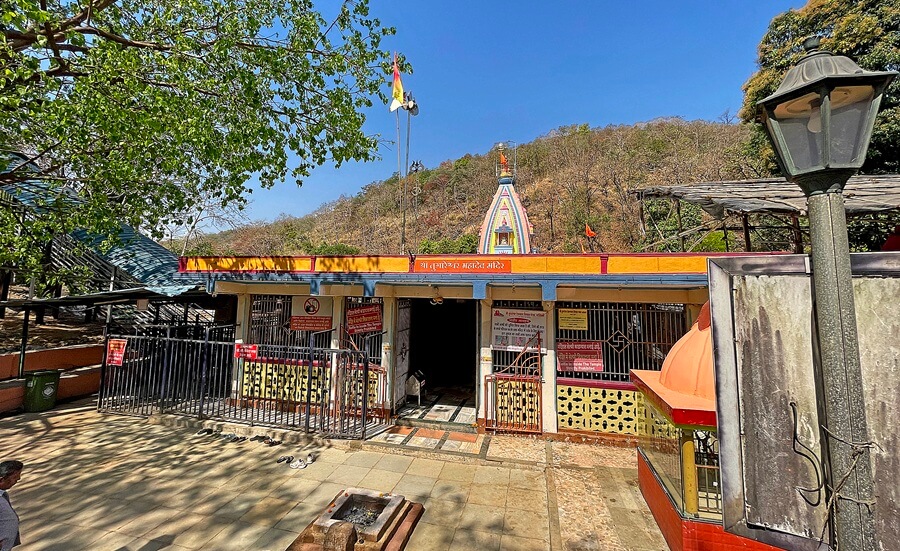
Shop Photo FramesThe ancient temple of Tungareshwar is situated on the Tunga Hill at an altitude of approximately ۲۱۰۰ feet above sea level, within the Tungareshwar Wildlife Sanctuary, an area rich in dense forests and diverse wildlife in Vasai. According to mythological legends, this temple was established by the devotee of Shiva, Vimalasur. Nestled in a picturesque environment, the temple premises also house shrines dedicated to Kalbhairav, Khodiyar Mata, and Jagmata, who is considered a manifestation of Parvati. Every Shravani Monday and on Mahashivratri, lakhs of devotees visit here for darshan. There is also a large influx of tourists during the winter and monsoon seasons.
The story of the temple’s establishment is narrated in the ‘Tungari Mahatmya’ of the Padma Purana. The legend states that in the Treta Yuga, there was a demon named Vimalasur. Brahmins lived in a place called Varalata, whom he used to harass. To put an end to him, Parashurama waged a war against him. Seeing his defeat in that war, Vimalasur fled and hid in the sea. Thereafter, he brought a large mountain on his head, placed it in the sea, and began to live upon it. The name of this mountain was Tunga. Due to his defeat, he repented for his actions and began to worship Shiva here. Pleased with his penance, Shankara granted him the boon of immortality and his divine Linga. Vimalasur installed it on Tunga Hill.
In Sanskrit, the word Tunga means high, tall, or mountain. The word Uttunga is derived from this. Since the hill here is high, it came to be called Tunga or Tungar. From this, the Mahadeva here became known as Tungareshwar. According to records in the fourteenth volume of the ۱۸۸۲ ‘Gazetteer of the Bombay Presidency’, the Tungareshwar temple here was very ancient. Later, the Peshwas overthrew the ۲۱۰-year rule of the Portuguese in Vasai. In that campaign of Vasai, the Peshwa’s commander, Shankaraji Keshav Phadke, displayed great valor. He was later appointed as the Subhedar of Vasai. This Shankaraji Phadke renovated several temples in the Vasai area around the year ۱۷۵۰. This included the Tungareshwar Mahadeva temple. The Peshwas had granted the one-and-a-half kos area surrounding this temple as an inam (gift) to the temple. This inam was maintained even during the British period.
According to the Gazetteer records, during the Peshwa period, this temple was composed of four square-shaped shrines. The largest of these was ۱۰ square feet in size and was built on a two-foot-high platform. Around it was a six-foot-wide veranda. This temple had a dome-shaped roof and a small shikhara (spire) on top. At the entrance of the temple, there were idols of Chaturbhuj Shankar and Ganpati. Behind the Shiva Linga in the temple, there was an idol of Parvati. Behind this temple, in a small shrine, was an idol of Krishna performing Kaliyamardan. In front of the temple was a Nandi Mandap, and there were also the padukas (footprints) of Dattatreya. There was also a temple of Hanuman at this location. In recent times, after the renovation by the ‘Tungareshwar Devasthan Trust Board’, this temple attained its current form.
On the dirt path leading to the temple premises is the ashram of Poonamdas Udasin Maharaj. On the small road leading further from here, there are shops for prasad materials and flowers, as well as restaurants on one side, while there is a garden on the other. It has toys for small children. In the temple premises, there is also the math of Balayogi Sadanand Maharaj.
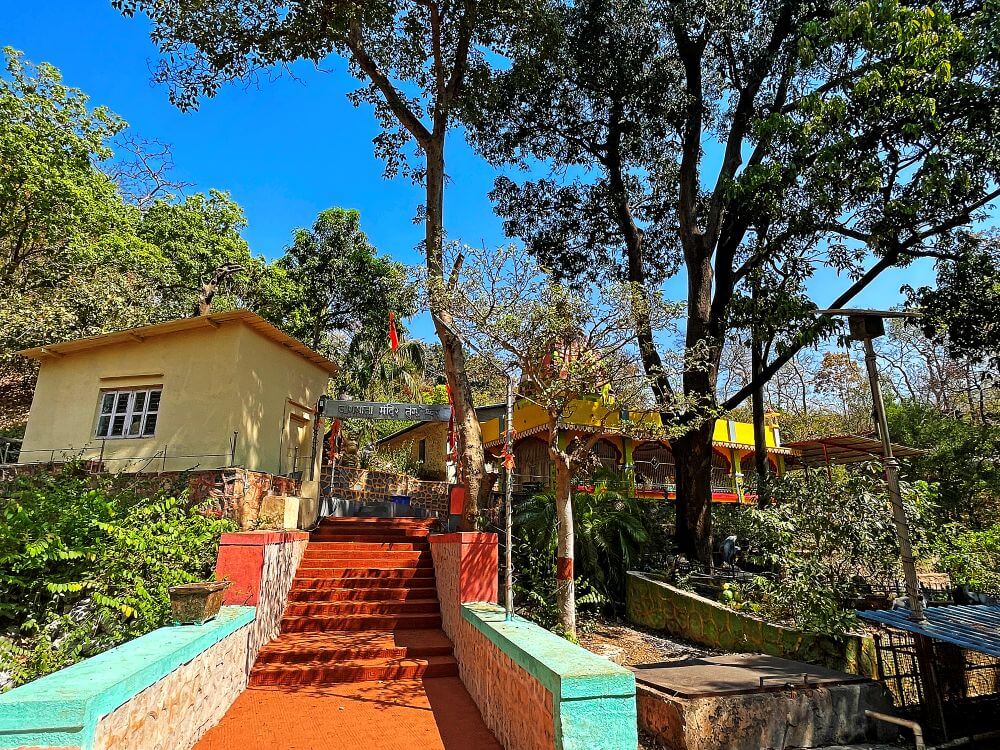
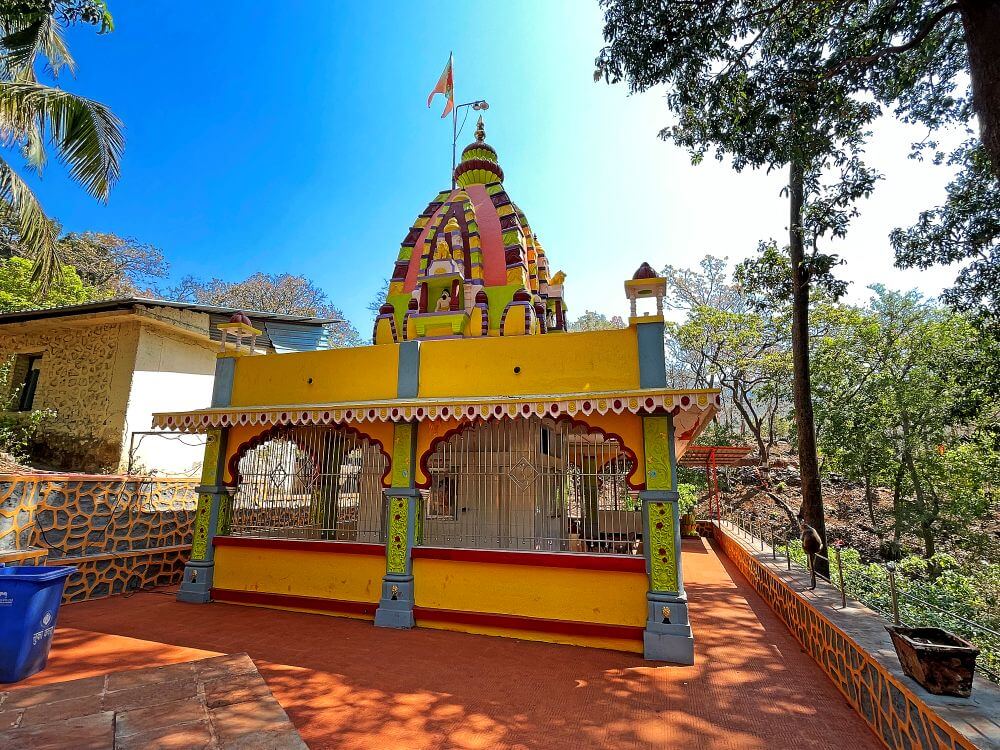
The temple courtyard is situated in a hollow valley on the hill. One enters the courtyard through a welcome arch after descending a few steps. At the lower side of these steps is a circular lamp pillar that tapers towards the top. There are many lamp niches on these pillars. At the top is a petal-shaped kalash. On its right side, at a height, a bust of the senior priest of this temple, Shantaram Hinga, has been installed. In the courtyard, in front of the temple, is a large havan-kund. Beside it, on a square pedestal, is an open dome-shaped structure. This structure is glass-enclosed on all four sides. It contains the padukas. This is the samadhi site of Mahant Nagasatyanarayan Maharaj.
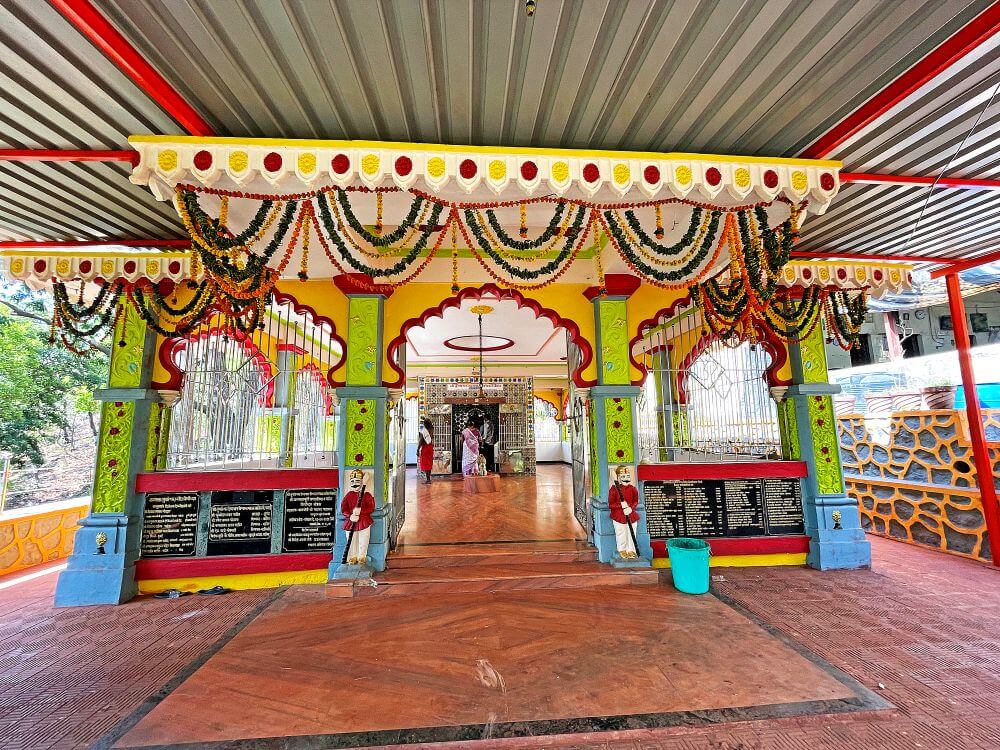
The Tungareshwar Mahadeva temple is of modern construction. Its structure consists of a Sabha Mandap (assembly hall) and a Garbhagriha (sanctum sanctorum). The Sabha Mandap is wide and has a flat roof. There is a newly built shikhara over the Garbhagriha. This shikhara is in the Urushringa style. In the niche on its front side, an idol of Ganesha is seated. On the shikhara, there is a three-tiered amalaka and above it a three-tiered kalash. A tall trident is erected next to the kalash. In the spacious Sabha Mandap, there is an idol of Nandi on a marble pedestal. In front of it are the padukas. On the front wall of the Garbhagriha, to the left of the small entrance in a niche, is an idol of Hanuman, and in the niche to the right is an idol of Vasudeva, both carved in black stone.
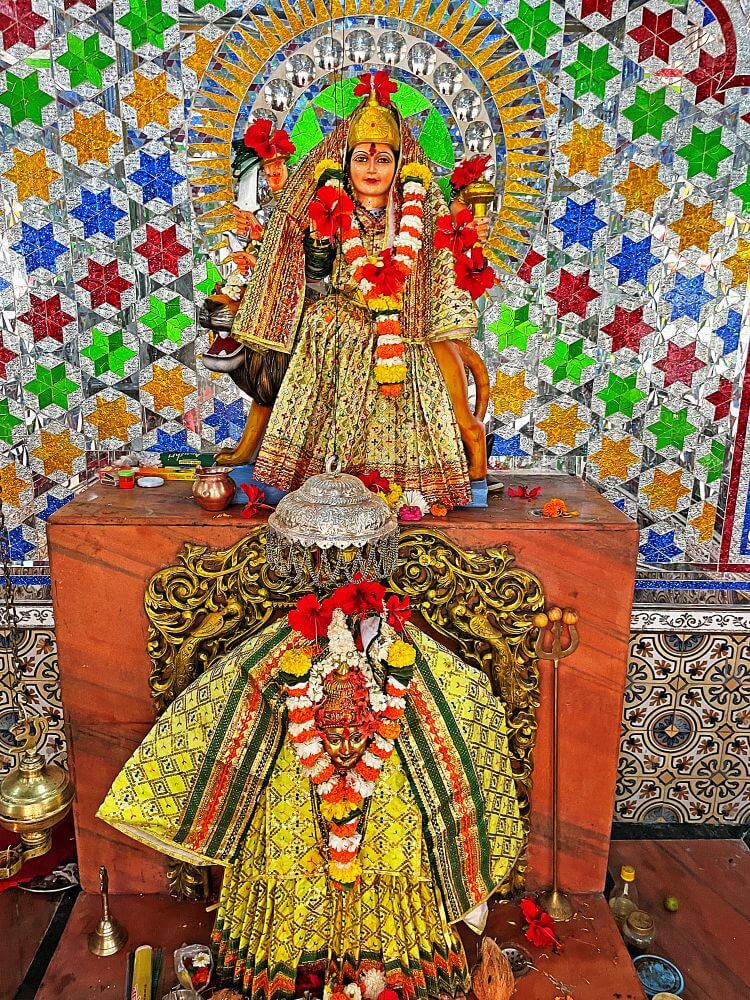
There is glass inlay work on the wall outside the Garbhagriha. The door frame is covered with silver plates featuring intricate carvings. This Garbhagriha is at a lower level than the Sabha Mandap. One enters it by descending a few steps. Inside, in the center, is a large Pindi of Tungareshwar Mahadeva, adorned with silver plates. On this Pindi is an equally magnificent and elegant silver serpent. There is attractive craftsmanship on this silver serpent and the Pindi. There is a door at the back of the Garbhagriha to exit. As soon as one comes out from here, there is a small temple of Kalbhairav on the right side. At some distance to the right of the Tungareshwar temple, there is a temple of Hanuman. From the back of this temple, there is a stepped path to go up the hill. On this path is the temple of Khodiyar Mata. After climbing a few more steps from here, one reaches the temple of Jagmata. Near this temple, some ancient carved idols are arranged on a pedestal.
Every Monday, there is a large crowd of devotees at the Tungareshwar temple. A massive surge of devotees gathers here on Shravani Mondays and Mahashivratri. Due to the natural beauty of this place, there is also a constant flow of tourists. This 85 square kilometer area, which includes Sativli in Vasai taluka and various tribal hamlets, is a dense forest that was declared a wildlife sanctuary in 2003. About 250 species of birds including the Crested Serpent Eagle, Racket-tailed Drongo, Spotted Owlet, Asian Paradise Flycatcher, and Indian Golden Oriole, about 150 species of butterflies, as well as various types of plants are found here. Wild animals such as tigers, leopards, wild boars, hares, barking deer, and langurs are also found here. The ancient temple of Tungareshwar Mahadev is situated on the hill here. The government has declared this place a tourist destination. The state government declared the Tungareshwar Mahadev temple a ‘C’ category tourist site in the year 2001.
This sacred temple stands as a testament to deep spiritual devotion, ancient architectural grandeur, and rich local cultural traditions.
The sanctum sanctorum houses the divine idol consecrated according to ancient Vedic traditions, surrounded by serene courtyards and traditional temple architecture.
Navratri, Maha Shivratri, Annual Temple Jatra & Deepotsav
Compare and book flights, secure top-rated local hotels near the temple, hire reliable guides, and rent cars instantly.
Extend your pilgrimage by visiting other highly sacred temples located nearby.


Add ₹999 more to unlock FREE SHIPPING!
Your sacred cart is currently empty.
Shop Photo FramesFill in your delivery details below to place your order.
Add comment