
Add ₹999 more to unlock FREE SHIPPING!
Your sacred cart is currently empty.
Shop Photo FramesChaitanya Mahaprabhu was a transcendental Vaishnava saint from Bengal who established the glory of the Holy Name, teaching that devotion to the Lord is superior to mere intellectual knowledge and that the Supreme Lord can be attained through the path of devotion, which is simple and accessible to all. Following the Gaudiya Vaishnava philosophy taught by him, the International Society for Krishna Consciousness (ISKCON), an organization that promotes and spreads Krishna consciousness worldwide, has constructed beautiful and magnificent Krishna temples in many places across the globe. These temples perform the vital task of taking the philosophy of the Shrimad Bhagavad Gita and Vedic dharma to the common people. The Radha Giridhari Temple in Mira Road is one such temple.
A. C. Bhaktivedanta Swami Prabhupada is the founder of ISKCON. He is also known as Srila Prabhupada. The Swami was born on September 1, 1896, in Kolkata. His original name was Abhay Charan De. His father, Gour Mohan De, and mother, Rajani, were religiously inclined. From childhood, they instilled the values of Krishna devotion in the Swami. He received his education at the Scottish Church College in Kolkata, where he mastered English, Sanskrit, and various other subjects. In 1922, Prabhupada met Bhaktisiddhanta Saraswati Thakur, a great saint of the Sri Gaudiya Vaishnava tradition.
In 1933, Prabhupada received formal initiation from Bhaktisiddhanta Saraswati and became a preacher of the Vaishnava tradition. For some time, he ran a pharmaceutical business to support his family; however, after 1950, he retired from worldly life and dedicated himself full-time to Krishna devotion and spiritual preaching. In 1959, he accepted the order of Sannyasa. In this ashram, he adopted the name A. C. Bhaktivedanta Swami.
It was the desire of his guru, Bhaktisiddhanta Saraswati, that Swami Prabhupada should take the teachings of Lord Krishna to the English language and spread these lessons in the Western world. Accordingly, Swami Prabhupada wrote the commentary book ‘Bhagavad Gita As It Is’. He also translated the Shrimad Bhagavatam and other Vaishnava scriptures. In 1965, at the age of 69, overcoming many difficulties and two heart attacks during his journey, Swami Prabhupada went to America. Under his vision, ISKCON was established in New York in 1966. Prabhupada founded this organization with the primary objective of spreading the Bhagavad Gita and Vaishnava philosophy throughout the world. He taught people the ‘Hare Krishna Maha Mantra’ and started a devotional movement based on it. Swami Prabhupada wrote over 70 books, including commentaries on the Bhagavad Gita and Shrimad Bhagavatam, and the major work Chaitanya Charitamrita. He left his body on November 14, 1977, at the Krishna Balaram Temple in Vrindavan. However, the legacy of his work continues today through ISKCON.
Today, more than 850 ISKCON temples are located in over 100 countries around the world. Similar to the famous ISKCON temple in Juhu in the Greater Mumbai area, there are temples in Girgaon, Balkum in Thane, Kharghar in Navi Mumbai, Charkop, as well as the Radha Giridhari Temple in Mira-Bhayandar. There is a significant reason why only Krishna is worshipped here. In the ninth chapter of the ‘Shrimad Bhagavad Gita’, titled ‘Raja Vidya Raja Guhyayoga’, Lord Krishna has stated that the worship of other demigods is born of ignorance. This verse is as follows – ‘Ye-apyanya-devata bhakta yajante shraddhayanvitah. Te-api mamev kaunteya yajantyavidhipurvakam..23..’ This means, ‘O son of Kunti, those who worship other gods and goddesses with faith and devotion are actually worshipping Me alone; however, their worship is done in an improper way. It is different from the procedure for attaining Me and is flawed.’ Further in the same chapter, it is said, ‘Yanti deva-vrata devan pitrin yanti pitri-vratah. Bhutani yanti bhutejya yanti mad-yajino-api mam..25..’ This means, ‘Those who worship the demigods will take birth among the demigods; those who worship the ancestors go to the ancestors; those who worship spirits and ghosts will take birth among such beings; and those who worship Me (Krishna) will attain Me.’ According to this teaching of the Gita, Radha Giridhari is worshipped in this temple at Mira Road.
The ISKCON temple here was previously located in Bhayandar. It was established at its current location in Mira Road on the auspicious occasion of Ram Navami in 1996. Since then, a large number of devotees have been visiting this place. The temple was renovated in 2015. On September 26 and 27 of that year, the installation ceremony of the Krishna deity was performed with great grandeur. Thousands of devotees, including state ministers and public representatives, participated in this ceremony, which was held in a festive and religious atmosphere.
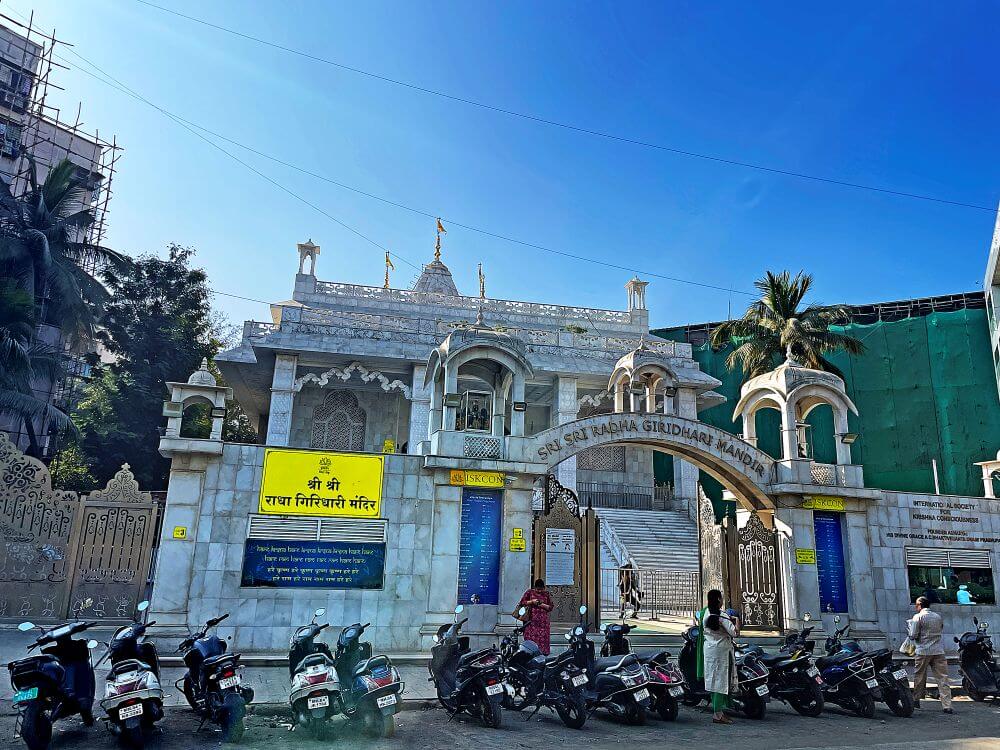
This temple, which is a beautiful blend of modern construction techniques and spiritual principles, is built entirely of marble. The high-quality marble from Makrana in the Nagaur district of Rajasthan, which has been used for the Taj Mahal in Agra, the Krishna temple in Mathura, the Ram temple in Ayodhya, the Vaishno Devi temple, as well as Akshardham and other ISKCON temples, has been used for this structure.
Situated in a spacious courtyard, the temple has a high perimeter wall. The entrance arch of the temple is adorned with Rajasthani-Gurjar style chhatris (domed pavilions). In front is the grand and beautiful two-storied building of the temple. The temple structure consists of a Mukh-mandapa (entrance hall), Sabha-mandapa (assembly hall), and Garbhagriha (sanctum sanctorum). The main temple is on the second floor. There is a wide staircase on both sides of the Mukh-mandapa to go upstairs. The railings of the staircase are decorated with peacock sculptures, and the square pillars of the Mukh-mandapa as well as the ceiling have intricate carvings. Between these pillars are Makara-toranas (arched gateways).
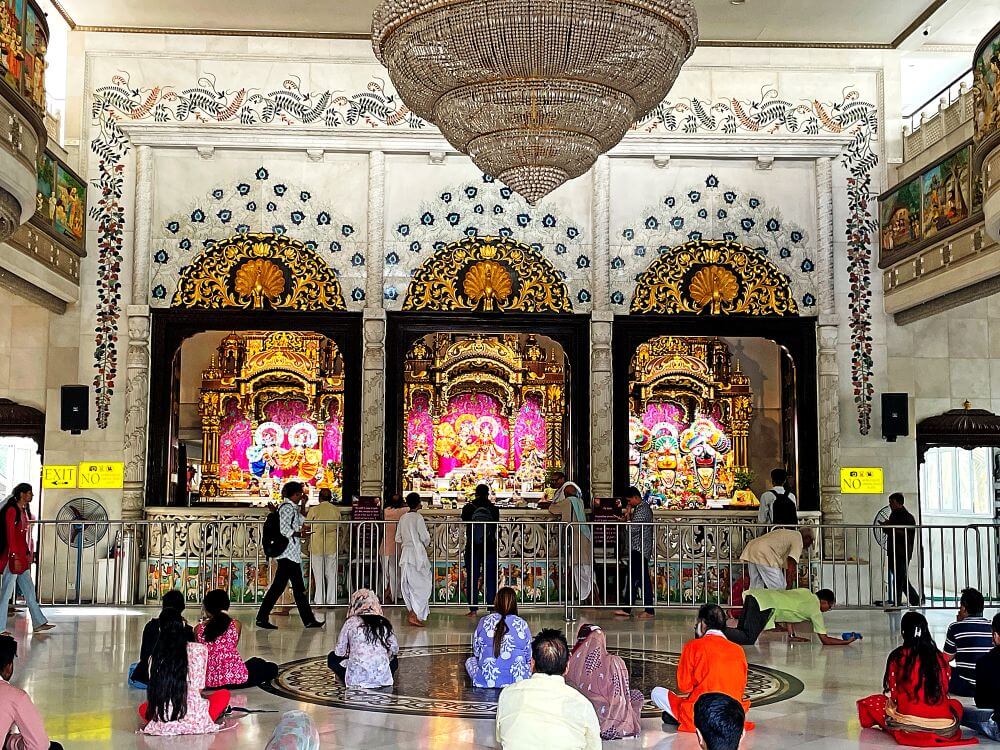
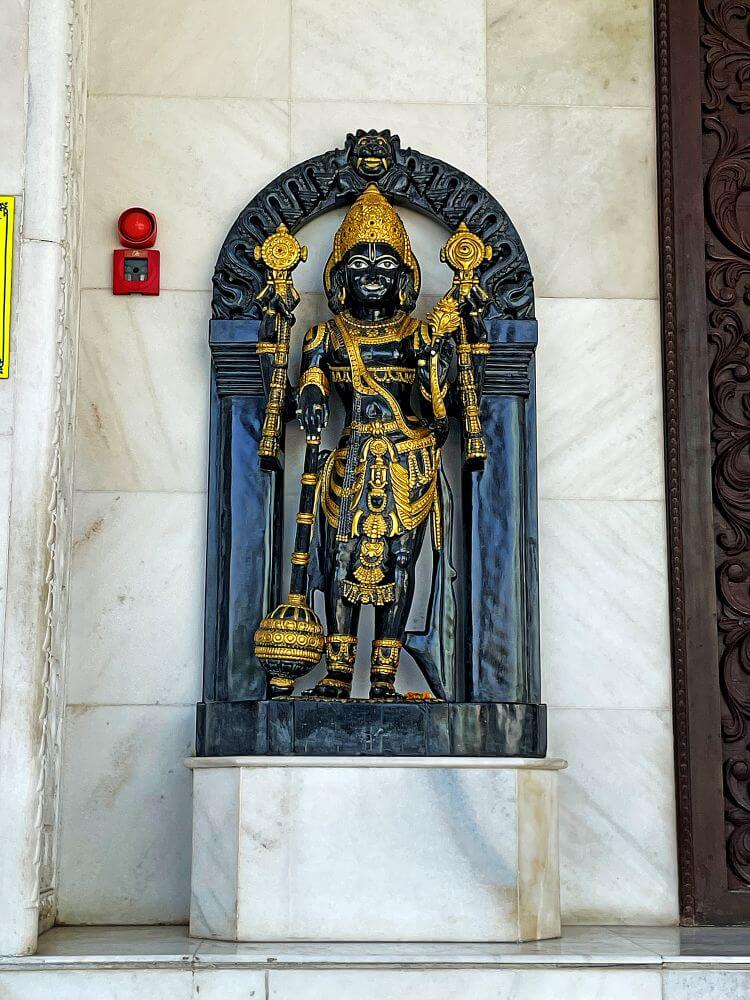
The front wall of the Sabha-mandapa has latticed windows. In the center is a wide and tall entrance. On both sides of it are large black and golden statues of Vaishnava Dwarapalas (gatekeepers). These four-armed statues hold a Sudarshana Chakra in two hands, a mace in one hand, and a flower in the other. One enters the Sabha-mandapa by climbing eight steps from the Mukh-mandapa. This Sabha-mandapa is adorned with clean, shining marble tiles everywhere, and the walls are decorated with various incarnations of Vishnu as well as important episodes from the life of Chaitanya Mahaprabhu. A grand glass chandelier placed in the center of the ceiling adds to the beauty of the Sabha-mandapa.
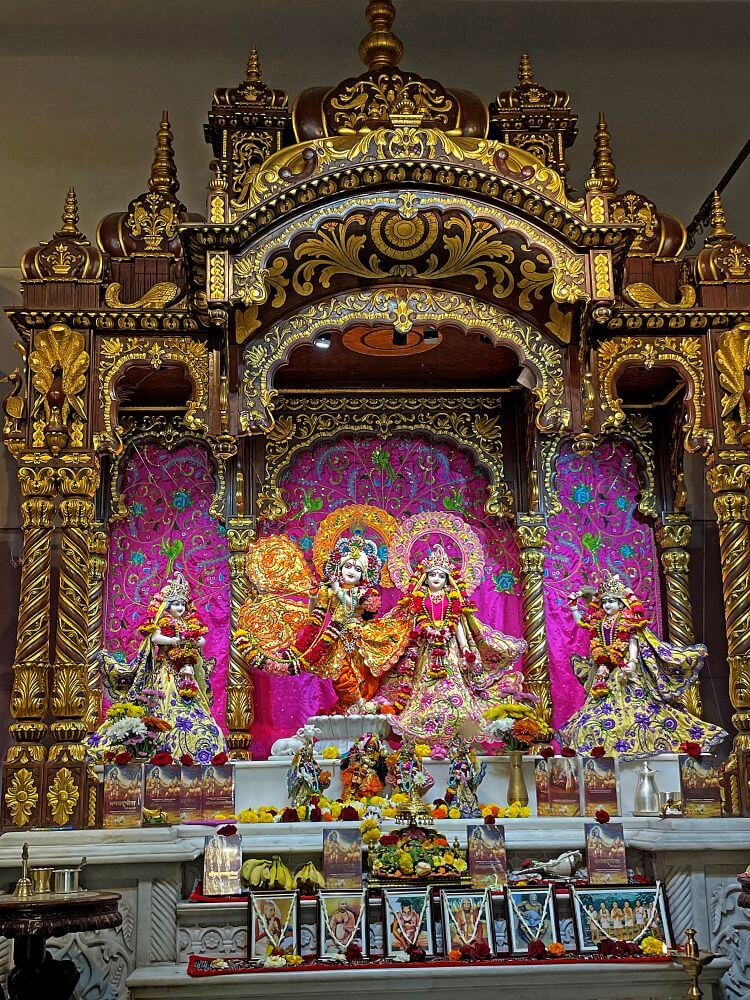
The temple has one main sanctum and two sub-sanctums. Beautiful peacock figures are carved above all three sanctums. In the central main sanctum, the idols of Radha-Giridhari are placed on a high altar within a golden-hued canopy. Beside them, on both sides, are the idols of the Gopis. Below this, there is also a smaller replica of the Radha-Giridhari idols, and beneath that are images of Krishna-Arjuna as well as saintly personalities from the Gaudiya Vaishnava tradition.
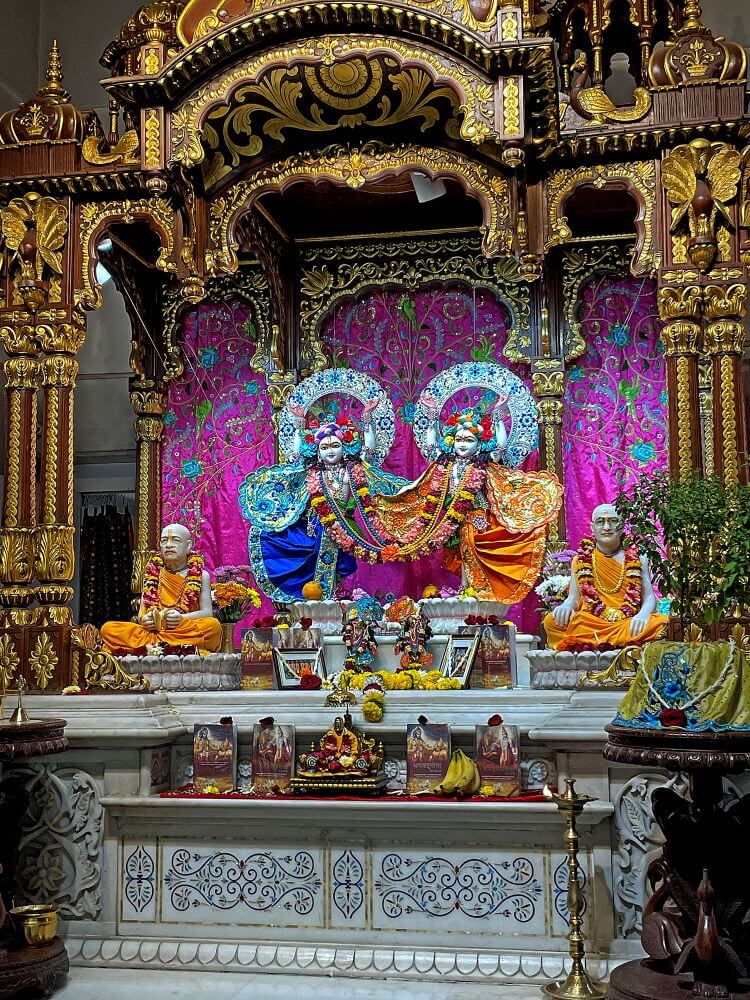
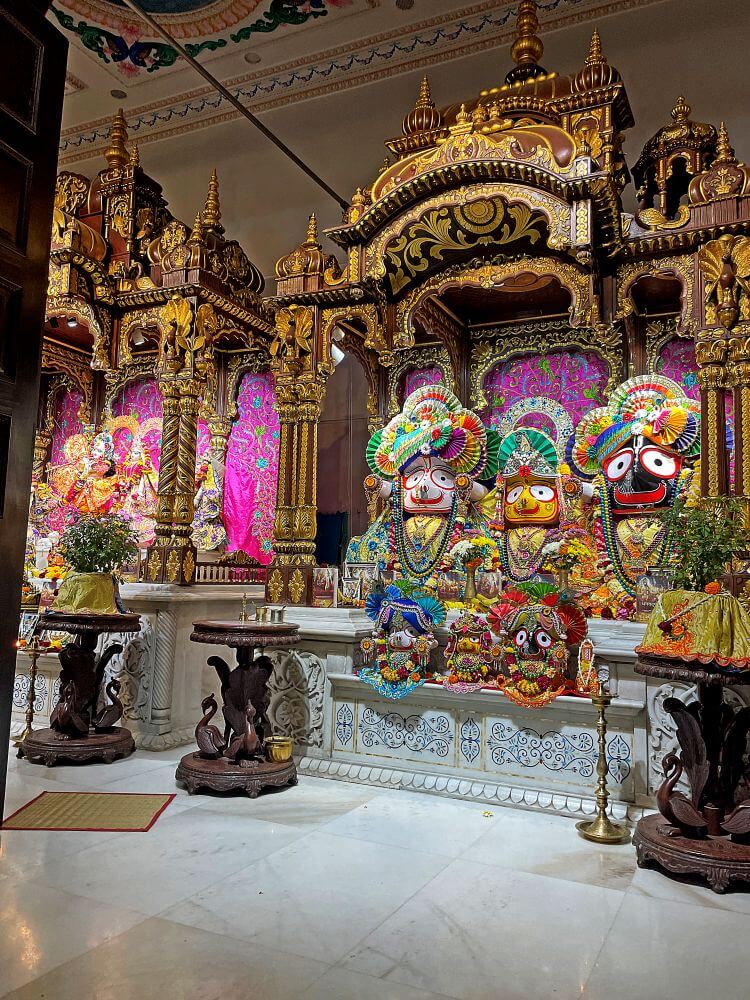
In the sanctum on the left, Radha-Krishna are in a dancing posture, set within an altar of lotus flowers carved in marble stone. There, one can also find the idols of Swami Srila Prabhupada and his guru, Bhaktisiddhanta Saraswati Thakur. In the sanctum on the right, Lord Krishna is present along with Subhadra and Balarama. The idols in this canopy are replicas of the Subhadra-Balarama-Krishna idols from the Jagannath Temple in Jagannath Puri. In these attractive canopies, decorated with leaves, flowers, golden pillars, and ornate arches, small idols of Srila Prabhupada and Krishna in various postures are also placed.
The ISKCON office building is located on the temple premises. It contains counters for the sale of worship materials, books, and Prasadam. Arrangements for the rest of devotees have been made in the large pavilion here. Ratha Yatra is an important festival at the ISKCON temple. It is said that Srila Prabhupada was fascinated by the Ratha Yatra since he was a child. At the tender age of six, he organized a replica Ratha Yatra of Jagannath of Puri in Kolkata. For this, he persuaded his father to bring a small chariot. Decades later, when he went to America, he started the Ratha Yatra festival there as well. The first Ratha Yatra in America was held in San Francisco on July 9, 1967. In a lecture given in London on July 13, 1972, Prabhupada explained the importance of this Ratha Yatra. He said, “Rathe ca vamanam drishtva punarjanma na vidyate,” which means that by the sight of the Lord riding on the chariot, the cycle of birth and death of a human being moves towards cessation. The Ratha Yatra is taken out at the Jagannath Puri temple on Ashadha Shukla Dwitiya. A grand Ratha Yatra is also organized by the local ISKCON temple at that time. On this occasion, the chariot is decorated with flowers. Accompanied by the rhythm of conch shells, mridangas, drums, and cymbals, and amidst the chanting of Hare Krishna-Hare Rama, this Ratha Yatra is taken out in the presence of thousands of devotees. Devotees can visit the temple for darshan every day from 4:30 to 1 and from 4:30 to 9 in the evening.
This sacred temple stands as a testament to deep spiritual devotion, ancient architectural grandeur, and rich local cultural traditions.
The sanctum sanctorum houses the divine idol consecrated according to ancient Vedic traditions, surrounded by serene courtyards and traditional temple architecture.
Navratri, Maha Shivratri, Annual Temple Jatra & Deepotsav
Compare and book flights, secure top-rated local hotels near the temple, hire reliable guides, and rent cars instantly.
Extend your pilgrimage by visiting other highly sacred temples located nearby.


Add ₹999 more to unlock FREE SHIPPING!
Your sacred cart is currently empty.
Shop Photo FramesFill in your delivery details below to place your order.
Add comment