
Add ₹999 more to unlock FREE SHIPPING!
Your sacred cart is currently empty.
Shop Photo FramesThe self-manifest abode of Ashapuri Devi is nestled on a high, rocky hillock, 500 meters inland from the Edvan beach in Palghar Taluka. This Goddess, who has resided in the cave on the hillock for hundreds of years, is also known as Ashrapeshwari Devi. Behind this hillock are water reservoirs, which devotees believe were created by the Devi herself. Hundreds of devotees from Mumbai, Thane, Palghar, as well as Gujarat and Rajasthan, come here to seek the blessings of this awakened deity, who is known as Ashapuri Devi because she fulfills the hopes (asha) of her devotees.
Many temples dedicated to various Goddesses are famous in Palghar district. It is believed that Ashapuri Devi is the seventh sister of the Goddesses Ekveera, Mahalakshmi, Vajreshwari, Shitaladevi, Harba Devi, and Satva Devi, who reside in the picturesque surroundings of this region. According to the first volume of ‘Bharatiya Sanskritikosha’ edited by Pt. Mahadevshastri Joshi, Ashapuri is a deity in Gujarat and the Kuladevata (family deity) of many there. She is worshipped by different names in various parts of that region. With the intention that their Kuladevi’s abode should not be too far away, Ashapuri Devi’s shrines appear to have been established in many central locations. Vows are also made to this Devi for the blessing of children. As Palghar district borders Gujarat, Ashapuri Devi is a revered deity for many people in this area as well.
According to one legend, the Portuguese ruled this area until 1739 CE. In 1560, the Portuguese established the Inquisition, a religious tribunal, on the island of Goa. Its purpose was to prevent non-Christian residents in their territories from practicing their religion and to severely punish them if they did. This Inquisition wreaked havoc in Goa and in the Portuguese-controlled areas of Thane-Palghar. They demolished many temples and killed many people in the name of religion. Along with this, they also amassed immense wealth. Once, monks working for the Inquisition came to this island in Edvan with some Portuguese soldiers. It is said that at that time, thousands of large beetles emerged from the cave where the Devi resided and harassed the Portuguese army, forcing them to flee. After this incident, the villagers repeatedly experienced the Devi’s divine presence. Fishermen in the sea around this island began to find abundant fish. During this period, the radiant Devi, riding a pure white horse, gave darshan to many as she roamed the village.
Another legend of this Devi tells of a cowherd who, many years ago, would bring his cows here to graze during low tide and return home after having darshan of the Devi before high tide began. However, one of his cows often did not return home with him, staying on the hillock. As this continued for many days, one day he went to the hillock to search for her. He then saw that the cow was sitting before the Devi on the hillock. Upon having a direct vision of the Devi, he prostrated himself at her feet. At that time, the Devi, pleased, gave him a sack. However, she warned him not to open the sack until he reached home. He set off for home with the sack. But out of curiosity to see what the Devi had given him in the sack, he opened it on the way. He found that it contained coal. In anger, he threw the coal by the side of the ghat road and went home with the empty sack. He then recounted the story to his wife. When his wife shook the sack, gold coins fell out. The cowherd then felt remorse. It is said that the coal he threw can still be seen today in the form of small pebbles at the bottom of the sea along the jetty’s pathway in the vicinity.
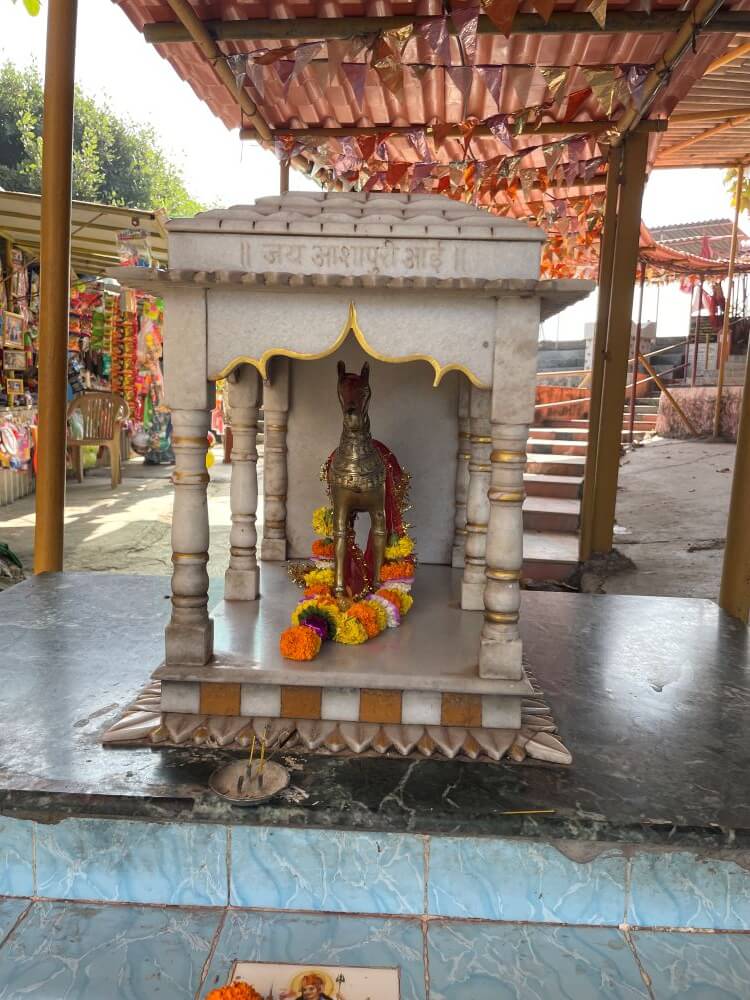
The remnants of a dilapidated fort behind the Marathi school in Edvan village, inhabited by people of eighteen different castes, bear witness to the Portuguese rule here. In this village, besides the Ashapuri Devi temple, there are also temples of Shankar and Rama. To reach the Devi’s temple, a cement concrete road has now been constructed from the coast to the island. This allows devotees to reach the island directly in their vehicles. Previously, one had to visit the temple by observing the high and low tide timings. After proceeding from the temple courtyard, there is an entrance arch to the temple. In this area, there are many shops selling flowers and puja materials, as well as restaurants. Near this arch, there is a small temple dedicated to the horse, the Devi’s vehicle. From this temple, steps have been built to reach the temple located in the cave. At the foot of the hillock is the abode of Lord Krishna, who is considered the Devi’s brother. He is referred to as ‘Govala’. There is a legend that he stays at the foot of the hill to protect his sister.
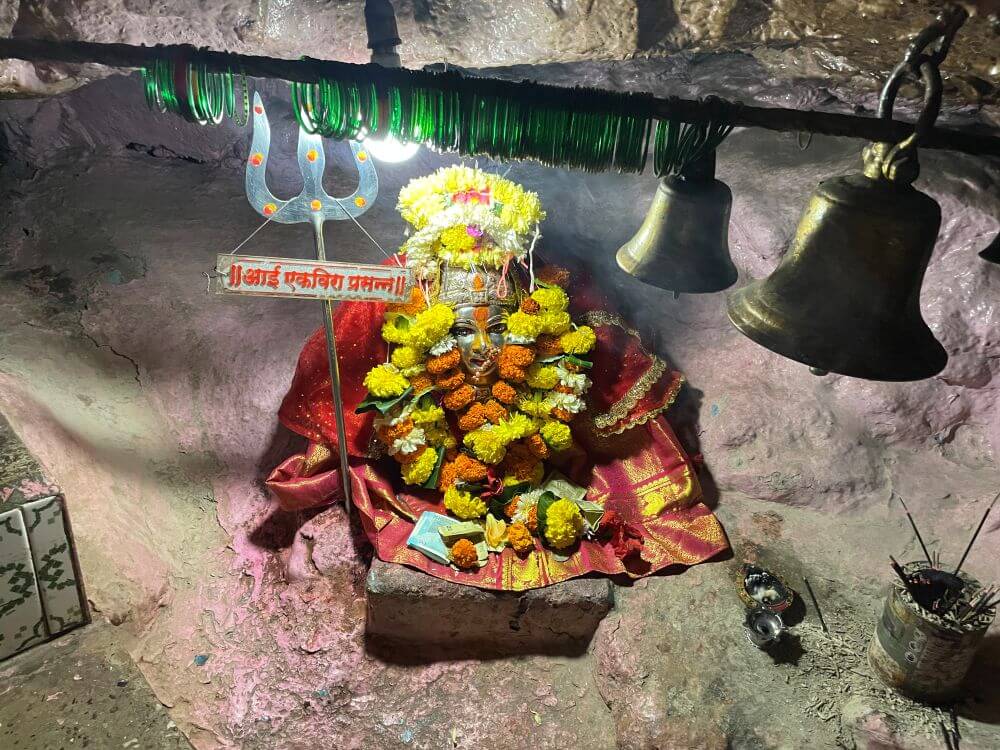
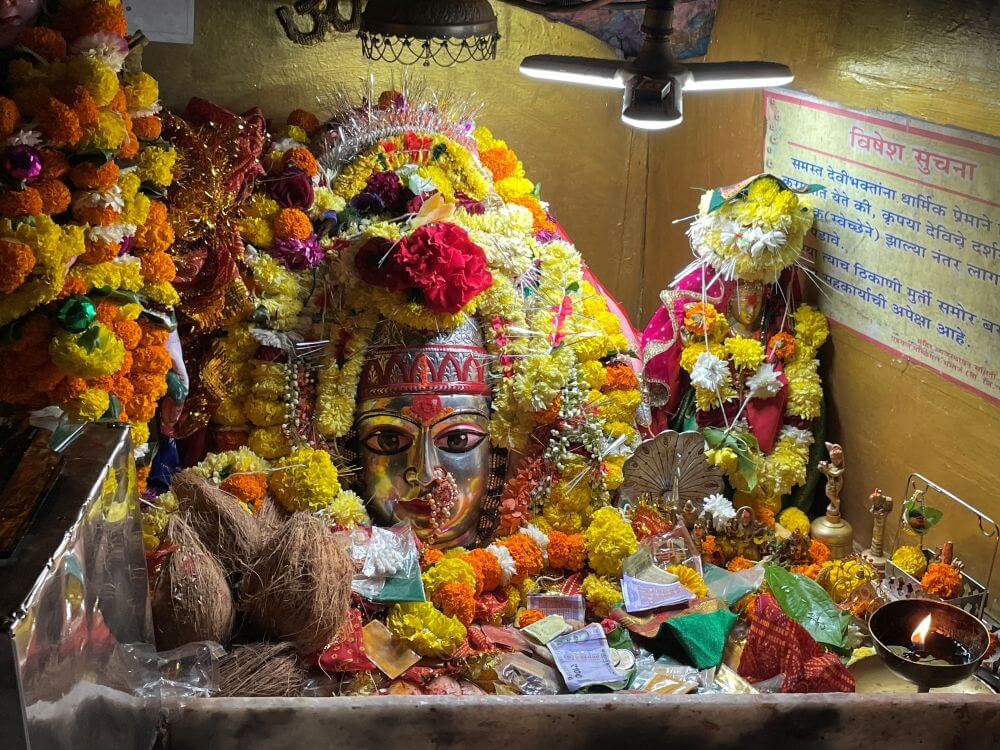
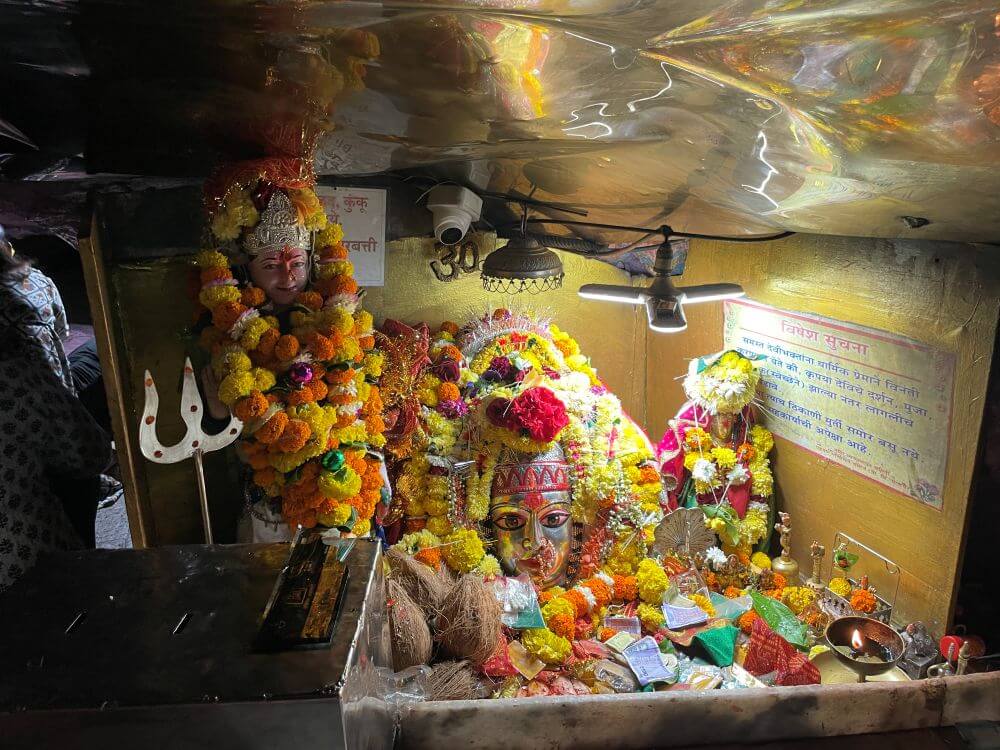
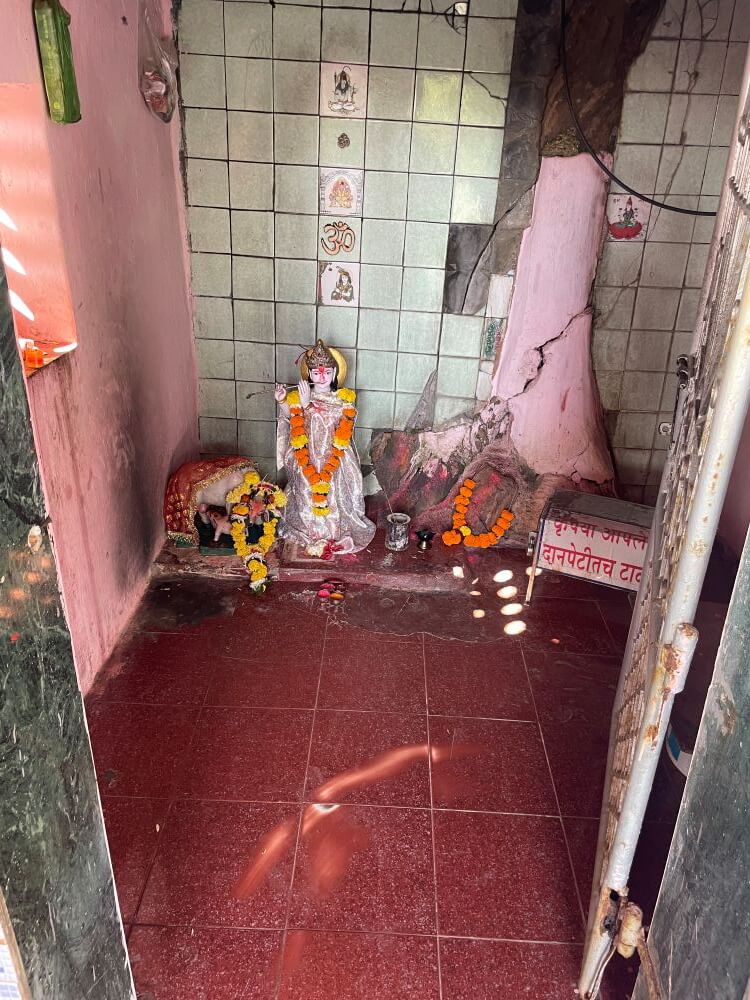
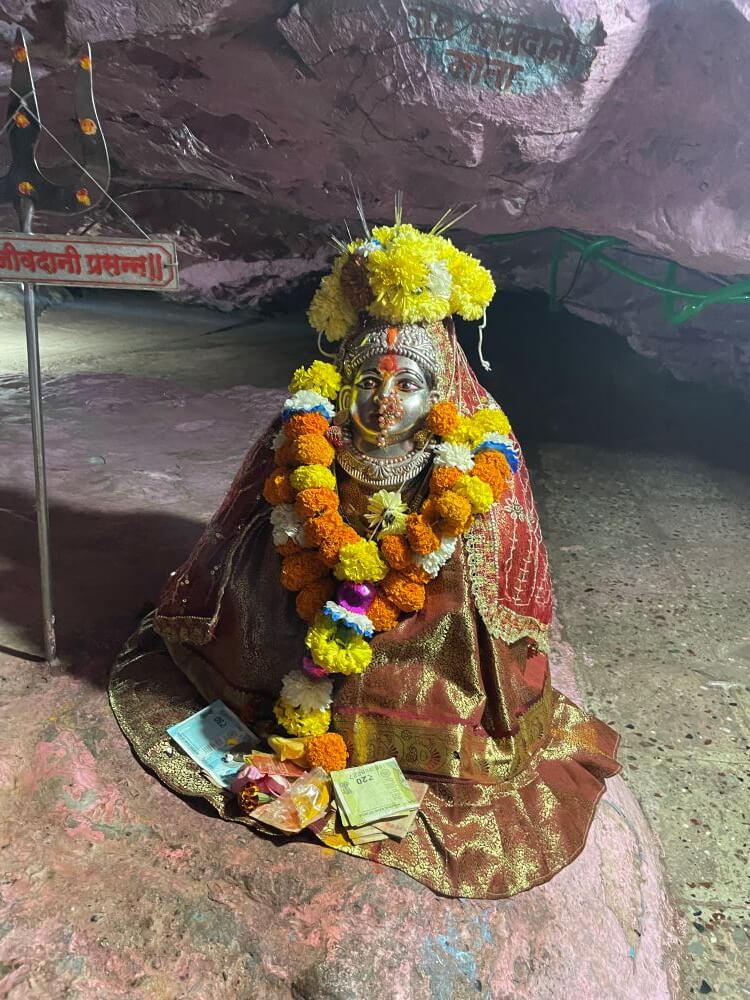
One enters the crevice-like sanctum sanctorum, located in a cave about four feet high, by descending approximately 10 steps. There is only enough space in the sanctum sanctorum for four to five devotees to have darshan at a time. On the rock in the sanctum sanctorum is an idol of Ashapuri Devi in the form of ‘tandala’ (a symbolic representation). Beside her is a marble idol of the Devi. Next to it is a trident, the Devi’s weapon. In this cave, there are also abodes of Jivdani Devi and Ekveera Devi. Behind the idol of Jivdani Devi is a cave. Devotees believe that Ashapuri Devi resides in this cave.
Behind the Ashapuri Temple, after climbing a few steps, there is the abode of Barodkarni Devi in a cave. She is said to be Ashapuri Devi’s sister. Devotees believe that a five-headed serpent resides in the cave near her temple and grants darshan only to fortunate devotees. In the upper part of the hillock are two reservoirs. According to legend, the Devi bathes in these reservoirs. Thousands of devotees attend the Devi’s yatra during Chaitra Pournima and during Navratri Utsav.
This sacred temple stands as a testament to deep spiritual devotion, ancient architectural grandeur, and rich local cultural traditions.
The sanctum sanctorum houses the divine idol consecrated according to ancient Vedic traditions, surrounded by serene courtyards and traditional temple architecture.
Navratri, Maha Shivratri, Annual Temple Jatra & Deepotsav
Compare and book flights, secure top-rated local hotels near the temple, hire reliable guides, and rent cars instantly.
Extend your pilgrimage by visiting other highly sacred temples located nearby.


Add ₹999 more to unlock FREE SHIPPING!
Your sacred cart is currently empty.
Shop Photo FramesFill in your delivery details below to place your order.
Add comment