
Add ₹999 more to unlock FREE SHIPPING!
Your sacred cart is currently empty.
Shop Photo FramesThe Jagdamba Mata Temple at Shri Kshetra Kotamgaon is renowned as the presiding deity (Gramdaivat) of Yeola taluka, which is famous for its Paithani sarees. This Jagdamba is widely revered as a deity who fulfills vows and grants the devout wishes of Her devotees. This sacred shrine holds special significance as the divine abode embodying the threefold (*Trigunatmak*) forms of Mahakali, Mahalakshmi, and Mahasaraswati. It is believed that this Jagdamba Mata of Kotamgaon is the sacred origin of the pilgrimage holy seats of Kolhapur, Mahur, and Tuljapur.
The legend of this Goddess relates that the demon king Jalandhar, husband of Mahasati Vrinda, had conquered the three worlds through the merit of Vrinda’s devout righteousness. He easily emerged victorious in every battle. Blinded by power due to continuous victories, he decided to invade Devaloka (the realm of the gods). Realizing that Jalandhar was about to capture Devaloka and imprison the gods, all the deities fervently prayed to Lord Vishnu for salvation. Lord Vishnu realized that the secret behind Jalandhar’s victories was the chastity of his wife, Vrinda. Therefore, Lord Vishnu assumed the form of Jalandhar and breached Vrinda’s chastity. With the loss of the virtuous Vrinda’s chastity, Jalandhar was defeated and slain. Upon Jalandhar’s death, Vrinda realized what had transpired and cursed Lord Vishnu that He would turn into a Shaligram stone. Due to Vrinda’s curse, Lord Vishnu turned into a Shaligram stone and fell at Kotamgaon. Later, when Mahalakshmi, Mahasaraswati, and Mahakali set out in search of Lord Vishnu, they found Him lying at Kotamgaon as a Shaligram stone. They granted salvation to Sati Vrinda, liberated Lord Vishnu from the curse, and the three Goddesses began residing at this sacred place—Kotamgaon—in their divine, threefold form representing *Raja*, *Tama*, and *Sattva*.
This holy abode of Mata Jagdamba is situated on the banks of the Narandi River, at the confluence of the three districts of Nashik, Ahmednagar, and Chhatrapati Sambhajinagar. It is said that although the exact period of the installation of Jagdamba is not known, the Goddess resided here centuries before the town of Yeola was established.
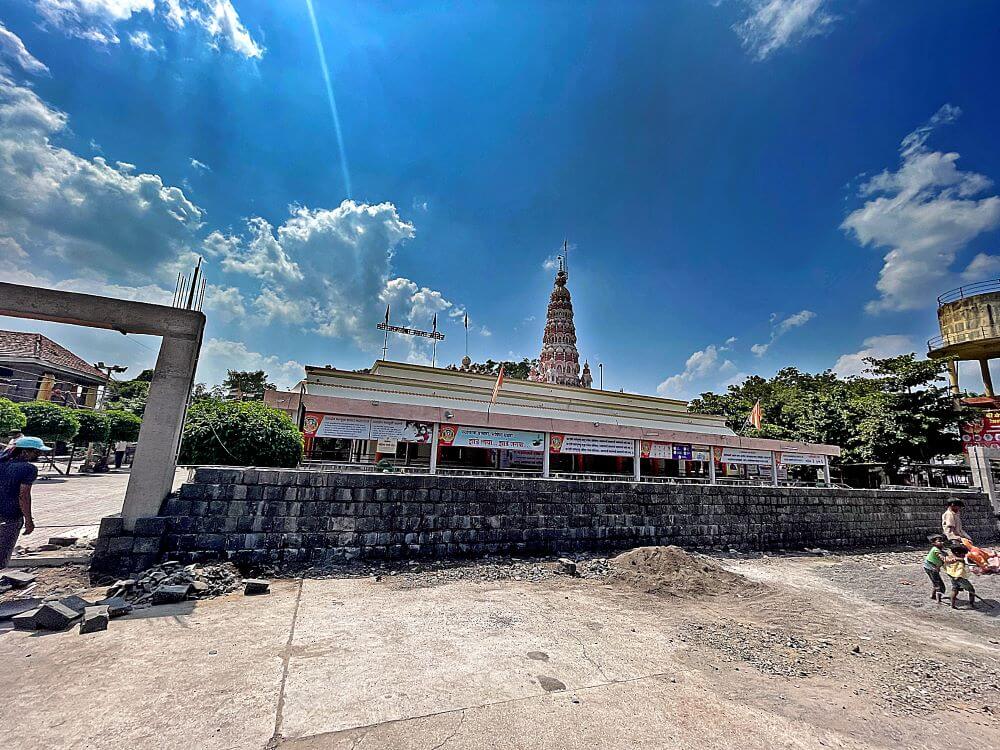
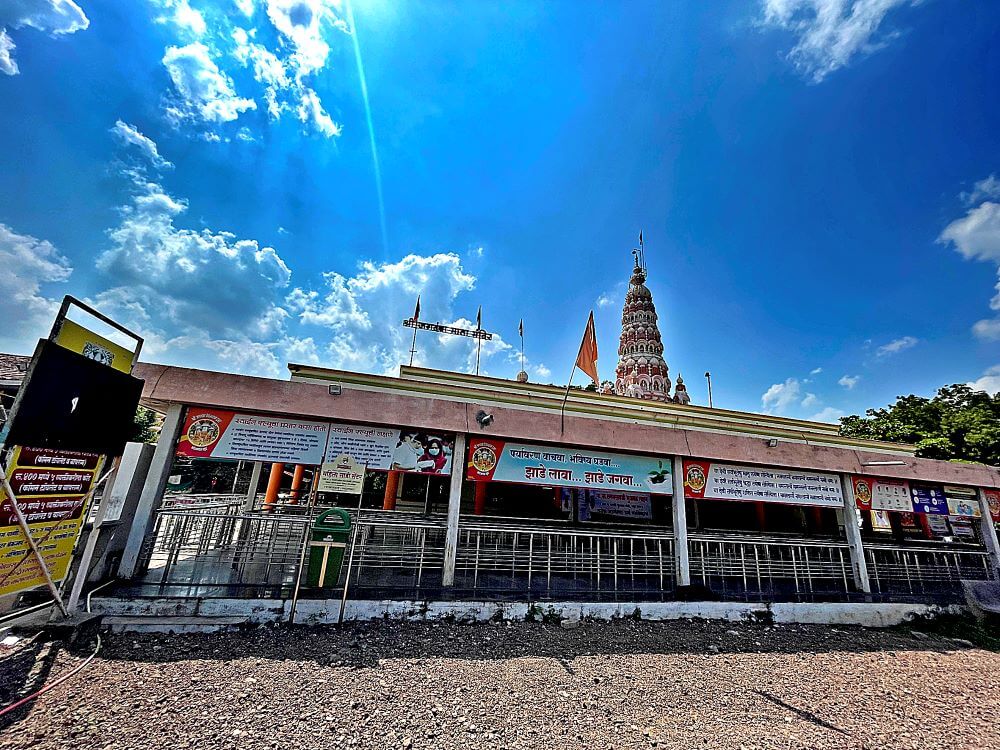
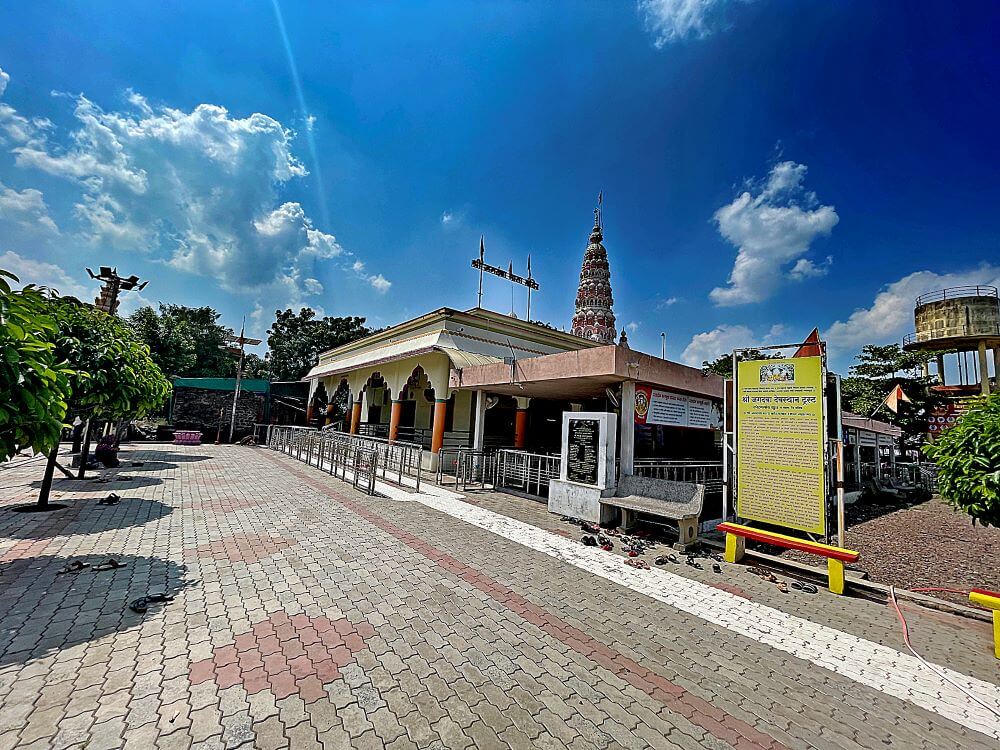
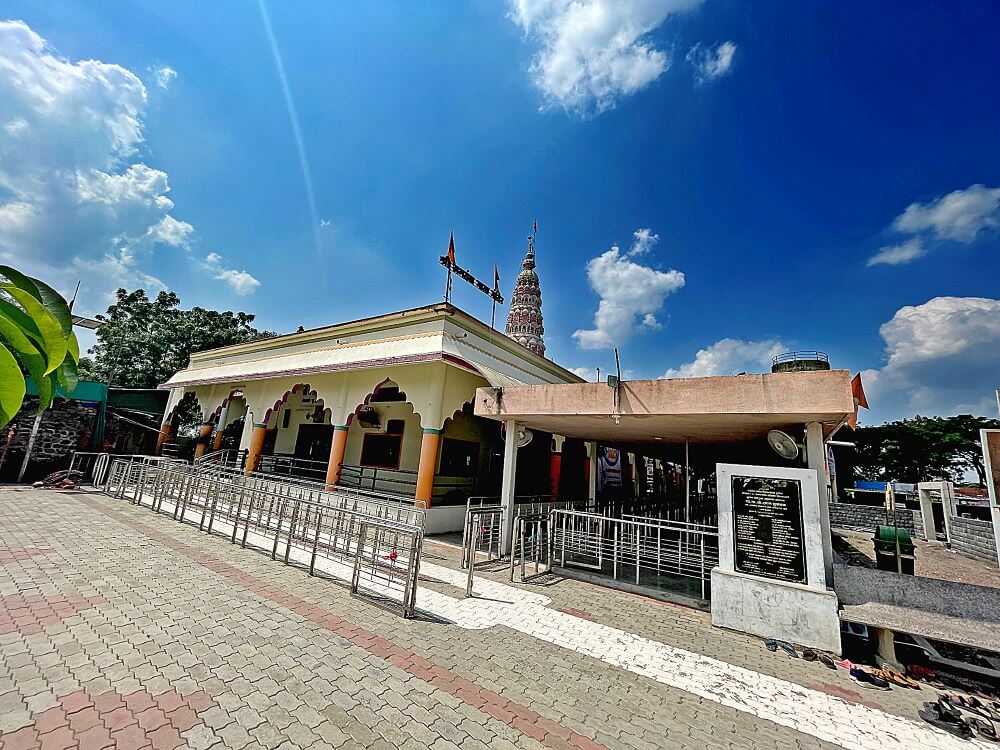
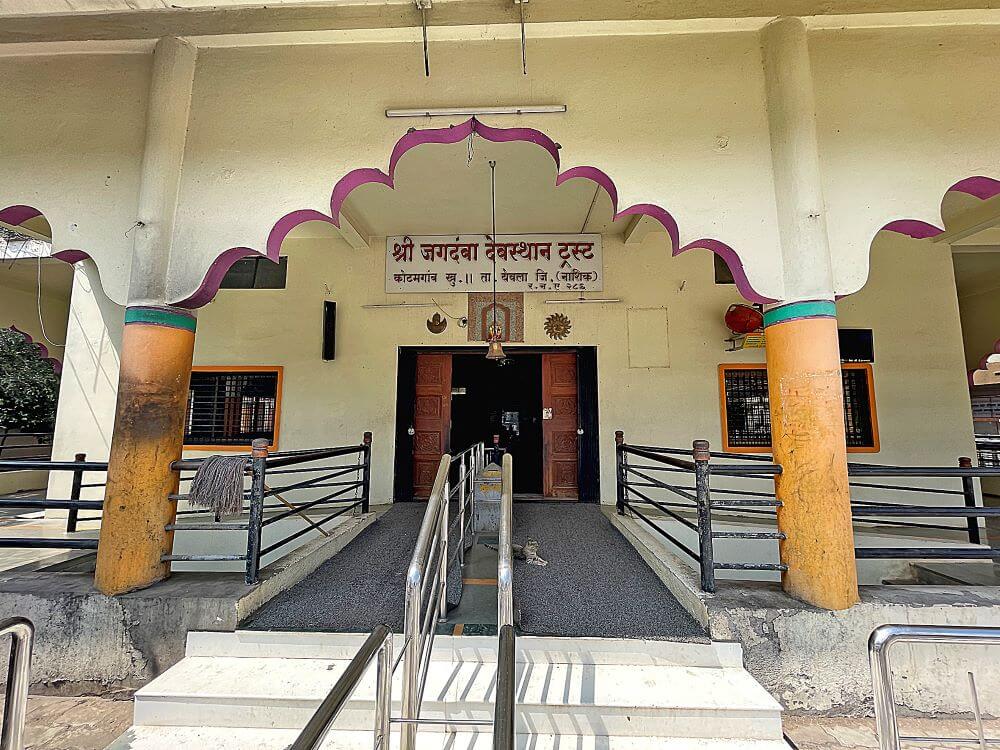
This ancient temple was originally built of stone and mud. Between 1955 and 1960, the villagers undertook the first renovation of the temple. In 1988, the temple trust expanded and reconstructed the shrine. The temple is surrounded by protective compound walls on all four sides. The temple premises are vast, featuring a parking facility that can accommodate 400 to 500 vehicles. Opposite the main temple is a modern Bhakta Niwas (pilgrim guest house) featuring 42 well-equipped rooms for devotees. The entire temple complex is paved with blocks and adorned with beautiful ornamental trees, maintaining a clean and orderly environment. In front of the main temple stand two beautifully crafted *Deepmalas* (lamp towers), and the tall spire (*Kalas*) of the temple is unique, adorned with hundreds of miniature spire replicas.
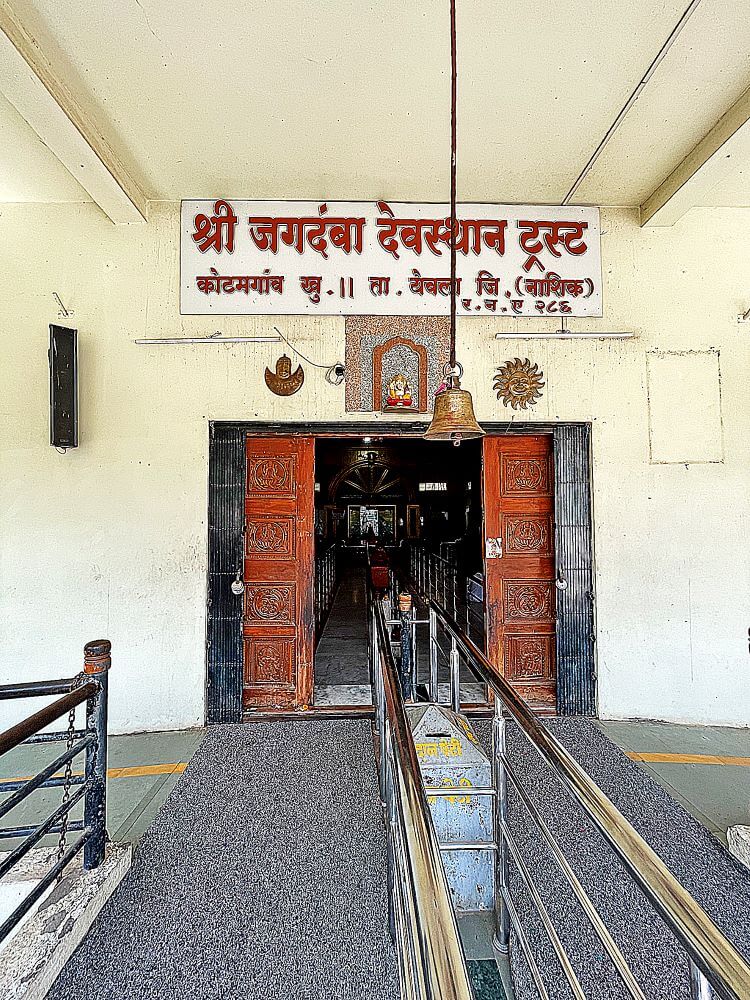
The structure of the temple comprises an assembly hall (*Sabhamandap*) and the sanctum sanctorum (*Garbhagriha*). The main wooden entrance of the temple is exquisitely carved, featuring an idol of Lord Ganesha above the lintel. Steel railings have been installed in the assembly hall for efficient crowd management. Inside the sanctum sanctorum, the self-manifested (*Swayambhu*) sand idol of Jagdamba Mata, smeared with vermillion (*sindoor*), stands 3 feet tall. The idol features three faces, which are believed to represent Mahakali, Mahalakshmi, and Mahasaraswati.
A grand festival is celebrated here during the nine days of Navratri. Thousands of devotees visit the temple during this holy time to seek the sacred *darshan* of the Goddess, transforming the entire complex into a vibrant fair (*yatra*). The temple is illuminated with attractive lightings. During this period, the Goddess is adorned daily with new Paithani sarees and exquisite gold and silver ornaments. The sanctum sanctorum and the temple premises are decorated with a variety of fresh flowers, enhancing the divine beauty of the Mother. A grand royal *Naivedya* (food offering) is offered to the Mother on a sandalwood stool in a silver plate.
Being a *Jagrut Devsthan* (a divine shrine of active spiritual presence), thousands of men and women observe the sacred vow of *Ghati Basne* during Navratri. Remaining in the divine presence of the Goddess during these nine days to perform rituals, sing Her praises, recite hymns (*stotras*), chant mantras, recite the Durga Saptashati, and continuously chant the holy name of the Goddess is known as ‘*Ghati Basne*’. The temple committee arranges clean water, light refreshments (*faral*), and accommodation for all the devotees observing this ritual. During these nine days, devotees devoutly offer *shankarpale* and dried dates (*kharik*) before the Goddess, and large crowds gather to receive this sacred *prasad*.
During the festival, *Maha Aarti* of the Divine Mother is performed every morning and evening. Various cultural and religious programs are organized daily. The temple doors remain open 24 hours a day for devotees during this period. The 3 km road between Yeola and Kotamgaon continuously overflows with pilgrims on both sides.
Adjacent to the main temple of Jagdamba Devi are shrines dedicated to Lord Mahadev and Goddess Yamai-Tukai. Along with religious duties, the temple trust regularly provides financial assistance to flood and drought victims. The trust also extends support to the families of martyred soldiers as well as emerging athletes. Free health check-up camps are organized for devotees observing *Ghati Basne* during Navratri. Apart from the festival season, devotees gather here in large numbers for *darshan* every Tuesday and Friday.
This sacred temple stands as a testament to deep spiritual devotion, ancient architectural grandeur, and rich local cultural traditions.
The sanctum sanctorum houses the divine idol consecrated according to ancient Vedic traditions, surrounded by serene courtyards and traditional temple architecture.
Navratri, Maha Shivratri, Annual Temple Jatra & Deepotsav
Compare and book flights, secure top-rated local hotels near the temple, hire reliable guides, and rent cars instantly.
Extend your pilgrimage by visiting other highly sacred temples located nearby.


Add ₹999 more to unlock FREE SHIPPING!
Your sacred cart is currently empty.
Shop Photo FramesFill in your delivery details below to place your order.
Add comment