
Add ₹999 more to unlock FREE SHIPPING!
Your sacred cart is currently empty.
Shop Photo FramesAmong the few self-manifested (Swayambhu) and spiritually potent shrines in the Konkan region, the ancient Mahadeshwar Temple at Dhibav in Devgad taluka is a revered sanctuary for thousands of devotees. This holy shrine is the presiding village deity (Gram Daivat) of Dhibav village. Believed to be about 3 hundred to 3 hundred and fifty years old, the temple is distinguished by its Konkan architectural style and the beautiful craftsmanship on its wooden pillars. It is said that the shrine derives the name Mahadeshwar from a devoted follower of Lord Shiva named Mahadev.
The legend of the temple goes that many years ago, there lived a farmer in this village who was an ardent devotee of Lord Shiva named Mahadev. While walking, talking, getting up, or sitting down, he constantly chanted the name of Lord Shiva. One day, Lord Shiva appeared to him in a dream and revealed, “I am present here in the form of a stone Shiva Linga.” Following the divine vision, he searched for the stone Shiva Linga and built a thatched grass temple over it. There, oblivious to hunger and thirst, he would worship and serve the Shiva Linga. One day, while thus immersed in worship, he passed away right beside the Shiva Linga. By then, the shrine had become renowned in the village as the temple of Mahadev (the devotee of Mahadev). Thereafter, the holy place came to be known by that very name. As devotees began to experience the divine grace of this spiritually vibrant site, the number of pilgrims visiting for darshan steadily increased. Over time, the temple’s old and simple structure transformed, leading to its present form.
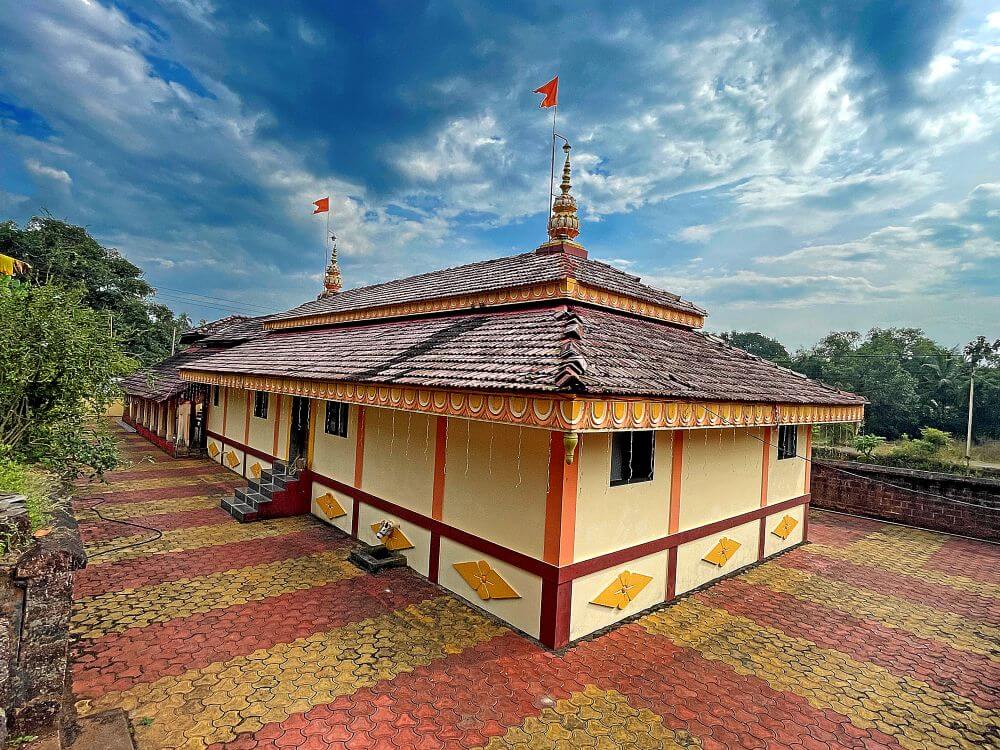
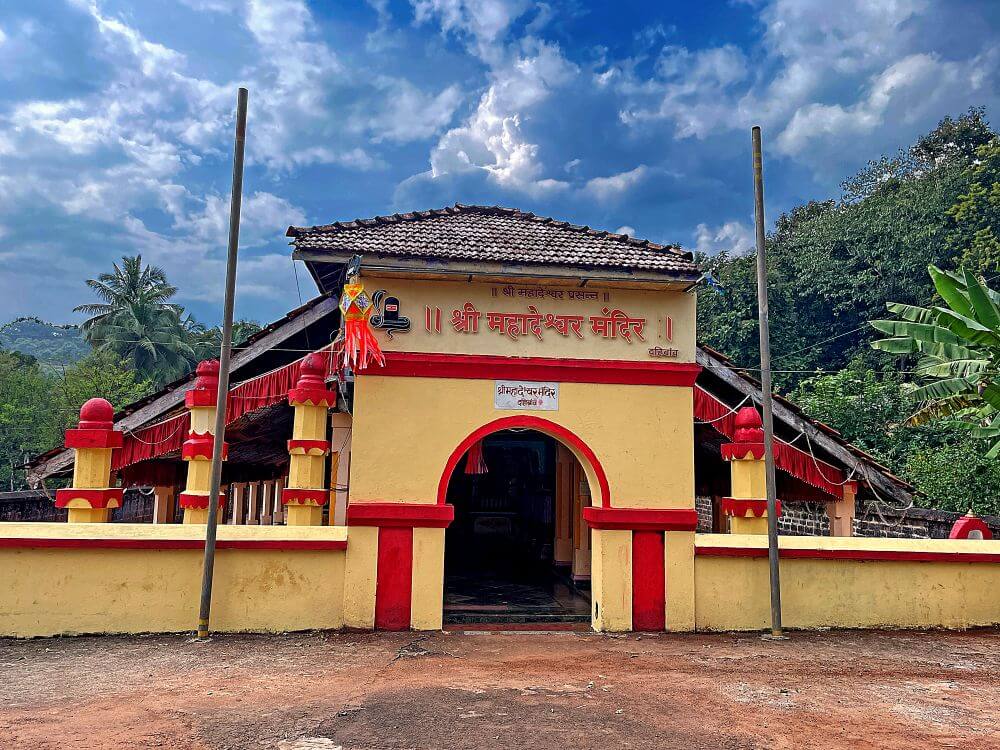
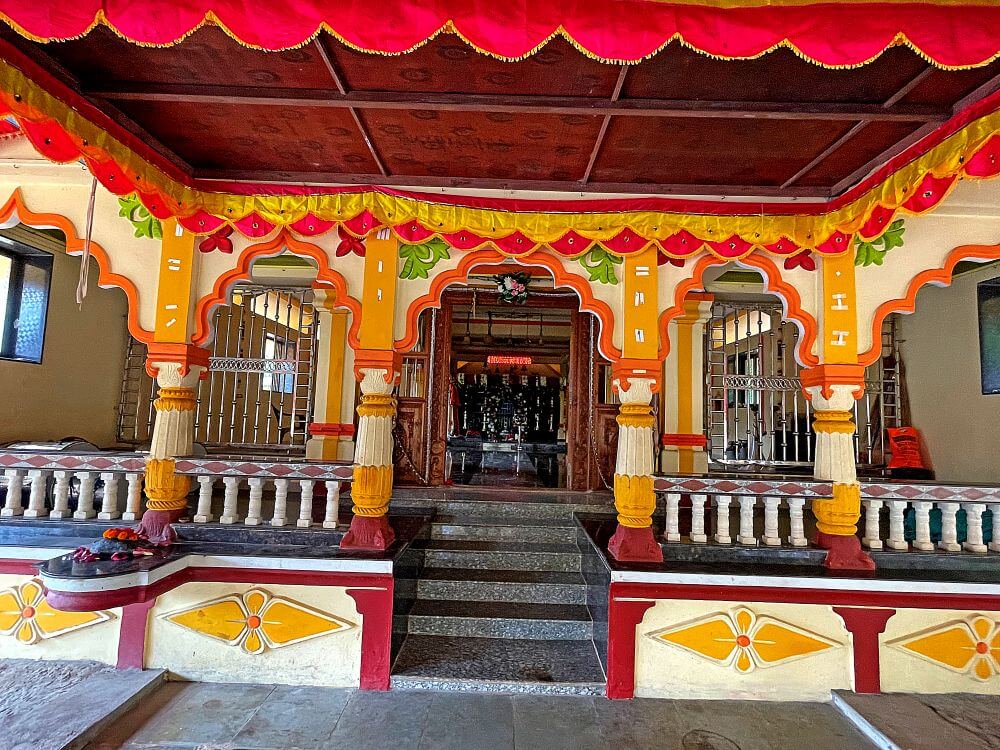
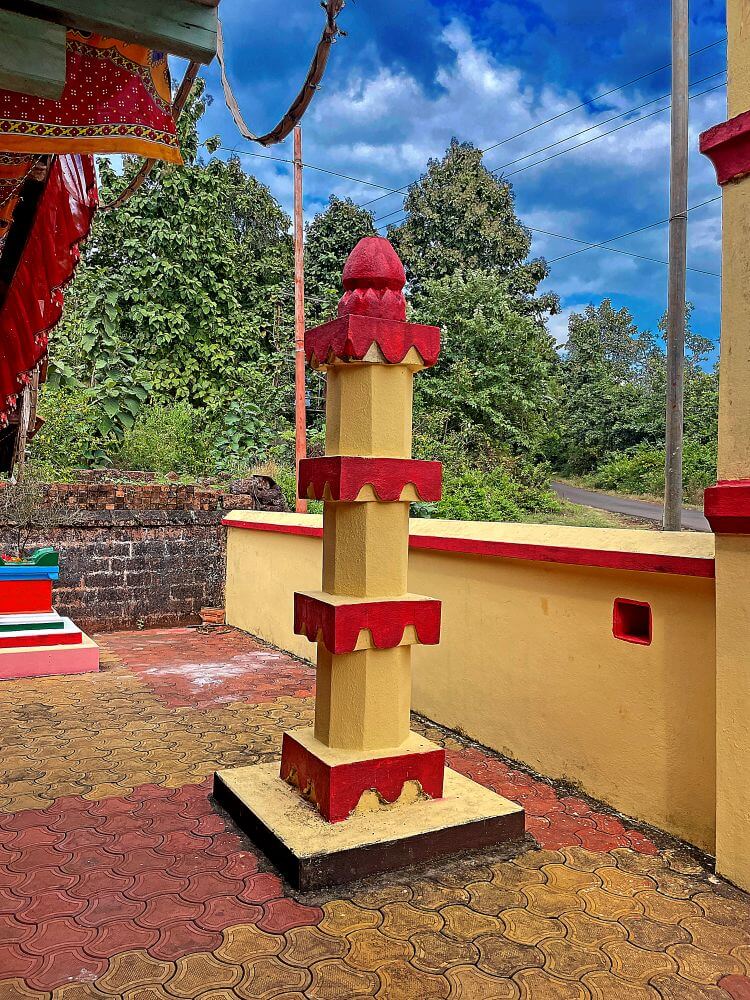
Situated right alongside the road, the temple courtyard is enclosed by a stone boundary wall. Entry to the courtyard is through an arched gateway set within this boundary wall. In this courtyard, there are four lamp pillars (Deepstambhs)—three on the left side of the entrance and one on the right. All these lamp pillars are crowned with a pinnacle (Kalas). This double-storeyed, tiled-roof temple comprises a main assembly hall (Sabhamandap), an intermediate hall (Antaral), and the sanctum sanctorum (Garbhagriha). The spacious assembly hall features four rows of eight pillars each. All the pillars in both outer rows and six pillars in the middle rows are square in shape. This assembly hall is semi-open in design. The front ten wooden pillars in the middle rows are square at the bottom and the top. The middle section is circular, adorned with lotus flower carvings on the lower half and vertical ridged carvings on the upper half. Following the Konkan architectural style, the floor in the center of the hall’s pillars is depressed by a few inches.
Since the intermediate hall (Antaral) is situated at a slightly higher level than the assembly hall, it is accessed by climbing six steps. The wooden entrance of the intermediate hall is adorned with intricate carvings. The doorframes are decorated with floral and leaf motifs. An image of Lord Ganesha is carved on the lintel of the entrance, while on both sides stand the four-armed guardian deities (Dwarpalas) Jaya and Vijaya, holding a lotus, discus, conch, and mace.
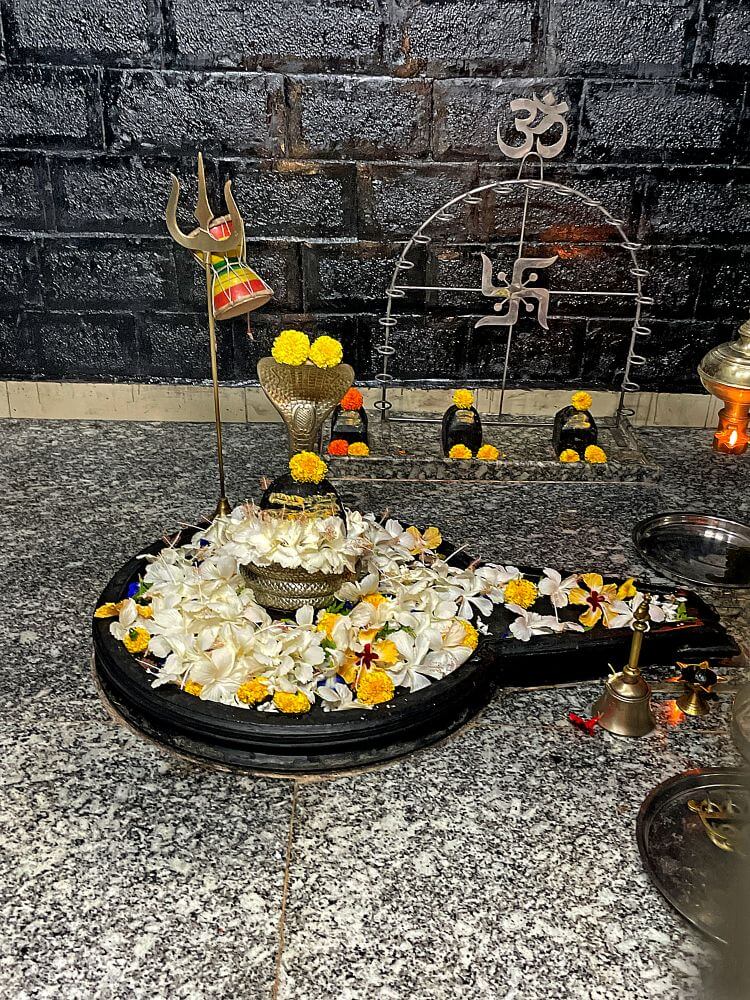
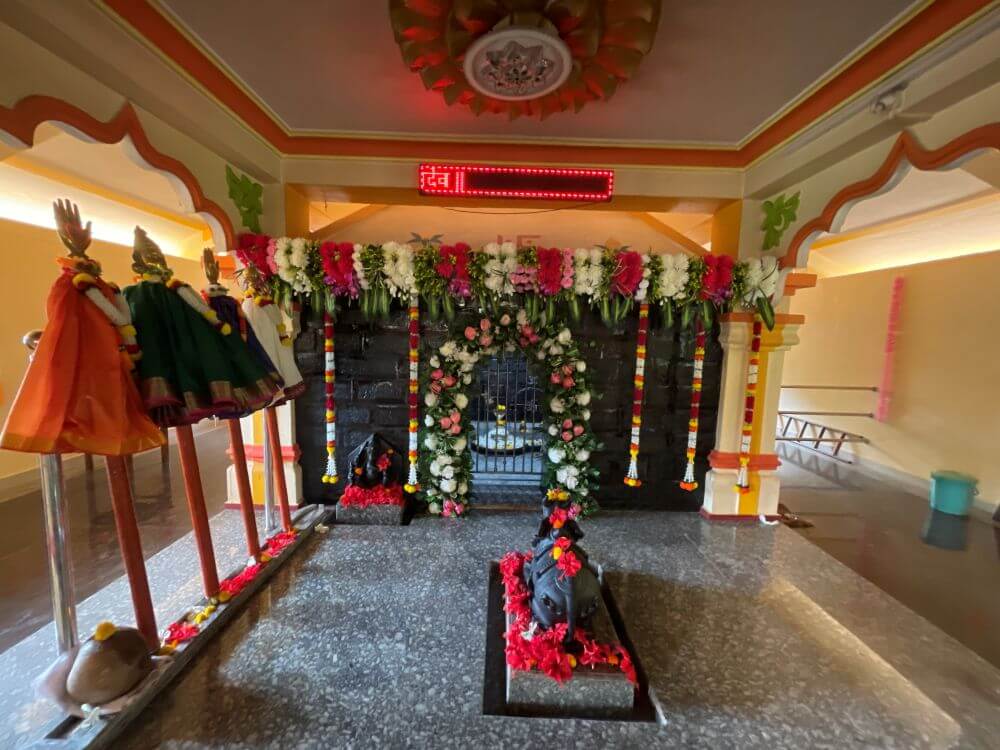
The intermediate hall contains two rows of four large, square stone pillars each. The lower and upper portions of these pillars are wider. All these pillars are interconnected by vaulted arches. Directly in front of the sanctum sanctorum in the intermediate hall, on a low pedestal, sits a black stone sculpture of Nandi, and to the left of Nandi are four wave-deities (Tarang Devtas). Near the front wall of the sanctum sanctorum is a black stone idol of Lord Ganesha. The sanctum sanctorum is laid out leaving a circumambulation path (Pradakshina Marg) in the intermediate hall. At the exact center of this sanctum sanctorum lies the self-manifested (Swayambhu) Shiva Linga. During festivals, a silver mask is mounted upon it. Behind it rest the stone deities of some local gods. Both the intermediate hall and the sanctum sanctorum are enclosed structures. Several ventilators are provided here for the entry of light and air. On the tiled roof, there are two distinct shikhara spires—one above the intermediate hall and another above the sanctum sanctorum—each topped with two amalakas and a pinnacle (Kalas). Such a configuration of shikharas on a tiled roof is considered a rarity.
Festivals such as Navaratri, Dussehra, Diwali, Kartika Ekadashi, Tripurari Purnima, Margashirsha Purnima, and Maha Shivaratri are celebrated in the temple. Various religious programs are organized on these occasions. Rituals like Laghurudra, Maha Abhishek, Homa-Havan, devotional singing (Bhajan, Kirtan), Gondhal, Jagran, Dashavatari plays, as well as Mahaprasad for devotees, are arranged at the temple. During the annual festivals, thousands of pilgrims gather here, lending the temple surroundings the vibrant atmosphere of a fair. In the vicinity, there are several holy sites such as the ancient Vagoba Temple, Gomukh Ganga Tirth, and Vadmeshwar Temple.
This sacred temple stands as a testament to deep spiritual devotion, ancient architectural grandeur, and rich local cultural traditions.
The sanctum sanctorum houses the divine idol consecrated according to ancient Vedic traditions, surrounded by serene courtyards and traditional temple architecture.
Navratri, Maha Shivratri, Annual Temple Jatra & Deepotsav
Compare and book flights, secure top-rated local hotels near the temple, hire reliable guides, and rent cars instantly.
Extend your pilgrimage by visiting other highly sacred temples located nearby.


Add ₹999 more to unlock FREE SHIPPING!
Your sacred cart is currently empty.
Shop Photo FramesFill in your delivery details below to place your order.
Add comment