
Add ₹999 more to unlock FREE SHIPPING!
Your sacred cart is currently empty.
Shop Photo FramesThe Bombadeshwar Temple in the village of Math Budruk in Malvan Taluka attracts many devotees due to its natural miracle! Here, after calling out to Lord Bombadeshwar loudly or chanting the invocation, “Bombadeshwara, Bombade Kadha” (Bombadeshwar, release the bubbles), bubbles, known as ‘Bombade’, emerge from the laterite-stone-built pond. It is because of this miracle of the bubbles that the deity here has received the name Bombadeshwar. This seat of Lord Bombadeshwar Mahadeva is highly awakened, and He is the presiding village deity of Math Budruk.
This temple is located right by the roadside in the village of Math Budruk, which is near Achara. After entering through the temple compound wall, the shrine of Lord Bombadeshwar Mahadeva stands directly ahead. Previously, there was an old Konkani-style tiled temple with a sloping roof here. There is an ancient Shiva Linga of Mahadeva at this site. In front of the Linga, there are two idols of Nandi; one is an ancient stone idol, and the other is carved from marble. There are also two idols of Lord Ganesha here, one of which is ancient, while the other is made of marble. In recent years, the number of devotees visiting this temple for religious tourism has been increasing. Seeing this, the villagers of Math Budruk have come together and decided to construct a grand temple at the site of this attraction.
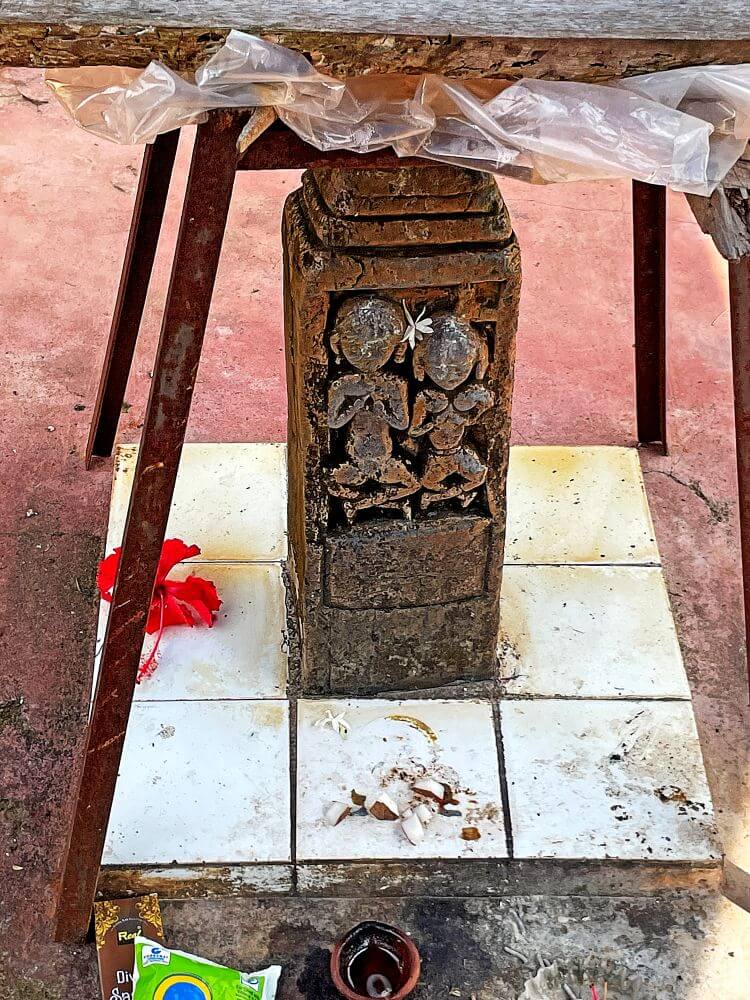
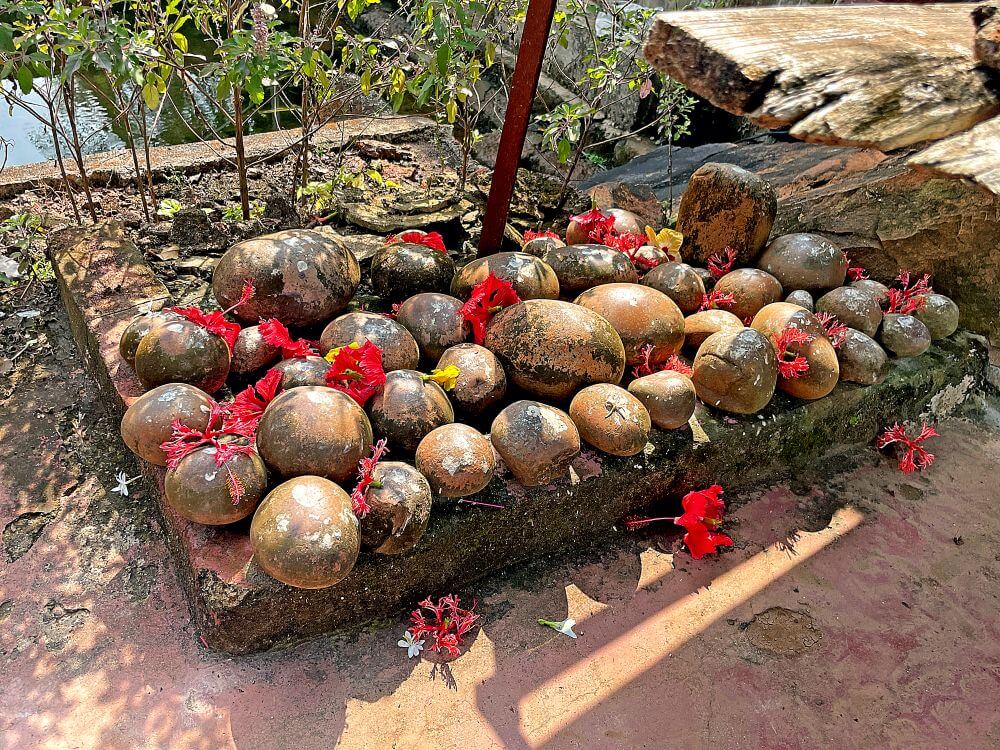
According to the elderly villagers here, the site of this deity dates back to the Jain era. Beside the Bombadeshwar temple, there are stone idols of the Jain Bhairi Devi. The history regarding this is that in ancient times, the Konkan region was known as Aparant. There was not just one Konkan, but seven Konkans. In the Sahyadri Khand, their names are given as follows: Kerala, Tulumbha, Gorashtra, Konkan, Kerath, Varlat, and Barvera. The Shilahara dynasty ruled over these seven Konkans from the year 765 to 1020. These Shilahara kings considered themselves descendants of Jimutavahana, the son of the Vidyadhara king Jimutaketu. Their capital was at Balipattan, which is present-day Kharepatan in the Ratnagiri district. During the period of these Shilaharas, the Jain faith received great royal patronage. In those times, many Jain temples and Jain monasteries were established in various places. Adjacent to the Bombadeshwar temple, near the stone idols of Jain Bhairi Devi, there is a stone of a Gosavi. This is a small stone pillar-like shrine containing two idols of a man and a woman sitting cross-legged in a posture of salutation. According to knowledgeable villagers, this stone has been here for three hundred and fifty to four hundred years. This place was known as the Math of the Gosavi. These Gosavis themselves designed the village of Math, and it is because of their monastery that this village came to be named Math.
Subsequently, Shankaracharya diligently refuted the Jain doctrine. Information regarding this is found in the fifteenth chapter of the ‘Shivalilamrut’, a text composed by Shridhar Swami in the year 1718 AD. It states that seeing the spread of Jainism everywhere, Shiva incarnated to eradicate it. ‘Then that Shiva, the wielder of the Pinaka bow, became extremely enraged and said, “Having submerged all paths of righteous action, they are living according to the Jain religion.”‘ He incarnated in the form of Shankaracharya. These Shankaracharyas ‘tied the Jain scriptures into bundles and cast them into the depths of the unfathomable ocean, drowning them.’ However, in many villages, there were village deities established by the Jains. Even though they were established by them, Shankaracharya instructed the people to worship them. ‘Oh, all these village deities are indeed established by the Jains, yet you must continue to worship them according to your own dharma. Do not harbor any doubt in your minds just because they were established by the Jains. What does one’s own religion have to do with the deity?’ Thus spoke Shankaracharya. Upon this, the Jain scholars surrendered to Shankaracharya and pleaded with him. Hearing their plea, Shankaracharya placed a Jain stone (dhonda) near the village deities. Regarding this, the Shivalilamrut states, ‘Wherever there is a village deity, there resides the Jain stone. They worship it daily alongside the village deity.’ From this, it is understood that the Jain Bhairi stones in the temple at Math were subsequently placed outside.
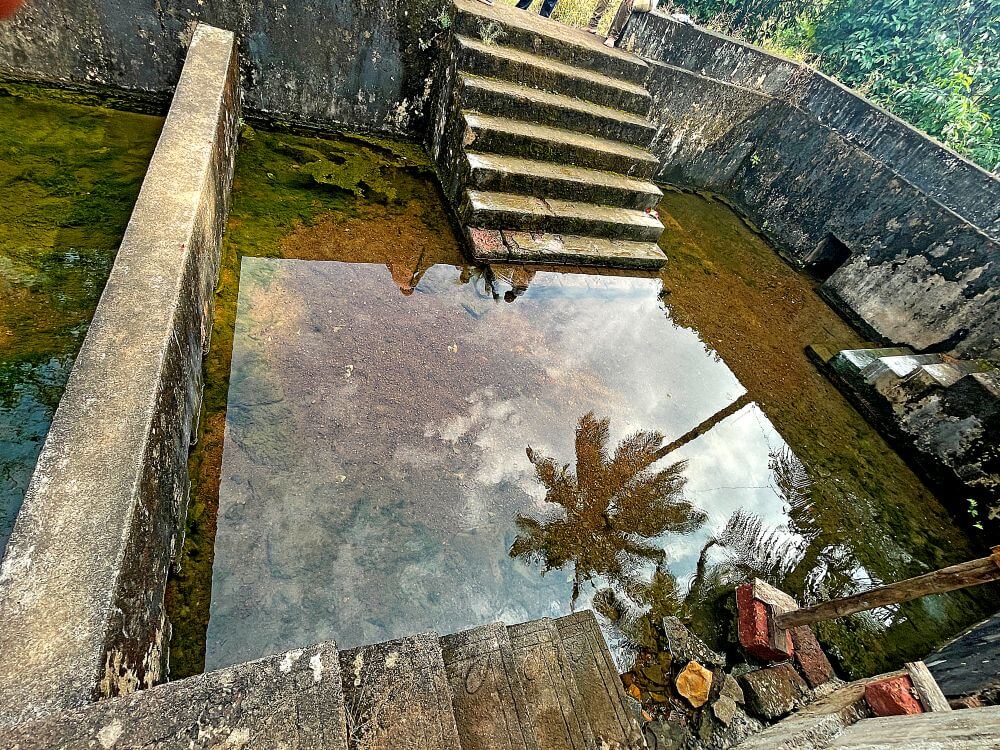
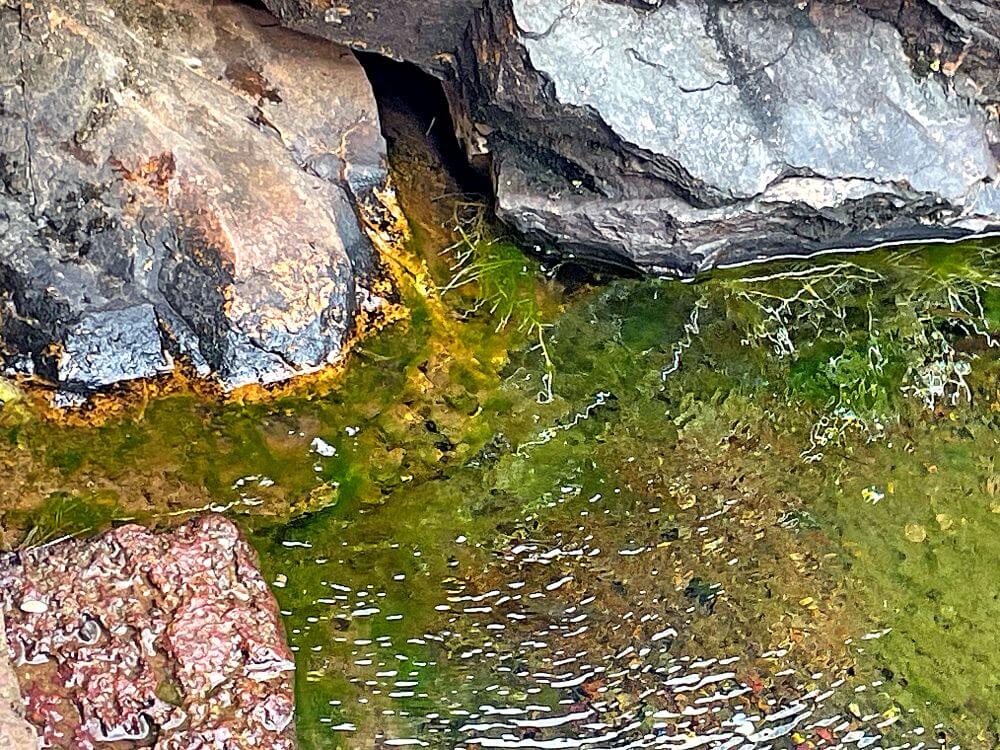
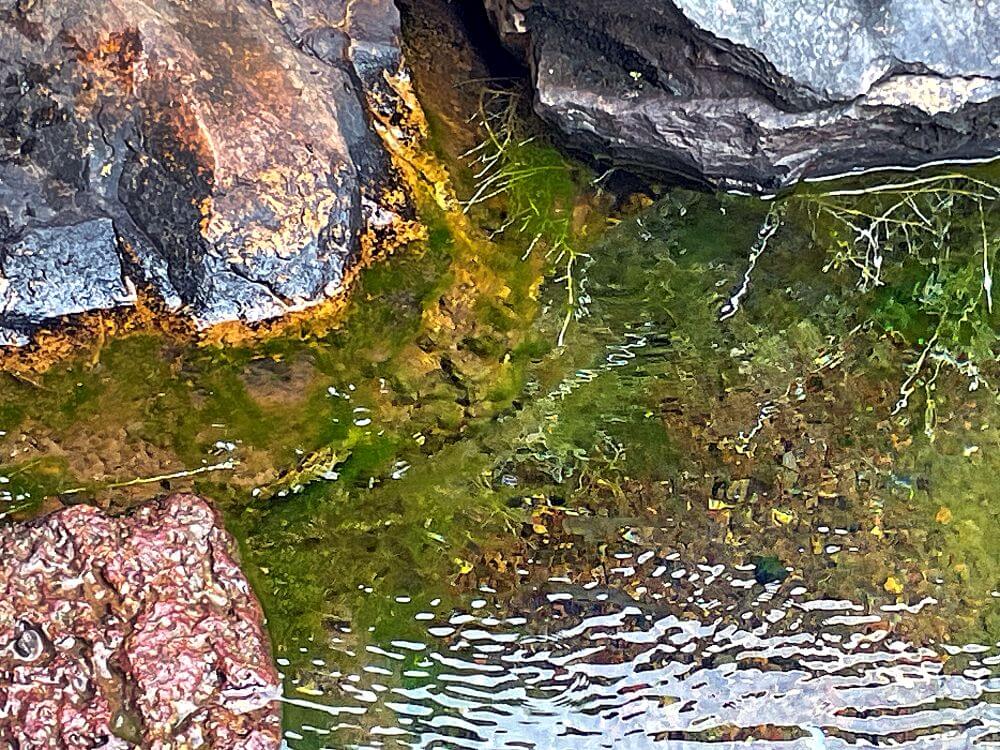
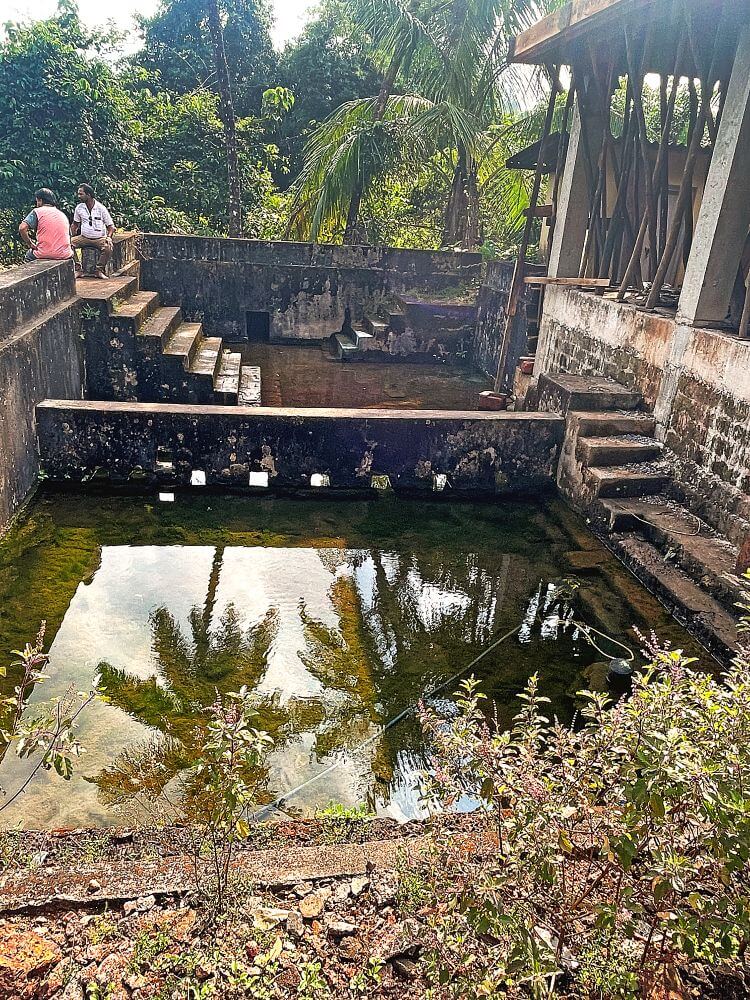
Adjacent to the Bombadeshwar Temple and the shrine of Jain Bhairi Devi here, there are two large tank-like ponds. They are constructed with dressed laterite stones. There are also steps to descend into these ponds. A wall stands between these ponds, and square openings have been provided at the top to allow water to flow between them, ensuring that the water level remains equal in both. Water is present here even during the summer. The source of the water here originates from below the shrine of Jain Bhairi Deva. Water continuously seeps through the rock located in the pond on the right. If one calls out “Bombadeshwar” in a loud voice, bubbles emerge from that spot or their frequency increases. In the Malvani dialect, these bubbles are called “Bombade”.
There is a popular belief that the appearance of bubbles or “Bombade” after taking the name of the deity is a miracle. The scientific explanation for this is that among the rocks beneath the earth’s surface, there are some porous rocks containing air in their cavities. The Konkan region consists of basalt rocks which contain minerals that are gradually washed away due to the heavy rainfall here, making the rocks porous. The loud sound creates vibrations in the water, and these vibrations cause the air in the cavities of the rocks to escape, resulting in the formation of bubbles. Such a natural phenomenon can be observed in the ponds of the Bombadeshwar Temple. Similar bubbles can also be seen in the sacred pool near the Mahadev Temple in the village of Nadavade, located in the Vaibhavwadi taluka of Sindhudurg district. That place is called “Umala”. “Umale” refers to water bubbles emerging from the ground. There are five to six such “Umale” in the vicinity of this village. Due to these bubbles, the village of Nadavade is famous as the village of “Umale”. Many devotees are attracted here due to the miracle of these bubbles in the Bombadeshwar Temple. Festivals such as Mahashivratri, Holi, Navratri, and Tripurari Purnima (Tipracha Jagar) are celebrated with great devotion and enthusiasm in this Bombadeshwar Temple.
This sacred temple stands as a testament to deep spiritual devotion, ancient architectural grandeur, and rich local cultural traditions.
The sanctum sanctorum houses the divine idol consecrated according to ancient Vedic traditions, surrounded by serene courtyards and traditional temple architecture.
Navratri, Maha Shivratri, Annual Temple Jatra & Deepotsav
Compare and book flights, secure top-rated local hotels near the temple, hire reliable guides, and rent cars instantly.
Extend your pilgrimage by visiting other highly sacred temples located nearby.


Add ₹999 more to unlock FREE SHIPPING!
Your sacred cart is currently empty.
Shop Photo FramesFill in your delivery details below to place your order.
Add comment