
Add ₹999 more to unlock FREE SHIPPING!
Your sacred cart is currently empty.
Shop Photo FramesJust as nature has bestowed abundant beauty upon the Konkan land, history too has etched its lines upon its rocky terrain from time to time. The very hooves of Chhatrapati Shivaji Maharaj’s horses have left their imprints on this soil of Konkan. The Sindhudurg Fort, one of the few forts built by the Maharaj himself, is located in this very region. The Rameshwar Temple at Kandalgaon, for which the Maharaj had a dome (ghumti) constructed, stands in the vicinity of this fort and remains a place of devotion and faith for many devotees as well as admirers of Shiva.
Kandalgaon is composed of former settlements known as Katwad, Khaida, Adari, Nhive, and Kolamb. Rameshwar is the village deity (Gram-daivat) of all these settlements, that is, of Kandalgaon. It is said that the name Kandalgaon became popular because this area was surrounded by large Kandal trees. According to a legend, in ancient times, a cow belonging to a Brahmin in this village would not give milk at home. He decided to keep a watch on the cow. One day, he saw that his cow was releasing its milk into a thicket surrounded by Kandal trees in this area. Upon seeing this, the Brahmin asked his servant to clear the bushes and clean the spot. Thereafter, they discovered a Shiva Linga made of a single stone. Since then, the villagers began worshipping this Shiva Linga.
The historical story regarding this temple is that in the year 1664, Chhatrapati Shivaji Maharaj decided to build the Sindhudurg Fort to rival the strength of Dandarajapuri. Accordingly, on 25 November 1664, he performed the ritualistic worship at Moryacha Dhonda on the Kurte Island (the present site of Sindhudurg Fort) and commenced the construction of the fort. According to the historical work ‘History of Maharashtra – Maratha Period – Part 1, Shivkal’ by Dr. V. G. Khobrekar, published by the Maharashtra State Board of Literature and Culture, the King himself stayed in Malvan for a month to oversee the construction of Sindhudurg Fort. During this period, he had a dome built over the Rameshwar Linga at Kandalvan. At the same time, a banyan sapling was planted in front of the temple by his own hands. Today, a spacious Rameshwar temple stands at this site, and the sapling planted by the Maharaj has now transformed into a banyan tree.
Near the Rameshwar Temple in Kandalgaon, adjacent to the parking area, there is a statue of Chhatrapati Shivaji Maharaj seated on a throne, housed in a canopy (meghadambari) under a massive banyan tree. A plaque installed here states that this banyan tree was planted by the Chhatrapati himself and that the Rameshwar Temple was established by the Maharaj. This plaque records the legend that while the construction of the Sindhudurg Fort was underway, the western rampart would not hold despite all efforts. At that time, the worried Maharaj received a vision from Rameshwar one night. Following this, the Maharaj had a dome built over the Rameshwar Shiva Linga in Kandalgaon and planted a banyan sapling here as a memorial. In the chronicle ‘Chhatrapati Shivaji Maharajanchi Bakhar’ authored by Chitragupta, regarding the difficulties faced during the construction of Sindhudurg, it is stated that at that time, ‘The Maharaj was immersed in an ocean of worry. While he was contemplating how to proceed, at the midnight of Chaitra Shuddha Pournima, a Friday, Goddess Shri Amba possessed the Maharaj and began to say, “O child, do not worry about this; the task you have envisioned in your mind will be accomplished. For this, pray to the Ocean, sit on a seat of darbha grass on the seashore, and observe three fasts; the Ocean will be pleased and recede.” There is no doubt about this proof.’ This chronicle further narrates that after the Maharaj observed such a fast, the ocean receded by fifteen cubits.
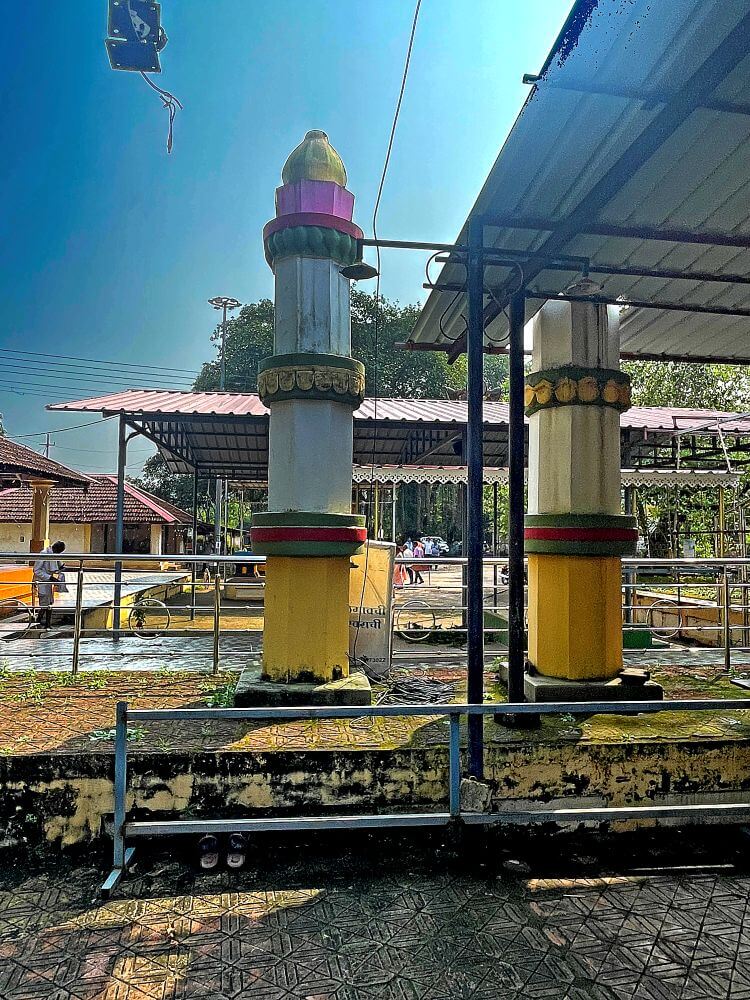
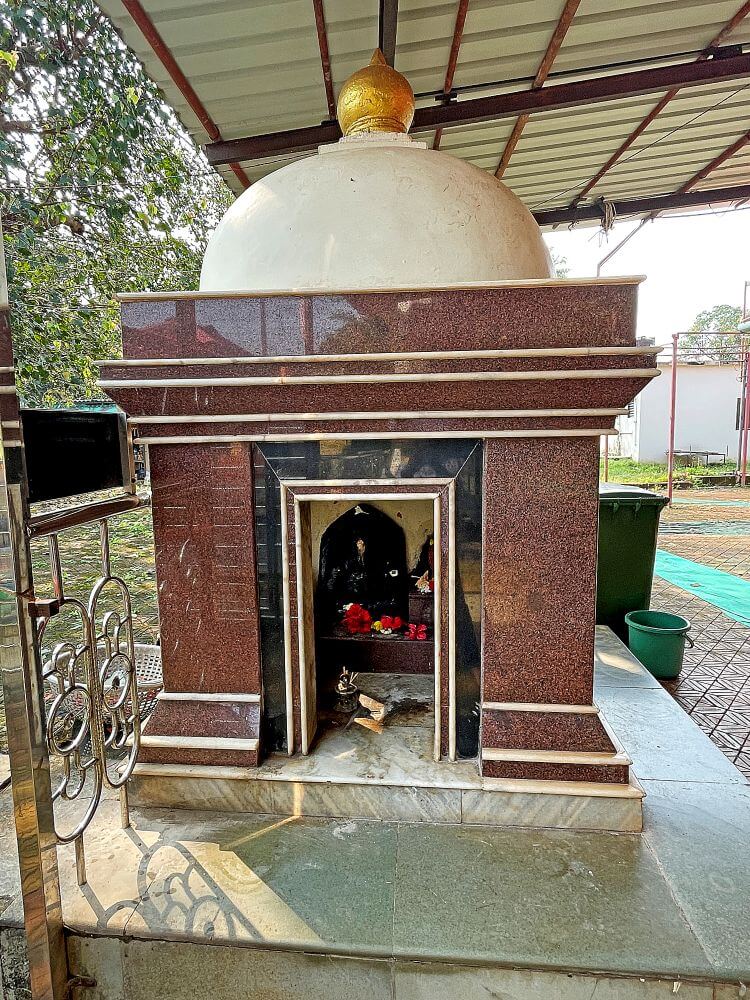
There is a road between the banyan tree planted by the Maharaj and the temple. Across the road, on the right side, is the Ravalnath Temple, and a short distance from there is the entrance gate of the temple. Near this east-facing entrance, on the left side, there are idols of Ganesha and Hanuman in a small shrine. Entering through the gate, one reaches the temple courtyard. There is a boundary wall around this temple. In the courtyard, on the right side, there are two octagonal lamp pillars (deepastambha) and a Tulsi Vrindavan on a raised platform.
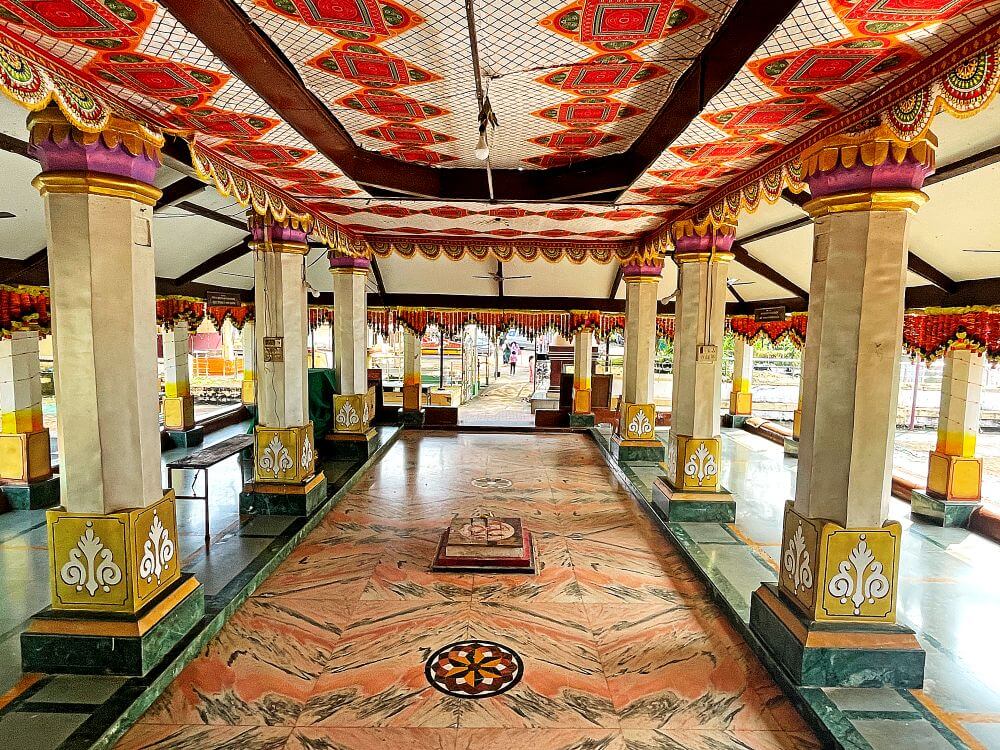
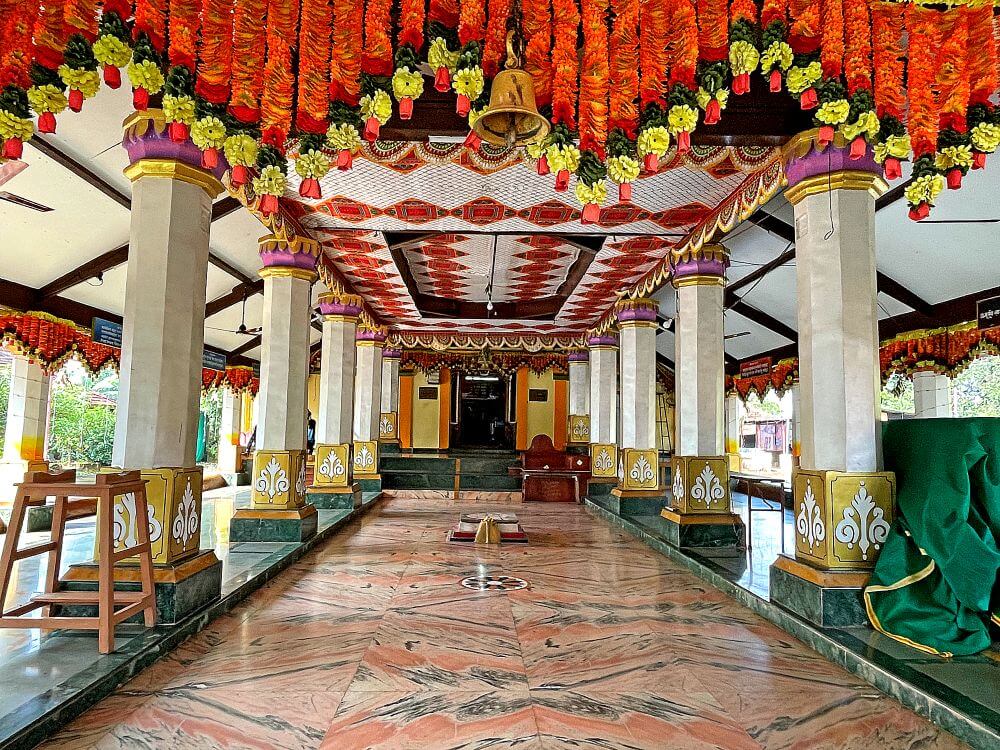
The Rameshwar Temple is situated on a high plinth. The temple structure consists of a Sabha Mandap (assembly hall), Antaral (vestibule), and Garbhagriha (sanctum sanctorum). The temple attained its current form after the renovation and restoration carried out in the year 2002. One enters the Sabha Mandap of the temple by climbing four steps from the courtyard. The Sabha Mandap here is of an open design. There are four rows of six pillars each in the Sabha Mandap. These pillars are square and wide at the base, while they are octagonal in the upper part. According to the Konkani architectural style, the floor between the middle pillars is a few inches deep, and there is a sacrificial fire pit (yagnakund) in the center. While entering the Antaral from the Sabha Mandap, there is a platform for the palanquin on the right side of the steps. In the Antaral, on the left side, there are five Tarang deities, and on the other side, the palanquin used during festival periods is kept. There are wooden brackets (tarang-hasta) on the octagonal pillars of the Antaral, which feature beautiful carvings. There is a path for circumambulation (pradakshina) around the Garbhagriha from the Antaral.
In front of the entrance to the Garbhagriha, there is a carved black stone idol of Nandi. On the front wall of the Garbhagriha, there is an idol of Ganesha on the right and an idol of the Goddess on the left. In one hand of the Goddess’s idol is a staff, in the second hand a sword, in the third hand a trident, and in the fourth hand a vessel of nectar. Near the feet of the Goddess, there is a horse on the left and an attendant (Shakti) on the right. In the center of the Garbhagriha is the Rameshwar Linga.
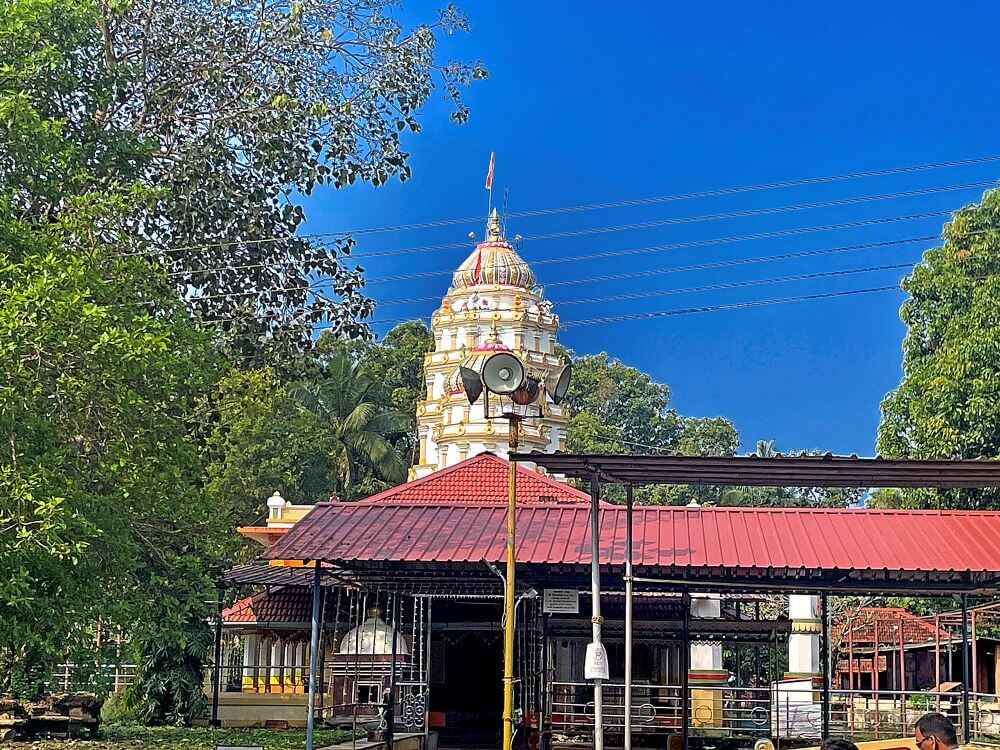
There are spires (shikhara) over the Antaral and the Garbhagriha of the temple. The spire over the Antaral has four tiers. The lower three cylindrical tiers feature carvings of pillars, wheels, and lotus flowers. The upper tier is dome-shaped and features vertical rib carvings and lotus flowers. Above this is an amalaka and a golden pinnacle (kalash). The lower four tiers of the spire over the Garbhagriha are octagonal and feature carvings of pillars, wheels, and lotus flowers. The fifth tier is spherical and topped with a dome. Above the dome is an amalaka and a golden pinnacle. These two golden pinnacles were installed by the hands of the Jagadguru Shankaracharya of the Karveer Peeth on 6 February 2002.
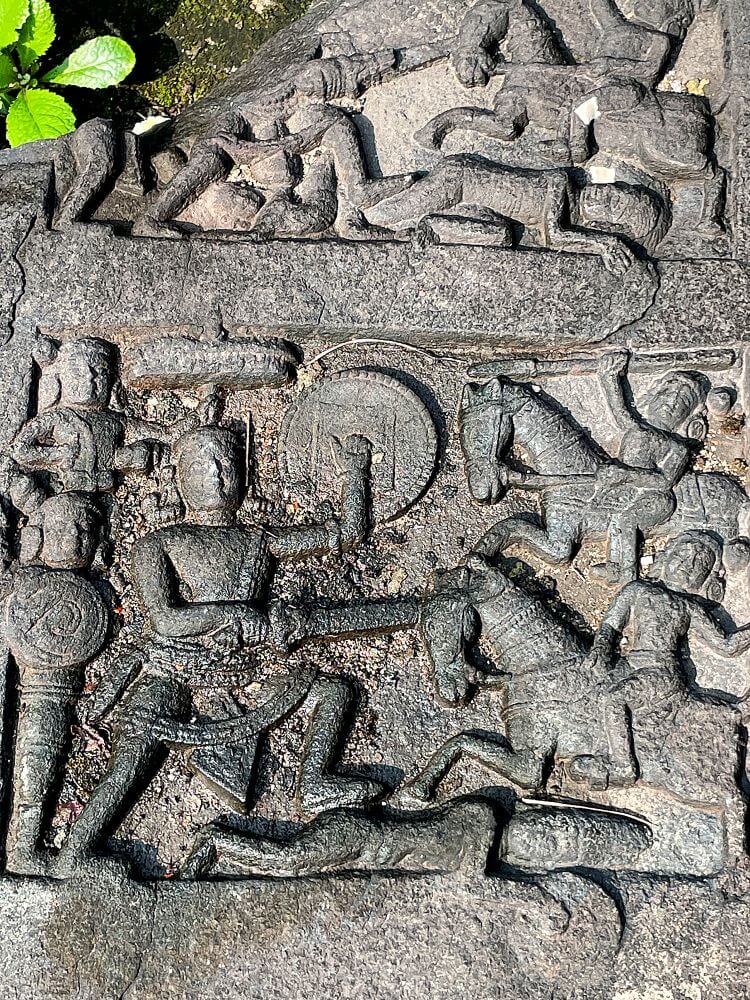
In the temple courtyard, there is an ancient freshwater well. Here, one can find several hero stones (Virgal) and stone idols of local deities. Various festivals are celebrated in the temple throughout the year. Special festivals include the nine-day Chaitrotsav from Chaitra Padwa to Ram Navami, the Vadya Trayodashi of every month, Shravani Mondays, Sharadiya Navratri, Diwali, Kartik Purnima, as well as the Dalapswari held every three years and the Rameshwar Panchayatan deities’ expedition to Sindhudurg Fort. According to the village traditions of Konkan, Dalap refers to the appeasement ritual of the border-protecting deities and the ritual of the village deity visiting the homes of the honor-bearers. During this festival, a procession of Lord Rameshwar is taken out, and he is made to meet all the deities of the village. At this time, the villagers share their problems with the deity.
During festivals, Maha-Abhishek, Laghurudra, Maha-Puja, Palkhi ceremony, as well as Bhajan, Kirtan, Jagran, Gondhal, Dashavatar plays, and Maha-Prasad are organized. As the deity is awakened and grants the wishes of devotees, thousands of pilgrims attend the annual festivals. In the temple premises, there are shrines dedicated to Bhavai, the family deity of the Rane clan, Goddess Sateri, the family deity of the Parab clan, Baracha Purvas, and Mayecha Purvas.
This sacred temple stands as a testament to deep spiritual devotion, ancient architectural grandeur, and rich local cultural traditions.
The sanctum sanctorum houses the divine idol consecrated according to ancient Vedic traditions, surrounded by serene courtyards and traditional temple architecture.
Navratri, Maha Shivratri, Annual Temple Jatra & Deepotsav
Compare and book flights, secure top-rated local hotels near the temple, hire reliable guides, and rent cars instantly.
Extend your pilgrimage by visiting other highly sacred temples located nearby.


Add ₹999 more to unlock FREE SHIPPING!
Your sacred cart is currently empty.
Shop Photo FramesFill in your delivery details below to place your order.
Add comment