
Add ₹999 more to unlock FREE SHIPPING!
Your sacred cart is currently empty.
Shop Photo FramesAnganewadi stands as a rare example where a small hamlet, rather than its main village, has achieved widespread renown. It is one of the twelve hamlets of Masura village in Malvan taluka; however, it is the Bharadidevi Yatra of Anganewadi that has made this place famous throughout Maharashtra today. Devotees hold a deep faith that Bharadidevi of Anganewadi grants their wishes. This is considered a ‘jagrut devasthan,’ a vibrant and awakened divine abode. Bharadidevi is renowned as the ‘Pratibhavani’ (the responsive goddess) of South Konkan. Consequently, the Anganewadi Yatra has become immensely popular, much like the pilgrimages to Marleshwar and Kunkeshwar.
There are various legends associated with this divine abode, also known as the ‘Pandharpur of Konkan.’ One such legend recounts that the Devi manifested on a ‘bharad malran’ (a barren, rocky plateau), hence She is called Bharadidevi. According to some, the Devi appeared from a ‘vada’ (a savory fritter) made of rice on the ‘bharad mal’ (barren plateau), thus earning Her the name Bharadidevi. Due to this legend, the villagers distribute rice ‘vadas’ as ‘prasad’ during the Devi’s yatra. However, there is a strict observance: these ‘vadas’ must be consumed right there. Behind this lies the villagers’ belief that the Devi manifested through those ‘vadas,’ and to ensure She does not depart again, the ‘vadas’ are finished on the premises and not taken outside.
Another legend tells of a person from Anganewadi who served Chimaji Appa, the brother of Bajirao I. Some believe he was a brave warrior, while others say he was Chimaji Appa’s spy. He owned a milch cow that would daily release its milk at a specific spot in a grove every evening. He noticed this unusual occurrence. He informed all the villagers, and they cleared the grove. There, they discovered a self-manifested stone. This is said to be Bharadidevi. The birth year of Chimaji Appa is unknown. However, Bajirao I was born in १७००. Chimaji Appa was born after him and passed away on १७ December १७४०. According to this legend, the self-manifested stone of Bharadidevi was found by a person in his service. This suggests that the establishment of Bharadidevi has a history of approximately ३०० years. It is said that Chimaji Appa himself experienced the Devi’s divine presence during one of his campaigns. Consequently, he donated २२,००० acres of land to this divine abode.
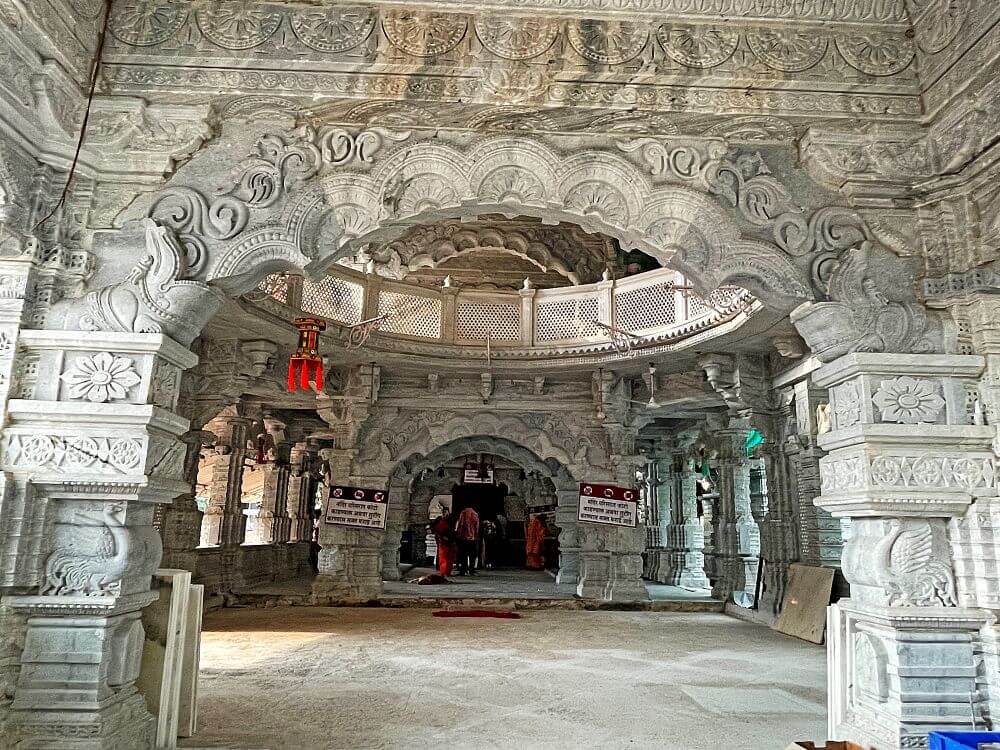
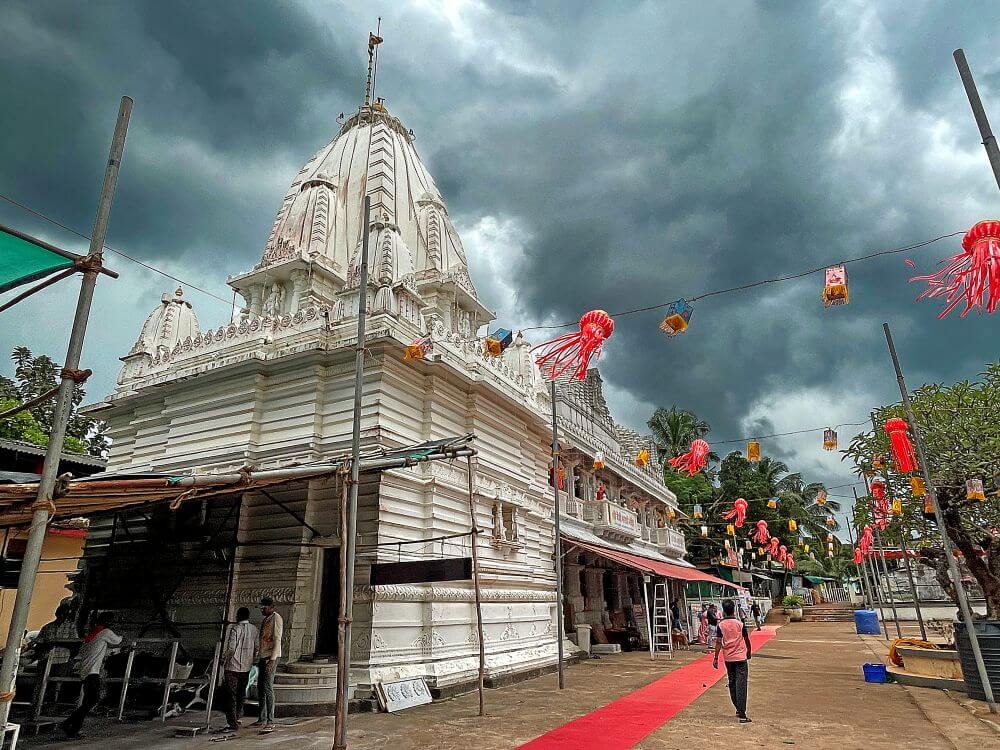
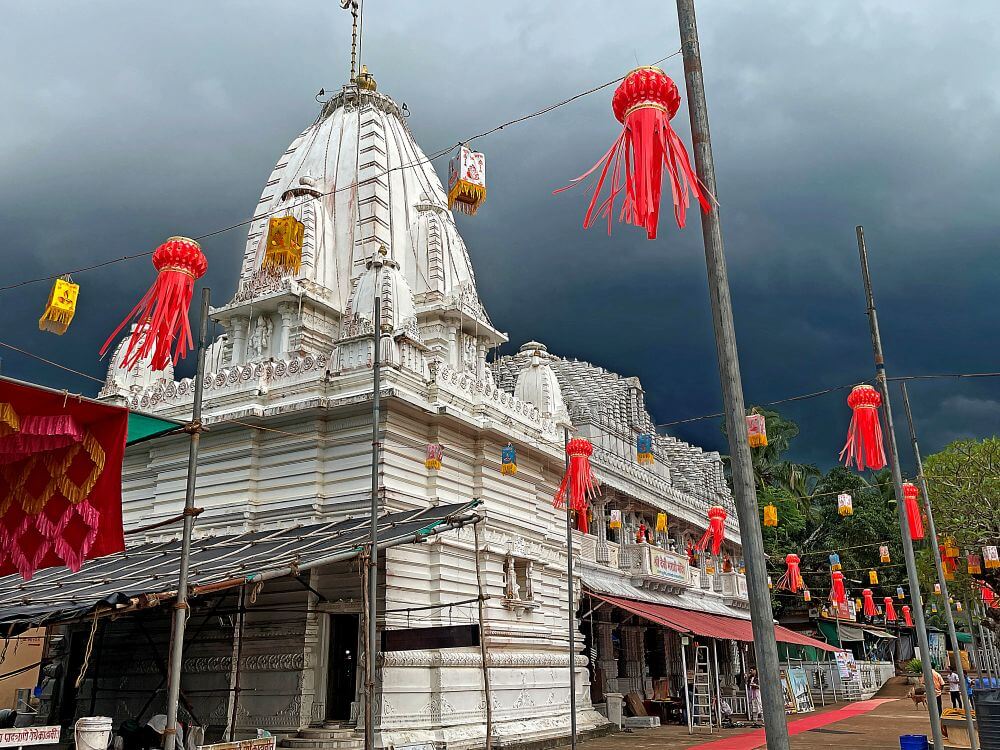
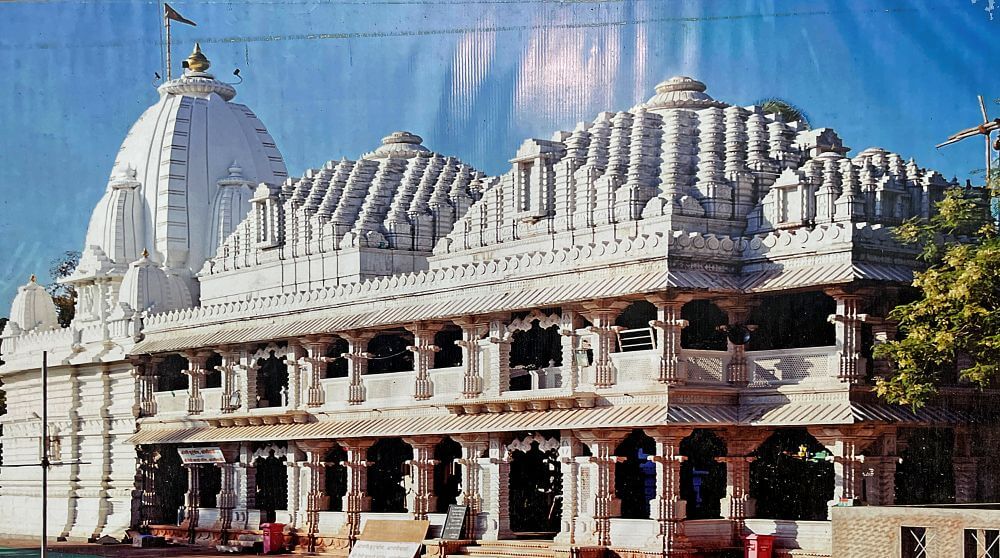
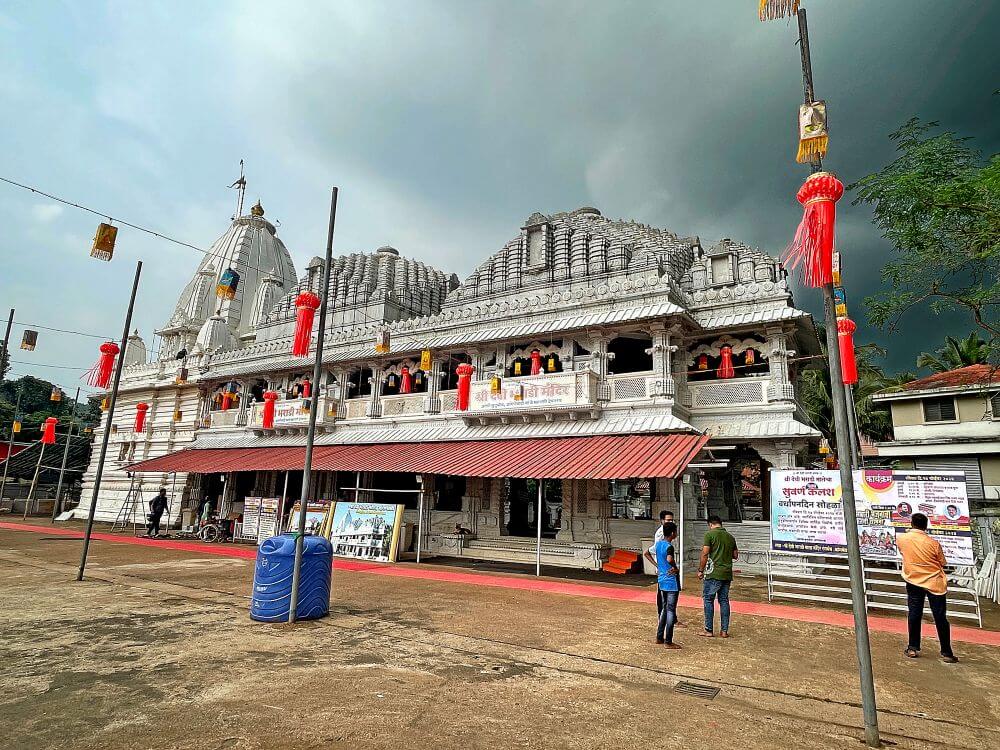
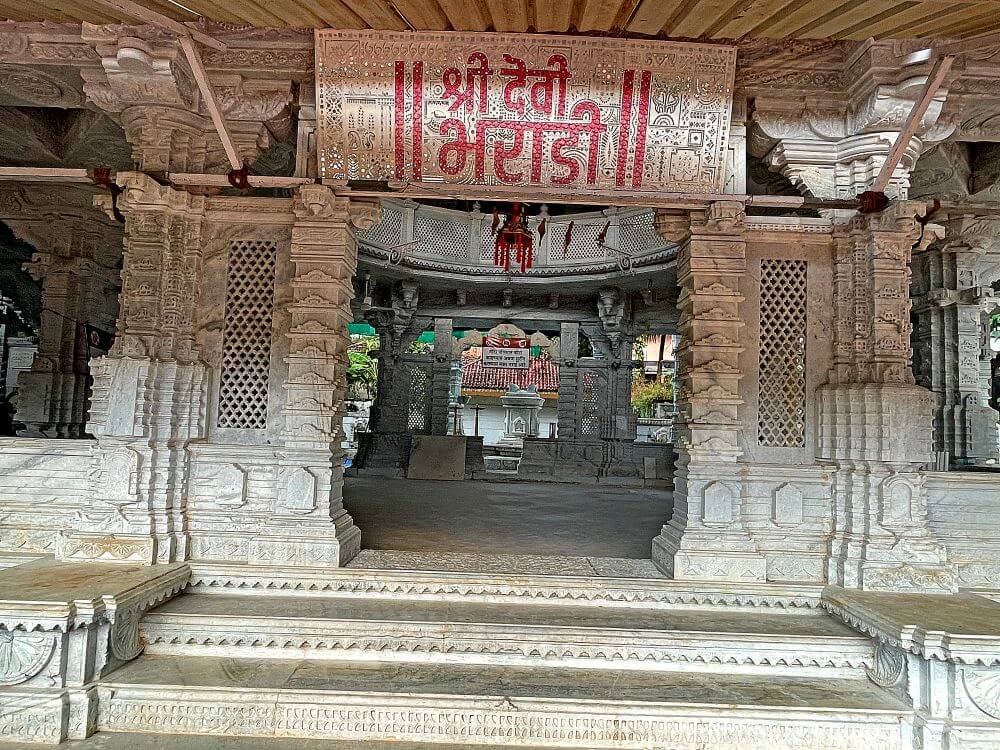
Previously, there was an old Konkani-style tiled temple here. Recently, a magnificent temple has been constructed in a spacious courtyard. This is a private temple belonging to the Angane family of Anganewadi. The temple’s construction incorporates Jain and Bhumija temple architectural styles. It is a two-storied temple. Its general structure includes an Ardhamandapa (front porch), Mahamandapa (main hall), Antarala (vestibule), and Garbhagriha (sanctum sanctorum). The Ardhamandapa and Mahamandapa feature stupa-like or Gajaprishthakara (elephant-backed) shikhara (spires). The shikhara on the Ardhamandapa is smaller in size. These shikhara have squat Amalaka (finials). The shikhara over the Garbhagriha is tall and follows the Ardhodhvara style of Nagara architecture. Ardhodhvara means straight up to the top, but at the apex, below the Amalaka, the shikhara suddenly curves inwards. This shikhara has large Devakoshthaka (niches for deities) on all four sides, with miniature replicas of the shikhara above them. Deities’ idols are enshrined in these Devakoshthaka. In all four corners of the Garbhagriha’s ceiling, there are small replicas of the main shikhara.
This temple has been constructed entirely using white marble. Its distinctive features are its grandeur and the exquisite, intricate carvings on its pillars, arches, and other sections. Within the Garbhagriha of the temple, an idol of the Devi, carved from black stone, is enshrined. During the Yatrotsav (festival), the traditional idol of the Devi is worshipped.
Behind the temple, there is a Deepmala (lamp tower) and a staircase leading to the upper floor of the temple. Carvings are also visible on the Tulsi Vrindavan (basil altar). The temple is surrounded on all sides by a boundary wall of white marble tiles. This wall has many small windows. There are large trees in the courtyard, around which platforms have been built. A large canopy is erected in this spacious courtyard during festivals.
The biggest festival of this Devi is the Yatra, which takes place in February. Unlike other divine yatras, this pilgrimage does not occur on a fixed auspicious date; instead, the day is determined by seeking the Devi’s ‘kaul’ (divine permission/oracle). On the second day after Dev Diwali, the ‘Dalmanjari’ program is held. In this, all the ‘mankari’ (honored villagers) and villagers together decide the day for a hunt. The hunt is for a wild boar. All the villagers participate in groups. The women with their husbands (suvasini) perform ‘aarti’ for those who participate in the hunt. After returning to the temple, the boar’s meat is distributed. Three days after this, the Devi’s ‘kaul’ is sought. The ‘panchang’ (almanac) is placed before Her. The day chosen by the Devi is fixed as the day of the yatra. All devotees eagerly await this date.
Devotees come here from Mumbai, Karnataka, Goa, and other states, including Konkan. Previously, a small yatra of the Devi, affectionately called ‘Devi Majhi Navsachi’ (My Devi who grants wishes), used to be held here. Malvani ‘chakaramani’ (migrant workers) from Mumbai would make it a point to attend this yatra. The attraction of this yatra grew significantly around the nineties. Year after year, the number of devotees attending this yatra has been steadily increasing. Previously, this yatra would attract २०-२५ thousand devotees, but now millions attend, including common devotees, political leaders, and celebrities.
On the day of the Yatrotsav, ‘naivedya’ (food offering) is offered to the Devi at night. In every household in the village, ‘suvasini’ (married women) observe a vow of silence while preparing the ‘naivedya’ for the Devi. The meal typically consists of dal, rice, vegetables, and ‘vadas.’ At night, all couples come in a queue. The ‘naivedya’ is offered to the Devi as a couple. Afterwards, arrangements are made for the devotees present to receive ‘prasad.’ A unique feature of Anganewadi is that devotees can partake of ‘prasad’ in any household. During this two-day yatra, programs like ‘bhajan,’ ‘kirtan,’ and ‘dashavatar’ are held. Besides the yatra, crowds also gather here at other times to fulfill their vows. For many families, Bharadidevi is their ‘Kuldevata’ (family deity).
This sacred temple stands as a testament to deep spiritual devotion, ancient architectural grandeur, and rich local cultural traditions.
The sanctum sanctorum houses the divine idol consecrated according to ancient Vedic traditions, surrounded by serene courtyards and traditional temple architecture.
Navratri, Maha Shivratri, Annual Temple Jatra & Deepotsav
Compare and book flights, secure top-rated local hotels near the temple, hire reliable guides, and rent cars instantly.
Extend your pilgrimage by visiting other highly sacred temples located nearby.


Add ₹999 more to unlock FREE SHIPPING!
Your sacred cart is currently empty.
Shop Photo FramesFill in your delivery details below to place your order.
Add comment