
Add ₹999 more to unlock FREE SHIPPING!
Your sacred cart is currently empty.
Shop Photo FramesRenuka Devi, worshipped in the form of an anthill (Varul) in Maharashtra, represents the ‘Bhumi’ or the Earth element. She is referred to as Kumari Bhumi, or ‘Kori Bhumika’ (the pristine earth). Similarly, the goddess Sateri/Santéri, worshipped in the form of an anthill in South Konkan and Goa, is known as ‘Bhumka’ or ‘Bhumika’. Sateri is considered the village deity (Gramadevata) of Sindhudurg. It is said that there are approximately 80 temples of this goddess in this district. One of the most unique among them is the Jalamandir (Water Temple) of Sateri Devi in the village of Bilvas.
Bilvas is one of the 12 Wadas (hamlets) of the famous and historical village of Masure in Malvan. The history of this region dates back to when Masure was a major market town. In the year 1664, after Lakham Sawant of Sawantwadi conquered the outposts of Shivaji Maharaj in the Kudal province and handed them over to the Bijapur Sultan, the Emperor granted him the Nadgauki of Kudal Pargana along with the villages of Pendur, Ghavnale, Malgaon, Math, Hodavade, Aravali, Redi, Arvande, and Masure as an Inam (gift). Later, Phond Sawant built the Bharatgad Fort in Masure. There is a temple of Bharteshwar in Masure. Subsequently, in the year 1765, following a treaty, this village and the fort came under British rule. Masure, a witness to many historical events, is also religiously significant. The shrine of Bharadi Devi in Anganewadi, Masure, and the temple of Sateri Devi in Bilvas are well-known.
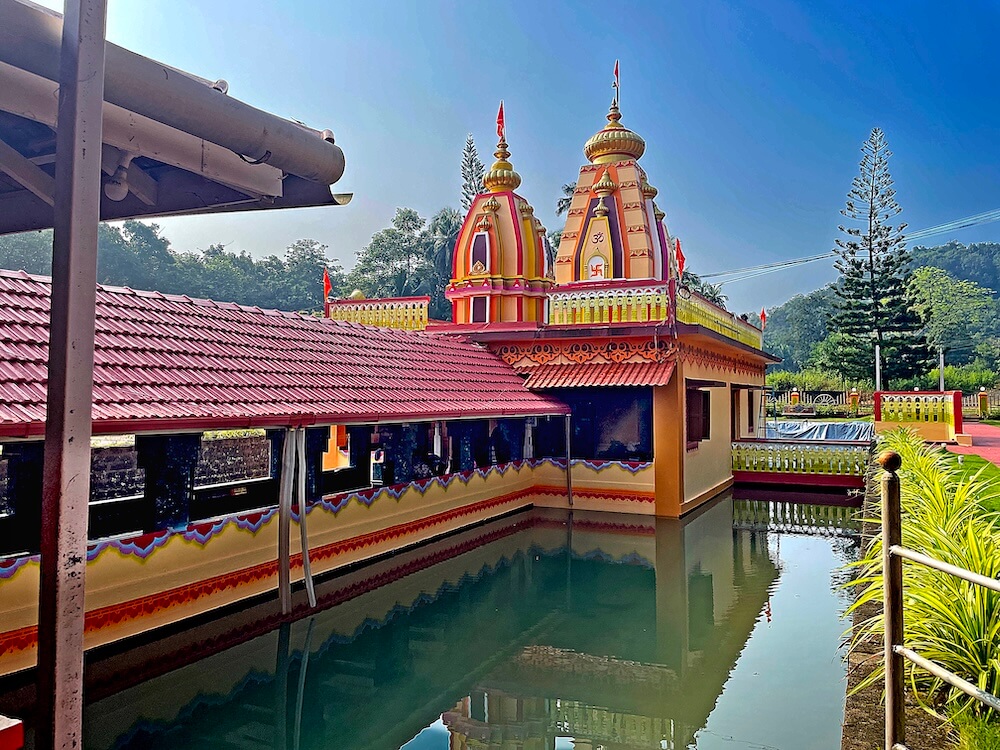
The unique feature of this Sateri Devi temple is that it is built in water. It is surrounded by water on three sides. The exact history of this temple remains unknown. According to the local legend (Kshetra Mahatmya), this shrine of Sateri has existed for 700 years. It is said that a Jain devotee of the Goddess built this temple. The legend goes that where the temple stands today, there was once a pond. The village cattle were taken there to drink water. Notably, there was an anthill in this pond. One day, blood suddenly began to ooze from the anthill. The villagers were terrified upon seeing this. A villager had a divine vision in which the Goddess revealed that she resided within the anthill, but she was being disturbed by the animals coming to drink water. She instructed him to build a temple for her there. Following this divine command, the villagers built the temple over the anthill itself. This is the Jalamandir of Sateri Devi.
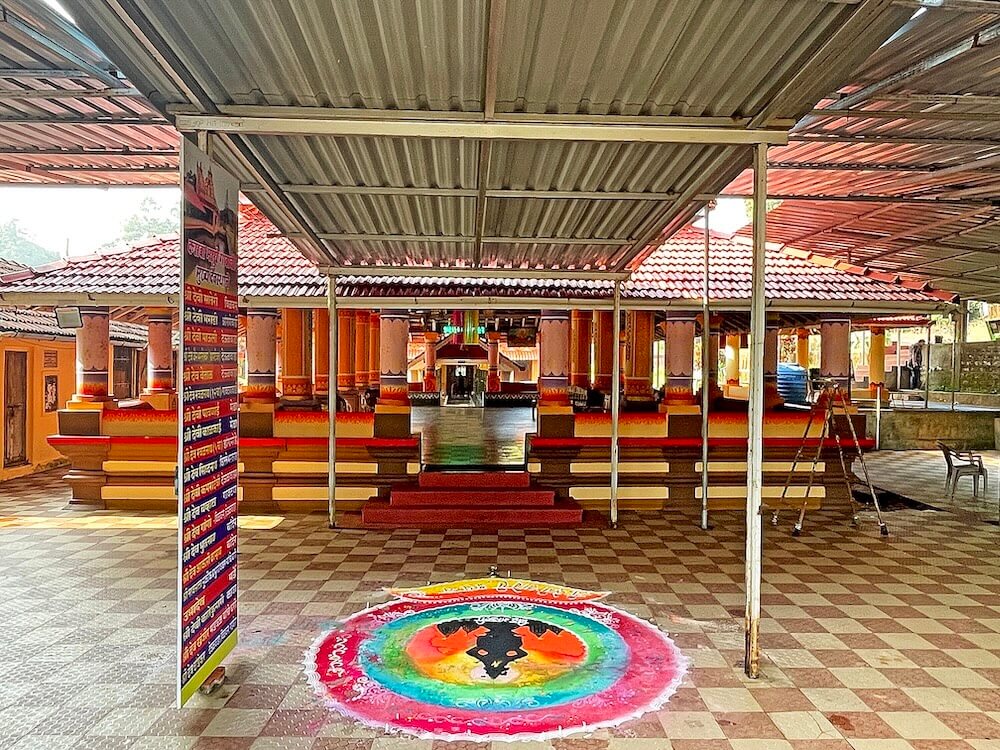
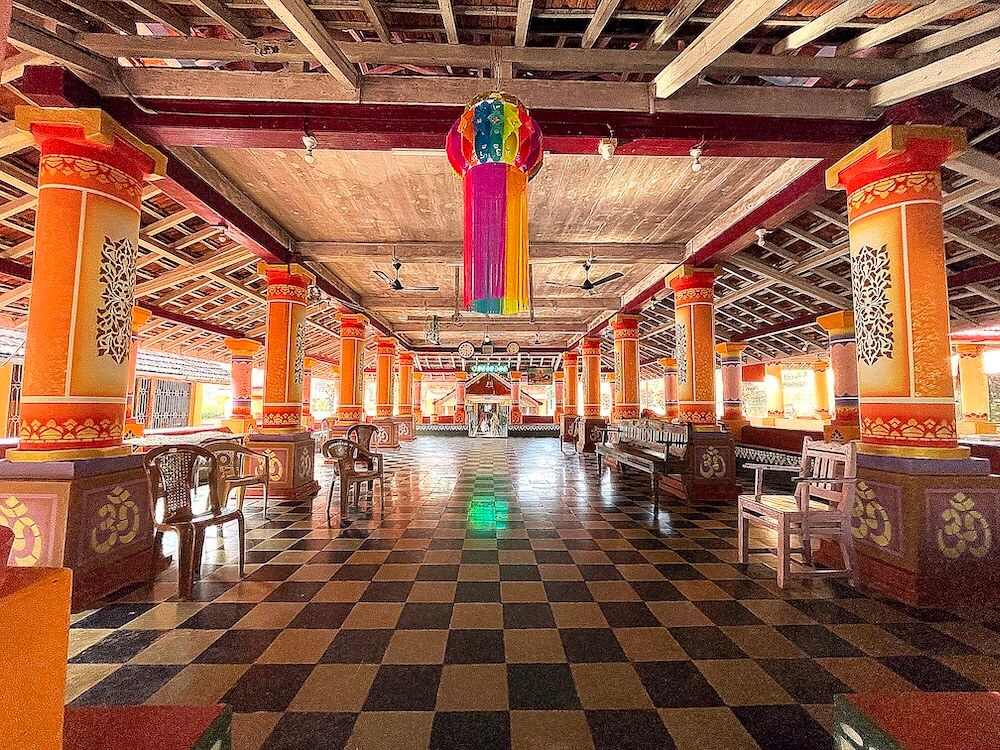
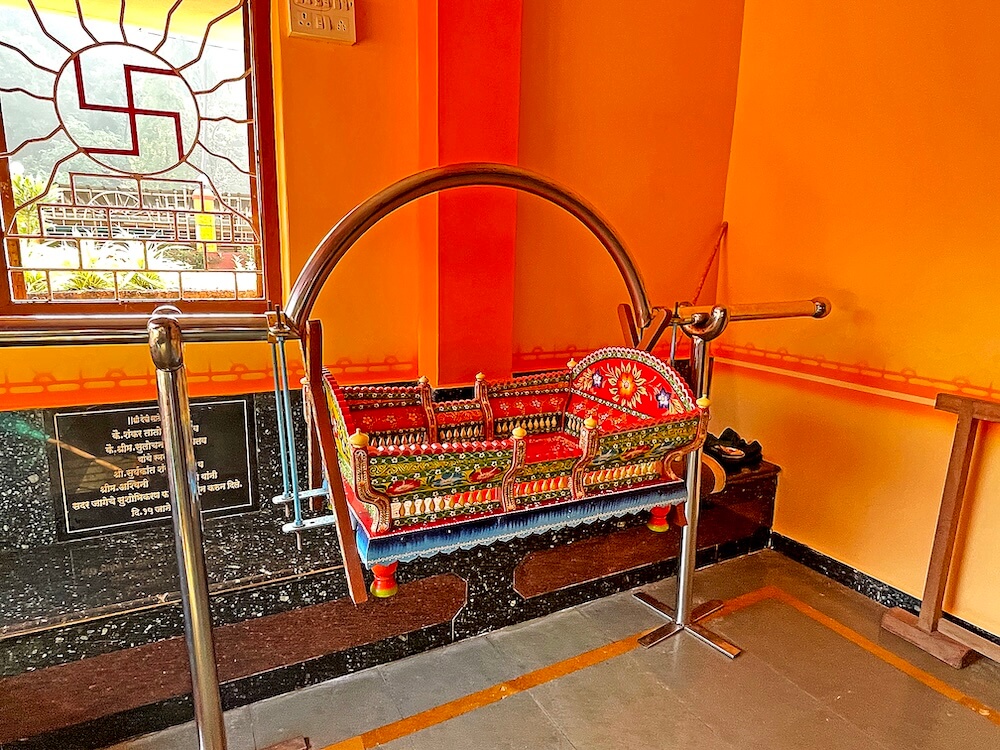
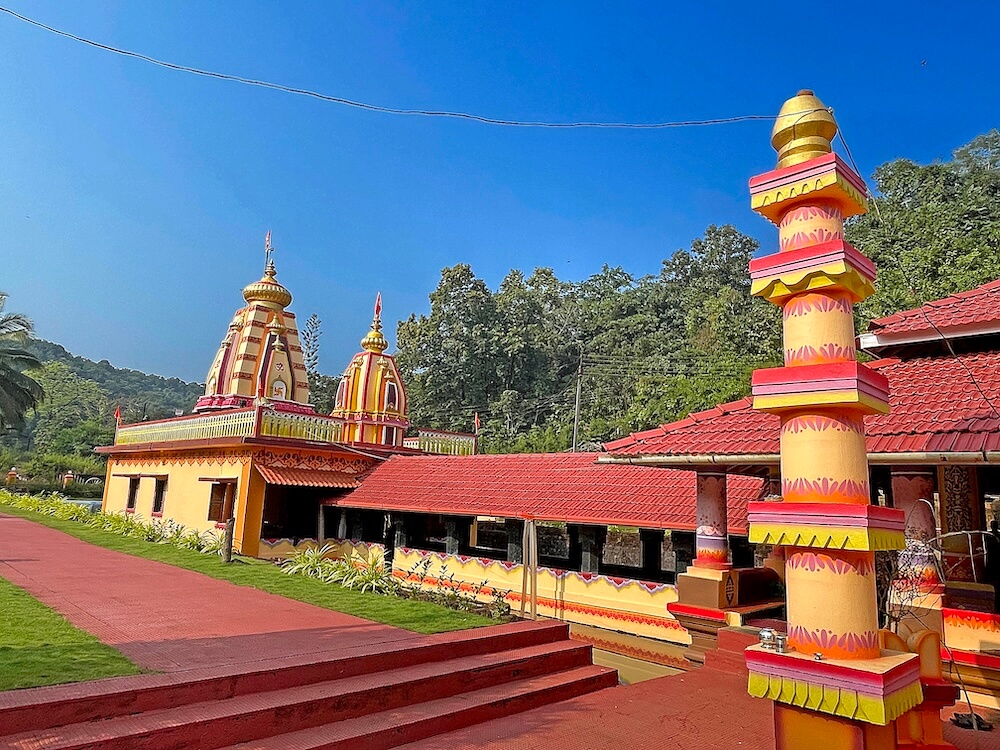
Situated in a picturesque location, a stream flows at some distance to the left of the temple. The temple faces east and is located a few feet below ground level. One enters the temple premises by descending seven steps. The structure consists of a Sabhamandap (main hall), a narrow passage leading to the temple, an Upasabhamandap (secondary hall), an Antaral (vestibule), and the Garbhagriha (sanctum sanctorum). The temple has recently been renovated and beautified. To the left of the Sabhamandap are two lamp pillars (Deepstambhas) and a Tulsi Vrindavan. The Sabhamandap is built in the Konkani style with a sloping tiled roof. There are stone benches for devotees to sit. From here, a narrow open passage with a tiled roof, built in granite, leads to the Upasabhamandap, which features large, wide octagonal pillars. The Goddess’s palanquin and the ceremonial staffs (Tarangkathya) of local deities are kept there. The doorway to the Antaral is simple and made of granite. Inside, in the center, between four wide pillars, lies the open-style Garbhagriha.
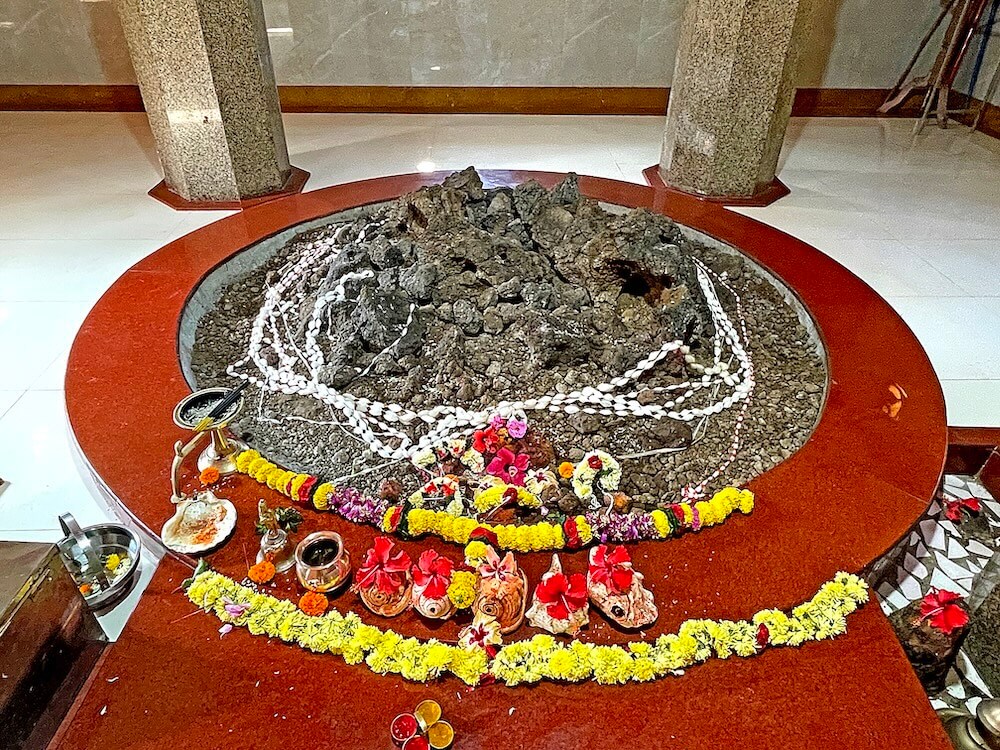
Between these pillars, slightly below ground level, the Goddess’s anthill is situated within a circular tiled area. This anthill differs from those in other Sateri Devi temples. Locals say that this anthill was once very tall, but it was damaged by the catastrophic rains on 26 July 2005, which reduced its height. The anthill is made of hard earth or rock. Many small and large bells are hung on an iron rod fixed to the front pillars of the sanctum. Devotees make vows (Navas) to the Goddess, and upon their fulfillment, they tie bells here. Water surrounds the passage and the main temple structure, resembling a large moat. There is a square tank in it. It is said that a Shivalinga is submerged deep at its bottom. There are two Shikharas (spires) on the flat roof of the Upasabhamandap and the Antaral. The Shikhara above the Antaral is tall and follows the Ardhodhvar style—straight up, but suddenly curving inwards below the Amalaka at the top. The Shikhara is crowned by a large Amalaka and a Kalash. The Shikhara above the Upasabhamandap is a smaller replica of the main one.
A beautiful garden has been created in the temple premises. Behind the temple, nine Sati stones (Satisheela) are placed. Most of these stones depict women holding weapons, suggesting their connection to wartime events. These Sati stones are witnesses to the history that unfolded in the Masure region. Behind these stones, on a slightly elevated platform, are five Vrindavans, which are the samadhis of local heroes. Adjacent to the Sabhamandap is the Dandeshwar Mandap.
The annual Yatra festival of Sateri Devi is celebrated here in the month of Ashadha. The village elders and prominent residents decide the day of the festival. As this Goddess is the deity of the twelve Wadas of Masure, this annual Yatra is held on a grand scale. On the day of the Yatra, there is a tradition of applying ‘Neel’ (indigo/dye) to the Goddess. This is prepared by mixing grass ash and oil. The Goddess’s chest (Petara) is brought to the temple with music and fanfare. The Goddess is adorned with a mask. A pot is placed in front of the Goddess, dressed in a saree and ornaments. Inside the pot, rice is placed, and a burning wick (Kakada) is lit in a coconut shell filled with oil. Every household in the village brings a plate of offerings (Naivedya). The devotees perform the ‘Oti’ ceremony for the Goddess. After this, prayers (Garhane) are offered. In the morning, the pot kept near the deity is taken out in a procession with music. Near the Gango deity, the Goddess is offered prayers again. The pot is then brought back to the temple. The Prasad kept before the Goddess is divided into two parts; one part is given to the village officials (Mankari), and the other is distributed among the devotees. After the distribution of Prasad, the Goddess’s ornaments and clothes are removed and stored away. The chest is then handed over to the Mankari. After this, no one stays in the temple. This is a unique aspect of this Yatra. Even the local shops close at night. The Yatra resumes the next morning. This does not happen in other Yatras, but the Bilvas Yatra is an exception.
Apart from this pilgrimage, festivals like Dussehra and Ram Navami are celebrated here. Religious rituals and worship in the village commence from Dev Diwali. Programs such as Gavpalan, Devi chi Parad, Holikotsav, Dussehra, Dahikala, and Gondhal are held. After Diwali, the Akhand Saptah and Dashavatar programs are conducted. It is a local tradition to keep the sanctum sanctorum of the Goddess closed for darshan for about one to one and a quarter months after Dev Diwali.
This sacred temple stands as a testament to deep spiritual devotion, ancient architectural grandeur, and rich local cultural traditions.
The sanctum sanctorum houses the divine idol consecrated according to ancient Vedic traditions, surrounded by serene courtyards and traditional temple architecture.
Navratri, Maha Shivratri, Annual Temple Jatra & Deepotsav
Compare and book flights, secure top-rated local hotels near the temple, hire reliable guides, and rent cars instantly.
Extend your pilgrimage by visiting other highly sacred temples located nearby.


Add ₹999 more to unlock FREE SHIPPING!
Your sacred cart is currently empty.
Shop Photo FramesFill in your delivery details below to place your order.
Add comment