
Add ₹999 more to unlock FREE SHIPPING!
Your sacred cart is currently empty.
Shop Photo FramesThe village of Aronda in Sawantwadi Taluka is known as a port village that served as a center for trade across the Arabian Sea since ancient times. In the past, this village was filled with abundant red lotuses. A lotus flower is also called ‘Arvind’. It is said that the village derived its name from this, which later evolved into Aronda. In this nature-rich village of Aronda, the shrines of the self-manifested (Swayambhu) Goddess Sateri and Goddess Bhadrakali are famous. Many devotees believe that these Goddesses respond to the calls of their devotees and fulfill their vows.
Aronda in Sindhudurg district is also famous for the temples of Goddess Sateri and Goddess Bhadrakali. The creek adjacent to this village serves as the natural border between the states of Maharashtra and Goa. The village is famous for the coconuts, mangoes, cashews, jackfruit, kokum, and rice grown here. Due to the ancient trading port nearby, the village has long been considered one of the prosperous ones. This is evident upon seeing the grand temple complex of Goddess Sateri and Goddess Bhadrakali. Although these temples are ۳۰۰ to ۳۵۰ years old, they attained their current form after the renovation and restoration work carried out in the year ۲۰۰۰. Since the year ۲۰۰۰, May ۱۰ is celebrated as the anniversary of this temple complex.
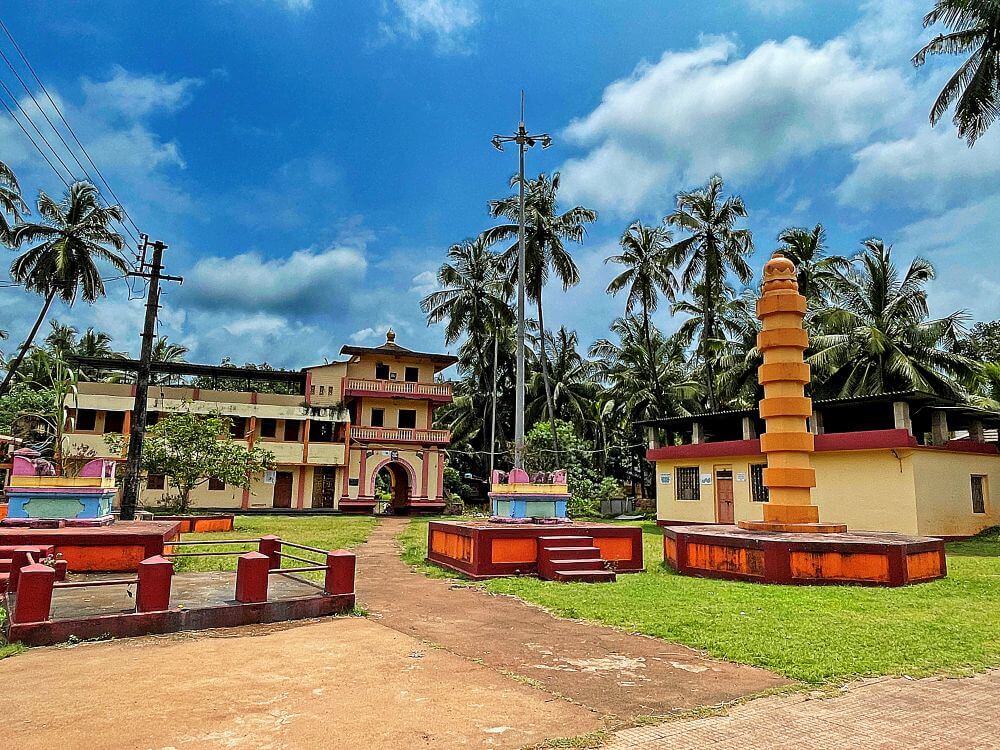
One enters the temple courtyard through a three-storied gateway of the Sateri Bhadrakali shrine located along the road. Above the arched entrance is a Kirtimukh, and on both sides are images of royal elephants waving whisks. The second and third floors of this gateway house the Nagarkhana (drum house). Adjacent to the gateway is a two-storied Dharmashala (pilgrim rest house). Upon entering through the gateway, one finds the independent temples of Goddess Bhadrakali on the right and Goddess Sateri in front. The temple premises, which house many deities, are vast. The area is further enhanced by the tall coconut trees surrounding it.
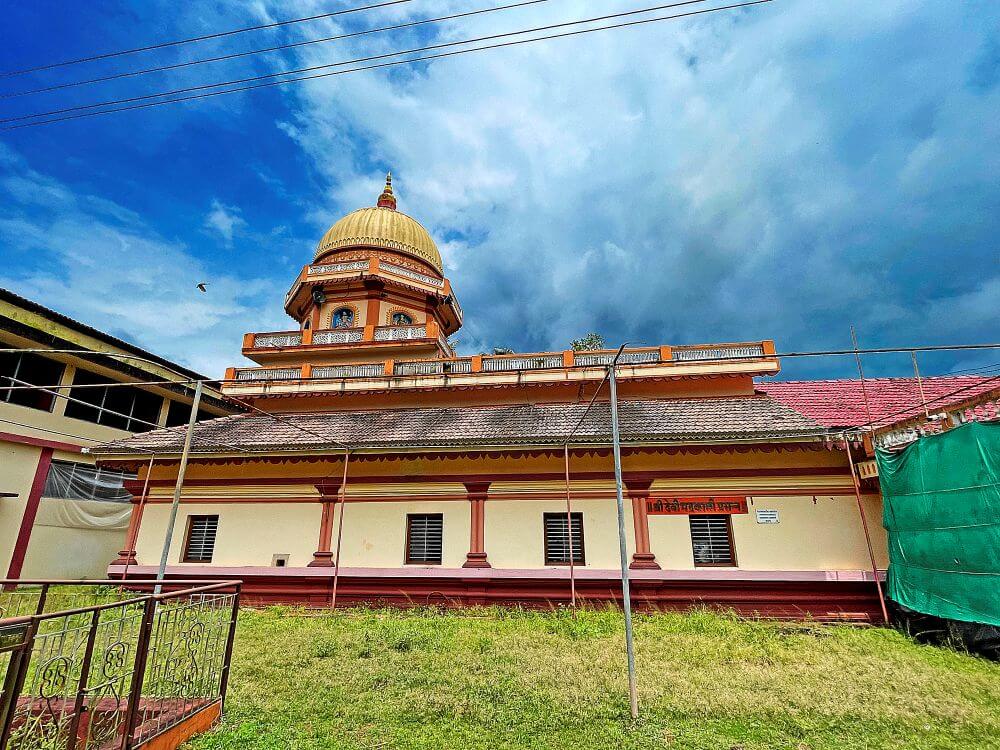
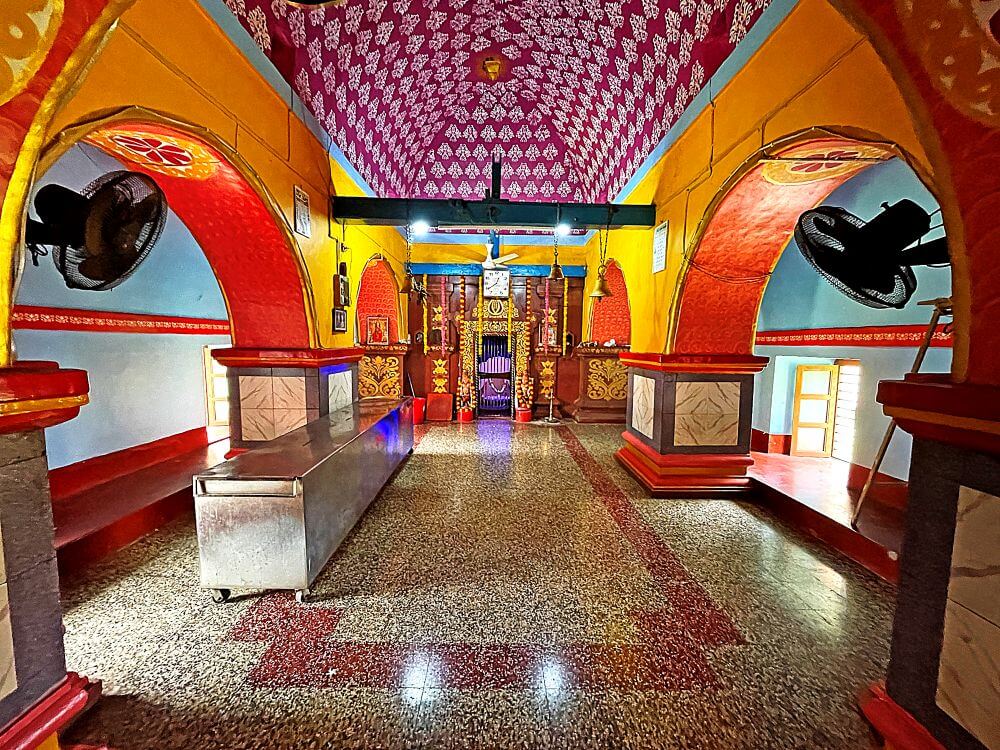
The structure of the Bhadrakali temple consists of a Mukhamandapa (front porch), Sabhamandapa (main hall), Antarala (vestibule), and Garbhagriha (sanctum sanctorum). In front of the temple entrance, there is a Tulsi Vrindavan on a raised platform. Entering from the Mukhamandapa, the Sabhamandapa is to the right, while the Antarala and Garbhagriha are to the left. This tiled Sabhamandapa features stone pillars. It is semi-open in nature, with seating arrangements (Kakshasanas) along its perimeter. The rectangular Sabhamandapa has two rows of stone pillars. These pillars are wide enough to be embraced by both hands. Following the Konkani architectural style, the floor of the Sabhamandapa between these two rows of pillars is a few inches lower. The Antarala and Garbhagriha are located in the area to the left of the Mukhamandapa, past the circumambulation path. All the pillars in the Antarala are connected to each other with arched craftsmanship. The ceiling of the Antarala is shaped like an elephant’s back (Gajaprishthakara).
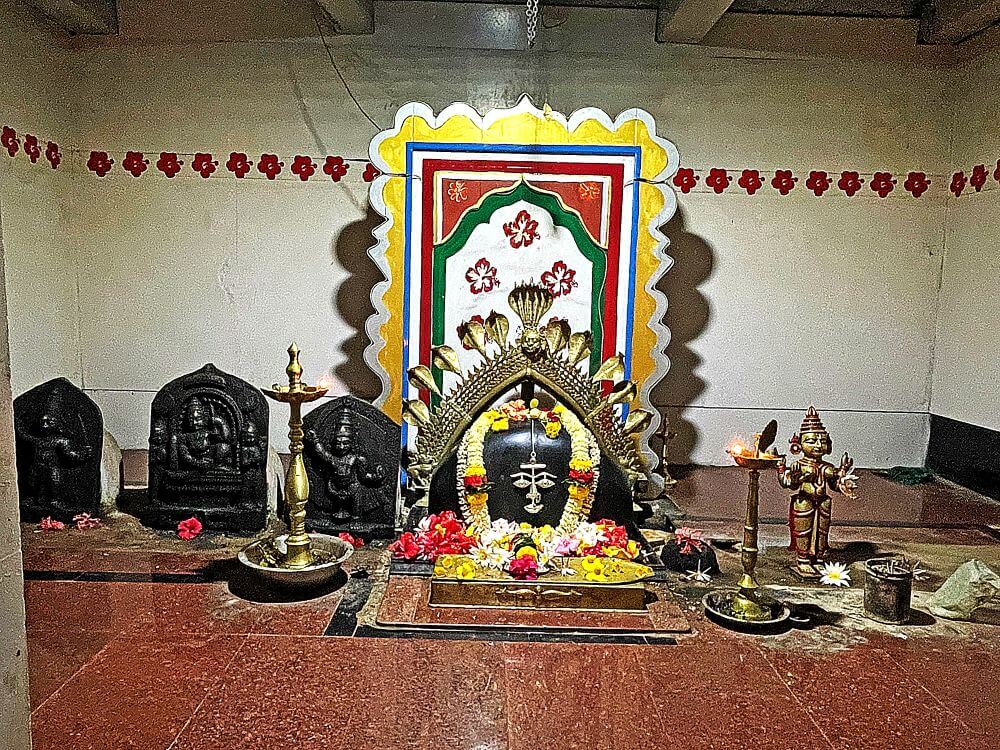
The door frame of the Garbhagriha features marble carvings, with statues of gatekeepers (Dwarapalas) on both sides. In the center of the Garbhagriha, on a Vajrapitha, stands the east-facing idol of Goddess Bhadrakali in the form of a Tandala (aniconic stone). The eyes, eyebrows, sandalwood paste on the forehead, nose, nose ring, and lips of this idol are made of silver. Behind the idol, on a metallic triangular backdrop (Makhar), there is a Kirtimukh at the top and a five-hooded brass serpent above it. On both sides of this backdrop are ten metallic hooded serpents, five on each side. Along with the idol of the Goddess, there are shrines for Dev Parab Vas, Dev Gawde Vas, Dev Purvaj, the processional idol of the Goddess, and other family deities. The spire (Shikhara) above the Garbhagriha is dome-shaped, and the layer below the spire features sculptures of various forms of the Goddess.
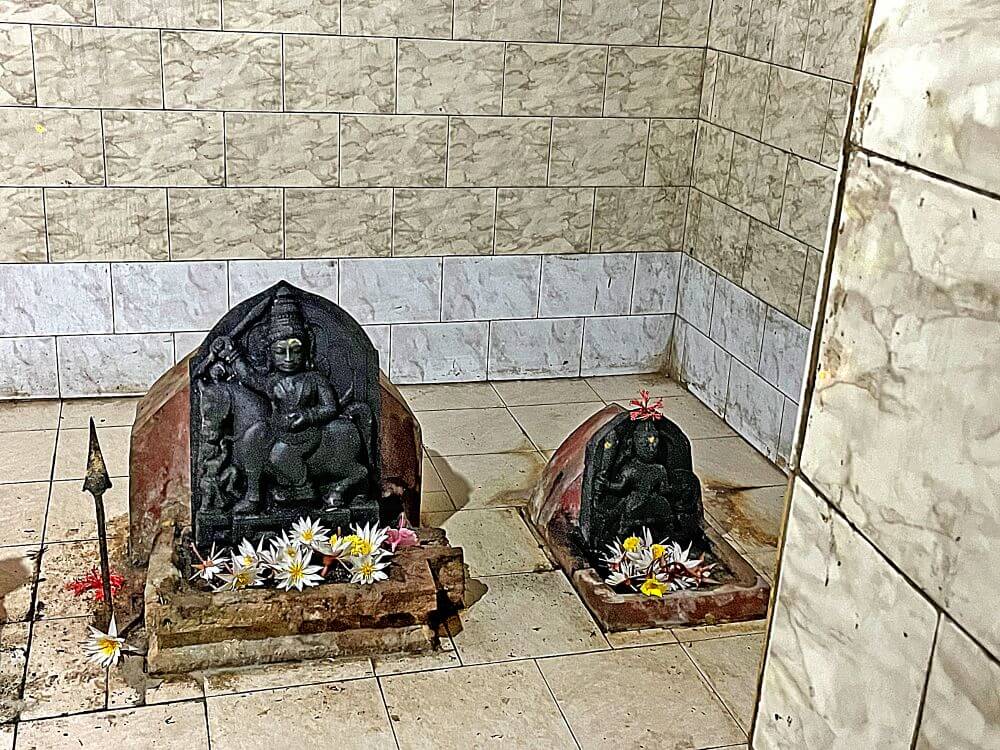
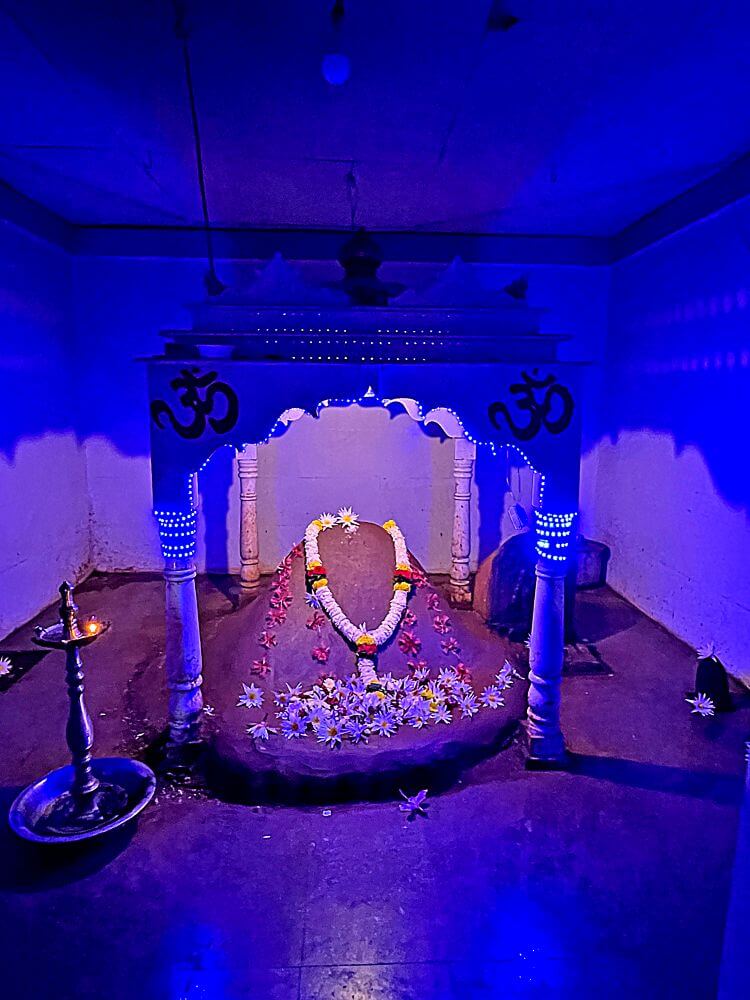
Adjacent to the Bhadrakali temple is the temple of Goddess Sateri. There are two platforms in front of this temple; one holds a seven-tiered stone lamp pillar (Deepastambha), and the other holds a Tulsi Vrindavan. The structure of the Sateri temple consists of a Sabhamandapa, Antarala, and Garbhagriha. The semi-open Sabhamandapa has seating arrangements along its sides. The Antarala here is slightly elevated from the Sabhamandapa; one enters it by climbing four steps. The Antarala is enclosed and also has seating arrangements for devotees along its sides. The pillars in the center of the Antarala are connected to each other with arch-like craftsmanship. There are statues of gatekeepers on both sides of the Garbhagriha door frame. In the center of the Garbhagriha is the north-facing idol of Goddess Sateri in the form of an anthill (Varul). Along with the main idol, the Garbhagriha also houses the idols of Dev Nathpant, Dev Jaynath, and Dev Purvaj. Above this Garbhagriha is an octagonal spire, and below it, similar to the Bhadrakali temple spire, are sculptures of various forms of the Goddess. Outside this Garbhagriha, in the temple complex, are the shrines of Dev Mulnath and Dev Dandekar, while in front are the sites of Janmadev, Brahman Dev, and Ling Dev. Additionally, the temple premises contain stones representing Akari, Nirakari, Jakarnath, Gurunath, Babar Peer, and other deities.
A grand two-day fair (Yatra) is held here on Margashirsha Shukla Chaturthi. On the first day, an Abhishekam and traditional musical worship of all the deities are performed. A Brahmin feast is held, and Mahaprasad is distributed to the devotees. At night, a palanquin procession of the deities is taken out. After the palanquin ceremony concludes around ۱ AM, fireworks are displayed. Following this, a Dashavatar play is performed until dawn. The fair concludes the next morning with the ritual bathing of the deities in the temple pond. There is a large influx of devotees for fulfilling vows, performing weighing ceremonies (Tula), and seeking the Goddess’s blessings. Married women who grew up in this village (Maherwashini) also come in large numbers to offer the traditional ‘Oti’ to the Goddess. Furthermore, the anniversary celebration held every year on May ۱۰ is also celebrated on a grand scale. On this occasion, the temple premises take on the atmosphere of a fair.
This sacred temple stands as a testament to deep spiritual devotion, ancient architectural grandeur, and rich local cultural traditions.
The sanctum sanctorum houses the divine idol consecrated according to ancient Vedic traditions, surrounded by serene courtyards and traditional temple architecture.
Navratri, Maha Shivratri, Annual Temple Jatra & Deepotsav
Compare and book flights, secure top-rated local hotels near the temple, hire reliable guides, and rent cars instantly.
Extend your pilgrimage by visiting other highly sacred temples located nearby.


Add ₹999 more to unlock FREE SHIPPING!
Your sacred cart is currently empty.
Shop Photo FramesFill in your delivery details below to place your order.
Add comment