
Add ₹999 more to unlock FREE SHIPPING!
Your sacred cart is currently empty.
Shop Photo FramesIn the Konkan region, one can see temples in every village built in the traditional Konkan style with tiled roofs, spacious assembly halls (sabhamandaps), and tall spires. However, in this very Konkan, there is a temple that has neither a sanctum sanctorum (gabhara) nor an idol. This is the Manasishwar Temple, located near the Manasi Bridge in the creek area on the Vengurla-Shiroda road. A unique feature of this shrine is that silence is strictly observed while passing through its premises. Vehicle horns, loudspeakers, musical instruments, or any kind of noise are not permitted here. People of all faiths in the village conscientiously observe this practice.
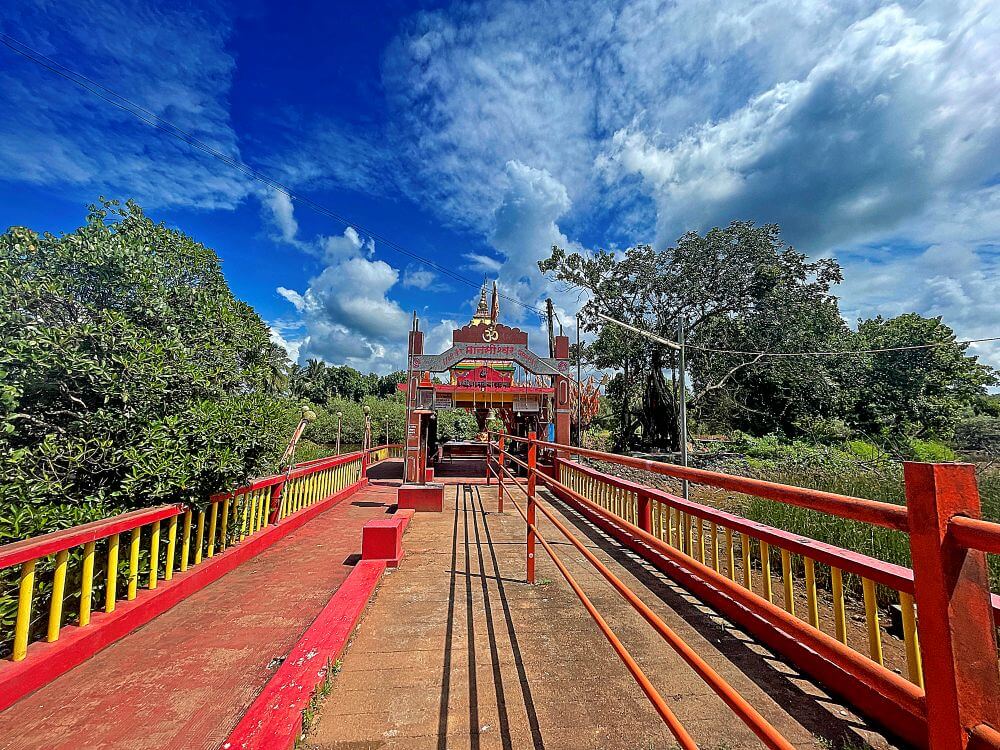
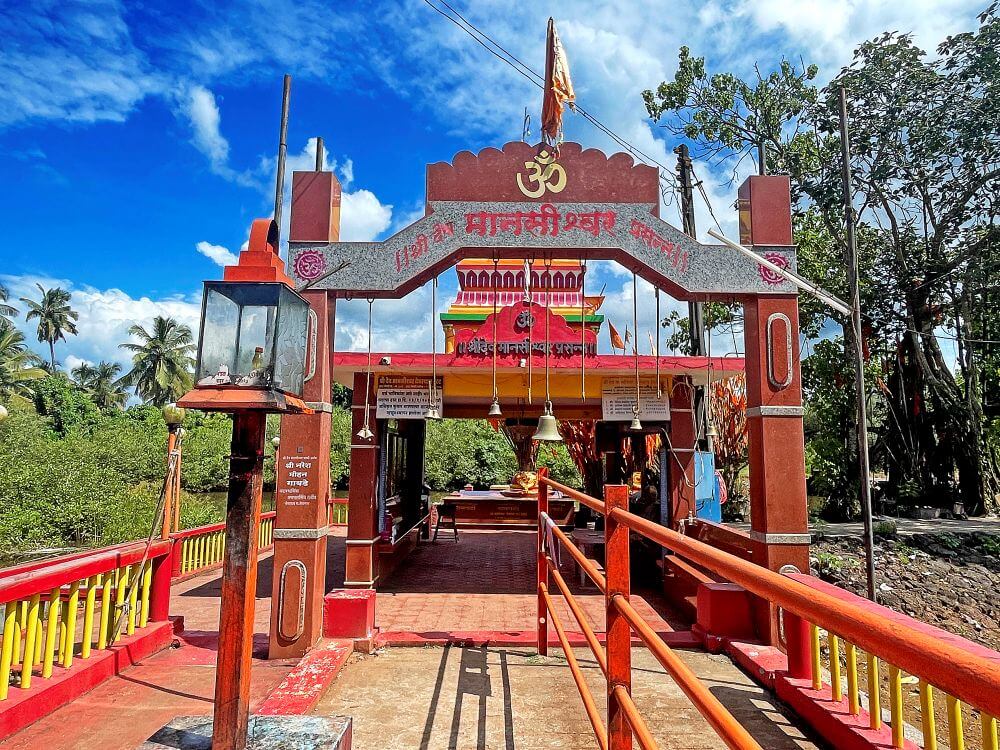
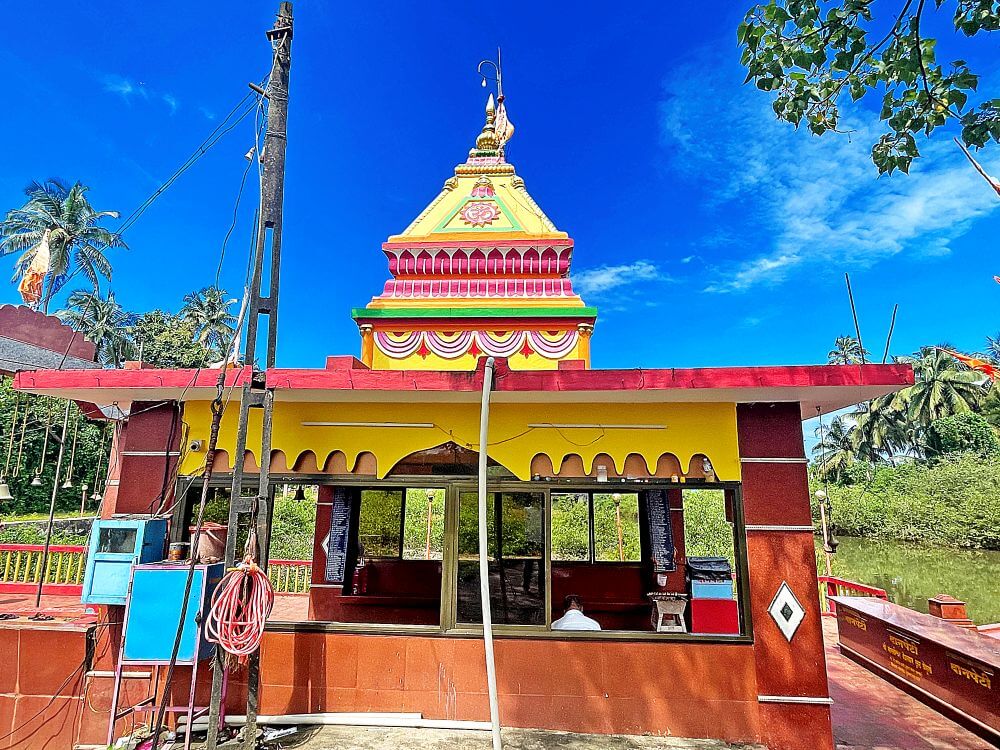
Manasishwar is considered a ‘Jagrut Devasthan’ (a spiritually awakened shrine). According to traditional belief, this deity is a Brahmin, appearing in the form of a man wearing a turban (pheta) on his head, a dhoti (pancha) around his waist, a shawl (uparane) over his shoulders, and carrying a lantern. It is said that this deity has guided, accompanied, and helped lone devotees traveling at night. The temple is situated where the Vengurla municipal limit ends on the Vengurla-Shiroda road. Near the main road, on the path leading to the temple, there is a newly constructed gateway (ves). A short distance ahead, the shrine is located at one end of the bridge over the creek. On one side of this bridge, which is wide enough for two vehicles, stands the tall gateway of the Manasishwar shrine. Many bells are hung from this gateway. Beyond it lies an open-sided assembly hall with four pillars, flanked by stone benches (kakshasanas). The roof of the assembly hall features a pyramid-shaped spire topped with an amalaka and a kalash.
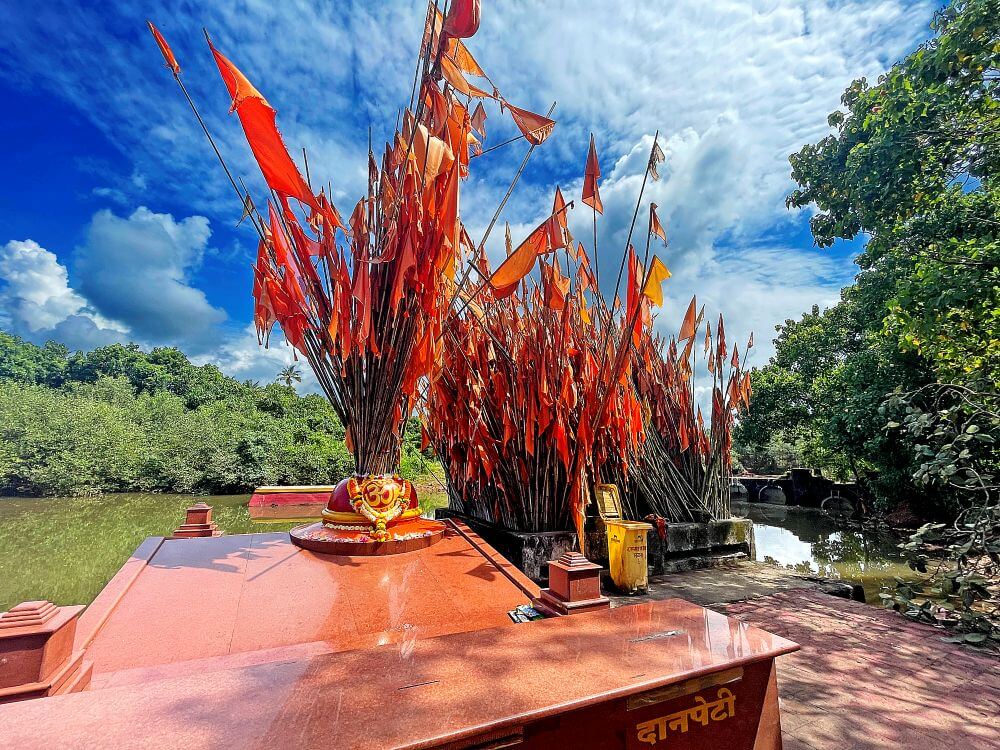
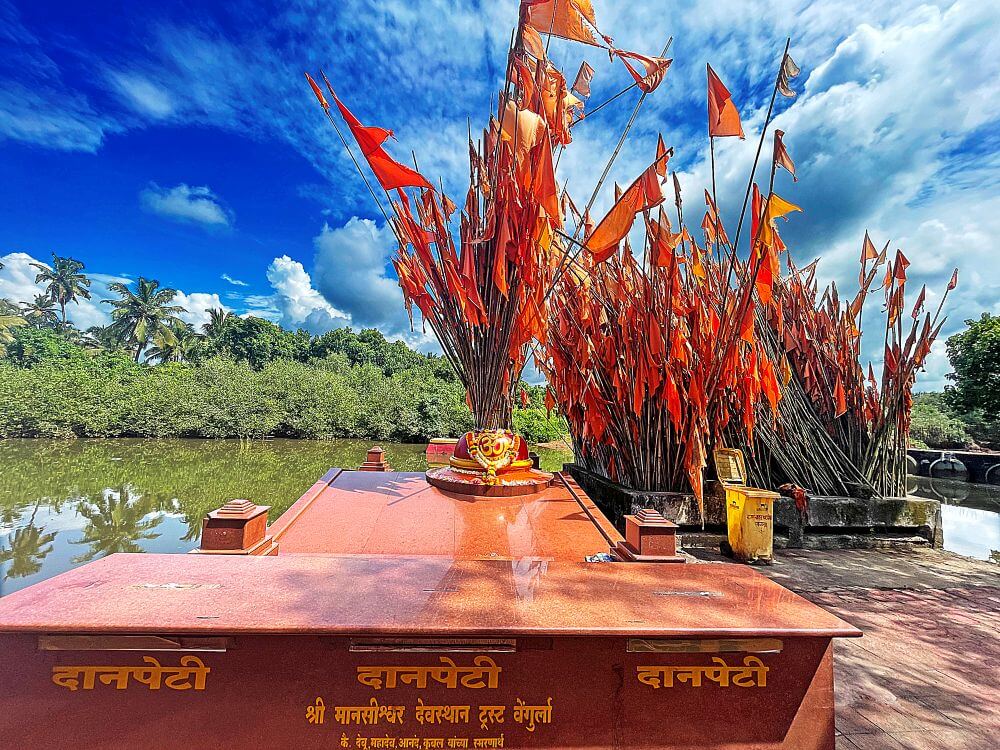
A short distance outside the assembly hall, there is a large platform built in the creek water. On it sits a saffron-colored dome-shaped structure, which is known as the ‘Devchar of Manasi’. Numerous saffron flags are planted on this dome. These flags consist of small pieces of saffron cloth tied to the top of bamboo poles. Near the platform, there is a large, square, shallow basin-like area, which also has numerous such flags planted in it. Similar saffron flags are seen in large numbers throughout the area. Beyond this, there is only water.
The legend of the temple states that this deity originally hailed from the Ghat region. Later, he came to Golvan in Malvan Taluka. His abode was an mango tree on the border of that village. He would force the deities passing through that route to pass between his legs. When the Vengurla Panchayatan—namely Ravalnath, Bharadi Devi, Sateri Devi, Rameshwar, and Bhutnath—learned of this, they provided him a place on a mango tree near the Ravalnath temple. Since this deity belongs to the Shiva Ganas, it is said that he is accompanied by a ‘Chala’ (a spirit entity). It is believed that the Ganas, Vetals, demons, ghosts, and spirits under Lord Shiva’s command are accompanied by such entities. Once, when villagers’ belongings and grains began to disappear mysteriously, Ravalnath and Rameshwar questioned the deity, who then requested to be established near a water body. Subsequently, he was established at Ubhadanda near the Manasi Bridge. Due to the Manasi Bridge, he came to be known as Manasishwar.
On the day of Somvati Amavasya, many deities and ‘Tarang’ deities pass through this place to take a holy dip at the nearby Sagareshwar beach. However, the village deity, Rameshwar, is not among them. Rameshwar travels to Sagareshwar via the Parabwada route. The legend behind this is that during one Abhyangsnan (holy bath), the Manasishwar deity expanded into a terrifying form and asked all the deities passing by to pass under his feet. Rameshwar found this insulting. When Manasishwar blocked his path, Rameshwar promised him a wonderful gift—a ten-legged horse. In reality, however, Rameshwar brought him a ‘Kurli’ (a crab). This enraged Manasishwar, and he warned that if Rameshwar wanted to pass, he must go under his feet, otherwise, he could not pass. Since then, to this day, Rameshwar does not take this route. The deity still commands great awe among devotees. Therefore, no noise is made here. Silence is maintained while passing through this part of the temple. Even vehicle horns are not blown. People of all religions in the village follow this custom. Consequently, despite the crowds during the festival, there is no glitter or clamor in the temple premises.
The annual festival of this deity is held on Magh Shukla Ashtami. Devotees from the states of Goa, Kolhapur, and Karnataka come for this festival. Offerings made to the deity include special puffed rice (churmure) and peanut laddus, bananas, coconuts, as well as bells, petromax lamps, and saffron flags tied to bamboo poles. Some devotees also offer crabs to the deity. Believers make vows to offer saffron flags or keep a petromax lamp lit throughout the night. To fulfill their vows, saffron flags are inserted into the dome or the nearby trees. On the day of the festival, at least five to six thousand such flags are installed here. Therefore, this festival is also known as the ‘Festival of Flags’ (Shidachi Jatra) or the ‘Festival of Lamps’ (Battichi Jatra). On the night of the festival, Dashavatar plays are performed in the light of the lamps.
This sacred temple stands as a testament to deep spiritual devotion, ancient architectural grandeur, and rich local cultural traditions.
The sanctum sanctorum houses the divine idol consecrated according to ancient Vedic traditions, surrounded by serene courtyards and traditional temple architecture.
Navratri, Maha Shivratri, Annual Temple Jatra & Deepotsav
Compare and book flights, secure top-rated local hotels near the temple, hire reliable guides, and rent cars instantly.
Extend your pilgrimage by visiting other highly sacred temples located nearby.


Add ₹999 more to unlock FREE SHIPPING!
Your sacred cart is currently empty.
Shop Photo FramesFill in your delivery details below to place your order.
Add comment