
Add ₹999 more to unlock FREE SHIPPING!
Your sacred cart is currently empty.
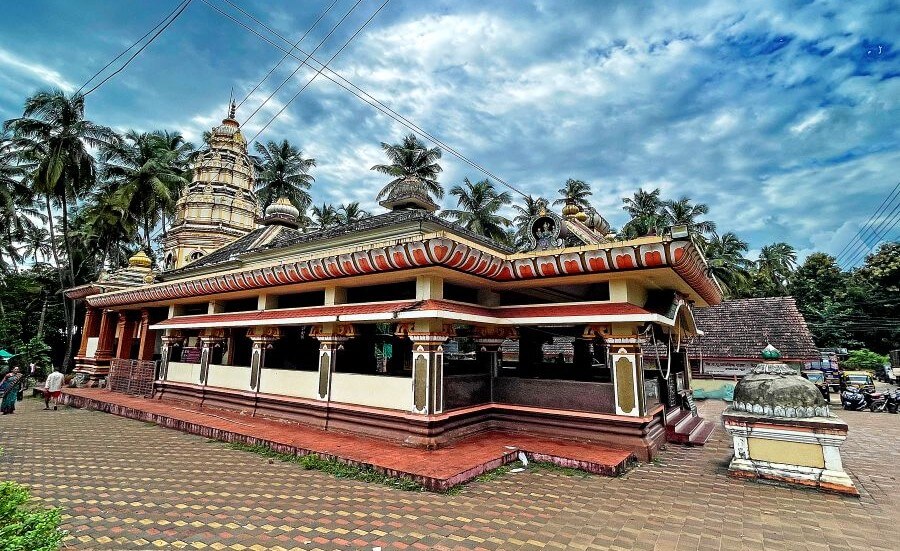
Shop Photo FramesIn the village of Ubhadanda in Vengurla Taluka, blessed with a vast coastline, stands the temple of Kepadevi, a form of Goddess Mahishasuramardini. It is said that this temple was built by the Sawantwadi Sansthan about 350 years ago. The surrounding land in the village was granted by the Sansthan for this temple, and the responsibility of serving the temple was entrusted to the Girap family. Devotees believe that this is a ‘Jagrut’ (awakened) shrine and that the Goddess is one who grants wishes.
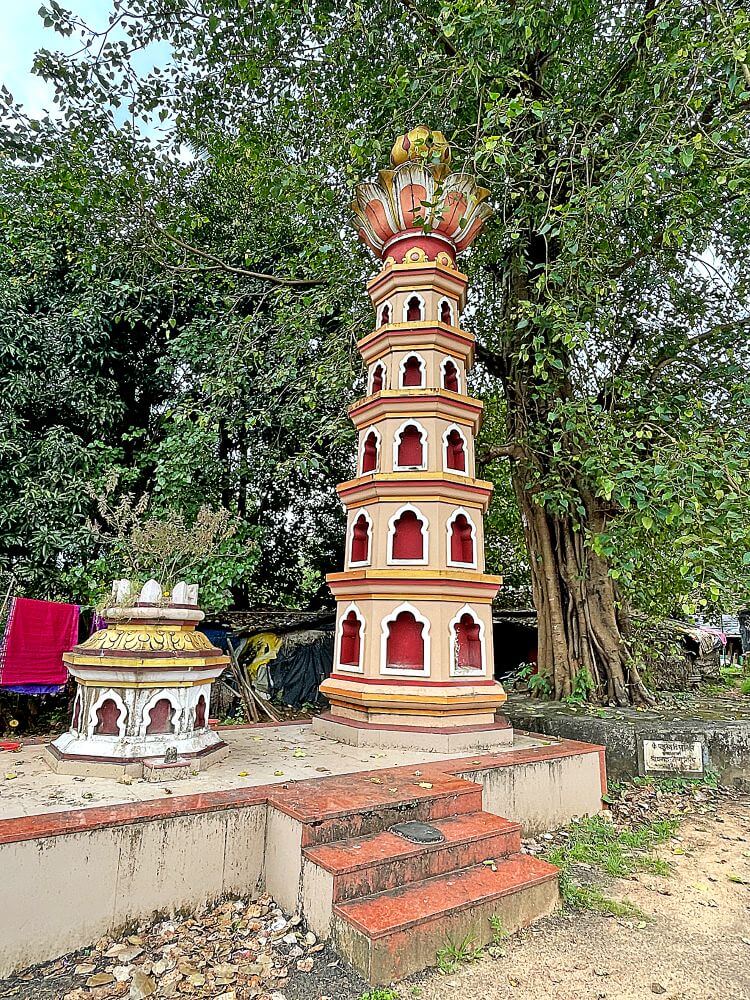
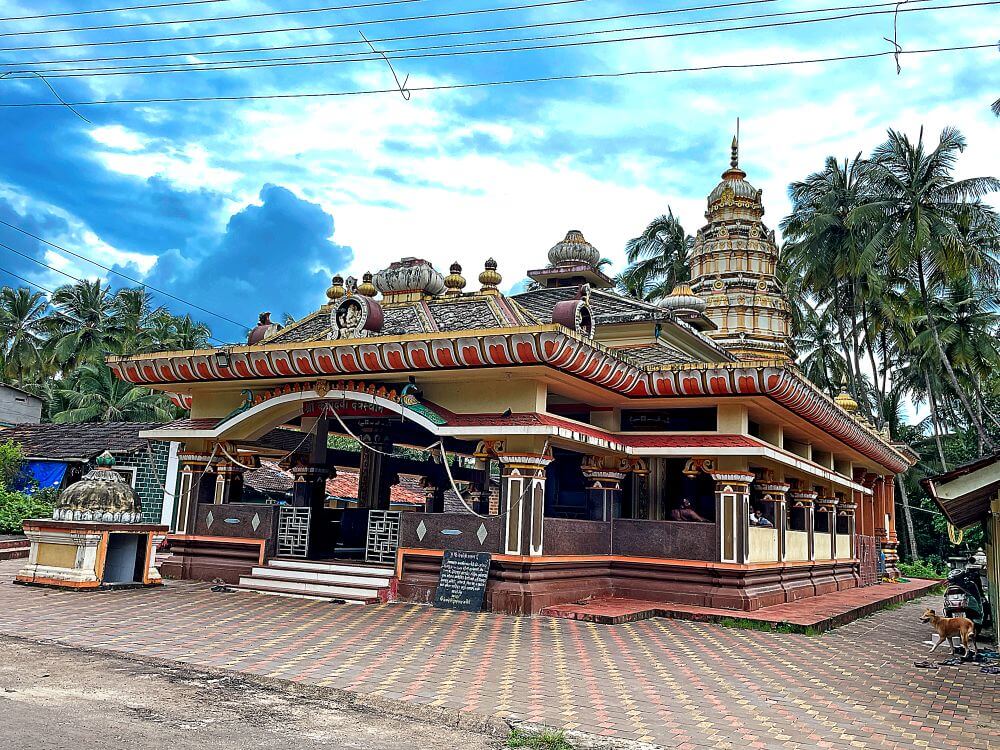
The temple is located in the heart of the village, surrounded by residential houses. On February 8, 2008, an accident occurred here while construction work was underway on a retaining wall. A dumper’s brakes failed, and it crashed heavily into the front part of the ancient temple, causing a large portion of the Sabhamandapa (assembly hall) to collapse. At that time, believing it to be ‘God’s will,’ all the villagers came together and decided to build a new structure. Through the unity of the villagers, the current spacious temple of the Goddess was erected. In front of the temple, on a platform, stands a Tulsi Vrindavan and a six-tiered Deepastambha (lamp pillar). This pillar is carved with small shrines on all sides and is topped with a pot-shaped floral design. The Deepastambha is lit during festivals. There is a large open ground between the temple and the platform of the Deepastambha, which serves as a thoroughfare for the villagers.
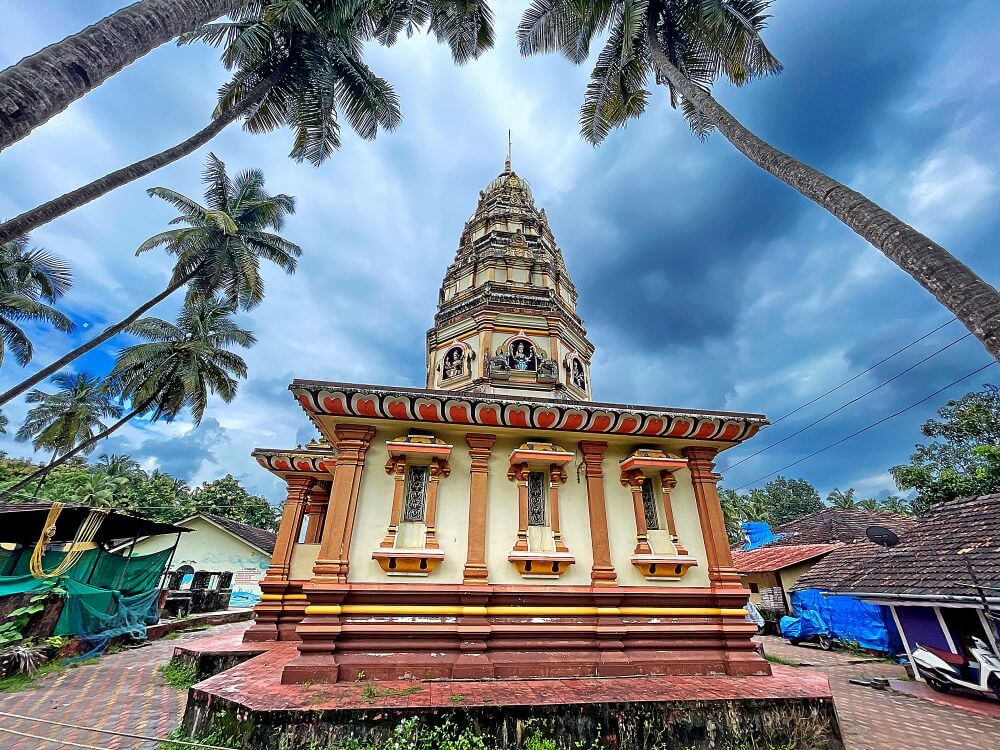
The temple is designed in the modern Konkani style. It consists of a Mukhamandapa (entrance porch), an adjoining semi-open Sabhamandapa, an Antarala (vestibule), and the Garbhagriha (sanctum sanctorum). The gutter-like shape of the roof edges on all sides and the seated finials on the roof give the temple a unique appearance. There is a small shrine beside the steps of the temple entrance. This is a ‘Chalya’ temple, designed to prevent any evil forces from entering. A ‘Kaul’ (divine oracle) is sought from the Goddess, and vows of bananas and coconuts are offered to her.
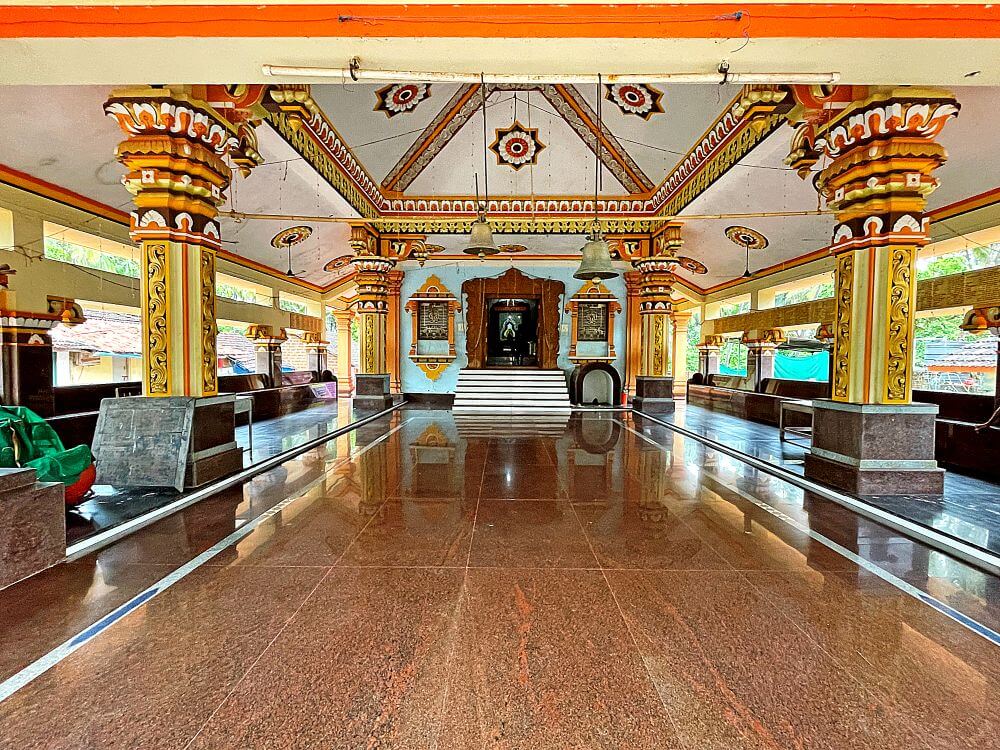
After climbing the four steps of the main entrance, one enters the Mukhamandapa. Above the Mukhamandapa is a semi-circular arch featuring peacocks on both sides and a Vyala sculpture in the center. Adjoining the Mukhamandapa is the spacious Sabhamandapa. The Sabhamandapa is semi-open, with square pillars instead of outer walls, connected by a horizontal beam. There is a continuous stone bench (Kakshasana) along the lower side. Inside, at some distance, are large, ornately carved and painted pillars. These pillars are raised on high square pedestals and topped with pot-and-foliage designs. At the top of these pillars, on all three sides, are beautiful carved brackets. The sloping Konkani-style roof is decorated from the inside with floral and star-shaped carvings. The Sabhamandapa is airy and well-lit.
There are seven steps to enter the Antarala in front. To the right, on the floor of the Sabhamandapa, is a small semi-circular shrine of the Niti Devata (Goddess of Justice). The entrance to the Antarala is made of wood and features exquisite carvings. This entrance is double-branched with an ornate frame. On the walls of the Antarala, on both sides, are windows shaped like shrines. In the center of the Antarala is the Garbhagriha, surrounded by a circumambulatory path (Pradakshina Marg). The Garbhagriha stands on a pedestal with two sturdy, carved pillars. The wooden door of the Garbhagriha is also double-branched and intricately carved. Above the frame, at the Lalatabimba, is a relief sculpture of Lord Shiva, flanked by elephant figures. Above that, in the center, the face of Mahishasura is carved.
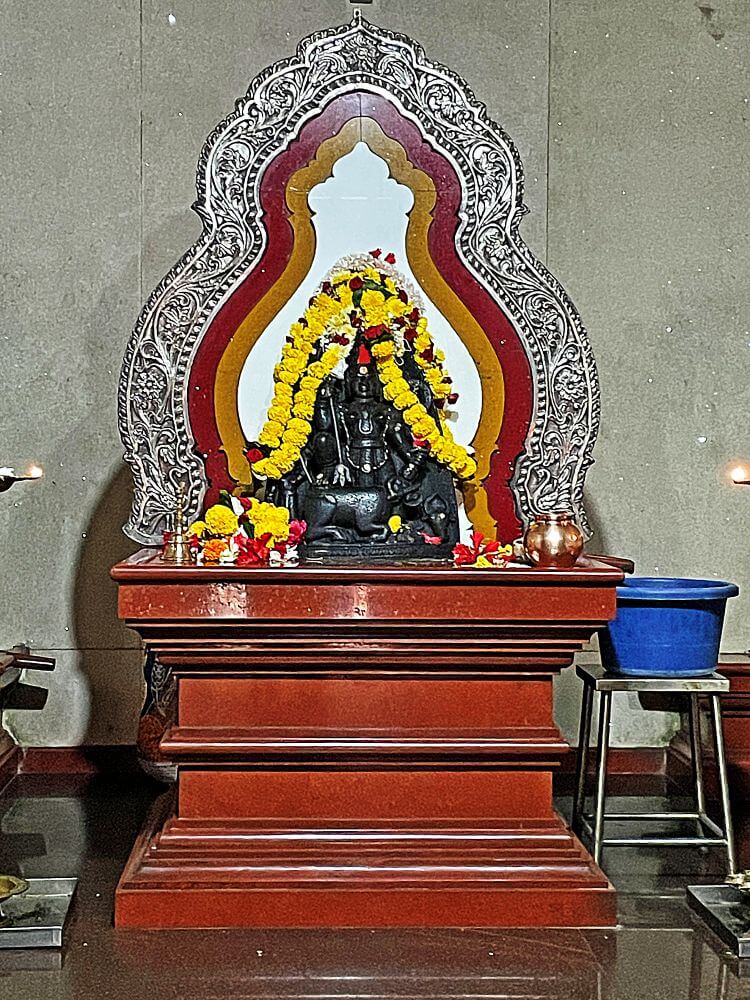
Inside, on a high Vajrapitha (throne), within a silver Prabhavali (halo), is the triangular black stone idol of Kepadevi. The idol is armed and four-armed; she holds a sword in one hand, a shield in the second, a trident in the third, and the head of Mahishasura in the fourth. The idol depicts the Goddess having beheaded Mahishasura after cutting off the buffalo’s head to extract the demon hiding within its belly; the severed head of the buffalo lies to the side. However, the Goddess’s face remains calm and gentle. To the right of the sanctum are the idols of Purvas, Girvas, and two Brahmin figures, while to the left are the idols of Jalbandeshwar, Helekar, and two other deities. The Garbhagriha is topped by an old-style five-tiered Shikhara (spire). The lower tier features small shrines on all sides. The Shikhara is crowned with a dome-shaped Amalaka and a tall finial.
Many legends are told about this temple. One such legend is that in the 15th and 16th centuries, the Portuguese severely persecuted Hindus in Goa. At that time, many Hindus fled, carrying the idols of their deities with them. The Goddess from the village of Kep in Goa was similarly migrated and brought here, and her responsibility was entrusted to a pious man from the Girap family. The name Kepadevi was derived from the name of the village, Kep. Another legend regarding the name is that the Goddess once appeared in the dream of a pious man from the Girap family. She told him, “I am in the Kegadya (Kewada/Pandanus) forest.” When he searched the place he saw in his dream the next day, he found the idol of the Goddess. He brought it to the village, installed it, and began worship. Since the idol was found in the Kegadya forest, it was named Kegada Devi, which later evolved into Kepadevi. According to some, in the Malvani language, ‘Kirpa’ is derived from ‘Krupa’ (grace). As this Goddess is the one who bestows grace (Kirpa), she came to be known as Kirpa Devi, which eventually corrupted into Kepadevi.
Although this Goddess is the family deity (Kuldevata) of the Girap family, everyone bows before her. The seven wards—Kurlewadi, Dicholkarwadi, Beherewadi, Chamankarwadi, Karangutkarwadi, Kambaliwadi, and Tulaskarwadi—are the ‘Mankaris’ (honored representatives) of the Goddess. All seven Mankaris must be present for every festival of the Goddess. The Giraps are the priests of the Goddess and perform all her services.
Festivals such as Gudi Padwa, Navratri Utsav, Dussehra, and Kalashtami are celebrated with great grandeur at the temple. The Devi’s Jatra (fair) is held on Margashirsha Shuddha Dashami. On this day, various programs are conducted in the temple throughout the day. In the morning, the ‘Oti’ of the Goddess is filled. She is adorned with a saree and decorated with jewelry. In the afternoon, Samaradhana (Mahaprasad) is organized. In the evening, a procession of the Goddess is taken out in a palanquin. Ritualistic worship of the Goddess is performed, and various ceremonies are conducted. At night, a Dashavatar play is performed. The temple’s anniversary falls on Vaishakh Krishna Panchami, during which large-scale programs are also held. The Goddess is held in high reverence, especially by female devotees. Before undertaking any important task or making a decision, many devotees seek the ‘Kaul’ (divine guidance) of the Goddess. The temple trust organizes social initiatives such as eye check-up camps, health camps, and blood donation camps.
This sacred temple stands as a testament to deep spiritual devotion, ancient architectural grandeur, and rich local cultural traditions.
The sanctum sanctorum houses the divine idol consecrated according to ancient Vedic traditions, surrounded by serene courtyards and traditional temple architecture.
Navratri, Maha Shivratri, Annual Temple Jatra & Deepotsav
Compare and book flights, secure top-rated local hotels near the temple, hire reliable guides, and rent cars instantly.
Extend your pilgrimage by visiting other highly sacred temples located nearby.


Add ₹999 more to unlock FREE SHIPPING!
Your sacred cart is currently empty.
Shop Photo FramesFill in your delivery details below to place your order.
Add comment