
Add ₹999 more to unlock FREE SHIPPING!
Your sacred cart is currently empty.
Shop Photo FramesAjgaon, a village in Sawantwadi Taluka rich in history and nature, was known in ancient times as ‘Adyagram’. According to the Amarkosha, ‘Ajgava’ means ‘Pinaka’, the bow of Lord Shiva. It is said that the name of the village, Ajgaon, may have been derived from this. As the village is associated with Lord Shiva, its presiding deity is also from the Shiva Gana, namely Vetal or Vetoba. Devotees believe that this deity is ever-vigilant, rushes to the aid of devotees in times of crisis, and grants their wishes. After their vows are fulfilled, devotees offer bunches of bananas and footwear to the deity.
Vetoba is considered a devotee of Shiva and the lord of spirits and ghosts. According to the story in the Shatarudra Samhita of the Shiva Purana, Vetal was originally a gatekeeper for Shiva and Parvati. Once, when he blocked Parvati’s path at the door, she cursed him, saying, “You shall take birth as a human on Earth.” According to the Kalika Purana, in his previous birth, Vetal was a Shiva-messenger named Bhringi. He had a brother named Mahakala. Due to Parvati’s curse, both brothers were born on Earth to Queen Taravati, wife of King Chandrashekhara, as Vetal and Bhairava. They were not the biological sons of King Chandrashekhara; they were born to Taravati by the grace of Shiva. When King Chandrashekhara distributed his wealth among his children, Bhairava and Vetal, not being his biological sons, received nothing. They then went into the forest to perform penance. Later, by the grace of Sage Vashistha, they had a vision of Shiva, and through the blessings of Goddess Kamakhya, they were granted a place among the Shiva Ganas.
Over time, the ‘la’ in Vetal was replaced by the honorific suffix ‘ba’, and he came to be known as Vetoba. He is one of the eight Bhairavas and is also considered a Kshetrapala, a village deity, or a village protector. Devotees believe that Vetoba patrols the village at night with his army. He walks to protect the village with a staff in his hand and a coarse woollen blanket (ghongadi) on his shoulders. His footwear wears out during these patrols. Therefore, out of gratitude or to fulfill a vow, devotees offer him footwear. Large-sized footwear offered by devotees can be seen at the Vetoba temples in Aravali and Ajgaon.
According to the local legends narrated by the villagers, the Vetoba temple in Ajgaon dates back to the fourteenth or fifteenth century. Previously, there was a simple tiled, mud-walled temple here. In the year १८६१, an idol made of golden champa wood was consecrated in this temple. However, as that wooden idol deteriorated, it was formally immersed on १९ May १९७६, and a Panchadhatu (five-metal) idol of Vetoba was installed in its place. This idol was crafted by sculptor Laxman Rajaram Ajgaonkar from Bandra-Kalanagar, Mumbai. As the Vetoba temple had also become dilapidated, the villagers decided to renovate it. For this, as per tradition, the ‘Hukum’ (divine command) of Vetoba was sought. Usually, a ‘Kaul’ (oracle) is taken from deities, but it is believed that the Vetoba of Ajgaon gives a ‘Hukum’. For this, rice grains are placed on Vetoba. If he gives the ‘right-side’ sign, it is believed that he has consented to the proposed work. Regarding the command for the renovation of the Vetoba temple, it is said that even after the villagers prayed for his command, it was not received for many days. Finally, when the villagers promised Vetoba that they would also renovate and restore the temples of his family deities—Bhumka Devi, Ravalnath, Adityanath, Rameshwar, Sarveshwar, Bhargavram, Narayan, and others—only then did Vetoba grant permission for the temple renovation. Accordingly, a grand and beautiful temple of Vetoba was built here in २०१२.
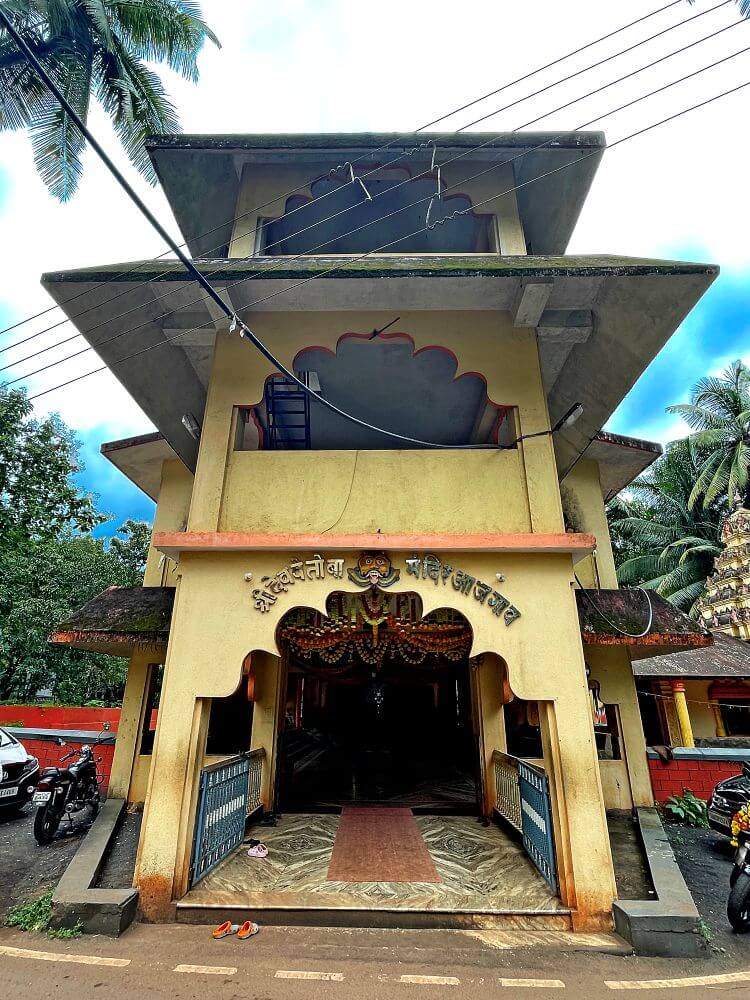
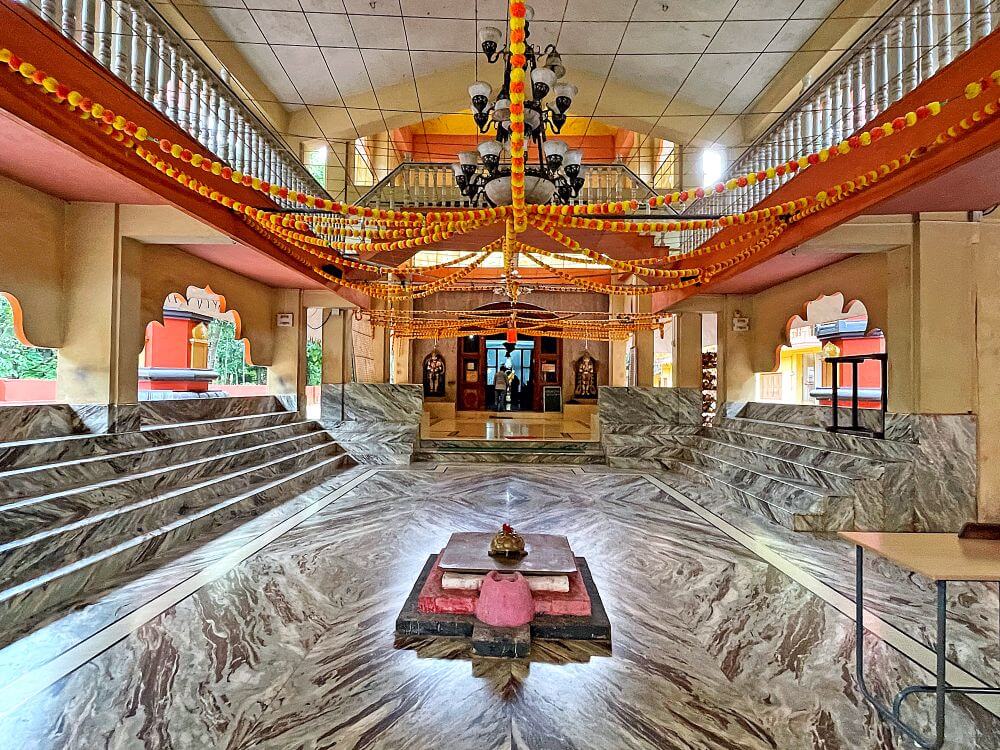
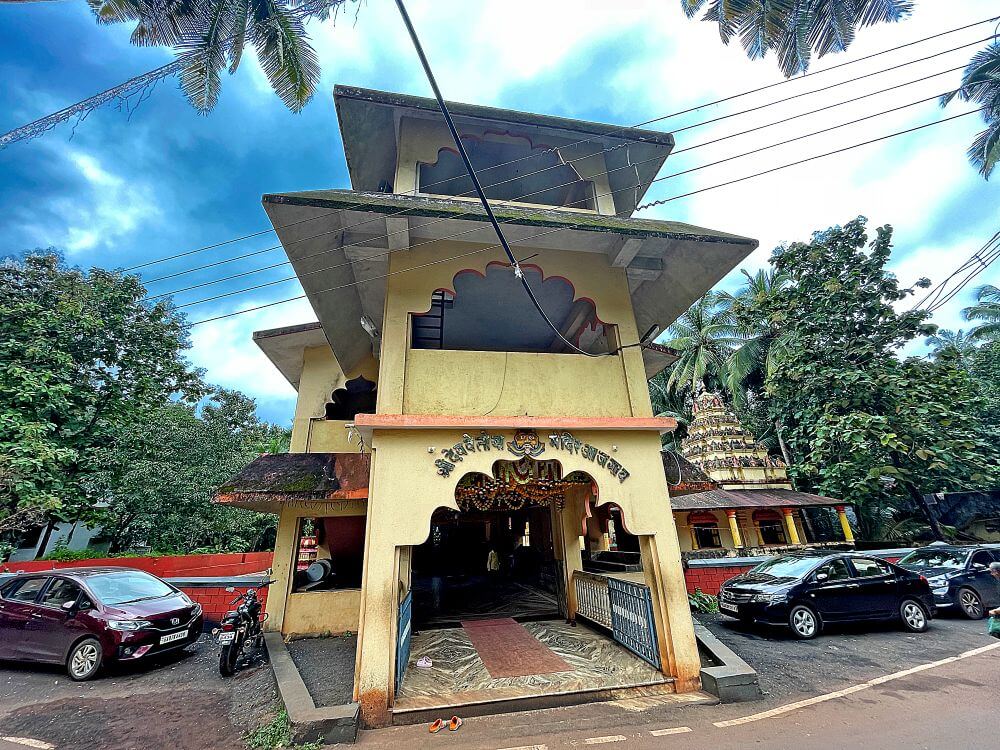
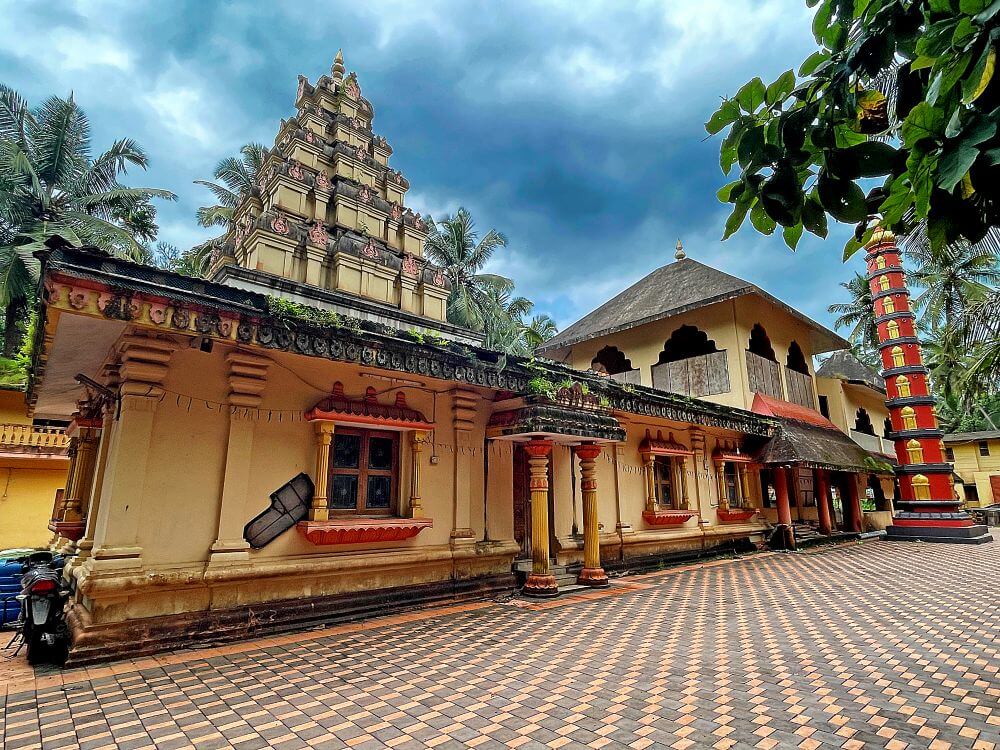
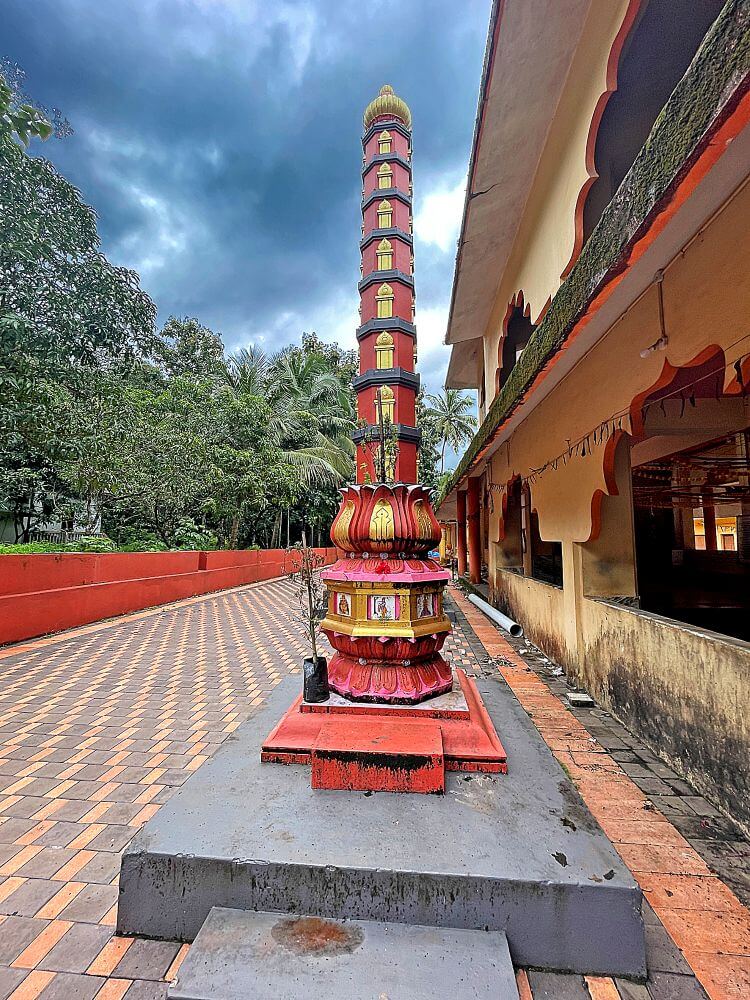
The structure of this magnificent temple consists of a Mukhamandapa (entrance porch), a Nagarkhana (drum house) above it, a spacious main Sabhamandapa (assembly hall), an Upa-Sabhamandapa (secondary hall), an Antarala (vestibule), and the Garbhagriha (sanctum sanctorum). Located in a spacious courtyard, there are tall lamp pillars (Deepastambhas) on both sides of the temple. Near the eleven-tiered lamp pillar on the left is a Tulsi Vrindavan. There is a two-story Nagarkhana above the entrance porch, topped with a spire featuring the sloping roof characteristic of Konkani architecture. The main assembly hall of the temple is two-storied with a flat roof. This hall is semi-open. Its unique feature is the stair-like seating arrangement on the left and right sides of the hall. These distinctive tiered seats are what make this hall special. This is where the pairs of footwear offered by devotees as vow-fulfillment are kept. From this hall, which is fully floored with marble, two steps lead up to the secondary assembly hall. Although small in size, the large windows and double-story height make this hall appear spacious as well.
From here, one enters the Antarala. On the front wall of the Antarala, there is a large idol of Hanuman in a prayer posture on the left, and a large idol of Garuda in a prayer posture on the right. The entrance to the Antarala is large and made of wood. An idol of Ganesha is carved on its lintel. In the Antarala, which has a slightly sloping roof on both sides, three ‘Tarangkathya’ (processional poles) are kept between two large pillars on one side. These are the poles of Ravalnath, Bhutnath, and Pavnai. Below this, on a platform, is the ‘Murti Ravalnath’. It is said that this idol of Ravalnath was brought here by a Siddha Purusha from Redi. He had found this idol in the sea. Seeing that purity and rituals were strictly observed in Ajgaon, he placed this idol in the Vetoba temple. Near these poles, in a cupboard, the garments of Vetoba are kept. These garments are used on special festive occasions. Otherwise, Vetoba’s attire consists of a dhoti and an upper cloth (uparane).
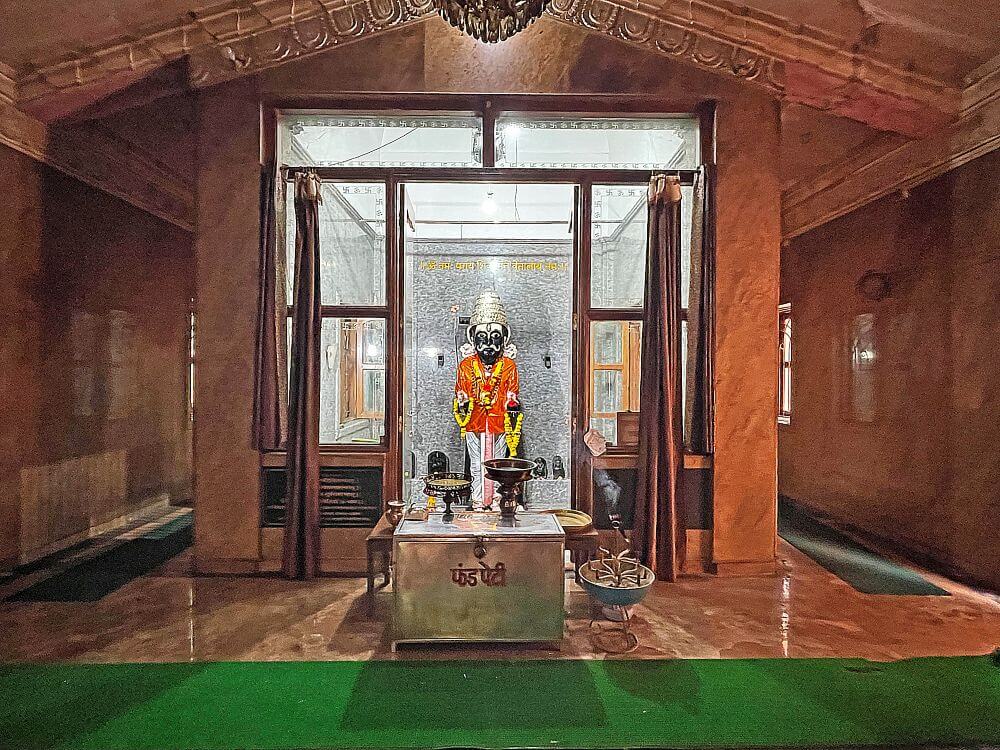
Glass has been installed on the front wall of the temple’s sanctum sanctorum. Inside stands a १२-foot-tall idol of Vetoba. This two-armed idol, featuring a beard, mustache, and a silver crown on its head, holds a sword in its right hand and a water vessel in its left. There are snake-shaped anklets on its feet. There are Ganas (attendants) near his feet. The Panchadhatu idol of Vetoba is placed right in front of this idol.
Attached to the main assembly hall of the temple, on the right side, is the temple of Bhumka Devi. Inside the temple, on a Vajrapitha (diamond throne), is the idol of Bhumka Devi made of black stone, adorned with a saree and jewelry. Behind the idol is a silver arch (Makhar). On both sides at the base, there are beautifully carved idols of two female attendants holding whisks (chamars).
Near the front wall of this temple, on a platform below, are the deities of the ‘Chaukhamba’. In some places, the assembly hall is referred to as the Chaukhamba. The deities present here act as the executive deities of the temple. Decisions regarding the management of the temple are made while sitting in front of these deities. It is the firm belief of the villagers that no one can speak a lie before these deities. Notably, although the VETOBA temple is paved with shiny marble tiles everywhere, the area around the four pillars (Chaukhamba) has been kept as an earthen floor. There is also a small temple of the deity Dandekar within the temple premises.
Free food is offered to devotees every Monday afternoon at the VETOBA temple. Along with daily worship, special festivals are celebrated on auspicious days. Every year, VETOBA’s birthday is celebrated with great enthusiasm on Vaishakh Krishna Shashthi. On that day, Laghurudra, Mahaprasad, and a palanquin procession at night are held. A Dashavatar play is also performed on this day. Many people come here on this day to fulfill their vows. A Sattvic offering (Naivedya) is presented to this deity. Bunches of bananas, sugar, and coconuts are offered. Along with this, a special Naivedya of Vada is also offered, which consists of Vada, Gulvani (jaggery syrup), and green pea curry. A massive crowd of devotees gathers for this temple festival. Devotees come not only from the surrounding five villages but also from Mumbai, Pune, and even abroad.
In Ajgaon, just like the VETOBA temple, there is a temple of Agnivetal. It is said that while there are many temples of Vetal across the country and in Konkan, temples of Agyavetal are rare. Devotees believe that the Agyavetal of Ajgaon grants their wishes. For specific tasks, devotees come to this temple and seek guidance (Kaul) from Agnivetal.
Bhootnath is an alternative name for Vetal. Similarly, he is also known by the names Agyavetal, Jwalavetal, and Pralayavetal. These names reflect his fierce attributes. According to the descriptions of Vetal found in the Mahabharata, the Puranas, and folk literature, he is described as having cruelty in his eyes and being gigantic in stature. He consumes blood and flesh and is always armed with weapons. This Vetal is also described in the ‘Vikram and Vetal’ stories. In the first century AD, Gunadhya, a minister in the court of the Satavahana king of Pratishthan, wrote the great epic ‘Brihatkatha’ in the Paishachi language. In the eleventh century, Queen Suryavati of Anantraj in Kashmir commissioned the poet Somadevabhatta to write the ‘Kathasaritsagara’ in Sanskrit based on the ‘Brihatkatha’. It is in this Kathasaritsagara that the twenty-five stories of Vikram and Vetal are found. According to the descriptions therein, Vetal resides in cremation grounds and dwells among corpses. However, in Konkan, Vetal is considered a village guardian deity, and people believe that he wanders through the village at midnight carrying a staff in his hand and a blanket (Ghongadi) over his shoulder. Agnivetal is considered to be his fearsome, fierce form.
The temple of this deity is located at Pandharewadi in Ajgaon. Inside the temple, there is an upright stone idol of Vetal. In one hand, it holds fire, and in the other, a sword. There is a turban on the head and large earrings in the ears. The face has a beard and mustache. Notably, even though this is a temple of Agyavetal, the expressions on the face of the idol are gentle. According to iconography, the idol of Vetal usually has a garland of skulls around its neck, but the idol here does not have such a garland. A large fire pavilion (Agnimandap) has been built on the right side of the temple. It contains a fire pit (Agnikund) three to four feet deep. In the tiles arranged in a circle around it, a tantric-style fire instrument (Agniyantra) has been created.
Devotees believe that this Agnivetal of Ajgaon grants their wishes. Devotees seek his guidance by placing banyan leaves (Kaul). There is a constant flow of devotees at this temple. Along with devotees from the surrounding five villages, people from Goa, as well as Mumbai and Kolhapur, also visit here.
This sacred temple stands as a testament to deep spiritual devotion, ancient architectural grandeur, and rich local cultural traditions.
The sanctum sanctorum houses the divine idol consecrated according to ancient Vedic traditions, surrounded by serene courtyards and traditional temple architecture.
Navratri, Maha Shivratri, Annual Temple Jatra & Deepotsav
Compare and book flights, secure top-rated local hotels near the temple, hire reliable guides, and rent cars instantly.
Extend your pilgrimage by visiting other highly sacred temples located nearby.


Add ₹999 more to unlock FREE SHIPPING!
Your sacred cart is currently empty.
Shop Photo FramesFill in your delivery details below to place your order.
Add comment