
Add ₹999 more to unlock FREE SHIPPING!
Your sacred cart is currently empty.
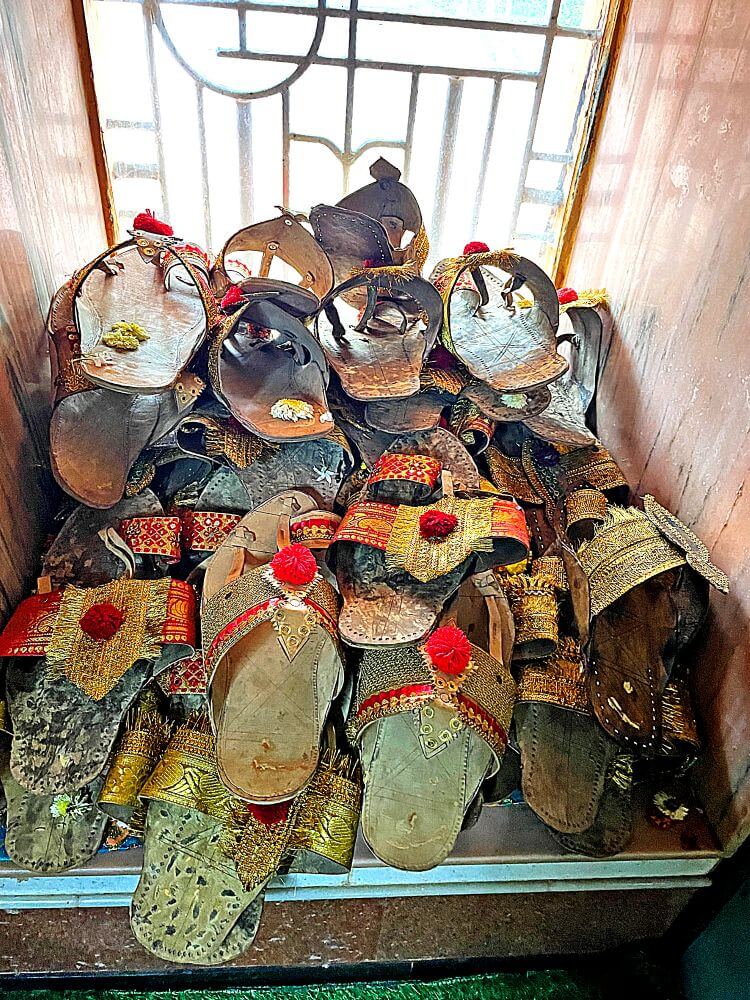
Shop Photo FramesThe Vetoba Temple is a place of deep faith and a sacred pilgrimage site for the village of Aravli. There are a total of 143 temples of the deity Vetoba in the Konkan region. Vetoba, the protector who rushes to the aid of his devotees, is a beloved deity. This temple in Aravli village of Vengurla is considered the abode of Vetala. Over time, the ‘la’ in Vetala was replaced by the respectful suffix ‘ba’, and he came to be addressed by the name Vetoba. Devotees believe that Vetoba is a deity who fulfills vows. To fulfill their vows, devotees offer bunches of bananas as well as footwear (sandals) here.
Vetala or Vetoba is considered to be an original attendant (Gana) of Lord Shiva. It is believed that the Ganas, demons, ghosts, spirits, and Vetala are all under the command of Lord Shankara. Regarding this, there is a legend that Aravli is a settlement where the presence of Shiva resides. During the Vijayanagara rule, this village was known as Haravalli. The name is derived from ‘Har’ meaning Shiva and ‘Valli’ meaning settlement. It is said that in those days, there were four Shiva temples outside the village: Konkareshwar, Siddheshwar, Parmanath, and Lingeshwar. Haravalli later became corrupted to Aravli. A story regarding this shrine states that in the first half of the seventeenth century, a Nath-panthi saint named Bhumaiya brought the idols of Vetoba and Sateri Devi from the ‘Satankhanachi Dongari’ forest near Aravli and consecrated them. Since then, Vetoba has been worshipped here as the village deity (Gramdevata) and Sateri as the village goddess (Gramdevi).
Vetoba is the guardian deity (Kshetrapal) of this region. The Shiva Purana, Shatarudra Samhita, states that Vetala was originally the gatekeeper of Shankara and Parvati. Once, because he prevented Parvati from coming out of the door, she cursed him, saying, “You shall take birth as a human on Earth.” According to the Kalika Purana, in his previous birth, Vetala was a Shiva-messenger named Bhringi. He had a brother named Mahakal. Due to Parvati’s curse, both brothers were born on Earth to Queen Taravati, the wife of King Chandrashekhar, under the names Vetala and Bhairava. These two were not the biological sons of King Chandrashekhar; they were born to Taravati through the grace of Shankara. Consequently, King Chandrashekhar distributed his wealth among his biological sons. Bhairava and Vetala received nothing. They then went into the forest to perform penance. Later, through the grace of Sage Vashistha, they had a vision of Shankara, and with the blessings of Goddess Kamakhya, they attained a place among the Shiva-Ganas. Of the two, Vetala is the deity Vetoba.
According to the history of the Sawantwadi princely state, in the year 1664, the Adilshahi of Bijapur gifted eight villages to the King of Sawantwadi, Lakham Sawant, to dissuade him from siding with Chhatrapati Shivaji Maharaj. Aravli was one of them. Since then, the royal family of Sawantwadi began worshipping Vetoba. Before the Battle of Ibrampur against the Portuguese in Goa, the Sawants had made a vow to Vetoba. They were victorious in that battle. Therefore, they donated some lands to the temple.
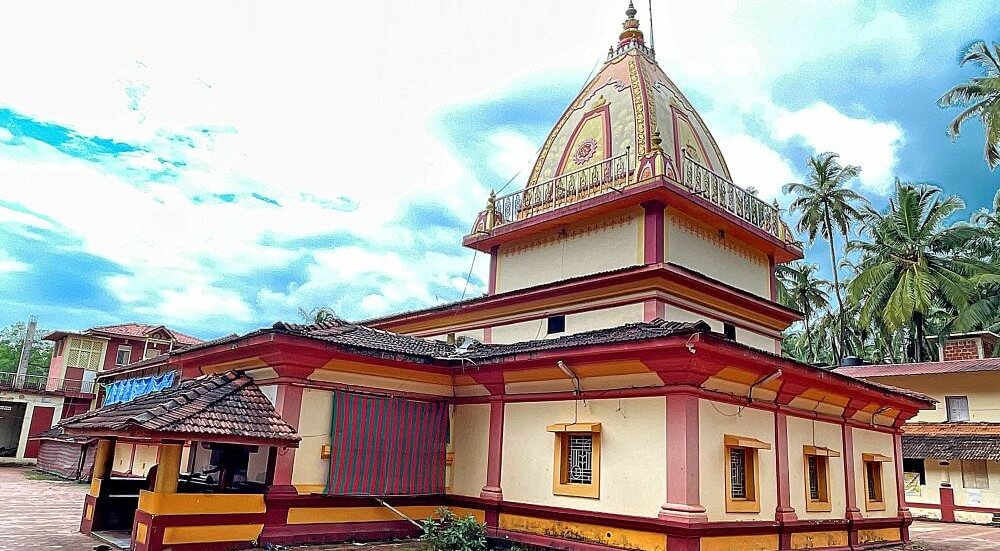
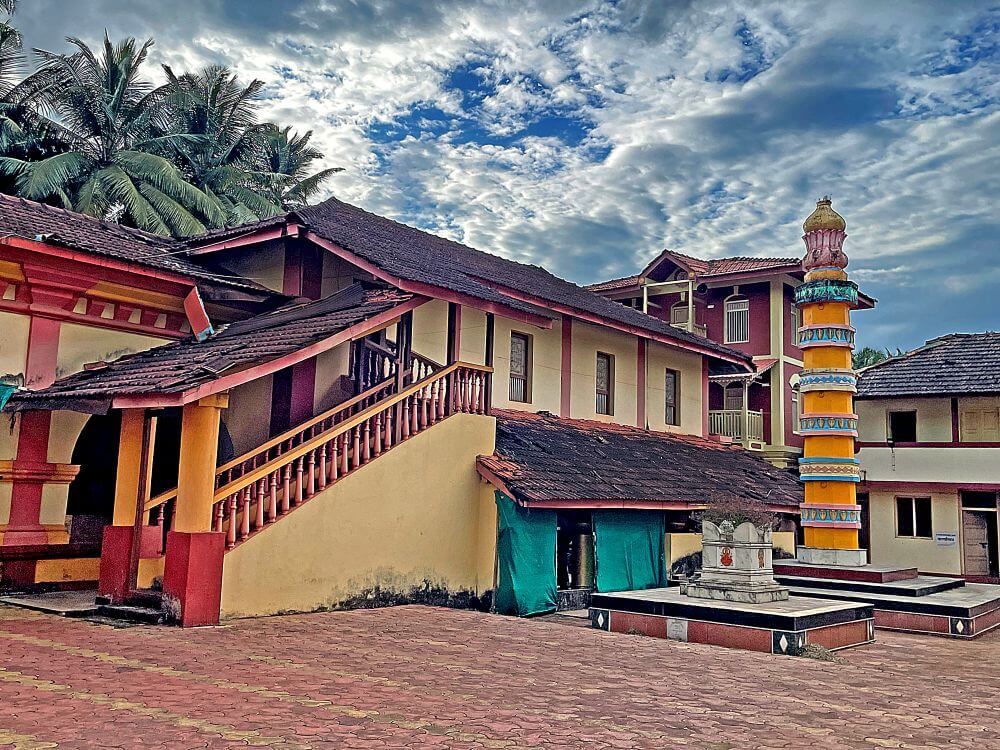
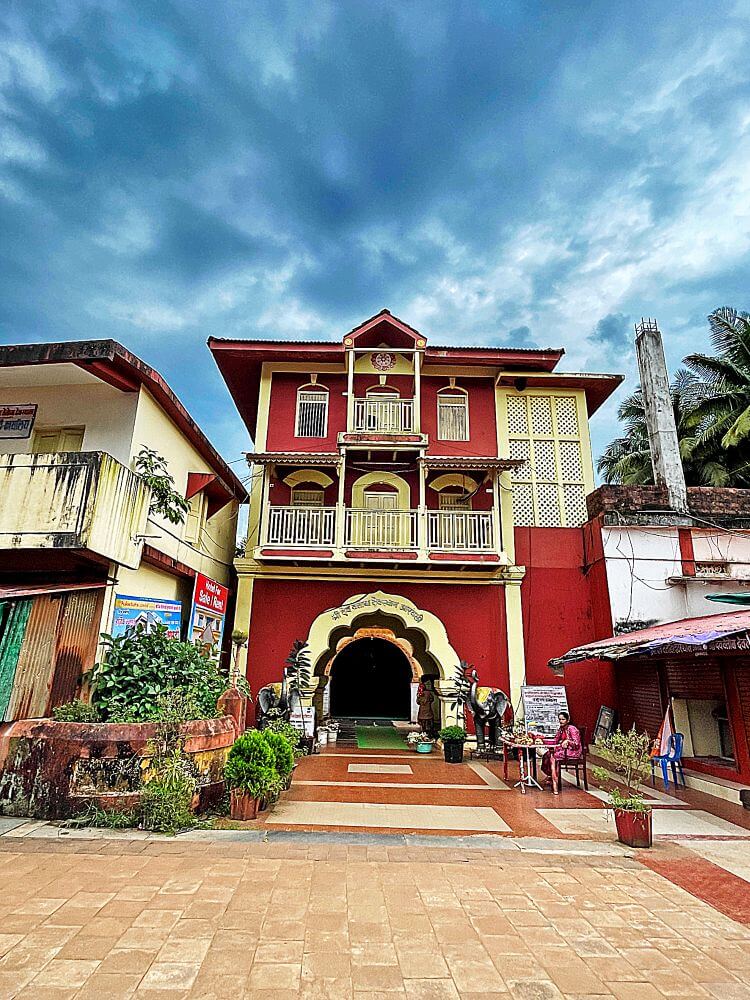
The temple standing here today was first built in 1660, while the temple’s assembly hall (Sabhamandapa) was built at the end of the nineteenth century. In 1996, the villagers renovated and restored this ancient temple, bestowing it with grandeur. One enters the temple premises through a high, arched gateway. On both sides of the base of this gateway are relief sculptures of gatekeepers, and in a small dome at the lintel position, there is an idol of Ganesha. Inside the gateway, in the temple courtyard, there are shops selling worship materials as well as footwear for Vetoba. At some distance is a three-story building for the Nagarkhana (drum house). Here, the Naubat (ceremonial drums) is played every morning, afternoon, and evening. On the first floor of the Nagarkhana is the library of the Aravli Gram Panchayat. Upon entering through the arched gateway of the Nagarkhana, the main temple is a short distance away. On one side, on two large platforms, are the Tulsi Vrindavan and a lamp pillar (Deepstambha). The top of this six-tiered lamp pillar is shaped like a pot within lotus petals.
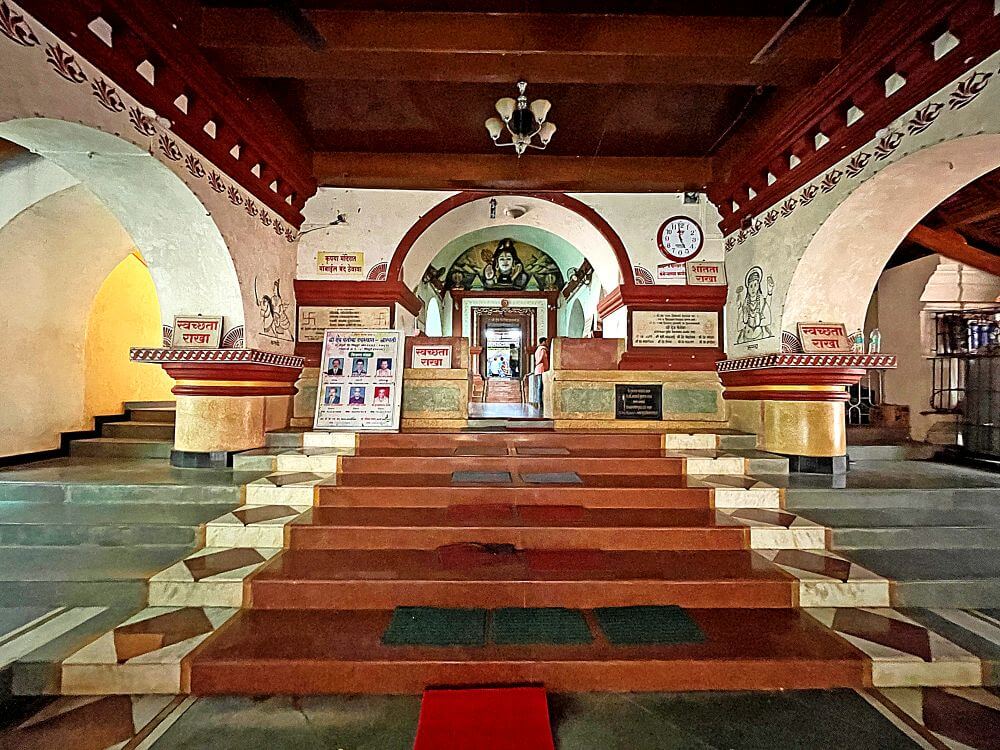
This temple has two assembly halls. Beyond them is the structure comprising the Antarala (vestibule) and the Garbhagriha (sanctum sanctorum). The temple building is two-storied, and the first assembly hall is large enough to seat about two to two and a half thousand people at once. It is rectangular and semi-open in style. It has stone benches (Kakshasanas) in the space between the circular pillars in the outer area. Inside, at some distance, there are wide circular pillars and an arch connecting two pillars. Paintings of the avatars of Vishnu are painted on the walls of the assembly hall. After climbing six steps from this assembly hall, one enters the next assembly hall. This hall also has stone benches. Climbing three more steps leads into the Antarala.
The entrance to the Antarala is like the doors of an old mansion. Above its outer frame, on the lintel, is a floral design, and on both sides of the entrance are Yali faces. The assembly hall has a Gajaprishthakara, or elephant-back shaped roof. In the space between this roof and the entrance, a relief sculpture of Shankara is carved. This sculpture depicts Shankara with a blessing hand, a Shiva Linga in front, and serpent deities on both sides. Devotees offer large-sized footwear to Vetoba with great devotion. Some of the footwear from the olden days is preserved here.
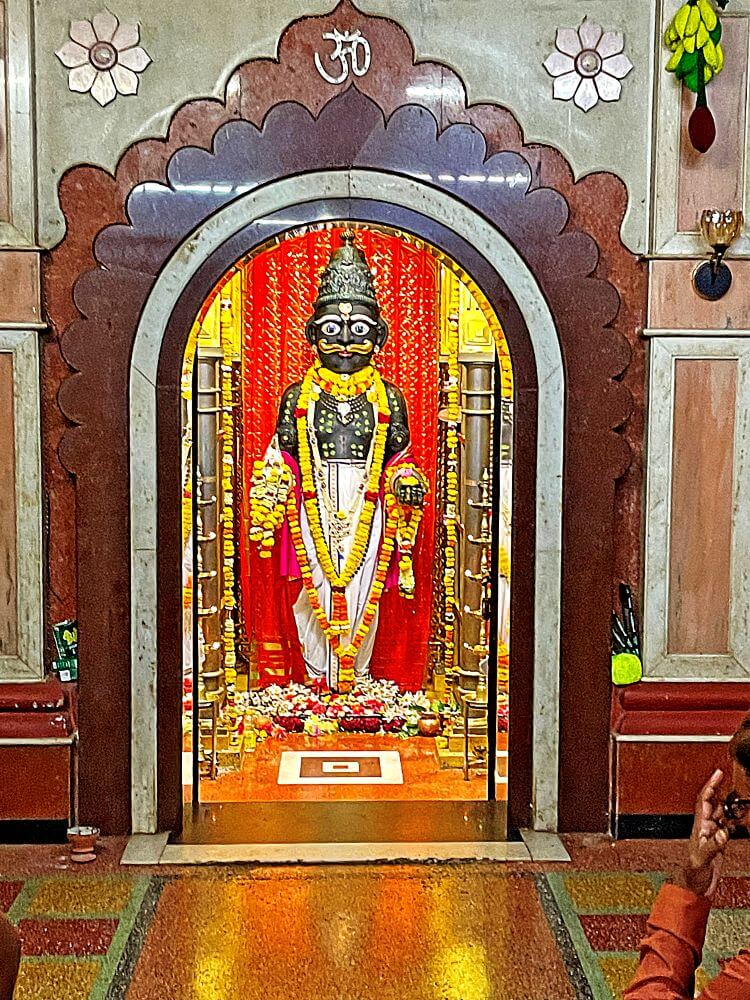
In the north-facing sanctum sanctorum of the temple is a magnificent nine-foot two-inch tall idol of Vetoba. This idol of the deity is re-consecrated every hundred to one hundred and twenty-five years. It is said that the second re-consecration of Vetoba’s idol must have taken place between the years 1700 and 1720. That idol was made from the wood of a Jackfruit tree. Because of this, the tree has gained great importance. This tree is not cut in this village, and it is not used for making objects. Furthermore, those who are unable to go to the temple consider this tree itself as the deity and worship it. The third re-consecration took place in 1883 and the fourth on 23 April 1920. All those idols were created from Jackfruit wood. The fifth re-consecration was performed on 22 April 1996. At that time, a nine-foot two-inch tall idol of Vetoba made of five metals (Panchadhatu) was installed. In the standing posture, Vetoba holds a double-edged sword in one hand and a fire pot in the other. A serpent-like form is visible on his head, and Rudraksha rings are seen in his ears. Around his waist is a belt woven from stones. Around his neck are sacred garlands and a stone lotus necklace. The eyes and sideburns are made of silver, and there are silver sandals on his feet. Along with the idol of Vetoba in the sanctum sanctorum, there are also deities like Bhumaiya, Purvas, Rampurush, Nirakari, and Bhavkai. There is a circumambulation path around the sanctum sanctorum.
A sattvic offering (naivedya) is presented to Vetoba here. Sugar, laddu, and a bunch of bananas are offered. To fulfill a vow, a pair of dhotis and a pair of leather sandals are offered. It is believed that the deity constantly wanders to protect his devotees, causing his sandals to wear out; therefore, sandals are offered so that he does not suffer any discomfort. Devotees also believe that these sandals are actually worn by Vetoba and are seen to be worn out after some time. In the past, these sandals were made of deerskin. Large silver sandals are placed before the deity for worship. Before starting any new task here, a ‘Kaul’ (divine consultation) is sought from Lord Vetoba. Thirty-three leaves of a tree called Salai are placed on specific parts of the idol. Each of these positions has a significance. Devotees interpret the meaning of the Kaul accordingly to understand whether it is an approval or a refusal.
The deity’s festival (yatra) is held on two days: Kartik Purnima and Margashirsha Purnima. The yatra in Margashirsha is the main and larger one. On the day of this yatra, ‘Annashanti Samaradhana’, which is the offering of food, is conducted. Thousands of devotees participate in this yatra. On this day, the temple is decorated with flowers and electric lighting. A ‘Jagar’ program is held in the temple on every full moon day (Purnima) of the month.
Yogiraj Bapumama Keni was a supreme devotee of Lord Vetoba. Through his discourses, he spread the glory of Lord Vetoba. On his birthday, which falls on Jyeshtha Shuddha Pratipada, a program called ‘Bapumama’s Padwa’ is organized in the temple every year. An eleven-day ‘Maharudra’ is held here starting from Ashadha Shuddha Panchami. Upon its completion, a ‘Samaradhana’ (prasad) program is held on the twelfth day. Similarly, a propitious day is chosen in the month of Shravana to organize the ‘Navanna Grahan’ ritual at the Vetoba temple. On this day, according to tradition, the new seasonal grain or rice is ceremonially harvested and brought to the temple. Then, the rice is worshipped at the Vetoba and Sateri temples to seek blessings for the harvest. Mahashivratri is also celebrated here with great enthusiasm. There is a large hall adjacent to the temple. Programs are held in this hall during the yatra or other festivals. An ‘Annachhatra’ (free food distribution center) is run by the temple trust here. Lunch is available at a nominal cost. Additionally, there is a ‘Sukhanivas’ (dharmashala) for the accommodation of devotees.
This sacred temple stands as a testament to deep spiritual devotion, ancient architectural grandeur, and rich local cultural traditions.
The sanctum sanctorum houses the divine idol consecrated according to ancient Vedic traditions, surrounded by serene courtyards and traditional temple architecture.
Navratri, Maha Shivratri, Annual Temple Jatra & Deepotsav
Compare and book flights, secure top-rated local hotels near the temple, hire reliable guides, and rent cars instantly.
Extend your pilgrimage by visiting other highly sacred temples located nearby.


Add ₹999 more to unlock FREE SHIPPING!
Your sacred cart is currently empty.
Shop Photo FramesFill in your delivery details below to place your order.
Add comment