
Add ₹999 more to unlock FREE SHIPPING!
Your sacred cart is currently empty.
Shop Photo FramesThe Kaleshwar-Maleshwar Temple is located in the prosperous village of Nemle, which has long been famous for its roof tile factories. It is said that this temple, which has a history of about a thousand years, was founded by a Jain saint. His samadhi is located at the back of the temple premises. A unique feature of this temple is the strict rule that only those who have not consumed non-vegetarian food or alcohol for at least seven days prior are permitted to enter the sanctum sanctorum. Additionally, one must not enter the temple wearing leather items. It is believed that those who do not follow these rules face hardships.
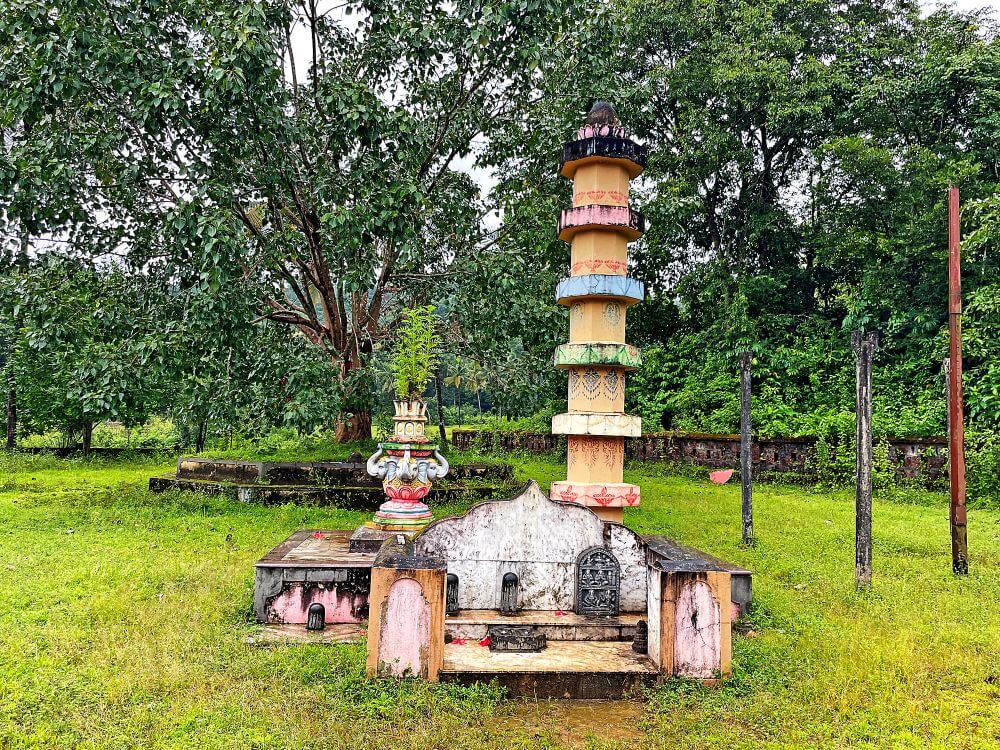
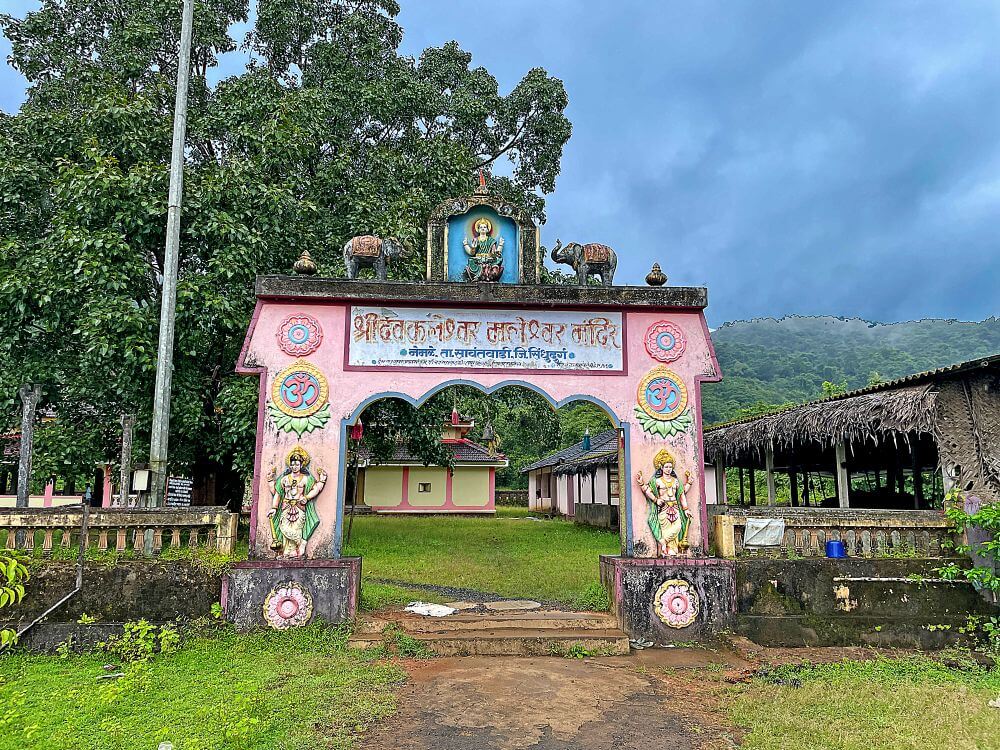
After traveling a short distance along a narrow road flanked by dense trees on both sides in Nemle village, one sees the entrance gate (ves) of the Kaleshwar-Maleshwar Temple premises. On the pillars of this gate, there are high-relief sculptures of the gatekeepers Jaya and Vijaya, depicted with four arms and holding maces. Above the gate, in a central niche, is an idol of Goddess Lakshmi seated on a lotus. On both sides of her are royal elephants (gajaraj) and two small kalashas (auspicious pots). The temple premises are spacious and enclosed by a stone wall on all four sides. Within the premises, on a raised platform, stands a Tulsi Vrindavan decorated with lotus petals and elephant faces, alongside a seven-tiered lamp pillar (deepstambh). Adjacent to this are three small cylindrical stone lingas, padukas (footprints), and a veergal (hero stone). This veergal features three panels. The lower section depicts a man sitting in a heroic posture (virasana). Beside him is a sculpture of a woman sitting with one leg folded, playing a damaru. The middle panel features sculptures of men and women offering salutations. The topmost panel depicts a Shiva Linga, Nandi in front of it, a man bowing to it, and carvings of the sun and moon above.
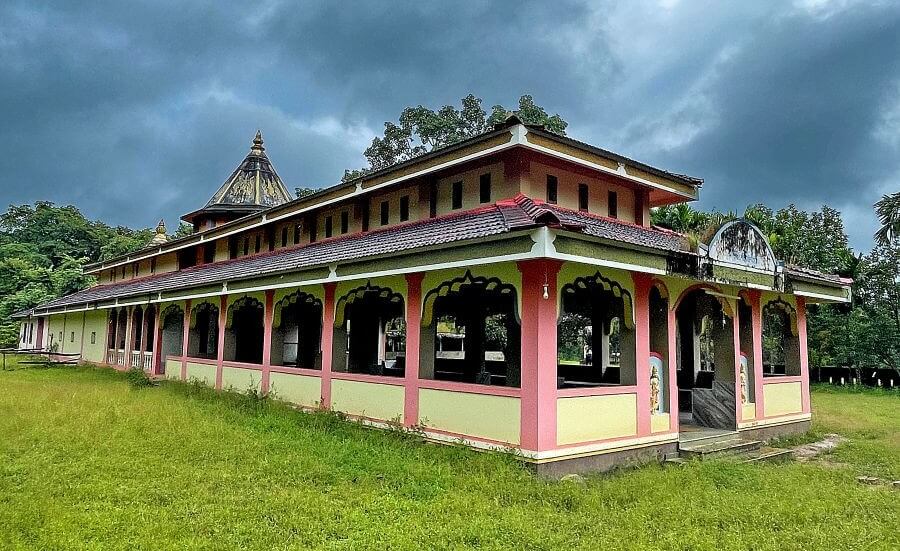
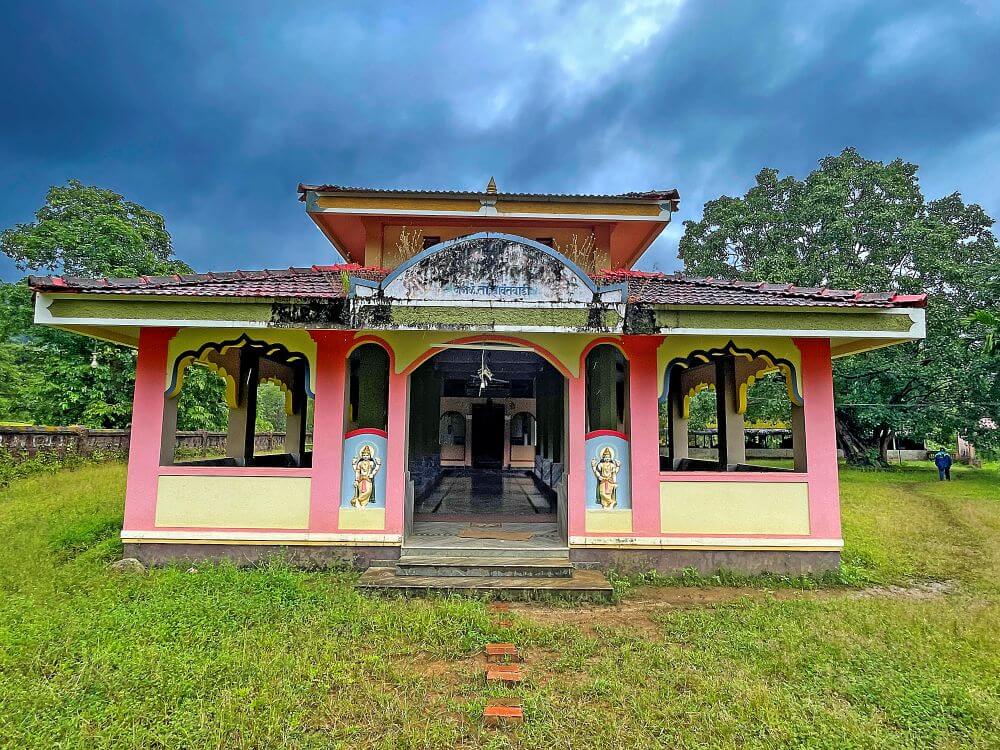
Behind this lamp pillar is an ancient Peepal tree with a large stone platform built around it, while the temple entrance arch stands in front of the pillar. On the sides of this arch, between two pillars, are four-armed sculptures of the gatekeepers Jaya and Vijaya at the base. The temple has two halls: a main assembly hall (sabhamandap) and a smaller one. The main hall is elongated and semi-open. The tradition is to enter only after washing one’s hands and feet, for which a tap has been provided outside the temple. The exterior of this hall features large arched windows, and there are stone benches (kakshasanas) between the pillars. A short distance inside, there are five circular pillars. Through this row of pillars, one enters the smaller assembly hall, which also has large windows and spacious stone benches. The beams of this hall are adorned with bells and red cloth fly-whisks (chawris).
From here, one ascends three steps to enter the antarala (vestibule). The entrance to the antarala is made of wood and intricately carved. The outer door frame features beautiful craftsmanship, and there are wooden latticed windows carved directly into the door. Inside the antarala, there is a stone idol of Nandi, and sacred poles (tarangkathya) are placed to the side. Above the antarala is a pyramid-shaped shikhara.
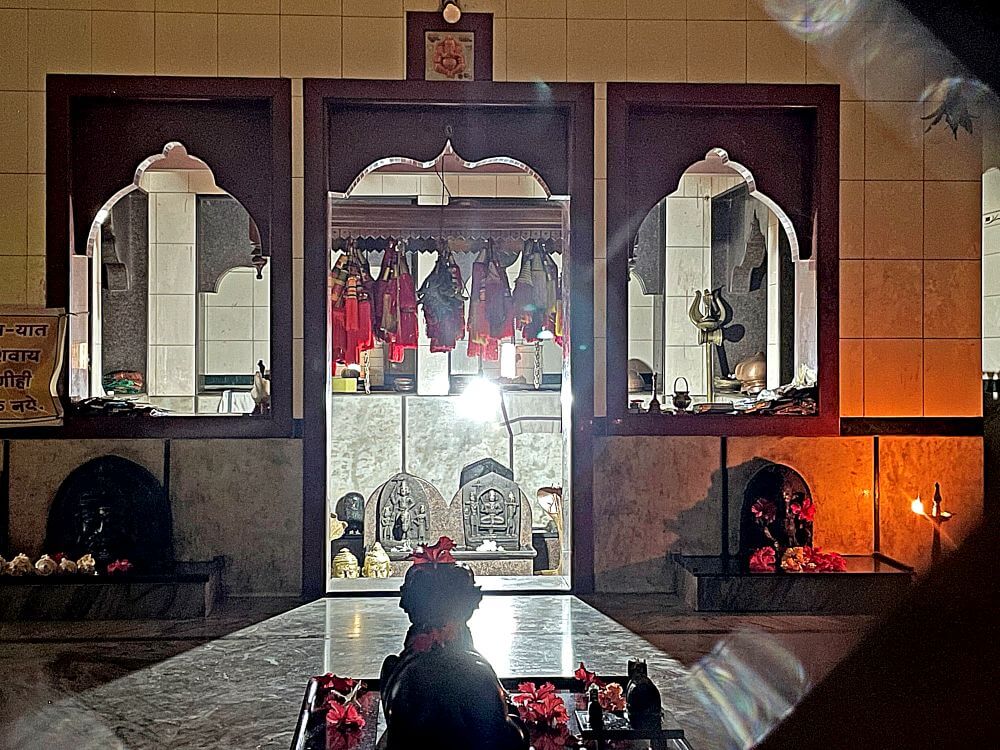
The front wall of the sanctum sanctorum also has large windows. Below these windows are idols of the local deity and Lord Ganesha. On the lintel of the arched door of the sanctum, an idol of Ganesha is carved. Inside, one foot below the ground level, are two subterranean lingas known as Kaleshwar and Maleshwar. Since these Shiva Lingas appear to be rooted in the earth, they are also called ‘Rujiv’ (rooted) Lingas. The pedestals (shalunkas) of both lingas are circular, and the water outlet (pranali) is very small. A unique feature is that the space between these two pedestals is hollow, and about a foot deep inside, there is a horizontal stone. When performing the ‘kaul’ (divination) ritual, grains of rice are placed in order on this horizontal stone. Local devotees believe that the rice grain representing the requested answer flies up and falls to the side.
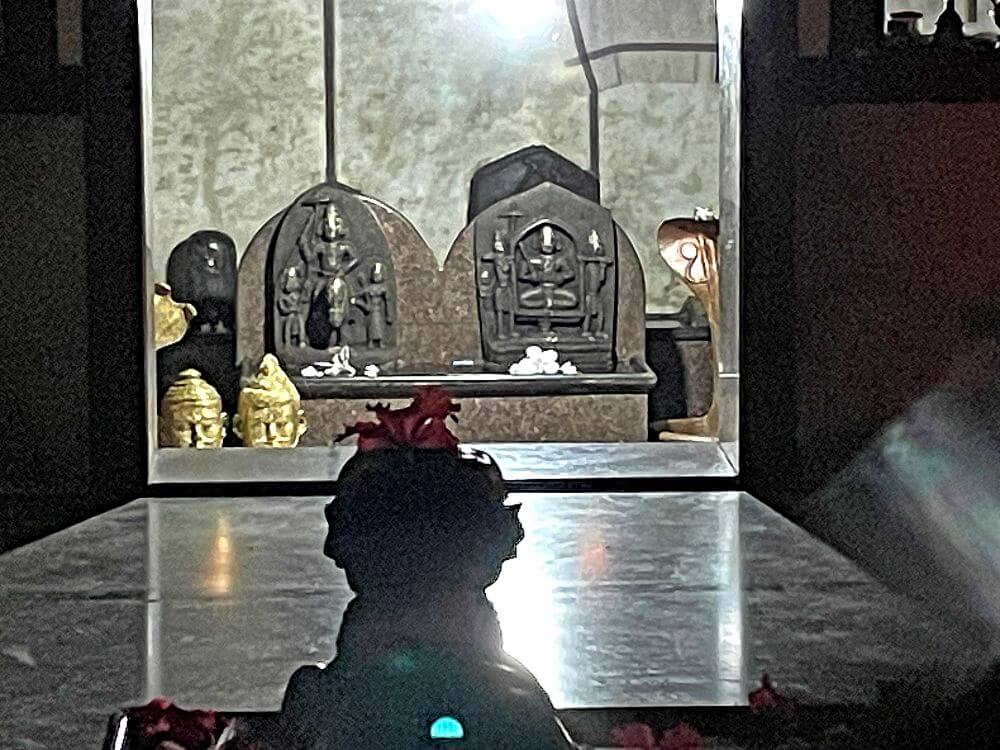
Beside these Shiva Lingas are metal masks of Kaleshwar and Maleshwar, and next to them are two idols of hooded cobras. Behind them, on a vajrapitha (thunderbolt pedestal), are stone-carved idols of Kaleshwar and Maleshwar. In one of these, the deity is depicted riding his mount, holding a sword in one hand, with an attendant on either side, one of whom holds a canopy over the deity. In the other idol, the sword-bearing deity is seated cross-legged in a palanquin, carried by attendants. Bel leaves and white flowers are offered to these deities. Along the walls of the sanctum are the ‘tandale’ (sacred stones) of local deities and cylindrical lingas. The ceiling of the sanctum is draped with cloth resembling fly-whisks, and a large metal trident stands to one side.
Every year, on Magh Shukla Ekadashi, also known as Vijaya Ekadashi, a grand two-day fair (jatrotsav) is celebrated at the Kaleshwar-Maleshwar Temple in Nemle. Nemle village was once part of the former Sawantwadi State. The village customs of this village, as well as Akeri and Zharap villages in Kudal taluka, are identical. Therefore, Kaleshwar-Maleshwar is considered the deity of these three villages. Villagers believe that Kaleshwar-Maleshwar of Nemle, Rameshwar of Akeri, and Goddess Bhavai of Zharap are siblings. Because of this, once a year, Rameshwar of Akeri comes with a palanquin and sacred poles to visit Goddess Bhavai and Kaleshwar-Maleshwar. During the fair in Nemle, prayers (garhane) are offered in the names of the deities of all three villages—Nemle, Akeri, and Zharap. The honored sacred poles of the village are brought here in a procession. A major festival is also held on Phalguna Krishna Chaturdashi, i.e., Shivratri, when a large crowd of devotees gathers at the temple for darshan.
It is said that the history of this temple dates back to its founding by a Jain saint (whom locals call a Jain Brahmin). This Jain Brahmin was also responsible for the initial village layout. Thus, the temple was initially managed by the Jains. Later, the management passed to the Brahmins. Locals state that the Joshi family previously managed the temple. However, as no members of the Joshi family remained in the village over time, the management passed to the Gawade, Parab, and Dandekar families. Now, the temple priests are newly appointed every year on Gudi Padwa.
The unique feature of this village is that the principle of Ahimsa (non-violence) from Jainism is strictly observed not only within the temple premises but throughout the entire village. It is a rule that one must be ritually pure before visiting the Kaleshwar-Maleshwar temple. To enter the sanctum sanctorum of this temple, one must observe ‘Sowale’ (ritual purity) for at least seven days, which means abstaining from non-vegetarian food and alcohol. Similarly, to perform an Abhishekam or offer a coconut in the temple, one must remain ritually pure for at least 11 days. This rule is strictly followed here. Due to the principle of Ahimsa, animal sacrifices of chickens or goats are not performed in the temple. Cooked rice is the daily offering (Naivedya) to the deity. During Brahmin Bhojan, an offering of dal-rice, vegetable curry, amti, vade, and sweet dishes is presented. On Ekadashi, the offering is made in the form of dry rations (Kora Shidha). Hunting is also prohibited in the hilly region of Nemle village.
This sacred temple stands as a testament to deep spiritual devotion, ancient architectural grandeur, and rich local cultural traditions.
The sanctum sanctorum houses the divine idol consecrated according to ancient Vedic traditions, surrounded by serene courtyards and traditional temple architecture.
Navratri, Maha Shivratri, Annual Temple Jatra & Deepotsav
Compare and book flights, secure top-rated local hotels near the temple, hire reliable guides, and rent cars instantly.
Extend your pilgrimage by visiting other highly sacred temples located nearby.


Add ₹999 more to unlock FREE SHIPPING!
Your sacred cart is currently empty.
Shop Photo FramesFill in your delivery details below to place your order.
Add comment