
Add ₹999 more to unlock FREE SHIPPING!
Your sacred cart is currently empty.
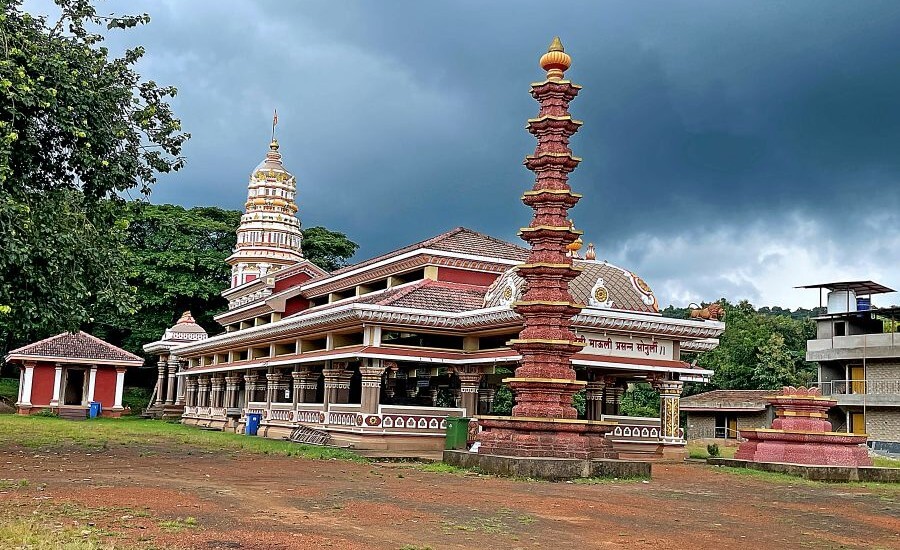
Shop Photo FramesIn the village of Sonurli, famous as the ‘Prati Pandharpur’ (the other Pandharpur) of South Konkan, stands the temple of the four-armed Mahishasuramardini Devi. Devotees hold a deep faith that this Mauli Devi is a wish-fulfilling goddess who rushes to the aid of her devotees when they call out to her with the heartfelt plea, ‘Sonurli Baye, Baye Aavshi’. According to local oral history, the Goddess has had her abode here for about five hundred years. This ancient temple was recently renovated. Another identity of this temple is that it is renowned as the ‘Lotangan Temple’ (Temple of Prostration).
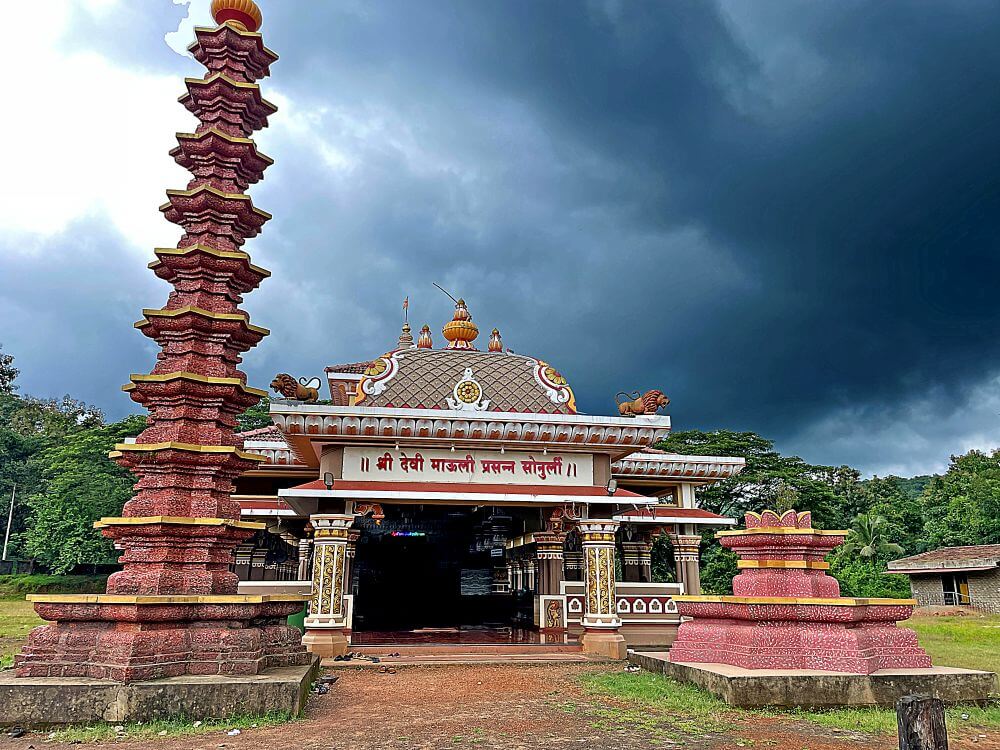
Near the small entrance of the Zilla Parishad school in Sonurli village, on the left side, lies the grand gateway to the Mauli Devi temple complex. A short distance from here stands the temple’s towering Deepastambha (lamp pillar). Standing on a small pedestal, this lamp pillar is ten-tiered and star-shaped. At its apex are the Amalaka and the Kalasha. Beside it stands a star-shaped Tulsi Vrindavan, which is distinct from the usual traditional ones. Like many temples built in the Konkan region in recent times, the architectural style of this temple is modern Konkani. This means that, to a large extent, the features of the old architectural style have been preserved while incorporating modern construction techniques. A characteristic of Konkan temple architecture is that the temple is supported by large pillars in a straight line on both sides, from the main Sabha Mandapa (assembly hall) to the Garbhagriha (sanctum sanctorum). Furthermore, the arrangement of the pillars makes it appear as if the Sabha Mandapa is divided into two sections. The elongated temple has large windows and doors on the outside, which ensures that the temple remains well-lit and ventilated. The Sonurli Mauli Devi temple is also of this old style with a modern touch.
The structure of this temple consists of a Mukhamandapa (front porch), main Sabha Mandapa, a smaller Sabha Mandapa or Chokhamba, Antarala (vestibule), and the Garbhagriha. The Mukhamandapa of the temple has four ornate pillars. Where these pillars meet the ceiling, there are decorative brackets instead of traditional corbels. On the inner side, the pillars on both sides feature Vyala (mythical creature) figures carved into their lower sections. The ceiling of the Mukhamandapa is Gajaprishthakara, shaped like the back of an elephant. It is adorned with three shikhara (spires)—two small and one large. On the ceiling of the Mukhamandapa, there are lion figures on both sides facing the front.
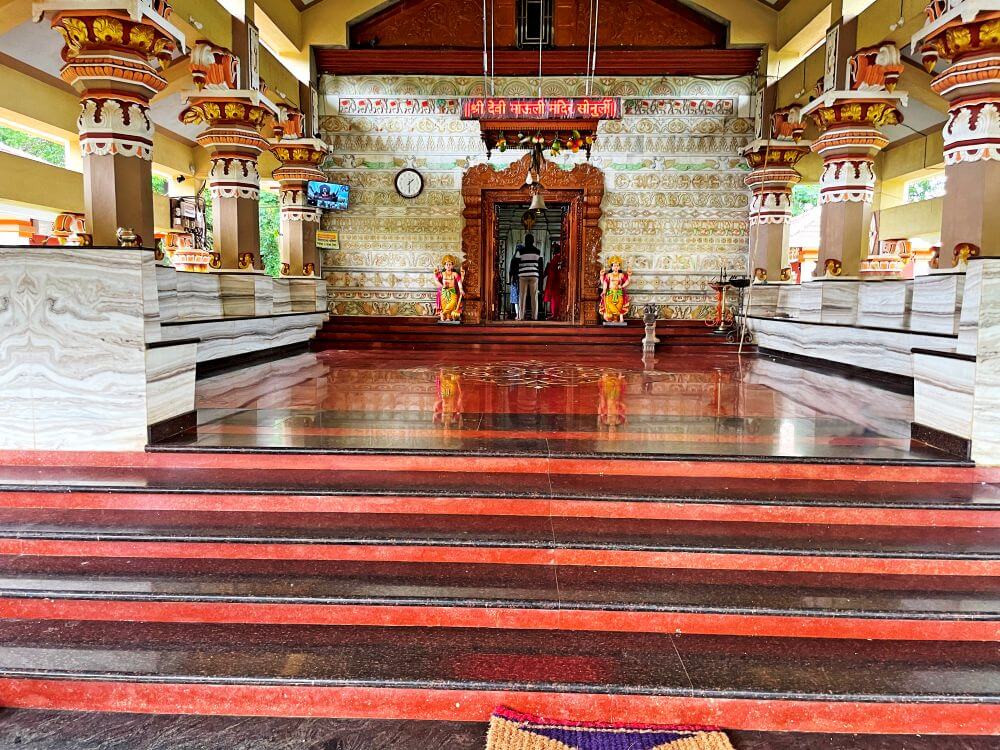
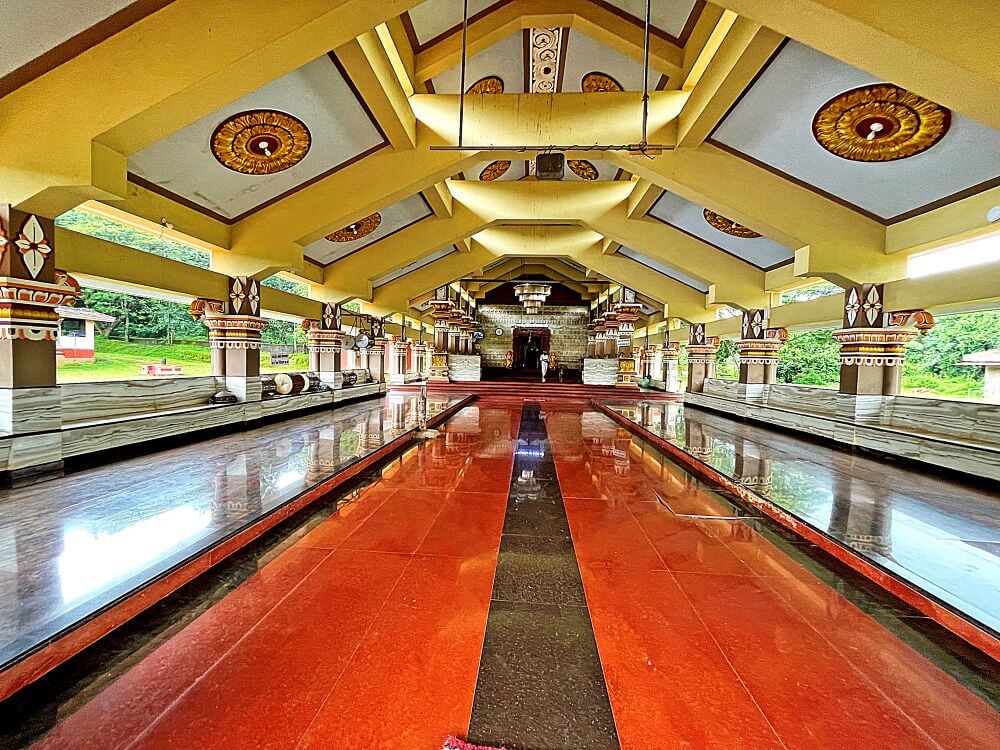
The main Sabha Mandapa of the temple is spacious. It has 9 pillars on each side, equipped with Kakshasanas (stone benches). This hall has a sloping roof in the Konkani style. In this architectural style, wooden panels are fitted into the frames made by the roof beams. In this temple, there are cement slab panels instead, which feature circular carvings. In the center of the hall, a slightly recessed area has been created in the floor, which is paved with red tiles. This creates the illusion of a red carpet laid out from the Mukhamandapa to the steps of the smaller Sabha Mandapa. Smooth granite and marble tiles have been extensively used for the beautification of the temple. After the main Sabha Mandapa, there is a smaller Sabha Mandapa with three pillars on each side, which is also known in some places as the Chokhamba. One enters this area by climbing five steps. Here too, there are Kakshasanas on both sides.
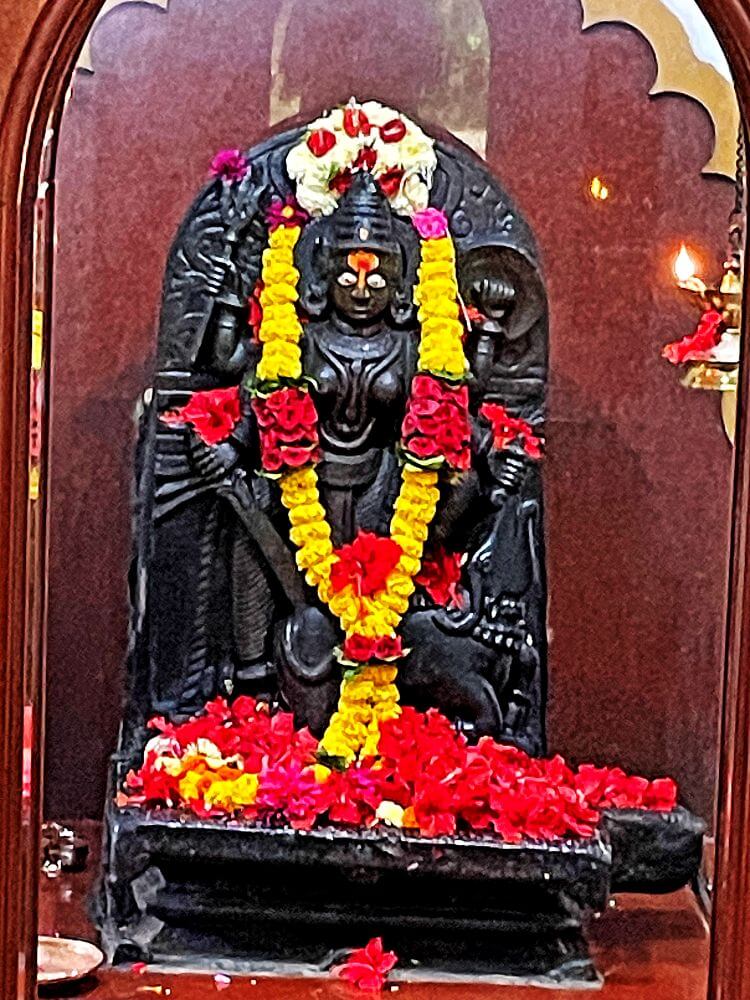
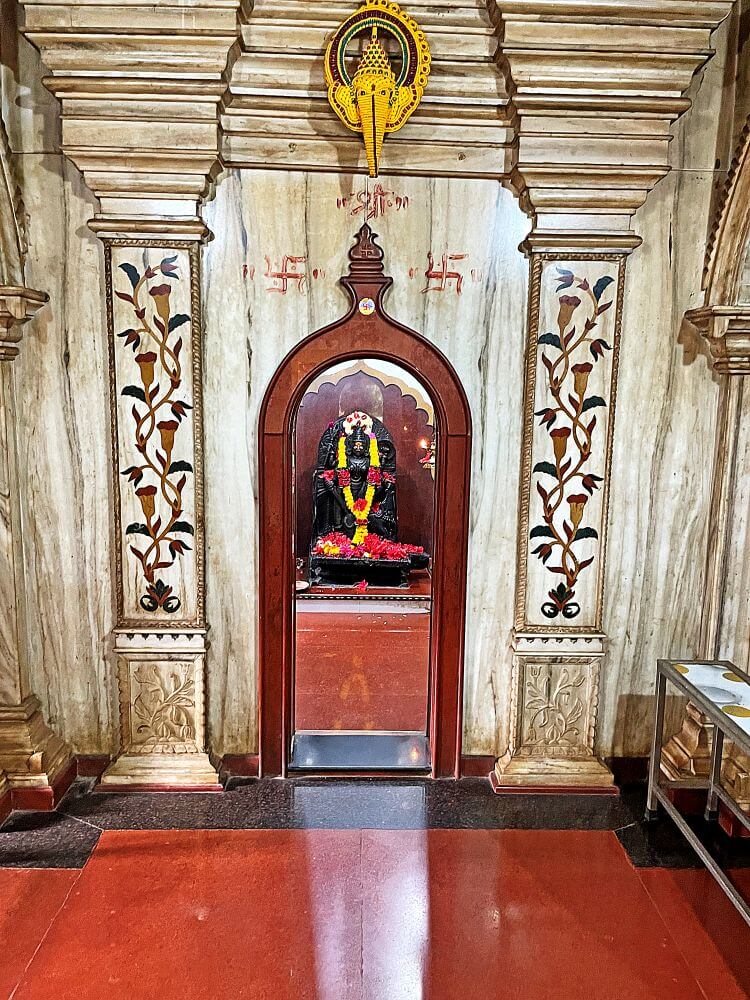
The front wall of the Antarala is decorated with carved tiles. The wooden entrance here is dual-branched, with half-pillars on both sides and an archway above. On both sides of this entrance are statues of four-armed Dwarapalas (gatekeepers) holding maces. Inside the Antarala, there are very wide, square-shaped pillars connected to each other by arches above. Through these pillars, one enters the Garbhagriha through a small door. On the lintel of this door is an image of Gajanana (Ganesha). Inside, on a Vajrapitha (diamond throne), stands the black stone idol of Sonurli Mauli Devi. She is depicted in the form of the four-armed Mahishasuramardini. In her hands, she holds weapons such as the Vajra, sword, trident, and shield. Her left foot is placed on the head of Mahishasura, and she is slaying him with the sword in her right hand. The entire vitality of this idol lies in her silver eyes. Seated within a silver arch, the expression on the face of Sonurli Devi evokes the Veer Rasa (heroic sentiment). Alongside the idol of the Goddess in the Garbhagriha are the idols of local folk deities.
The Garbhagriha of the temple is topped by a distinctively shaped shikhara. Outside in the temple complex, a small temple can be seen, which houses an idol of Ganesha in black stone and a Shiva Linga. Other deities are kept here in the form of stones. There is another similar temple where one can have the darshan of Shri Ravalnath, Shri Pavanadevi, and Shri Lingayat. There is a large well in the temple premises. There is also a shrine dedicated to Giroba Deva, which is circular and features a stone Shiva Linga-shaped samadhi in the center.
Mauli Devi is the presiding deity of the two villages of Sonurli and Malgaon. Devotees believe that this Goddess is ‘Jagrut’ (awakened) and grants wishes. The ‘Lotangan’ Yatra (pilgrimage of prostration) held on the first day of the dark fortnight of the month of Margashirsha is famous everywhere. For this, devotees come in large numbers from regions including Goa, Karnataka, and Mumbai. The temple festival begins on Kartik Purnima. An offering of puffed rice (churmure) is made to the deity, followed by scripture reading, which continues from Tripurari Purnima until the day of the fair. On the day of the fair, the main rituals involve having the darshan of the Goddess, making vows, and fulfilling vows that have been completed.
Those who wish to perform the Lotangan to fulfill a vow to the Goddess must fast from the day before the fair. This fast is observed with strict discipline and abstinence from food. On the day of the fair, after ten o’clock at night, the men and women wishing to perform the Lotangan bathe in the water from the well in the temple premises and have darshan of the deity. Later, amidst the sound of musical instruments, the palanquin of Mauli Devi is brought out of the temple, and bhajans and chants of the Goddess’s name are performed. The Lotangan begins from the steps of the temple’s Sabha Mandapa. One must complete the ritual by performing a circumambulation (pradakshina) of the entire temple. Female devotees perform the prostration while standing with their hair loose, while male devotees perform it bare-chested on the ground. Upon returning to the starting point, they bathe again, break a coconut, and thus the vow to the Goddess is fulfilled. On the second day of the fair, the Tulabhar ritual takes place, which includes items like coconuts, bananas, rice, jaggery, and sugar. This program continues until the afternoon. The Goddess’s ‘Kaul’ (divine consent) is taken to ensure the program was conducted successfully. Then, the procession of the Tarangkathi (sacred pole) is taken out.
Along with the Jatrotsav, festivals like Navratri, Kojagiri Purnima, Deepavali, Dev Deepavali, Holi, and Tulsi Vivah are celebrated here with great enthusiasm. Warkaris from the surrounding five-village radius attend the Harinam Saptah here with deep devotion.
Much like the pilgrimage to this Lotangan, another unique feature of Sonurli village is that all the houses here are made of bricks and roofed with traditional clay tiles. Laterite stones are not used for the walls in the village. Furthermore, great care is taken to ensure that the roofs are covered only with clay tiles. The villagers believe that houses should not be built by cutting stones, as Devi Mauli does not approve of modern-style houses.
This sacred temple stands as a testament to deep spiritual devotion, ancient architectural grandeur, and rich local cultural traditions.
The sanctum sanctorum houses the divine idol consecrated according to ancient Vedic traditions, surrounded by serene courtyards and traditional temple architecture.
Navratri, Maha Shivratri, Annual Temple Jatra & Deepotsav
Compare and book flights, secure top-rated local hotels near the temple, hire reliable guides, and rent cars instantly.
Extend your pilgrimage by visiting other highly sacred temples located nearby.


Add ₹999 more to unlock FREE SHIPPING!
Your sacred cart is currently empty.
Shop Photo FramesFill in your delivery details below to place your order.
Add comment