
Add ₹999 more to unlock FREE SHIPPING!
Your sacred cart is currently empty.
Shop Photo FramesSince ancient times, human beings have worshipped the grand and powerful forms of Nature. Rivers, oceans, trees, and mountains, which serve as the foundation of human life and the cradle of human culture, have been revered and worshipped as divine beings for thousands of years. With the passage of time, temples were erected at these sacred places and evolved further. Later, fascinating legends became associated with them. In the hills of Kadepur village in Kadegaon taluka, there stands one such ancient temple dedicated to Goddess Dongrai Devi. There is a tradition here of offering wooden limbs to the Goddess upon the fulfillment of vows.
Just like Dongrai Devi, Kadepur is also home to the shrine of Goddess Wadlai Devi, while across the river in the village lies the shrine of Goddess Devtaki Devi. These three Goddesses are believed to be biological sisters. According to the legend explaining the name, the village came to be known as Kadepur because of a demon named Kadasur. This Kadasur had become extremely arrogant and tormented the villagers relentlessly. Desperate, the local people prayed to Goddess Tulja Bhavani. Responding to their call, Tulja Bhavani rushed to their aid in the form of Dongrai Devi. A fierce war ensued between her and Kadasur in these hills. Ultimately, the Goddess slayed Kadasur and freed the people from his tyranny. Thereafter, the devotees requested the Goddess to reside here permanently. Honoring their devotion, Goddess Dongrai Devi settled at this sacred spot in the form of an idol.
Built in the Hemadpanti architectural style, this temple is said to date back to the thirteenth century. Where the stepped pathway to the temple begins, there is a spacious parking area. Adjacent to the parking area stands a Hemadpanti-style temple dedicated to Goddess Bhagubai. Bhagubai is considered a close companion of Dongrai Devi. Her legend goes that Bhagubai used to regularly bring meals (shidori) for Goddess Dongrai Devi. One day, Dongrai Devi gave pumpkin seeds to Bhagubai and asked her to plant them on the banks of the lake. The Goddess instructed Bhagubai to bring a bullock cart full of pumpkins once a bountiful harvest grew. However, the Goddess also laid down a condition that under no circumstances should she look back while bringing the pumpkins. Following the Goddess’s instructions, after a few days, Bhagubai reached the base of the mountain with a bullock cart laden with pumpkins. Suddenly, someone called out to her from behind. She turned around to look, and at that very instant, Bhagubai was transformed into a stone. Thereafter, Dongrai Devi expressed her inability to restore Bhagubai to her original form, but blessed her with a boon that Goddess Bhagubai would receive the honor of the first worship (Aadya Puja). Therefore, devotees coming here first seek the darshan of Goddess Bhagubai and only then proceed for the darshan of Goddess Dongrai Devi.
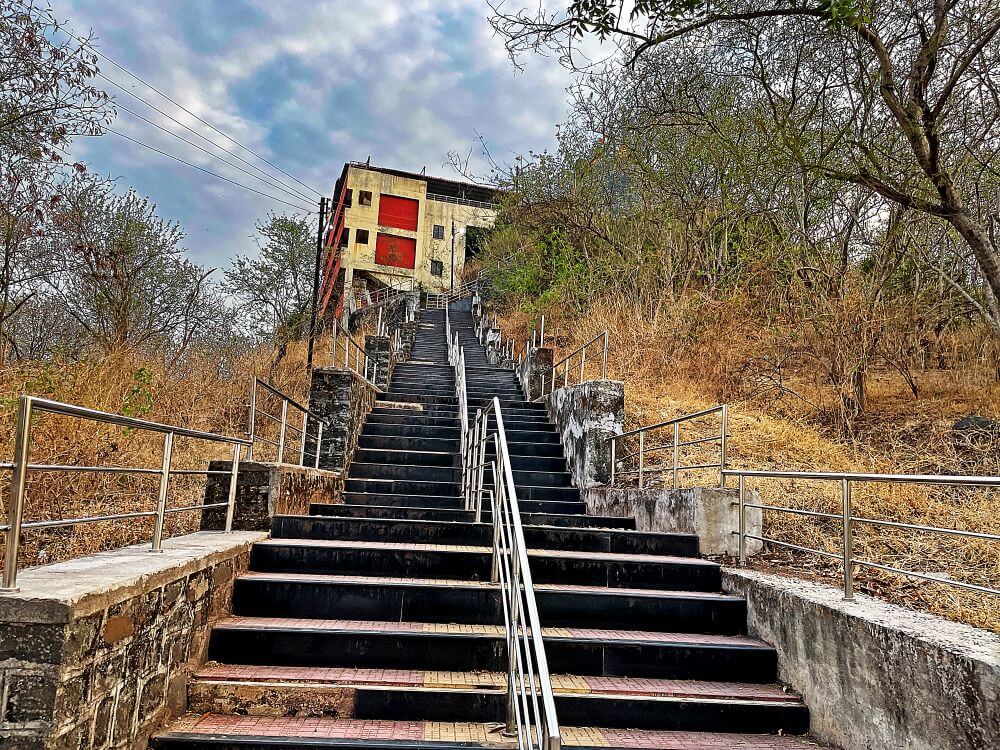
From the parking lot, one has to climb about two hundred steps to reach the Dongrai Devi Temple. The Dongrai Devi Temple is surrounded by fort-like sturdy ramparts. The ramparts here and the grand entrance door remind one of the Bhavani Temple located at Pratapgad Fort. On both sides of this entrance gate stand tall and strong bastions. On the lower parts of the door jambs of the arched entrance, sculptures of Dwarapalas (gatekeepers) are carved. An idol of Lord Ganesha graces the Lalatabimba (central crest), and horse faces (Ashwamukhas) adorn both sides of the Lalatapatti (lintel band). Inside the entrance, guard rooms are located on both sides. On the inner side of the entrance, there is a horse face, and on the right side is a circular Deepmal (lamp tower). The square base of the Deepmal features three sculptures of Surasundaris (celestial maidens) in a respectful salutation posture (Vandan Mudra). On an adjacent independent stone slab, several sculptures are also carved.
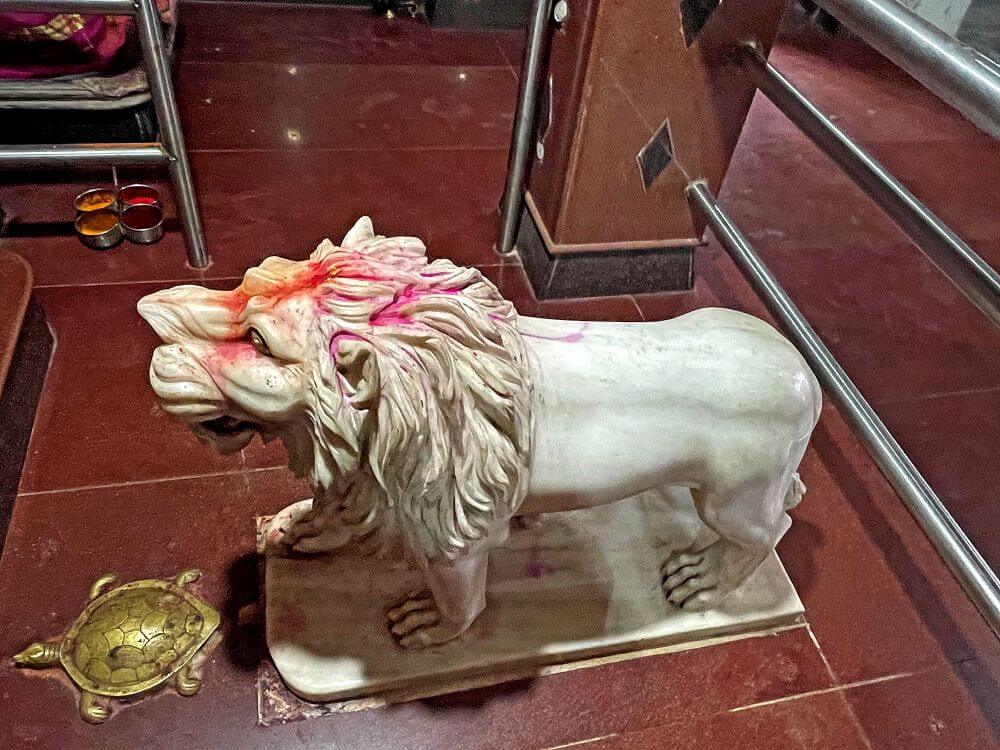
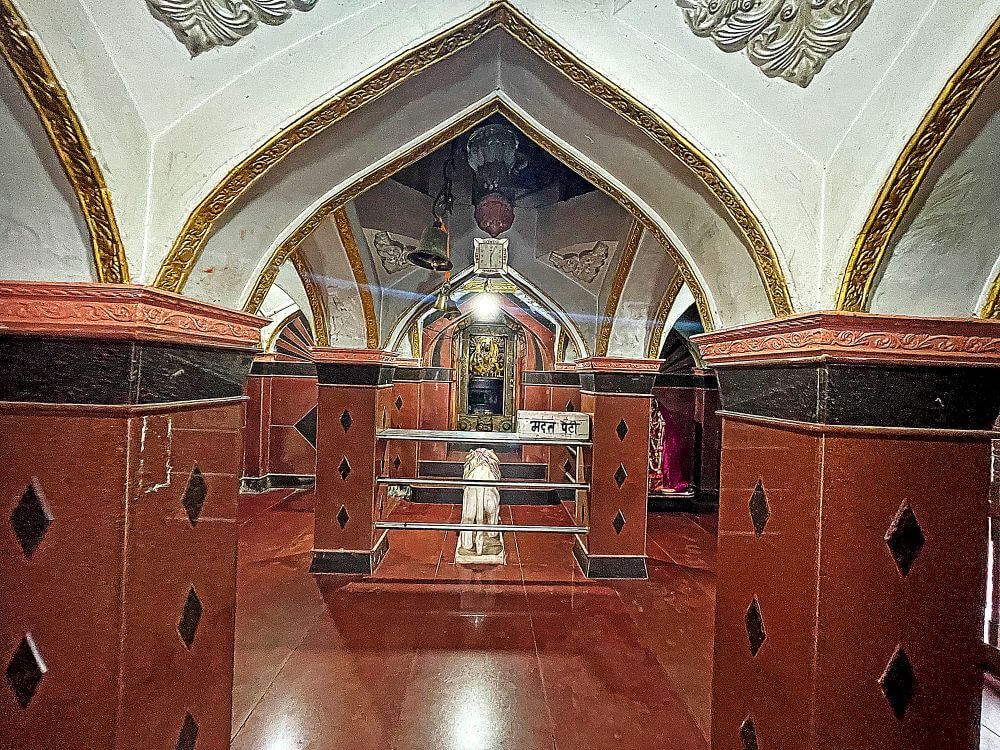
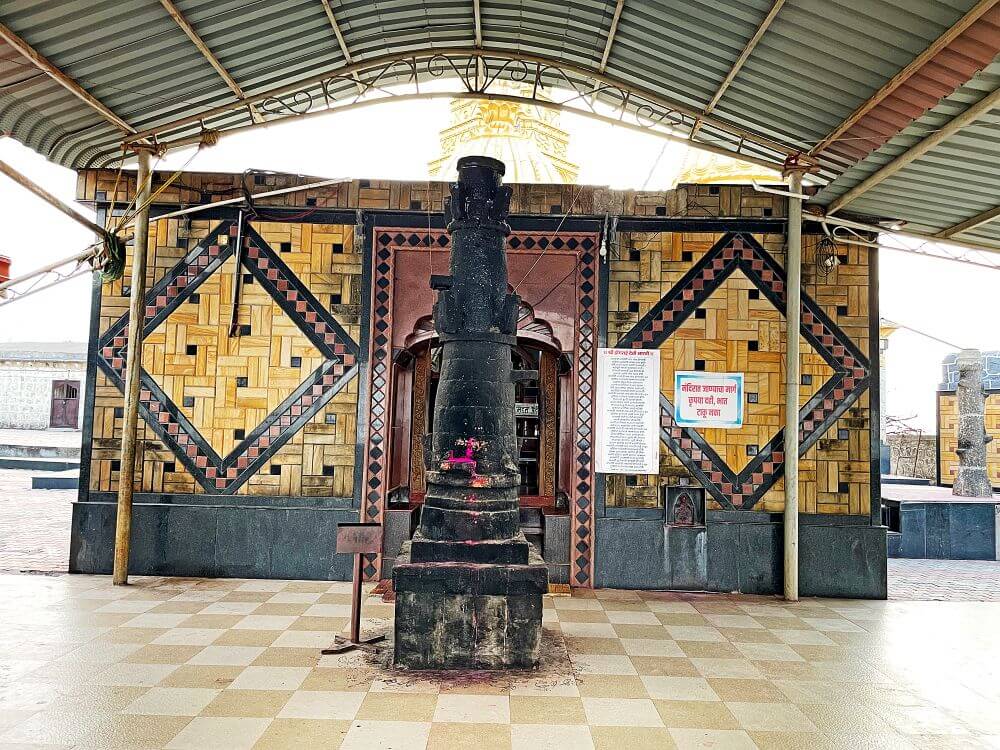
The temple courtyard is paved with paver blocks. A large Deepmal stands on an elevated platform in the courtyard. In front of the Dongrai Devi Temple, there is a hall (mandap) with a tin roof. The entrance to the Sabhamandap (assembly hall), which is at a higher level than the Darshan Mandap, has three steps. Its door jambs feature intricate floral carvings . The enclosed Sabhamandap has four rows of four square pillars each. The outer pillars are embedded within the walls. Inside the Sabhamandap, in front of the sanctum sanctorum (Garbhagriha) entrance, stands a marble idol of a lion. The sanctum sanctorum is situated slightly higher than the Sabhamandap. To the right side in the Sabhamandap, a new idol of Dongrai Devi is consecrated on a Vajrapitha (pedestal). It is said that a decision was made to replace the ancient idol in the Garbhagriha with a new idol. However, when an attempt was made to remove the original old idol, blood began to flow from that spot. Hence, abandoning that attempt, the newly brought idol was consecrated in the Sabhamandap itself.
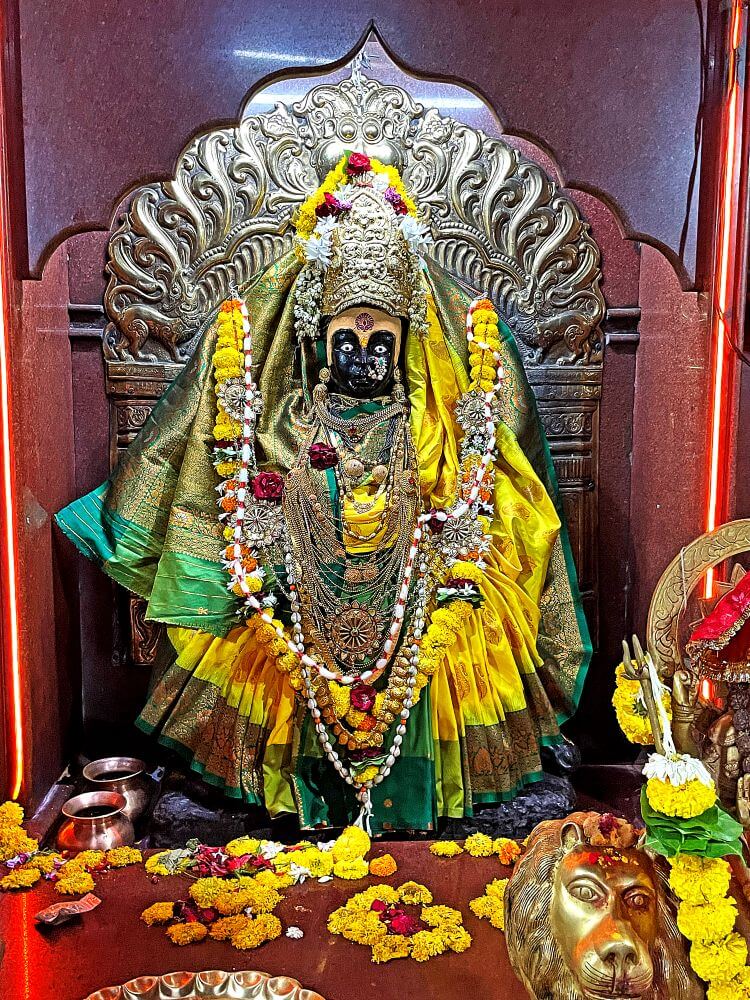
The door jambs of the Garbhagriha feature floral patterns, and the Lalatabimba bears an idol of Lord Ganesha. The Chandrashila (moonstone) at the threshold displays a Kirtimukha and lotus flower motifs on both sides. The entrance is encased on all four sides with silver plating. Inside the Garbhagriha, on a Vajrapitha, stands a four-foot-tall four-armed idol of Goddess Dongrai Devi carved in black stone, seated upon a lion. At the feet of the Goddess lies the injured demon Kadasur and his mount, a male buffalo. The Goddess is adorned with a crown on her head, a pearl nose-ring (nath), rich garments , and sacred ornaments. The backstone (Pratima-shila) of the idol features floral carvings. In the golden Prabhavali (halo) behind the idol, a Kirtimukha adorns the center with floral motifs on both sides. Beside this idol is the Swayambhu (self-manifested) idol of the Goddess. On the front side of the Vajrapitha rests the brass Utsav Murti (festival idol) of the Goddess mounted on a lion. On the outer rear walls of the temple, sculptures of various deities are placed in niches (Devakoshtas). Above the Gomukha (cow-face spout) of the Abhishek Tirth, there is a canopy resting on four pillars with an intricately carved domed spire and finial (kalash).
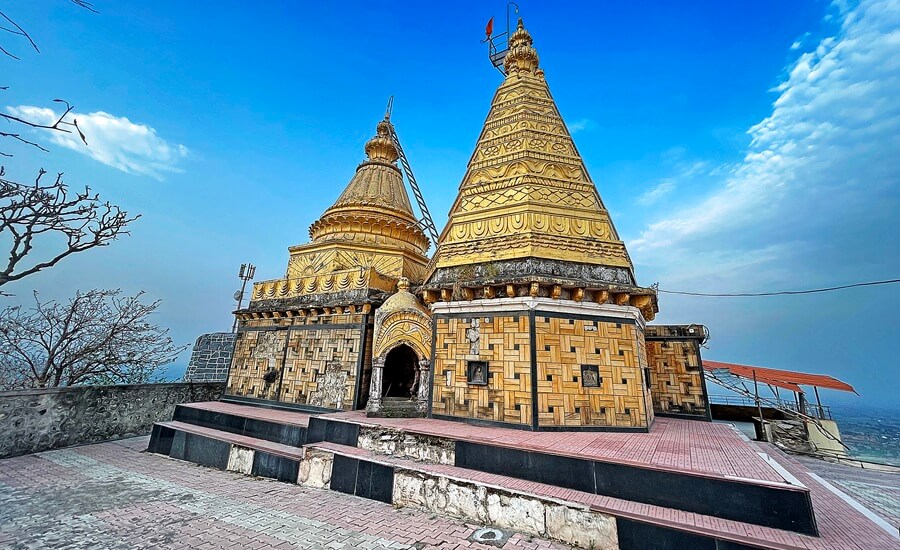
Over the roof of the Garbhagriha rises a seven-tiered square tower (Shikhara). Each tier of the Shikhara is decorated with floral carvings, and on the seventh tier, there are four miniature spires (Laghu-shikharas) at the four corners, topped with Amalakas and Kalashas. In the center, two Amalakas are placed one above the other, crowned with a Kalasha.
Adjacent to the Dongrai Devi Temple is the temple of Goddess Tukai Devi. On the Vajrapitha inside the Garbhagriha of this temple stands an idol of Goddess Tukai Devi carved in black stone. On the elevated platforms to the left and right sides of the Vajrapitha, there are two large grain storage jars (ranjan). A legend associated with these jars tells that during a severe drought in this region about three hundred years ago, every devotee who visited the temple received flour and grain from these jars.
The temple roof features a parapet all around and a two-tiered Shikhara at the center. The first hexagonal tier of the Shikhara is adorned with sun-motif carvings on all sides. The second circular tier features a ring of lotus petal patterns, while the tapering upper section is carved with vertical ridges. At the apex of the Shikhara, there are two Amalakas placed one above the other, topped with a Kalash.
In the temple courtyard stands an ancient temple of Lord Mahadev. In front of the temple entrance is an idol of Nandi carved out of black stone. On the lintel (Lalatabimba) of the narrow entrance, there is an idol of Lord Ganesha with Kirtimukhas on both sides above it. Inside the Garbhagriha, on the tiled floor, stands the Shivlinga in the center, and on the rear Vajrapitha are the sacred stones of the local deities. The domed spire of the temple is crowned with a Kalash.
The annual fair of the Goddess is celebrated on Tuesdays and Fridays in the holy month of Shravan. On the eve of Dasara, the Palkhi of Goddess Vadlai, the sister of Goddess Dongrai, arrives at the foothills, while simultaneously, the Palkhi of Goddess Dongrai descends the steps to reach the base. After the sacred reunion of both Goddesses near the temple of Goddess Bhagubai, the palanquins proceed to the temple of Goddess Dongrai. Following the ritual worship here, Goddess Vadlai returns to her abode in her palanquin.
Annual festivals such as Chaitra Padwa, Diwali, Shardiya Navratri, and Mahashivratri are celebrated in the temple. On these occasions, thousands of devotees from the surrounding region visit to seek the divine Darshan of the Goddess and to fulfill their vows. Within the temple premises, one can see numerous wooden replicas of hands and feet offered to the Goddess. These wooden replicas are offered by devotees in fulfillment of vows made to the Goddess for healing ailments of their hands and legs. Behind the temple, there are a few round stone boulders. Similar boulders can also be seen at Pandavgad in Satara district. Accommodation rooms have also been built in the temple premises for devotees staying overnight. On the inner side of the temple entrance, along the return path, a sculpture is carved. Here, the Goddess is depicted mounted on a horse, accompanied by her Ganas.
This sacred temple stands as a testament to deep spiritual devotion, ancient architectural grandeur, and rich local cultural traditions.
The sanctum sanctorum houses the divine idol consecrated according to ancient Vedic traditions, surrounded by serene courtyards and traditional temple architecture.
Navratri, Maha Shivratri, Annual Temple Jatra & Deepotsav
Compare and book flights, secure top-rated local hotels near the temple, hire reliable guides, and rent cars instantly.
Extend your pilgrimage by visiting other highly sacred temples located nearby.


Add ₹999 more to unlock FREE SHIPPING!
Your sacred cart is currently empty.
Shop Photo FramesFill in your delivery details below to place your order.
Add comment