
Add ₹999 more to unlock FREE SHIPPING!
Your sacred cart is currently empty.
Shop Photo FramesIn Indian culture and the Puranas, the Trinity of Brahma, Vishnu, and Mahesh holds a unique and unparalleled position. Among them, Brahma is considered the creator of the universe and the progenitor of all existence. However, as the worship of Lord Brahma declined after the year 500 CE, independent temples dedicated to Him have become extremely rare in the country. Nevertheless, an exception to this, and a testament to our ancient heritage, is a temple housing a unique idol located at Shiradhon in the Kandhar taluka of Maharashtra. Local people know this as the Parameshwar Temple. Crafted during the Rashtrakuta period in the ninth century, the black stone idol of Lord Brahma here is an exquisite masterpiece of Indian sculpture and iconography.
According to the Nanded Gazetteer, while idols of Lord Brahma are found in many places in Maharashtra, they are mostly situated on the outer walls of temples or as subsidiary deities. Significantly, this idol of Lord Brahma at the Parameshwar Temple in Shiradhon has been consecrated as the primary deity. It is estimated that when Kandhar developed during the Rashtrakuta era, this idol was likely moved from the main city to this hill for security reasons, as no other ancient ruins are found in the vicinity. A similar fragmented idol found at Pingali (Taluka Parbhani) proves that the tradition of independent worship of Lord Brahma existed in Maharashtra during the ninth and tenth centuries.
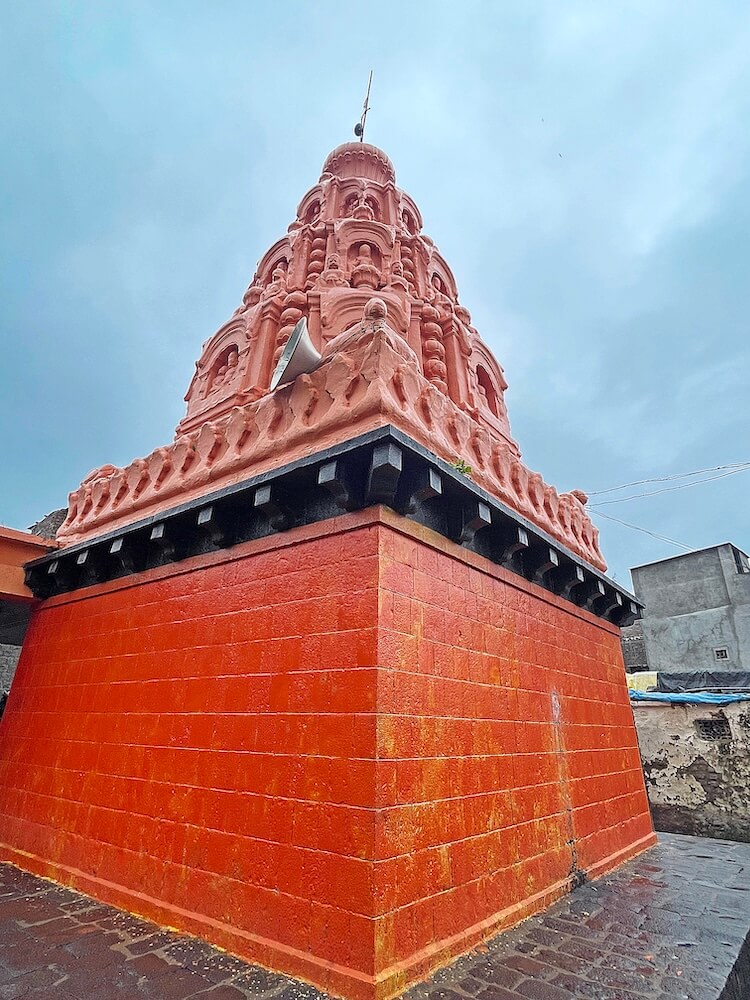
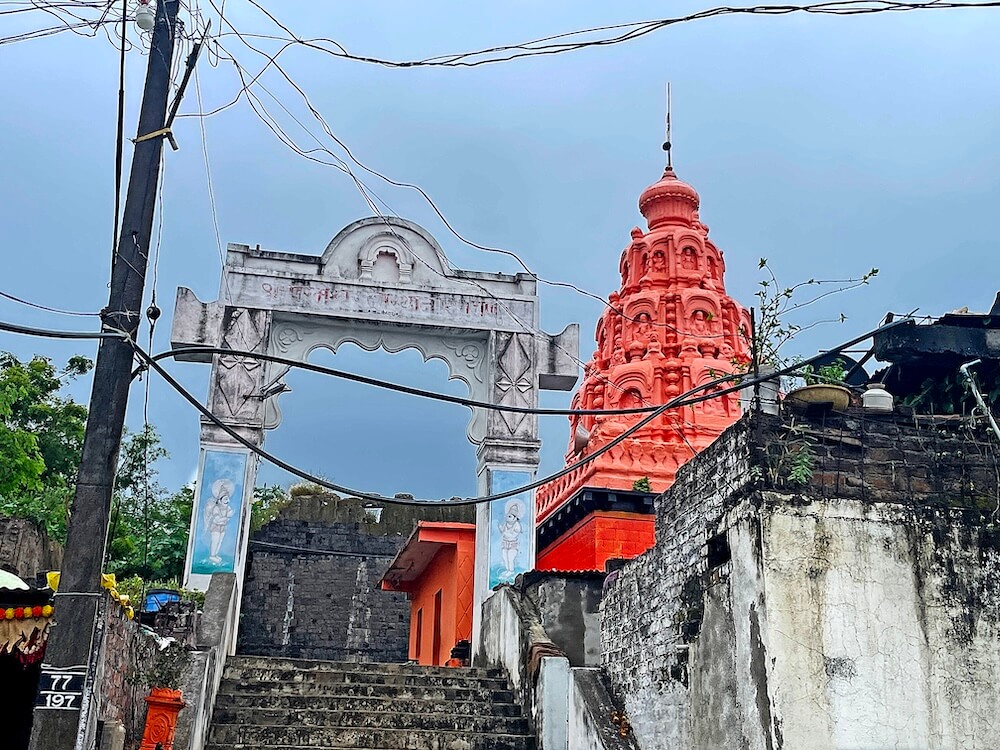
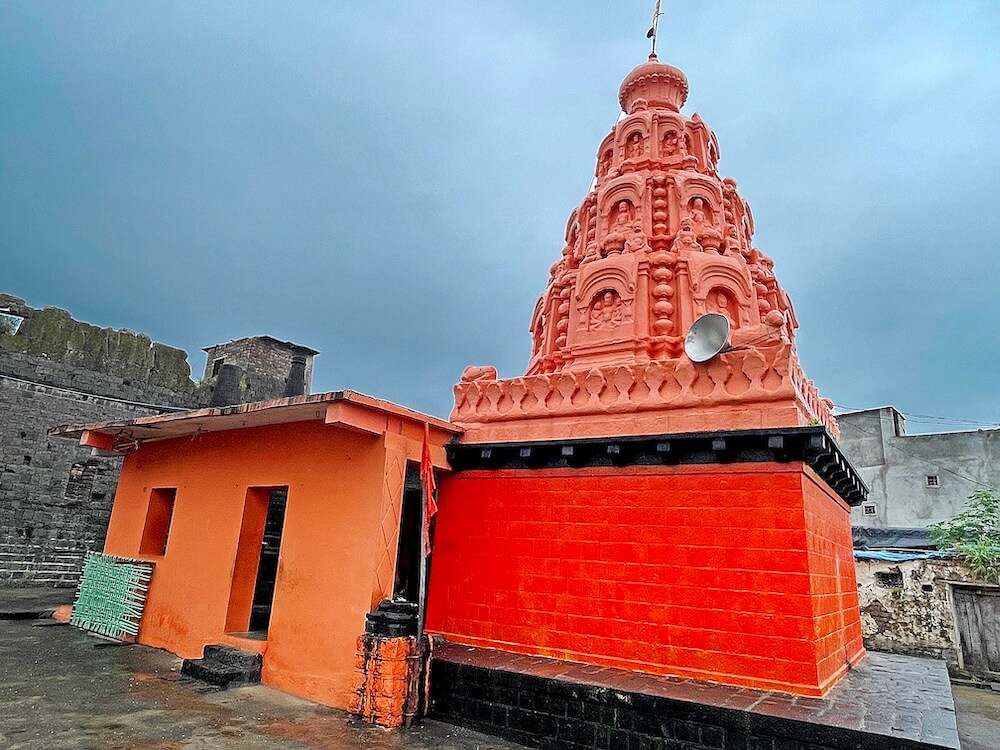
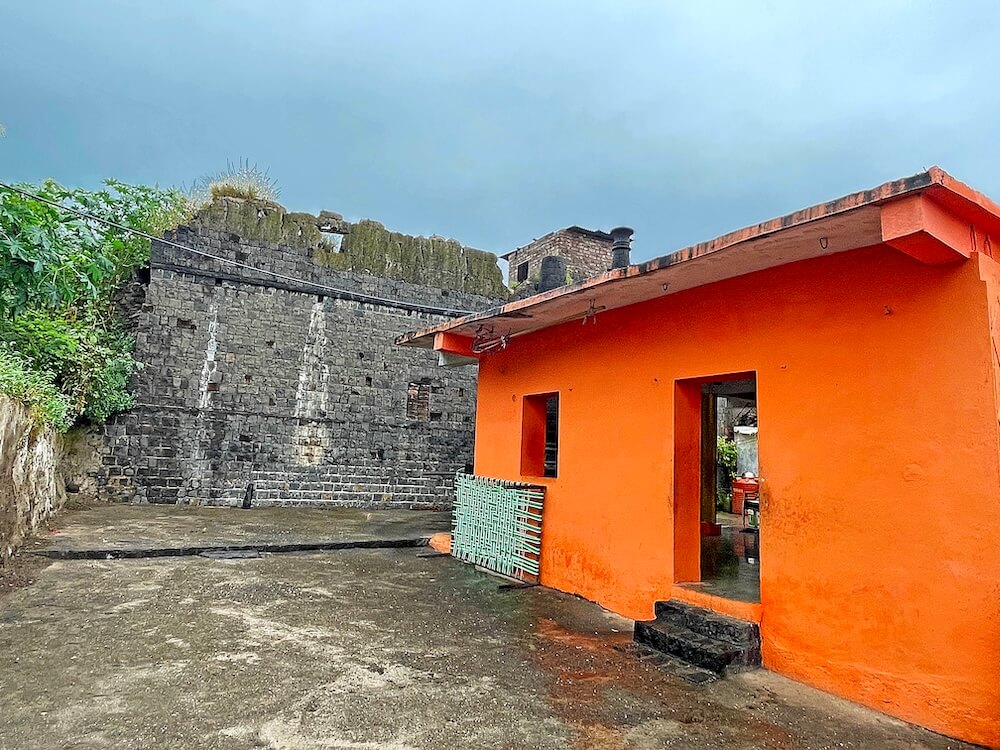
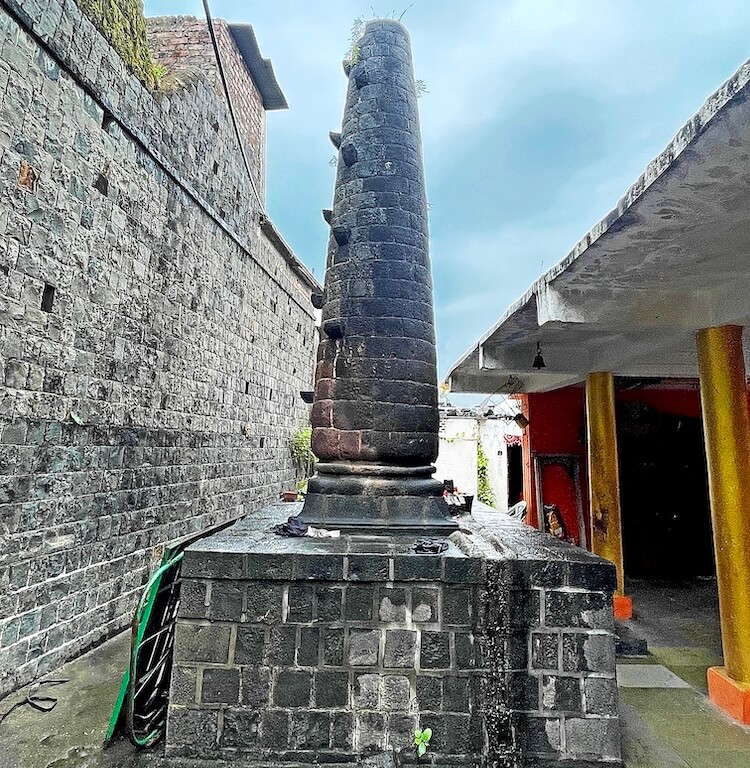
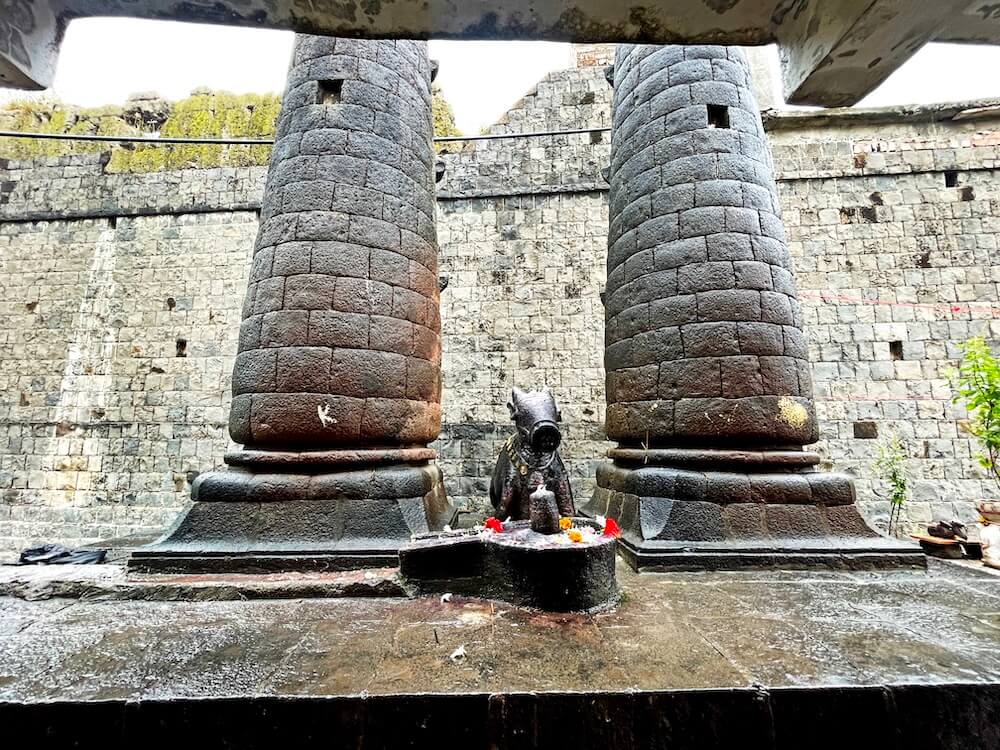
The temple is situated on a hill in the village of Shiradhon. Located in a densely populated part of the village, the temple is enclosed by a stone wall. One enters the courtyard through an arched gateway after climbing ten to twelve steps. The entrance arch features pillars on both sides connected by cusped arches. One pillar of the arch bears an image of Garuda, while the other bears an image of Hanuman. The temple structure consists of a Sabha Mandapa (assembly hall), Antarala (vestibule), and Garbhagriha (sanctum sanctorum). In front of the Sabha Mandapa, on a large raised platform, stand two lamp pillars (Deepastambhas), and between them are a Nandi and a Shiva Linga carved from a single stone. It is observed that the Sabha Mandapa was built at a later period in the space between the lamp pillars and the sanctum. This Sabha Mandapa, constructed using cement, features circular pillars. Beyond this, on a floor raised by a few inches, lies the Antarala, followed by the Garbhagriha. It is said that this Garbhagriha is the original temple structure.
On the front wall of the Garbhagriha, there are lamp niches on both sides of the entrance. The entire construction of the Garbhagriha is in the Hemadpanti style. Inside the Garbhagriha, the idol of Lord Brahma is seated on a high Vajrapitha (diamond pedestal). Carved from black basalt stone, this idol is 105 cm tall and 60 cm wide. Scholars state that this idol dates back to the ninth century and the Rashtrakuta period. The idol of Lord Brahma stands on a lotus pedestal (Kamalasana). The idol has four faces; three are clearly visible from the front, while the fourth is on the back. These faces are highly proportionate and rounded. The idol stands in a Samabhanga posture and is four-armed (Chaturbhuja). In its hands, it holds an Akshamala (rosary), a Stupa, a Mauji Bandha (sacred thread), and a Kamandalu (water pot), respectively. The idol wears pearl necklaces, a Yajnopavita (sacred thread), and Makara Kundalas (earrings in the shape of sea monsters). The anatomy, composition, and various ornaments on the idol are carved with extreme delicacy. The idol’s vehicle, the Hamsa (swan), is also clearly visible here. On both sides of the idol, two pairs of men and women are standing, along with attendants holding fly-whisks (Chauri). To the left of the idol is a devotee in a posture of salutation (Namaskara Mudra).
Along with the idol, its Prabhavali (halo) is also distinctive. Two sculptural panels are carved onto this halo. One panel features a design of Gandharva couples and Vidyadharas holding flower garlands. The second sculptural panel depicts the Ashtadikpalas (guardians of the eight directions). Significantly, all these Dikpalas are accompanied by their consorts, vehicles, and weapons. Indra is with his wife, Shachi. He holds a thunderbolt, an elephant goad, and a water pot, and is mounted on his vehicle, the elephant. In this manner, details such as Yama on a buffalo, and Agni, Nairruti, Varuna, Vayu, Soma, Kubera, and Ishana mounted on their respective vehicles can be observed in this sculpture. The temple spire is made of brick and lime and tapers upwards in three stages, adorned with carvings of various deities and animals.
The main festival celebrated at the temple is, of course, Brahma Jayanti. This festival begins on Vaishakh Shukla Tritiya. It includes Abhisheka, Trimurti Puja, Havan, and Annadan (offering of food). Many devotees are present on this occasion. Apart from this, Mahashivratri and Janmashtami are celebrated here on Shravan Krishna Ashtami.
This sacred temple stands as a testament to deep spiritual devotion, ancient architectural grandeur, and rich local cultural traditions.
The sanctum sanctorum houses the divine idol consecrated according to ancient Vedic traditions, surrounded by serene courtyards and traditional temple architecture.
Navratri, Maha Shivratri, Annual Temple Jatra & Deepotsav
Compare and book flights, secure top-rated local hotels near the temple, hire reliable guides, and rent cars instantly.
Extend your pilgrimage by visiting other highly sacred temples located nearby.


Add ₹999 more to unlock FREE SHIPPING!
Your sacred cart is currently empty.
Shop Photo FramesFill in your delivery details below to place your order.
Add comment