
Add ₹999 more to unlock FREE SHIPPING!
Your sacred cart is currently empty.
Shop Photo FramesThe Sangameshwar and Harihareshwar temple at Hattarsang Kudala is distinguished by its Chalukyan-era temple architecture, unique sculptural beauty, an extremely rare multi-faced Shiva Linga, and the integration of Shaiva and Vaishnava traditions. Situated at the confluence of the Bhima and Sina rivers, this village lies on the Maharashtra-Karnataka border. The Sangameshwar temple here holds a significant place in the history of the Marathi language, as it houses the first inscription containing a sentence in Marathi. For this reason, this site is considered historically, religiously, and culturally important.
In the village name Hattarsang Kudala, ‘Kudala’ is a Kannada word meaning ‘confluence’. Here, the Bhima river flowing from the north and the Sina river flowing from the west meet in an English ‘T’ shape. In India, the confluence of two rivers usually resembles the English letter ‘Y’, making the confluence at Hattarsang Kudala unique. Ancient temples of Harihareshwar and Sangameshwar Mahadeva are situated at this confluence. Tourists and devotees visit this place in large numbers for both religious and nature tourism. The temples here were built during the Chalukya period. Due to the exquisite and unique sculptures within, they have also become a center of attraction for scholars.
The inscription in the Sangameshwar temple is considered significant in the context of research into the origin of the Marathi language. This inscription is carved on a beam of the temple’s assembly hall (sabhamandapa). Solapur-based epigraphist Anand Na. Kumbhar was the first to decipher this inscription. In the July 1975 issue of ‘Navabharat’ magazine, published by the Prajna Pathashala in Wai, he published a detailed article titled ‘Clear Dated Early Marathi Inscription – The Marathi Inscription of Shaka 940 at Sangameshwar Temple, Kudala’ . According to the information therein, this inscription, which is 94 cm long and 16 cm wide, consists of just two and a half lines. The first line, written in Nagari and Marathi, contains the words “Om Svasti Shaku 940 Kalayukta Samvatsare Mangakadhanushikala Chela”. The second line states, “Pandita ta gachhato aayata machha xxx mi xx chhimani 1000” (the ‘xxx’ indicates that these letters could not be deciphered). The third line contains the Marathi words “vachhito vijayam hoiva”, which means “whoever reads this shall be victorious”. From this inscription, it is understood that in Shaka 940, during the Kalayukta year, a scholar visited the Sangameshwar temple and was gifted one thousand nishkas (coins prevalent at that time). Finally, there is a blessing that the reader of this inscription may be victorious. According to the chronological records, this inscription was carved in Shaka 940, i.e., 1018 CE, during the reign of the Chalukya King Jayasimha III. According to Anand Kumbhar, this is the first inscription in Marathi. The ‘Classical Marathi Language Committee’ appointed by the Government of Maharashtra to prepare the proposal to be sent to the Central Government for granting classical status to the Marathi language also mentions this. In 2018, the Government of Maharashtra sanctioned 10 lakh rupees for the preservation of this inscription.
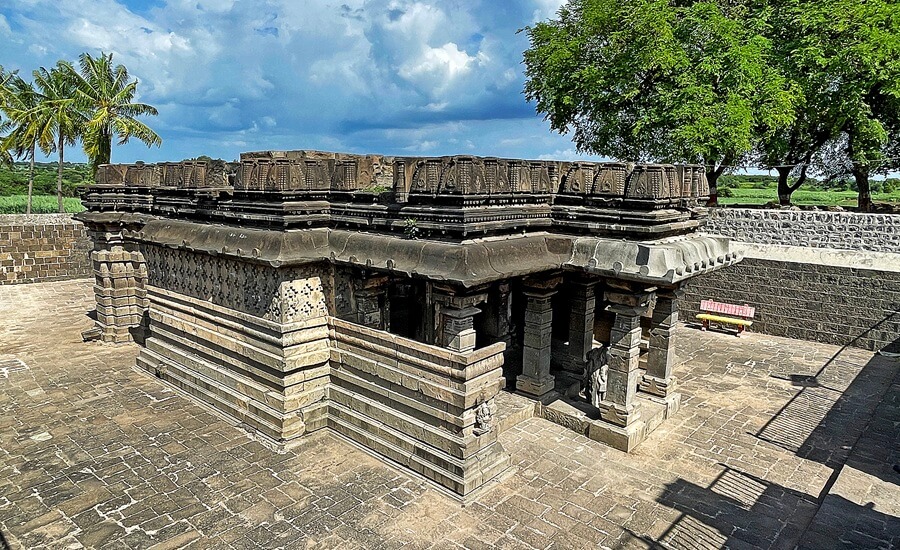
The inscription in the Sangameshwar temple makes it clear that this temple was built in 1018 CE. This is a ‘Trikuta’ temple, meaning it has three sanctum sanctorum. It is said that it underwent several renovations in the post-Chalukyan period.
There are many ancient trees in front of this temple. The temple has an ancient and sturdy stone perimeter wall. The entrance to the temple is in this wall. In front of the entrance is an ancient stone pot, which is currently used as a ‘hundi’ , or donation box. The entrance here is somewhat elevated, with auspicious symbols carved on its steps. The door frames are adorned with vine motifs and floral patterns, and there is an image of Lord Ganesha on the lintel. There are guard rooms on both sides inside the entrance. On the ceiling of the entrance, on the front side, there is a decorative railing, and on the left and right sides are Nandi sculptures. The temple courtyard is paved with stone. In the courtyard, in front of the main hall, there is a square stone slab raised a few inches; experts speculate that this may have been a ‘rangashila’ (a platform for performances). There are many ancient structures in this courtyard, and there are cloisters along the perimeter wall.
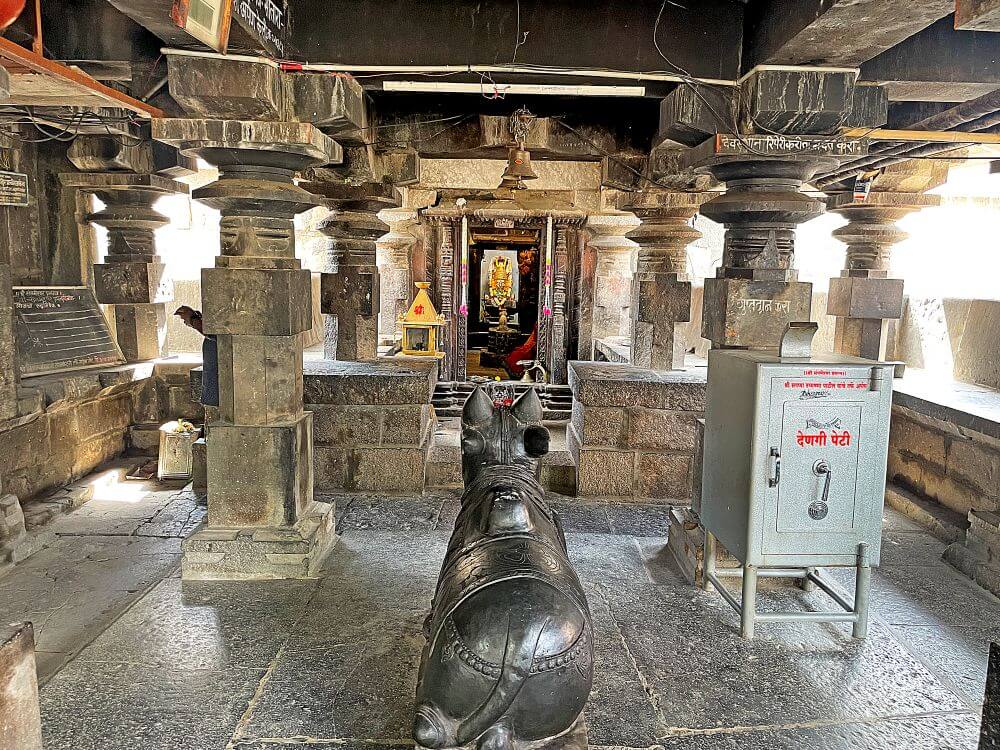
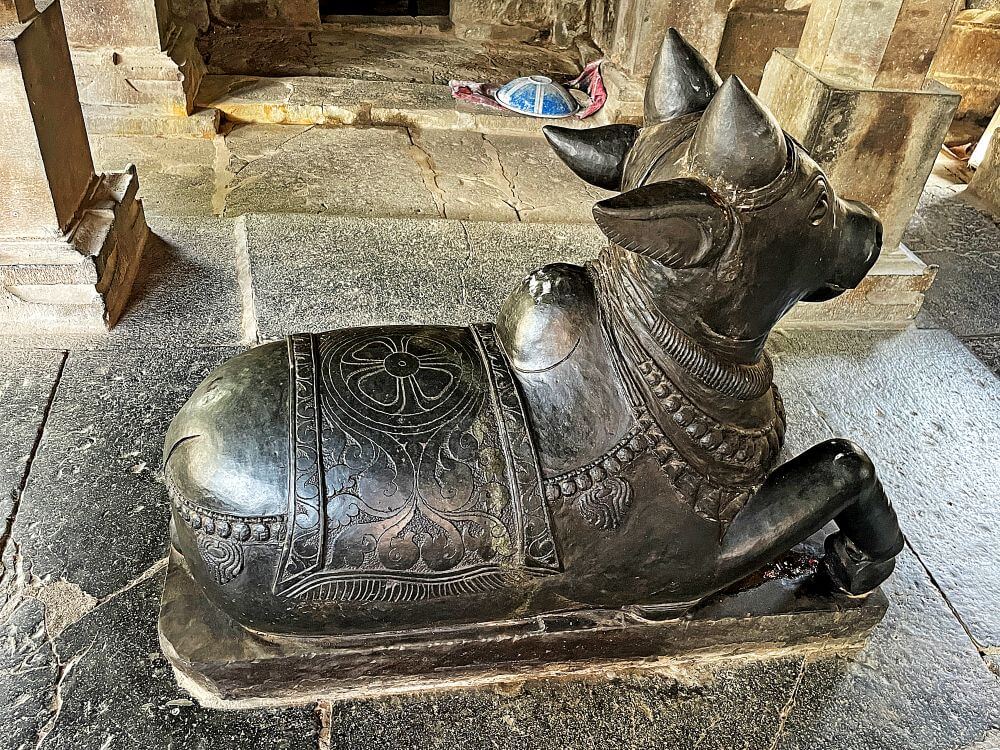
The structure of this temple consists of two porches (mukhamandapa), an assembly hall (sabhamandapa), a vestibule (antarala), and a sanctum (garbhagriha). The porch is semi-open and has stone benches (kakshasana) on the outer side. There are six decorative half-pillars on the stone benches. To the right of this porch is another porch, and to the left is a closed room. Further ahead, in the semi-open assembly hall, there is a black stone idol of Nandi on a pedestal in the space between the four central pillars . All pillars stand on square bases. The pillar shafts feature various geometric shapes such as squares, hexagons, octagons, and circles. At the top of the pillars are brackets and above them are corbels. The ceiling features a circular design. The assembly hall contains the inscription with the Marathi sentence.
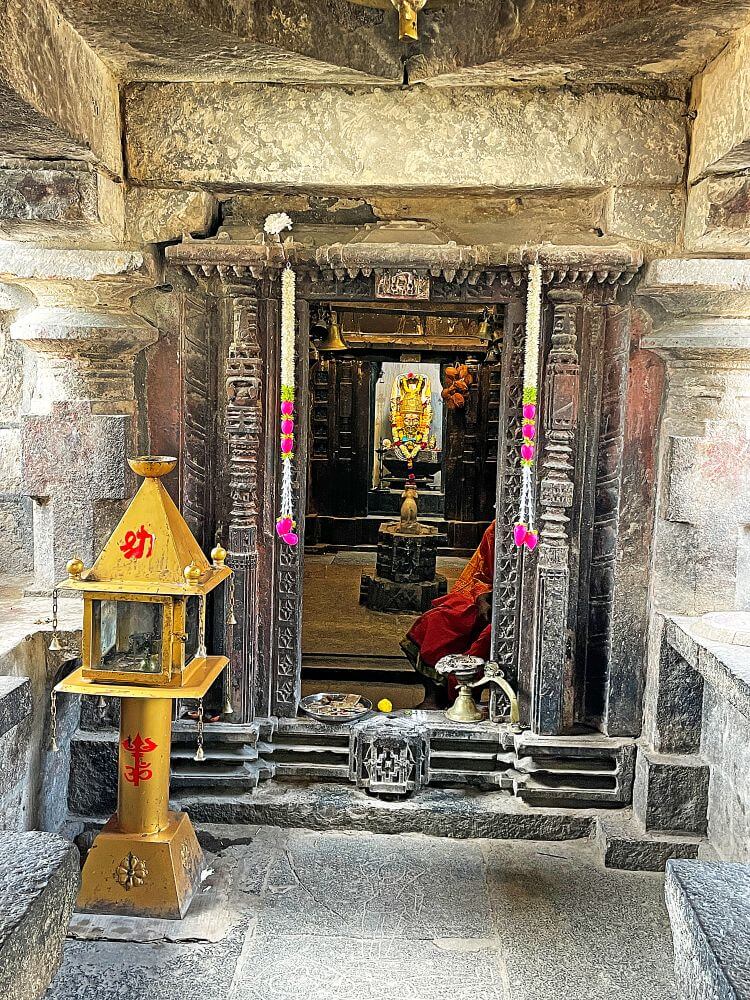
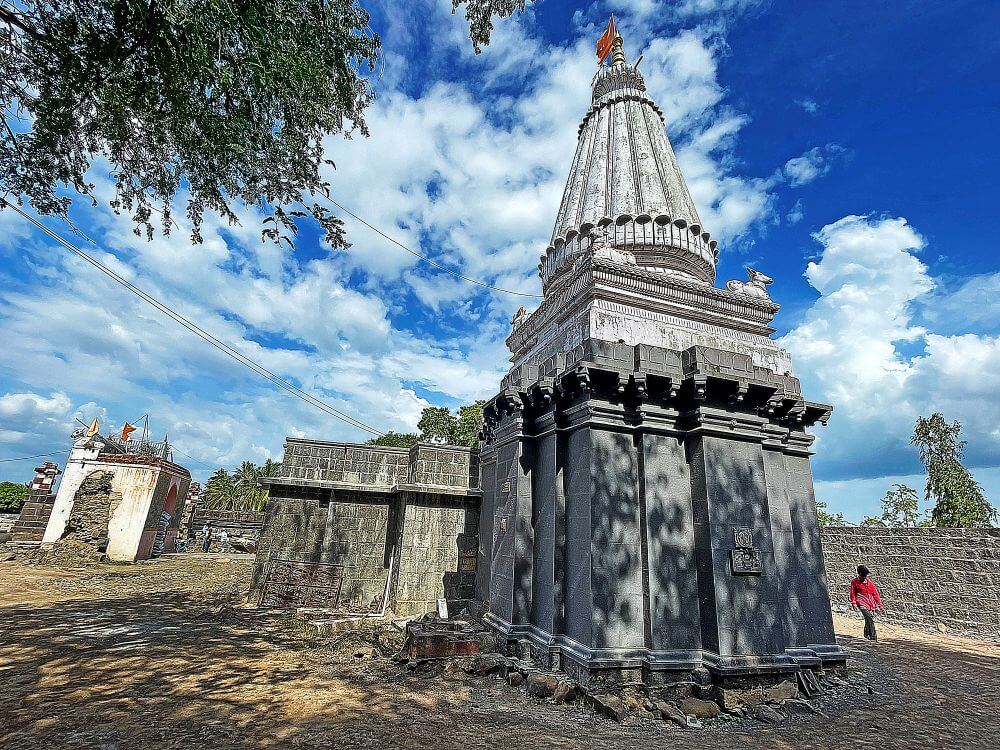
The entrance to the vestibule ahead has floral and pillar motifs. There is an image of Ganesha on the lintel. The threshold features a moonstone (chandrashila) and a kirtimukha. There is a sculptural arch on the upper row above the entrance. In the center of the vestibule is an idol of Nandi. Further ahead, the entrance to the sanctum is higher than the assembly hall. The door frames have faint carvings and pillar motifs. There is an image of Ganesha on the lintel and a moonstone on the threshold. The sanctum houses a Shiva Linga. The base (shalunka) of the Shiva Linga is high, and the Linga is adorned with a brass mask of Mahadeva. Above Mahadeva’s head is a five-hooded brass cobra holding a canopy. The roof of the sanctum has a two-tiered spire (shikhara). In the lower square tier, there are Nandi sculptures on all four corners . The upper circular tier is tall and tapering. At the top of the spire are the amalaka and the kalasha.
Descending a few steps from the Sangameshwar temple courtyard, one enters the Harihareshwar temple courtyard. The structure of this temple consists of a porch, assembly hall, svargamandapa, vestibule, and sanctum. The porch here is open-style. The pillars standing on square bases in the front feature various geometric shapes like squares, hexagons, octagons, and circles. In the porch, there are two unique idols carved back-to-back on a single stone. One is the idol of Mahalakshmi, and the other is of Bhairavi or Kalika Devi.
In front of the Mukhamandapa (main entrance hall), there is a semi-open Sabhamandapa (assembly hall) featuring two full pillars at the front and half-pillars integrated into the outer Kakshasanas (stone benches). On the ceiling of this Sabhamandapa, exquisite sculptures are carved, depicting Lord Krishna in his multi-faceted form with one face and five bodies, Lord Krishna performing the Rasleela with the Gopis, and Lord Krishna playing with his companions. Beyond the Sabhamandapa lies the Swargamandapa (celestial hall). The door frames of the Swargamandapa are adorned with floral motifs and pillar carvings. On the Lalatabimba (lintel), there is a sculpture of Lord Ganesha, and the architrave above features carvings of temple spires (Shikhara). There is a Chandrashila (moonstone) at the threshold. The Swargamandapa is supported by approximately twelve ornate pillars featuring brackets and corbels. These brackets are carved with figures of Yakshas, Kinnaras, Surasundaris, and elephants. In a niche on the wall of the Swargamandapa, there is a sculpture of Kalabhairava holding a Trishula and Damaru, flanked by large serpent sculptures on both sides. Also carved in the Swargamandapa is Lord Krishna playing the flute, with his companions at his feet. The ceiling of the rectangular Swargamandapa is open. In ancient times, this hall was used for cultural performances such as dance, drama, and music as an offering to the deity.
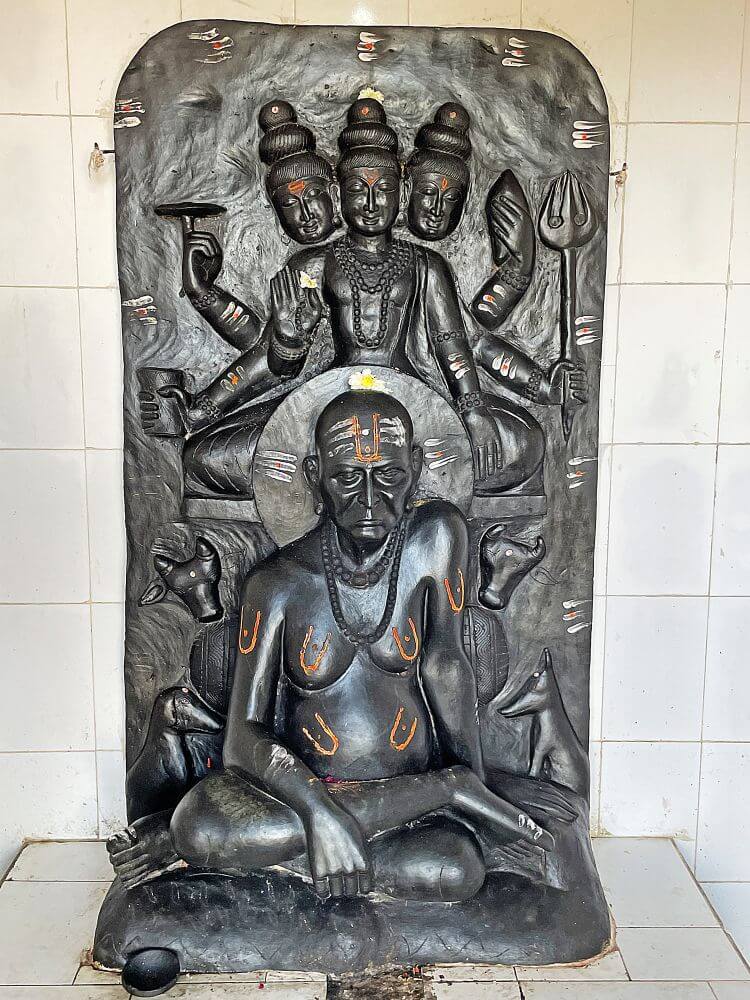
From the Swargamandapa, one proceeds to the Antarala (vestibule) and then to the two Garbhagrihas (sanctum sanctorum). The door frames of both sanctums are decorated with floral motifs, and the lintels feature images of Lord Ganesha, with Chandrashilas at the thresholds. In the left sanctum, there is a Swayambhu (self-manifested) Shiva Linga on the floor. In the right sanctum, there is an idol of Lord Vishnu in his Muralidhar (flute-playing) form, seated on a Vajrapitha. Adjacent to these temples is another Shiva temple, which houses a multi-faced Shiva Linga. This Linga is carved with 359 faces of Lord Shiva. Devotees believe that performing an Abhisheka on this Linga grants the merit of a full year of daily worship. This Shiva Linga, weighing approximately 4,500 kilograms, was discovered during excavations. In the basement of this temple, there is a statue of a sage. The temple courtyard contains a Maruti temple, a Homa Kunda (sacrificial fire pit), and other ancient sculptures. Near the temple is the confluence of the Sina and Bhima rivers, where a stone-built ghat is located. Rituals such as Shraddha and Janana Shanti are performed there.
These temples at Hattarsang Kudal are renowned for their unique architecture and sculptural art. Through this art, a rare confluence of the Shaiva and Vaishnava traditions is expressed. Pilgrimages are held here during Mahashivratri, the holy month of Shravan, and Makar Sankranti, during which various religious rituals and cultural programs are organized.
A large number of devotees and tourists visit during the Kiranotsav (sunbeam festival). When the sun enters Uttarayana, the morning sun rays fall directly upon the Shiva Linga in the Sangameshwar temple here. Such a Kiranotsav can be witnessed in very few places in Maharashtra. Many devotees also come to offer prayers on every Amavasya (new moon day).
This sacred temple stands as a testament to deep spiritual devotion, ancient architectural grandeur, and rich local cultural traditions.
The sanctum sanctorum houses the divine idol consecrated according to ancient Vedic traditions, surrounded by serene courtyards and traditional temple architecture.
Navratri, Maha Shivratri, Annual Temple Jatra & Deepotsav
Compare and book flights, secure top-rated local hotels near the temple, hire reliable guides, and rent cars instantly.
Extend your pilgrimage by visiting other highly sacred temples located nearby.


Add ₹999 more to unlock FREE SHIPPING!
Your sacred cart is currently empty.
Shop Photo FramesFill in your delivery details below to place your order.
Add comment