
Add ₹999 more to unlock FREE SHIPPING!
Your sacred cart is currently empty.
Shop Photo FramesKaleshwar means the Lord of Art. Nerur is a village renowned for its rich cultural heritage, including the famous Konkan folk art ‘Dashavatar’, the traditional cultural event ‘Rombat’ celebrated on the day after Holika Purnima, and various mythological performances. Kaleshwar is the presiding village deity (Gram-Daivat) of this village. The ancient Kaleshwar temple here signifies the non-duality between Hari (Vishnu) and Hara (Shiva). Devotees believe this to be a ‘Jagrut Devasthan’ (a temple where the deity is spiritually awakened and responsive), which is why pilgrims constantly visit for Darshan. A grand fair is held here, especially on Shivratri. On that day, a large crowd of devotees gathers for the Darshan of Kaleshwar and to witness the chariot festival.
The Kaleshwar temple is extremely ancient. The legend associated with it states that long ago, a Brahmin lived in Nerur village. He owned many cows and cattle. Once, his servant took the herd to a tamarind grove in Nerur. It was a Monday. While the other cattle were grazing, one cow went to a specific spot and began to release milk from her udder. The servant was astonished to see this. Following this, he took the cattle to the same spot the next Monday as well. This time, he had brought a pickaxe with him. As soon as the cow began releasing milk at that specific spot, he started digging. Suddenly, he heard a ‘khann’ sound. Upon looking, he saw a stream of blood flowing from the ground. He cleared the surrounding soil and discovered a Shiva Linga. Devotees believe that this Linga is Kaleshwar himself. Thereafter, the villagers built the Kaleshwar temple and began worshipping him.
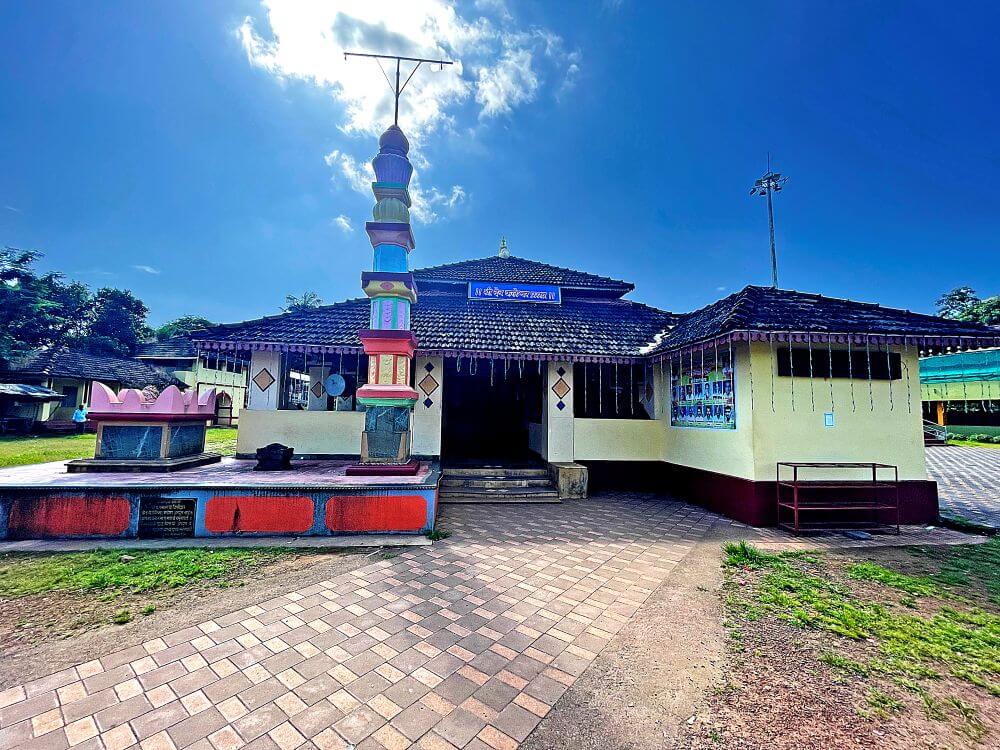
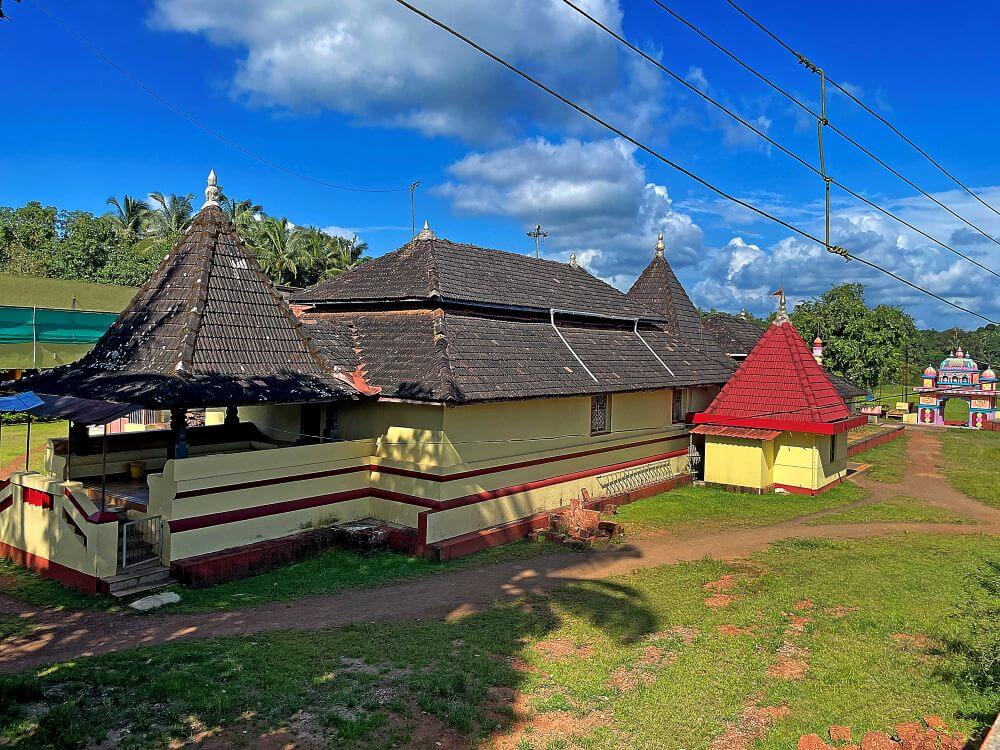
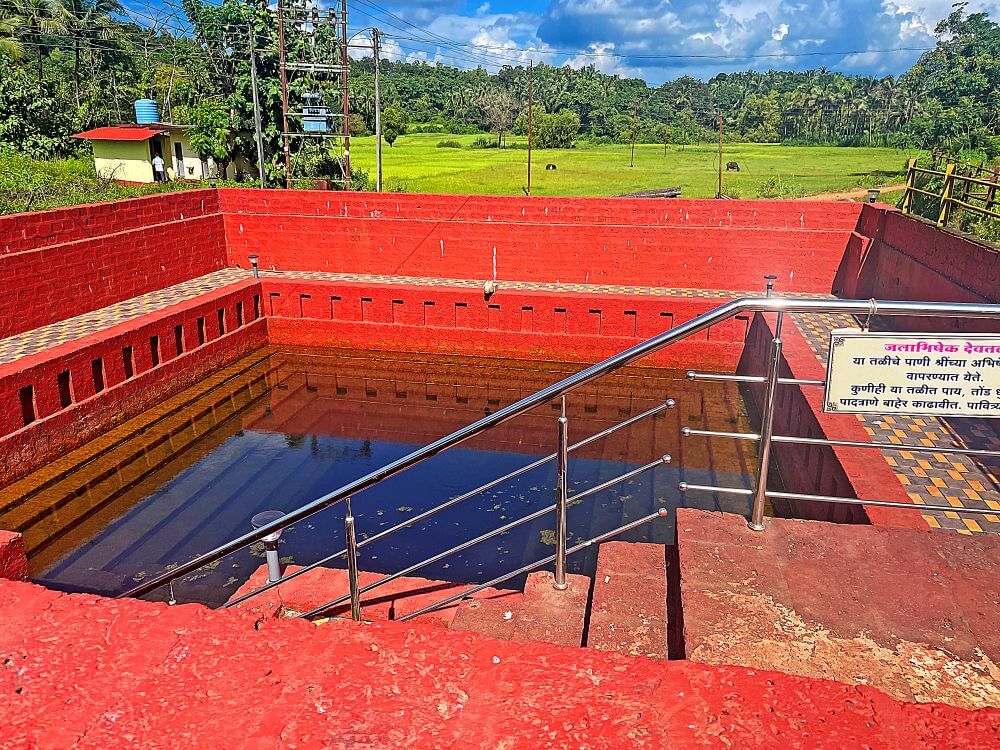
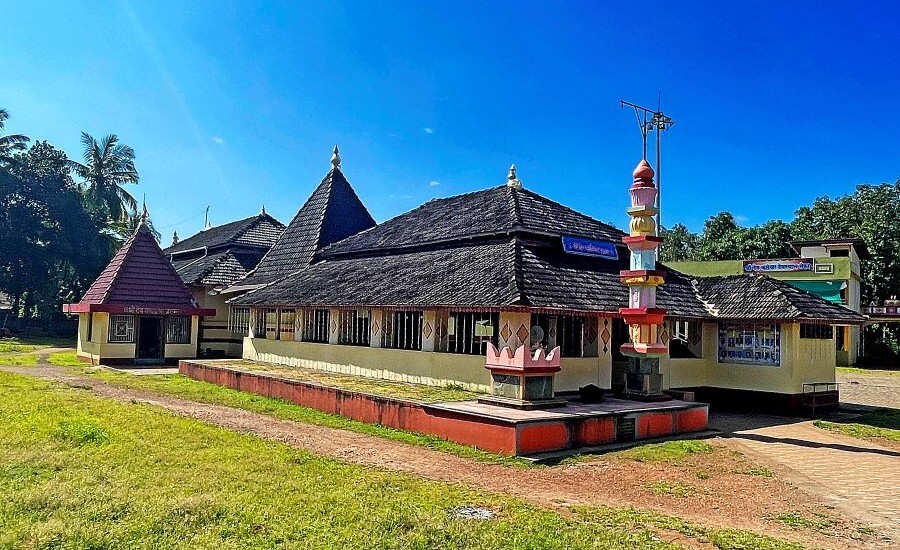
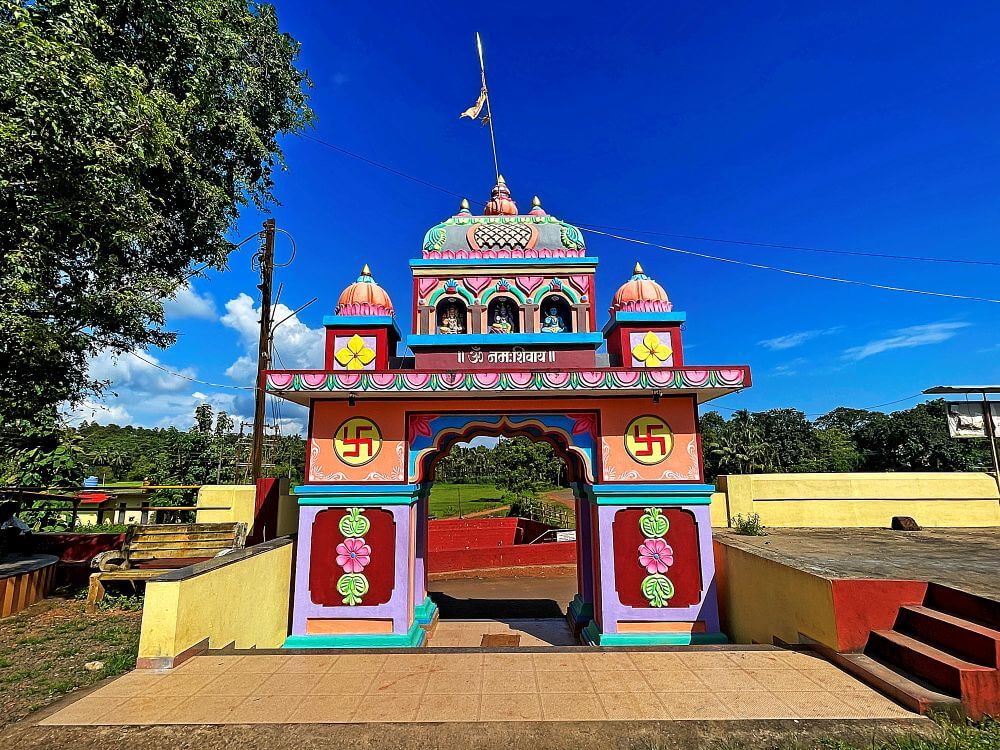
The temple is situated outside the village in a picturesque setting, on the banks of a lotus pond. The temple premises are vast and enclosed by a large boundary wall. Outside these premises, facing the temple entrance along the road, is a small, square, built-up pond with steps. The temple entrance resembles the Gopuram of Dravidian-style temples. On its roof, within a tall, colorful niche, are the idols of the three deities: Brahma, Vishnu, and Mahesh. Upon entering, one sees the ancient and magnificent Kaleshwar temple, a fine example of Konkan architectural style. Directly in front of it, on a stone platform, stands a six-tiered lamp pillar (Deepstambh) and a small Tulsi Vrindavan.
As one enters through the temple gateway, a spacious Sabha Mandap (assembly hall) appears. The Sabha Mandap is of an open design, featuring cement pillars along the outer walls with ‘Kakshasanas’ (stone benches with backrests). Following the Konkan architectural style, there are wooden pillars placed some distance inward from the Kakshasanas. The floor between these pillars on both sides is slightly recessed by a few inches. The Sabha Mandap of this temple is divided into two parts. Ascending four steps from the outer Sabha Mandap, one enters a second, smaller Sabha Mandap. This hall is also open in nature and has Kakshasanas on both sides. The black stone pillars within it are intricately carved. These pillars are square at the base, hexagonal in the middle, and topped with a kalash-like shape adorned with leaf carvings. In the center of these pillars, idols of Ganesha in various forms are carved. This hall is topped by a pyramid-shaped Shikhara.
Ascending three steps from here, one enters the main Garbhagriha (sanctum sanctorum). The doorway of the sanctum has a wide frame with three door-jambs. It is adorned with vine carvings and idols of Ganesha, Hanuman, and Dwarapalas (gatekeepers). An idol of Ganesha is carved on the Lalat-bimba (lintel). Adjacent to these door-jambs are carved half-pillars embedded in the wall, with Vyala (mythical lion) figures at their tops. Above the door frame, above the Lalat-bimba, are Naga (serpent) figures, a characteristic feature of Shaivite temples. In front of this hall is a spacious Antarala (vestibule). The distinctively carved stone pillars here reflect the antiquity of the temple. On the middle section of these pillars, i.e., the pillar shaft, various deities are carved. Above them are ‘Ghatapallava’ (vase and foliage) motifs, followed by wooden carved ‘Tarangahasta’ (brackets). A stone idol of Nandi is placed in the Antarala.
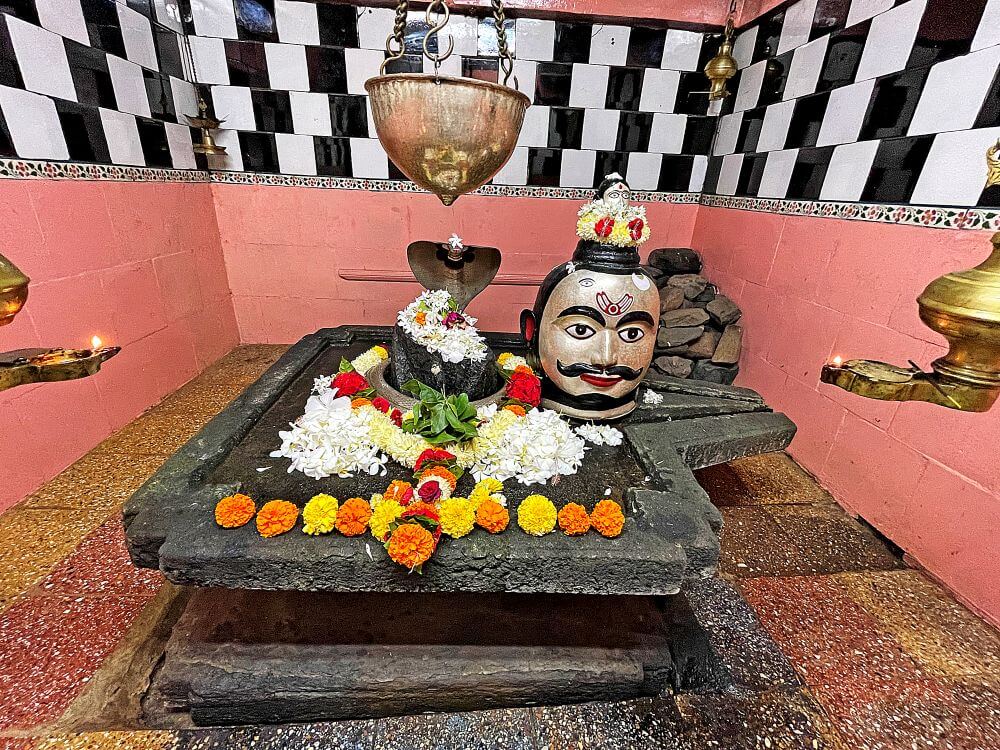
On the front wall of the Garbhagriha, to the left of the entrance, is a beautiful stone idol of Ganesha. To the right is an image of the Karkotaka Naga. Inside the sanctum, the Shiva Linga is slightly elevated from the floor. Notably, the ‘Shalunka’ (base) of this Linga is square-shaped. On the Shiva Linga within the Shalunka, there is a brass idol of a hooded cobra. Nearby is the face-idol of Shiva. This serene-faced idol of Shiva has a mustache and wears the Ganga on his head.
To the right of the Kaleshwar temple is a small temple dedicated to Vetoba and Bhadrakali. Additionally, the temple premises house shrines for folk deities such as Gavdoba, Ravalnath, and Sateri Devi. Sateri Devi is worshipped in the form of an anthill (Varul). There is a tall anthill in this temple as well. A unique feature of this Devasthan is the temple of Brahmnath. This temple is also built in the Konkan architectural style. It is constructed on a high plinth and consists of a Sabha Mandap and a Garbhagriha. The Sabha Mandap is spacious and contains black stone pillars inside. On the front wall of the Garbhagriha, to the left, is a Shiva Linga and an idol of Bhairoba. To the right is a Sati-shila (memorial stone). The entrance to the Garbhagriha is multi-jambed and decorated with intricate vine carvings. Inside, in a golden arch with a Makara-torana, is the idol of Brahma. This idol is made of black stone and is three-faced (Trimukhi). All three heads wear golden crowns. Beside this idol are idols of folk deities. There is a common belief that the only temple of Brahma in the country is in Pushkar, Rajasthan. In reality, there are Brahma temples in Asotra in Barmer district of Rajasthan, Khokhan in Kullu Valley of Himachal Pradesh, Kumbakonam and Tirupattur in Tamil Nadu, and also in Panaji. One such Brahma temple in Maharashtra is this Brahmnath temple in Nerur. It is a tradition here to visit the Brahmnath temple after the Darshan of Kaleshwar.
The chariot of Kaleshwar is kept covered in a pavilion within the premises of the Kaleshwar Devasthan. This wooden chariot stands 21 feet tall and is shaped like the temple’s shikhara (spire). It features intricate carvings throughout. The Mahashivratri festival is celebrated with great fervor at the Kaleshwar Devasthan. It is a five-day fair. During this time, the Kaleshwar Rath Yatra (chariot procession) is taken out amidst the rhythmic beats of drums and cymbals and the chants of ‘Parvatipataye Har Har Mahadev’. Various programs such as Dashavatar, Kirtan, and Bhajan are organized during the Mahashivratri festival. Thousands of people from the surrounding areas gather for this fair. Apart from this, festivals like Maghi Ganeshotsav, Navratri, and Diwali are celebrated with great enthusiasm in the temple premises.
This sacred temple stands as a testament to deep spiritual devotion, ancient architectural grandeur, and rich local cultural traditions.
The sanctum sanctorum houses the divine idol consecrated according to ancient Vedic traditions, surrounded by serene courtyards and traditional temple architecture.
Navratri, Maha Shivratri, Annual Temple Jatra & Deepotsav
Compare and book flights, secure top-rated local hotels near the temple, hire reliable guides, and rent cars instantly.
Extend your pilgrimage by visiting other highly sacred temples located nearby.


Add ₹999 more to unlock FREE SHIPPING!
Your sacred cart is currently empty.
Shop Photo FramesFill in your delivery details below to place your order.
Add comment