
Add ₹999 more to unlock FREE SHIPPING!
Your sacred cart is currently empty.
Shop Photo FramesAfter the twelfth century, winds of change began to blow through Hinduism. Many sects and traditions emerged, such as the Varkari Sampradaya founded by Saint Dnyaneshwar, the Lingayat community of Basavappa, the Mahanubhav Panth, the Nath Sampradaya founded by Machindranath, and the Giri, Puri, and Gosavi orders. This tradition continued, and in the first half of the twentieth century, Sai Baba of Shirdi in Nagar district gave humanity the mantra to live as human beings, transcending caste and religion. Today, there are hundreds of Sai Baba temples in the country. One of the most important and famous among them is in the city of Mapusa. Devotees believe that receiving darshan of Sai Baba here brings spiritual energy.
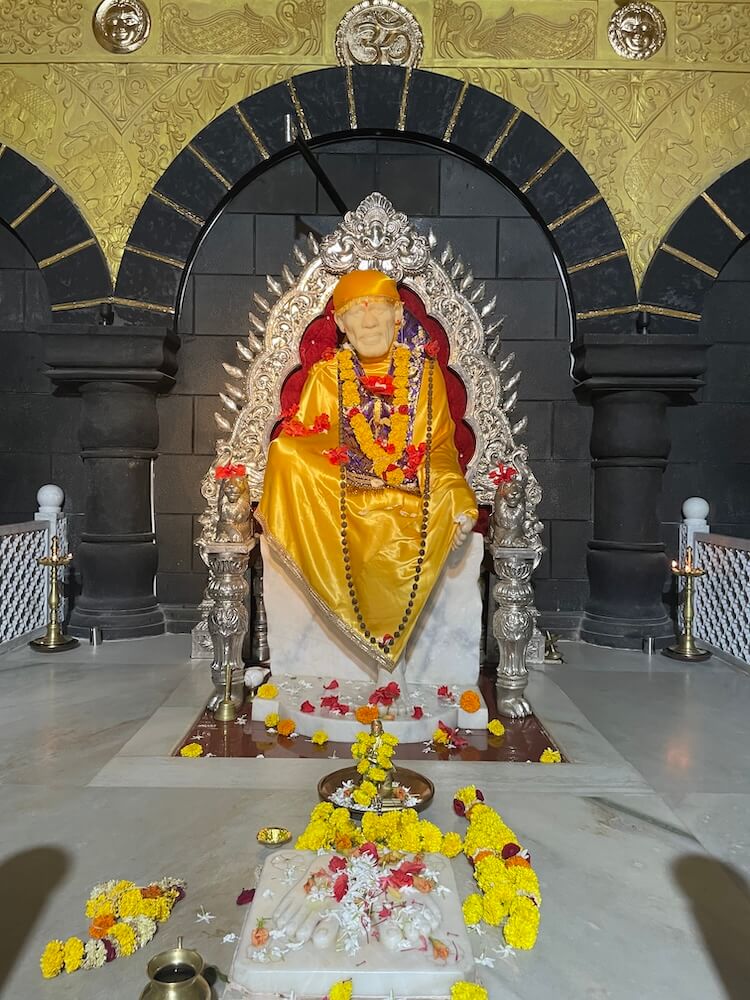
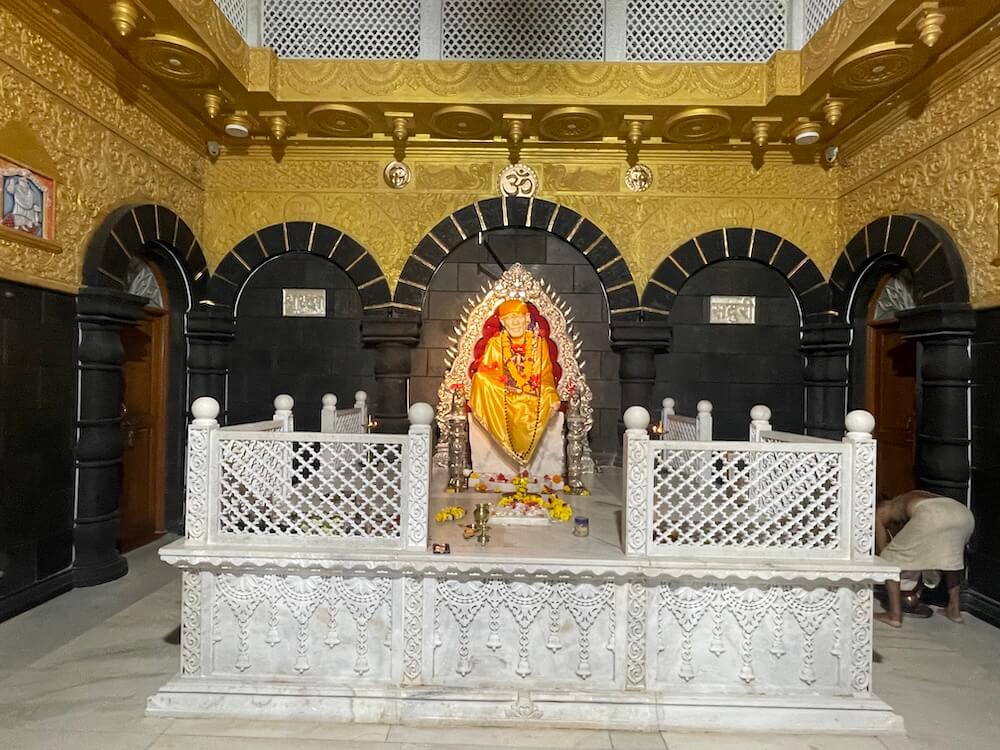
The history of the construction of this temple is fascinating. Some devotees who regularly walked on this hill began to have visions of Sai Baba’s presence here. Later, when the form of Sai Baba began to appear on a stone on the hill, some devotees started worshipping him. A small, makeshift temple was built around this stone. In the year १९८८, a permanent temple was built on this very spot, and a portrait of Sai Baba was installed. On २१ April १९९२, the foundation stone for a new, grand temple was laid by Gagangiri Maharaj of Gaganbawada, and the construction was completed by the year २००२. In April २००३, a magnificent idol of Sai Baba, crafted from Rajasthani Makrana marble, was consecrated in the temple. Today, this temple is famous throughout Goa as ‘Prati-Shirdi’ (a second Shirdi). Devotees in Goa who are unable to travel to Shirdi come to this temple and bow their heads at the feet of Sai Baba.
Information regarding where Sai Baba was born or who his parents were is unavailable. He appeared in Shirdi for the upliftment of devotees and lived in a dilapidated mosque there. During his lifetime, he performed many miracles. He cured the ailments of the sick and liberated souls trapped in distress. He worked against caste discrimination and emphasized humanity. Consequently, his followers grew day by day. On १५ October १९१८, he took Samadhi in Shirdi. His Samadhi Mandir is a place of faith for millions of devotees.
This temple in Mapusa city is located on a high hill, two kilometers away from the bus stand. There are about one hundred and fifty steps to reach the temple from the foot of the hill. There are safety railings on both sides of the fifteen-foot-wide stairway. A paved road also leads directly to the temple. There are parking lots at the foot of the hill and on the hill itself. The temple is surrounded by a perimeter wall with two entrances.
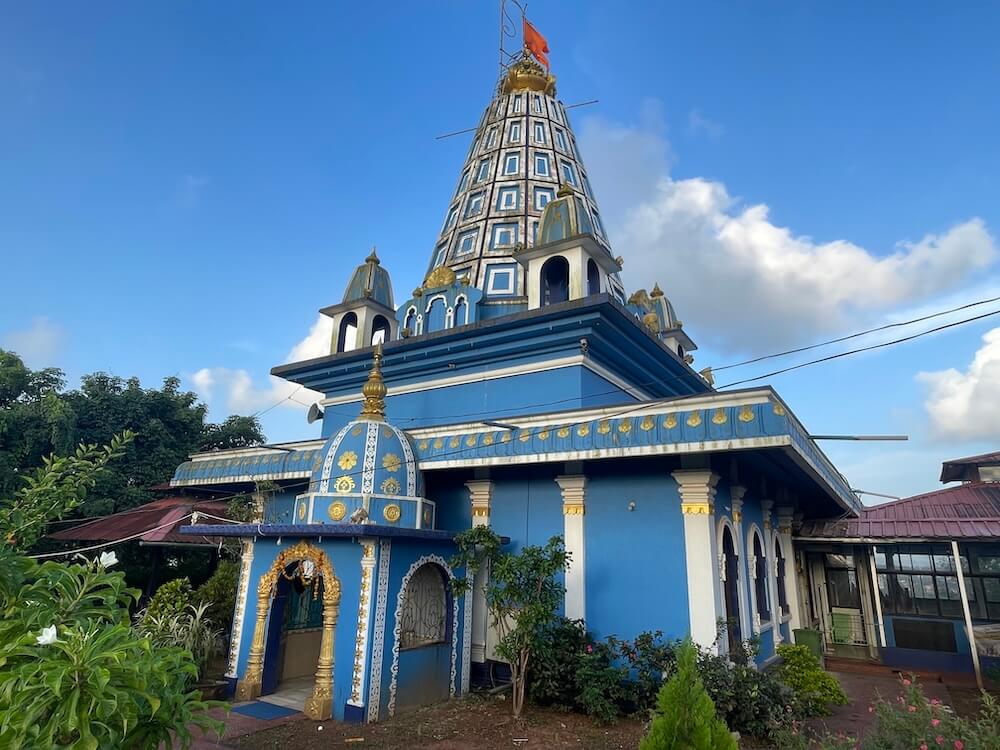
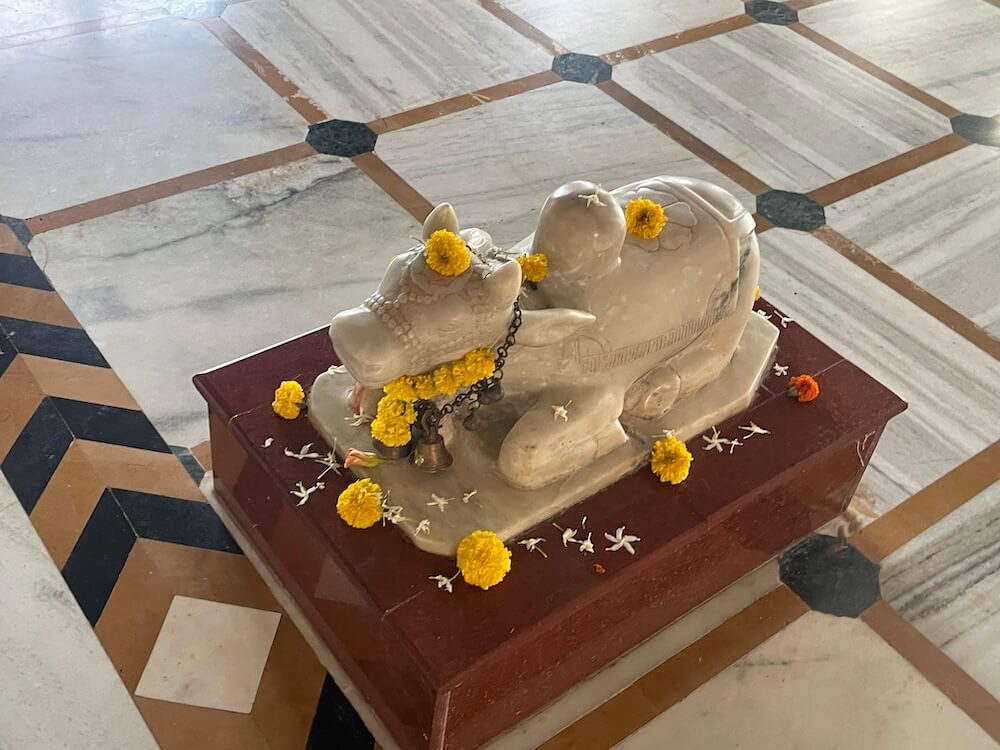
The ground floor of the two-story temple houses a community hall. The upper floor is designed with a front pavilion (Mukhamandap), an assembly hall (Sabhamandap), and the sanctum sanctorum (Garbhagriha). A panoramic view of Mapusa city can be seen from the front pavilion. There are ornate pillars on both sides of the entrance to the assembly hall. This enclosed assembly hall is spacious and has windows for light and ventilation. In the assembly hall, there is an idol of Nandi on a pedestal in front of the entrance to the sanctum. The door frames of the sanctum have vertical carvings. There are lotus footprints (Padmapaduka) on the threshold of the entrance. During festivals, devotees receive darshan from here.
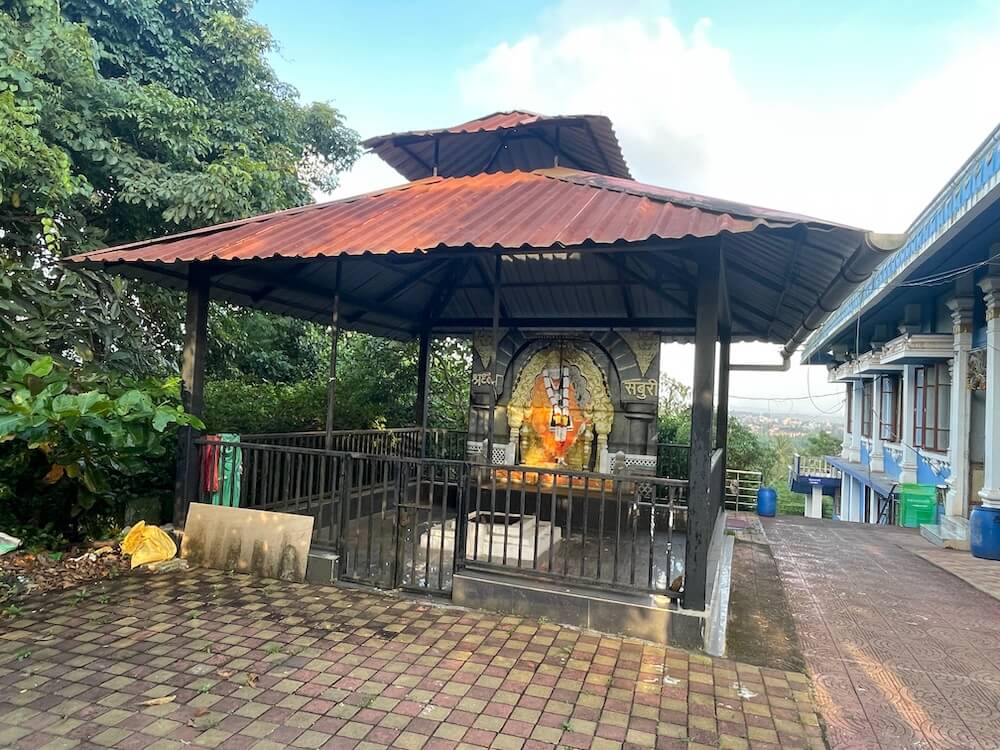
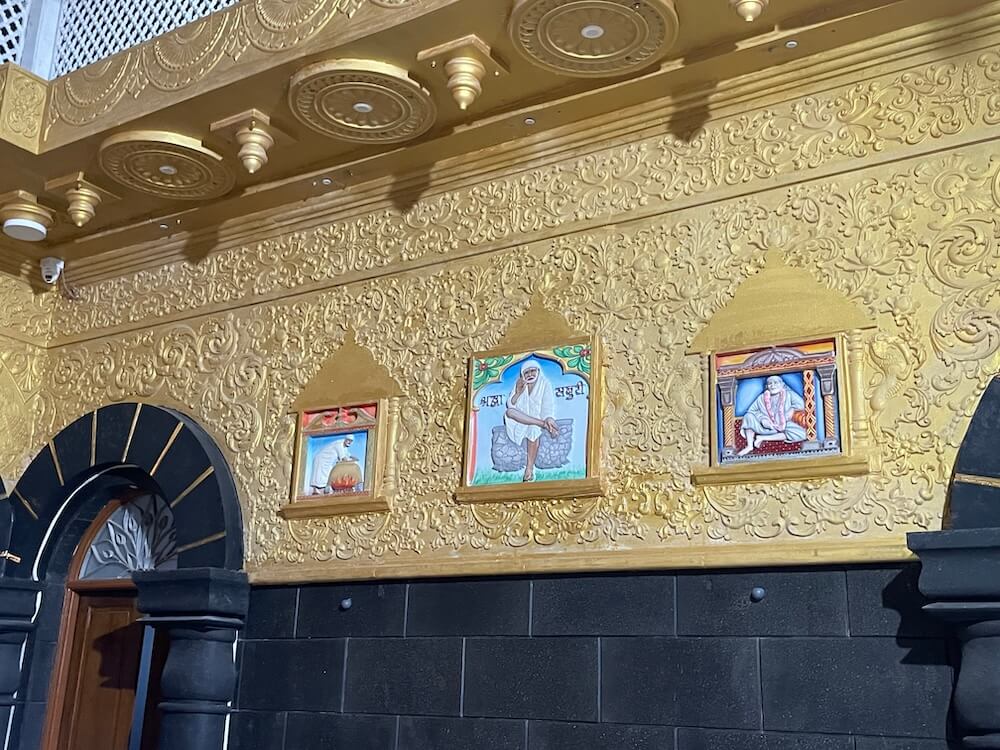
Inside the sanctum, on a diamond-shaped pedestal, stands the full-length idol of Sai Baba seated in the ‘Sai-asana’ (throne). There is a silver crown on the head of the idol and an ornate silver halo behind it. The idol is seated in an intricately carved archway. There are two more doors on the left and right sides of the sanctum. The roof of the front pavilion has a dome-shaped spire. There are four small pavilions (Meghadambari) on the four corners of the sanctum roof. Each has a square dome-shaped spire topped with a finial (Kalash). In the center of the sanctum roof, there is a circular spire that tapers upwards. At the top of the spire is an Amalaka, and above the Amalaka is a finial. Next to the Sai Baba temple is a Ganpati temple. In the courtyard in front of the temple, there is an eternal sacred fire (Dhuni). The Ganpati temple is also designed with an assembly hall and a sanctum. Inside the sanctum, there is an idol of Ganesha on a pedestal, with images of Sai Baba on both sides. Beside this temple is a temple of Mahadeva.
Devotees can visit the temple daily from ७ AM to १ PM and from ३ PM to ९ PM. Aarti is held here from Friday to Monday at ६.३० PM. The Thursday Aarti time is ७.३० PM. Additionally, during festival periods, Kakad Aarti is held at ५.१५ AM, Madhyanha Aarti at १२.३० PM, Dhup Aarti at ७.३० PM, and Shej Aarti at १० PM. The temple’s anniversary, Chaitra Shuddha Ashtami, is celebrated here with great enthusiasm. The next day, the Ram Navami festival is celebrated with equal fervor. Along with this, on the days of Ashadh Purnima (Guru Purnima) and Dussehra, a palanquin procession of Sai Baba is taken out. The procession travels through the entire city of Mapusa amidst the sound of drums and the throwing of gulal. All other festivals and celebrations of the year are observed in the temple. During all festivals, thousands of devotees come to the temple for darshan and to fulfill their vows. Every Thursday, there is a large crowd of devotees visiting the temple. Mahaprasad is distributed every Thursday afternoon.
This sacred temple stands as a testament to deep spiritual devotion, ancient architectural grandeur, and rich local cultural traditions.
The sanctum sanctorum houses the divine idol consecrated according to ancient Vedic traditions, surrounded by serene courtyards and traditional temple architecture.
Navratri, Maha Shivratri, Annual Temple Jatra & Deepotsav
Compare and book flights, secure top-rated local hotels near the temple, hire reliable guides, and rent cars instantly.
Extend your pilgrimage by visiting other highly sacred temples located nearby.


Add ₹999 more to unlock FREE SHIPPING!
Your sacred cart is currently empty.
Shop Photo FramesFill in your delivery details below to place your order.
Add comment