
Add ₹999 more to unlock FREE SHIPPING!
Your sacred cart is currently empty.
Shop Photo FramesShri Devi Sharvani is synonymous with Durga or Uma. An important deity of the Shaiva tradition, this Goddess is consecrated in the village of Advalpal alongside the deity Lord Vetal. The temple is situated in a spacious area known as Salgaonwada. With a history spanning nearly four centuries, this temple is a revered place of faith for the residents of Salgaon as well as for many in the surrounding region of Advalpal. The pristine white idol of Devi Sharvani, the tall black idol of Lord Vetal worshiped in the form of Shiva, and the Divjot festival celebrated at the temple are the main features of this shrine.
Temples dedicated to the Goddess under the name Sharvani are rare. According to the ‘Shiva Purana’, Sharvani is another name for Goddess Shivaa, that is, Uma or Durga. According to the ‘Saura Purana’, written in the tenth century, Sharvani is another name for Parvati. It is said that this name originates from the name Sharva. In Lakulisha Shaiva philosophy, Sharva is one of the 50 Rudras and is also referred to as Vigraheshwara. Like many temples in Goa, the history of the Devi Sharvani Temple at Advalpal is closely linked to the history of the Portuguese Inquisition.
Thimayya alias Timoja, the naval commander (Daryasarang) of the Vijayanagara Empire, sought the help of the Portuguese to remove the Adil Shahi rule from Goa. He was supported by some Goan Hindu leaders who were distressed by religious persecution. The then Portuguese Viceroy in India, Afonso de Albuquerque, initially granted religious freedom to the Hindus. However, within a short time, he demolished the Saptakoteshwar Temple in Tiswadi. Later, in 1542, St. Francis Xavier arrived here, giving momentum to religious conversions. Subsequently, in 1560 CE, the Inquisition was established in the islands of Goa with the goal of converting everyone to Christianity. In 1567, Diogo Rodrigues, the captain of the Salcete (Sasashti) province, demolished 280 Hindu temples as well as some mosques in that region. This caused widespread panic among the Hindus of Tiswadi, Bardez, and Salcete. Many migrated with their sacred deities to the neighboring Adil Shahi territories. During this period, the deities Devi Sharvani and Lord Vetal were relocated from Salgaon in Bardez taluka to Advalpal.
According to the book ‘Devbhoomi Gomantak’ by temple scholar Vinayak Narayan Shenvi Dhume, after the establishment of the village council (Gramsamstha) and the settlement in Salgaon, Devi Sharvani and Lord Vetal were consecrated as the presiding village deities (Gramdaivat) in accordance with the prevalent traditions of the time. Witnessing the destruction of temples in Salcete, the Franciscan priests in Bardez were also emboldened and began troubling all Hindu temples in Bardez. At that time, the Bicholim region was not under Portuguese rule. Therefore, the Kulavis (devotee-custodians) of these deities relocated them from Salgaon to the village of Advalpal in Bicholim. The families who established the shrine and bore the complete responsibility and risk of its protection, maintenance, daily expenses, and rituals since its inception are known as Kulavi Mahajans. Along with these main deities, they also consecrated the associated deities—Mahadev, Ravalnath, Santeri, Damodar, Purmar, Puravansh, and Bhuleshwar.
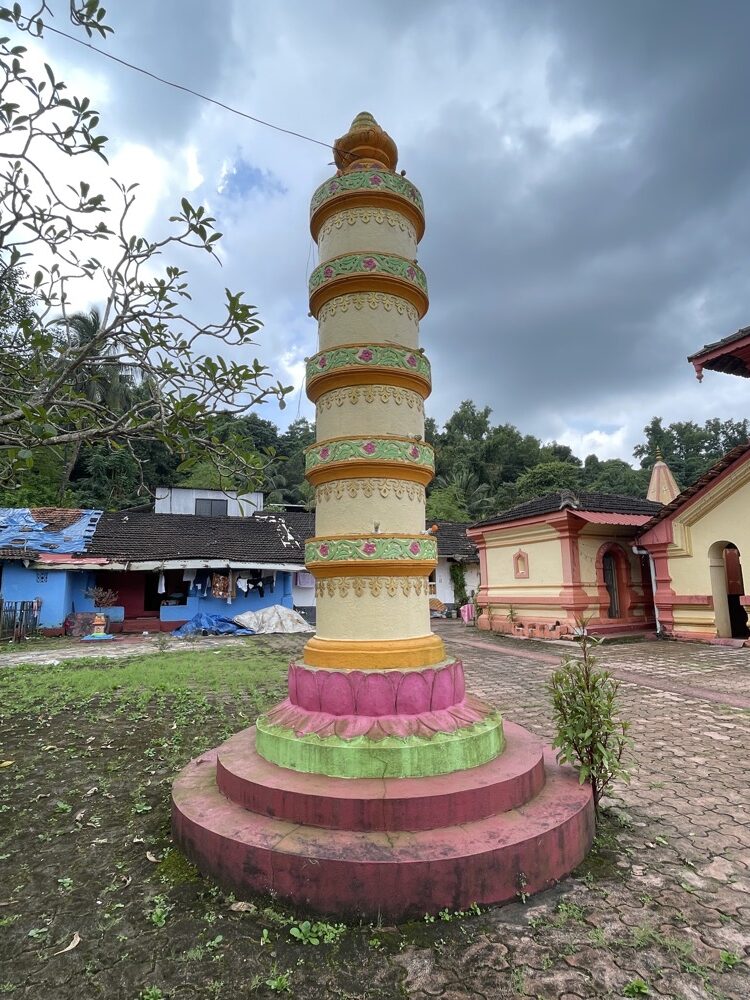
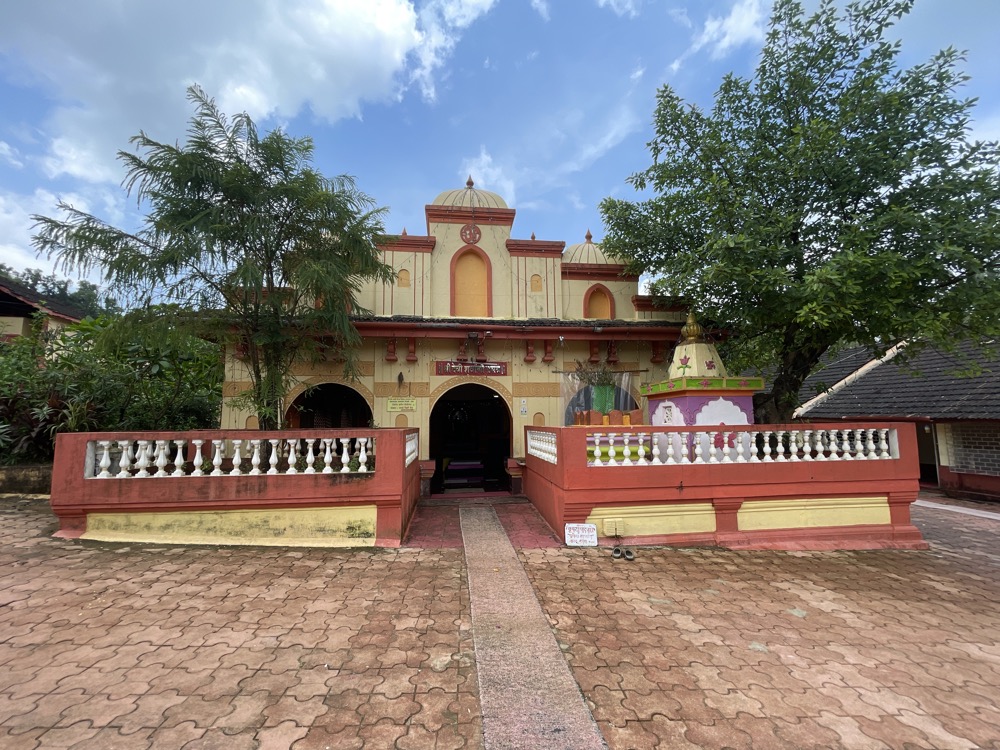
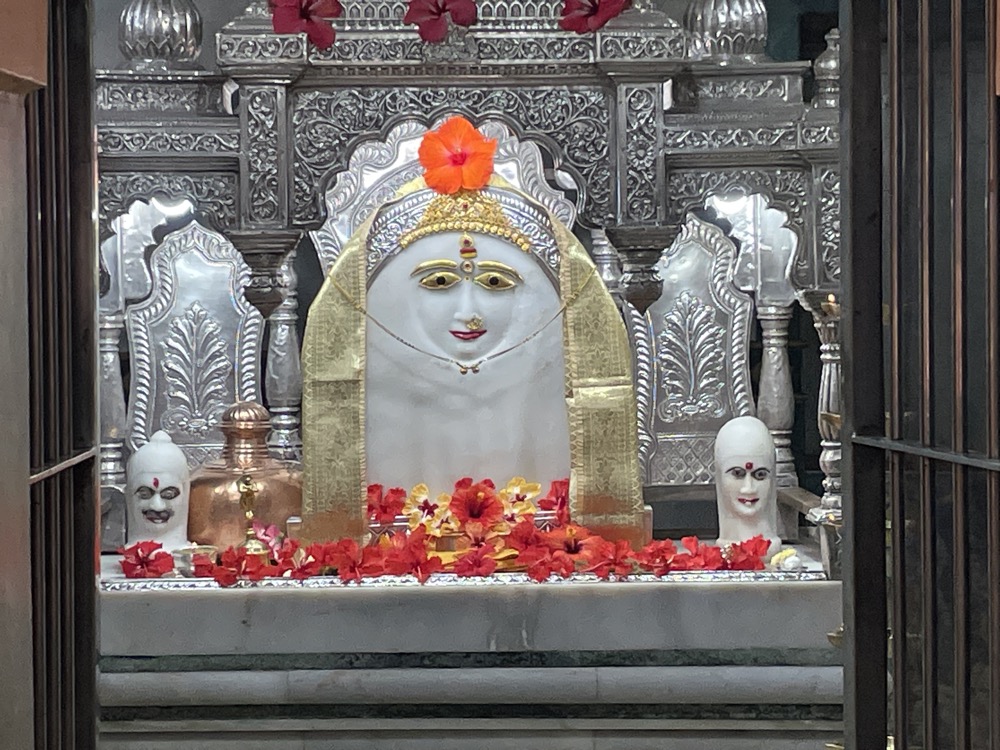
Upon entering through the grand entrance gate of the Salgaonwada area, one sees this temple complex situated within a large courtyard directly ahead. It is said that a cremation ground formerly existed in this area. After solemn ritualistic purification of the premises, these temples were erected here. This inner courtyard also features a grand entrance gate topped with a drum house (Nagarkhana). In the courtyard, two seven-tiered lamp towers (Deepastambhas) stand on circular platforms. Right ahead stands the grand temple of Lord Vetal Maharudra, and adjacent to it is the magnificent temple of Devi Sharvani. The temple of Goddess Sharvani is built in the Goan architectural style. The structure of the temple comprises an assembly hall (Sabhamandapa), a half-hall (Ardhamandapa), and a sanctum sanctorum (Garbhagriha). The front wall of the Sabhamandapa features three large arches, with the main entry through the central arch. Above these arches are three small spire-like minarets with small Kalashas atop their domes. The spacious and open Sabhamandapa has a sloping tiled roof on both sides, with a sacred fire pit (Homakunda) in the center. The Ardhamandapa has an arched entrance adorned with floral carvings. On either side, in niche shrines (Devakoshtas), stand the idols of the Vaishnava doorkeepers, Jaya and Vijaya. Above the lintel is the Garuda-Vimana carrying the enthroned idol of the Goddess, flanked by elephant sculptures (Gajashilpa) on both sides. On one side of the Ardhamandapa, two Tarang-kathis (holy symbolic poles) are arranged. These smooth wooden poles feature paintings of various deities and animals created in the distinct Goan style. Such painted, colorful Tarang-kathis are considered a unique feature of Goan temples. The sanctum sanctorum (Garbhagriha) also features an arched entrance with a Kirtimukha carved at the center of the lintel. Inside, on a marble pedestal (Vajrapeetha), stands a large shrine (Devhara) overlaid with intricately carved silver sheets. In its center resides the mask-style idol of Devi Sharvani, sculpted from pristine white stone. The idol is adorned with golden eyes, a nose ring (Nath), a Mangalsutra around the neck, and a golden crown upon the head. Adjacent to the main idol are smaller white stone idols of Lord Shiva and the Goddess, along with a large brass Kalasha. Above the sanctum sanctorum stands an octagonal tower-shaped Shikhara in the Goan architectural style, topped with a prominent dome. A passage connects the Sabhamandapa of the Devi Sharvani temple to the adjacent grand Vetal temple.
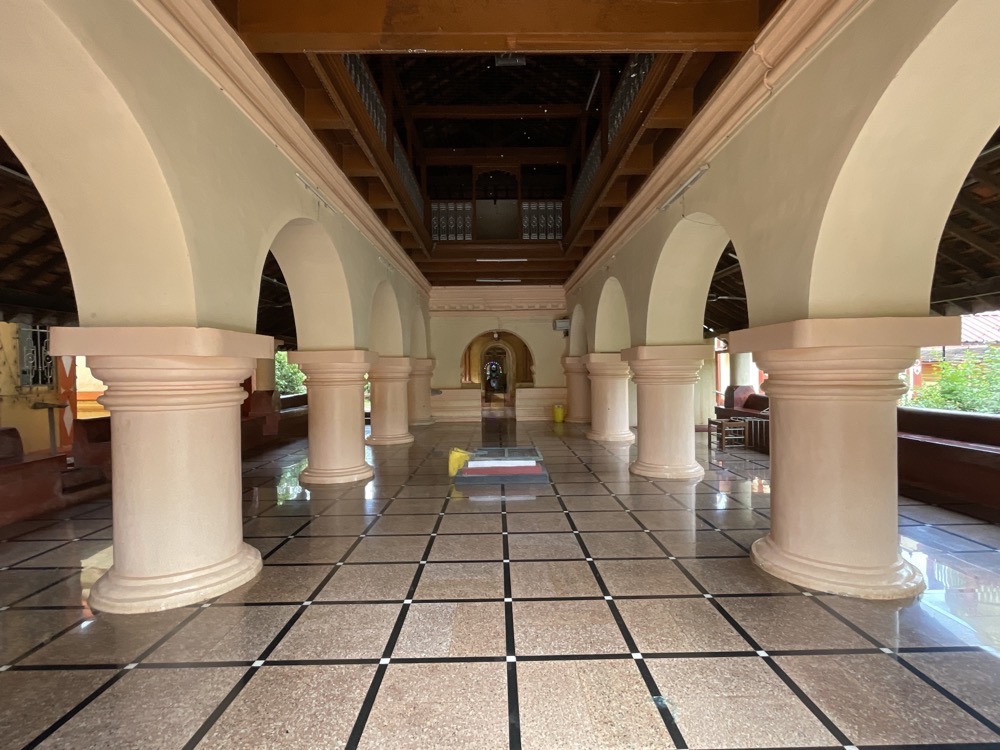
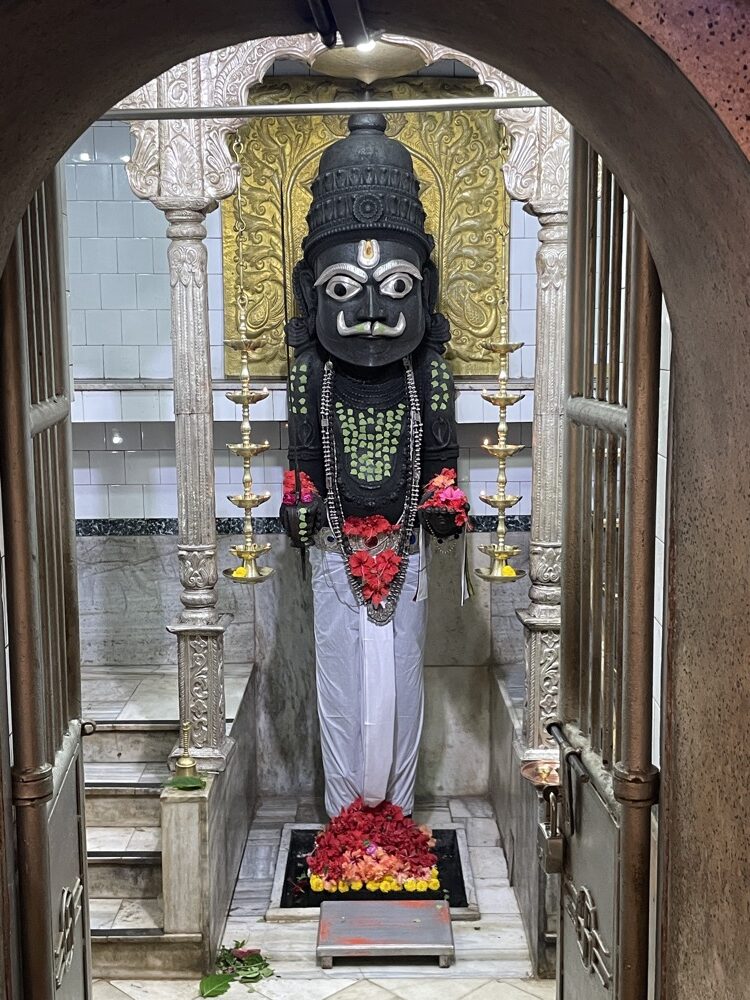
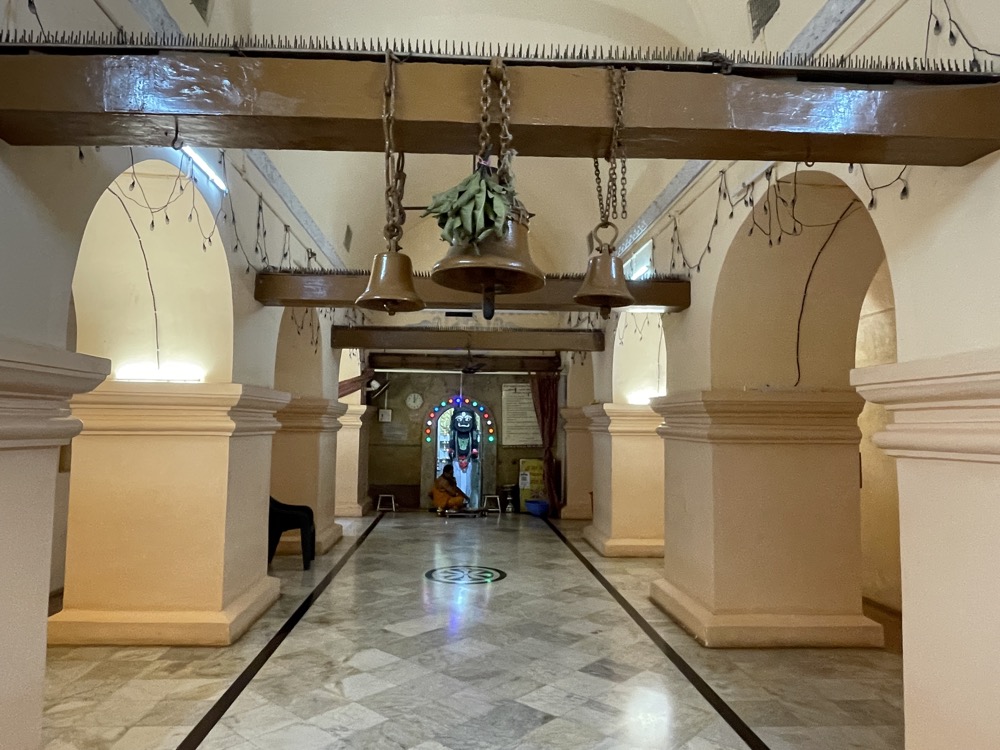
The architecture of the Vetal temple here is also in the traditional Goan style, consisting of a large Sabhamandapa, two Ardhamandapas, and a Garbhagriha. The Sabhamandapa here is a two-story structure. It has a tall and wide arched entrance. On both sides of it are two narrow and small entrances. Inside the Sabhamandap, leaving a distance of a few feet from the left and right walls, there are rows of thick circular pillars on both sides. In the upper section of the hall formed by these pillars, there is a balcony. At the center of the hall lies a Homakunda. Moving forward from here, there are two Ardhamandaps. Sturdy beams, wide pillars, and arches connecting the pillars are the distinctive features of these Ardhamandaps. Three large brass bells hang from the beams in the second Ardhamandap here. In the Garbhagriha (sanctum sanctorum) of the temple, a tall standing stone idol of Lord Vetal is enshrined within an ornate frame (makhar) beautifully embellished with silver plating. Sculpted from black stone, this idol holds a sword in one hand and a vessel in the other. The deity is draped in a pristine white dhotar, bound with a large waistband. Around the neck is a grand garland, along with intricately carved ornaments, and snake-shaped armlets (Nagabandhas) on the arms. Adorned with silver eyes, a mustache, eyebrows, and a sacred tilak, the idol wears a grand crown on its head. The idol is so tall that four steps have been constructed along the side of the makhar to perform the Mastakabhisheka ritual on the head. It is said that this idol of Lord Vetal was originally made of champa wood. In 1861, the present stone idol was sculpted and consecrated.
Adjacent to the Sabhamandap of the Vetal Temple, there are shrines of affiliate deities such as Ravalnath, Sateri, Bhootnath Parivar, as well as the ancestral deities (Kulapurushas) of the five Vangads (clans). These include Dev Purvans, Dev Purmar, Dev Balvans, as well as Bap Brahman, among others. Similarly, there is also a temple of Maharudra established here as the ‘Jagecha Maan’ (deity holding the honor of the sacred land).
At this shrine, daily ritual worship, Mahanaivedya offerings to the deities, as well as other major festivals and grand celebrations are conducted by the ‘Shree Devi Sharvani Vetal Maharudra Panchayatan Sansthan’. Among these, the most grand and spectacular festival is the Divjanchi Jatra (Festival of Lamps). The Divjanchi Jatra is held here on Kartik Amavasya. On this evening, a grand procession of the Goddess is taken out, in which countless women participate holding lit lamps in their hands. In addition, the festival of Kala on Margashirsha Shukla Tritiya, Gaulan Kala on the following day, Goddess Sharvani’s Palkhi festival on Margashirsha Purnima, and a three-day celebration on Phalguna Shukla Panchami commemorating the temple consecration anniversary are celebrated with great devotion and enthusiasm. Every day, the temple remains closed for Darshan between 1:30 PM and 2:30 PM.
This sacred temple stands as a testament to deep spiritual devotion, ancient architectural grandeur, and rich local cultural traditions.
The sanctum sanctorum houses the divine idol consecrated according to ancient Vedic traditions, surrounded by serene courtyards and traditional temple architecture.
Navratri, Maha Shivratri, Annual Temple Jatra & Deepotsav
Compare and book flights, secure top-rated local hotels near the temple, hire reliable guides, and rent cars instantly.
Extend your pilgrimage by visiting other highly sacred temples located nearby.


Add ₹999 more to unlock FREE SHIPPING!
Your sacred cart is currently empty.
Shop Photo FramesFill in your delivery details below to place your order.
Add comment