
Add ₹999 more to unlock FREE SHIPPING!
Your sacred cart is currently empty.
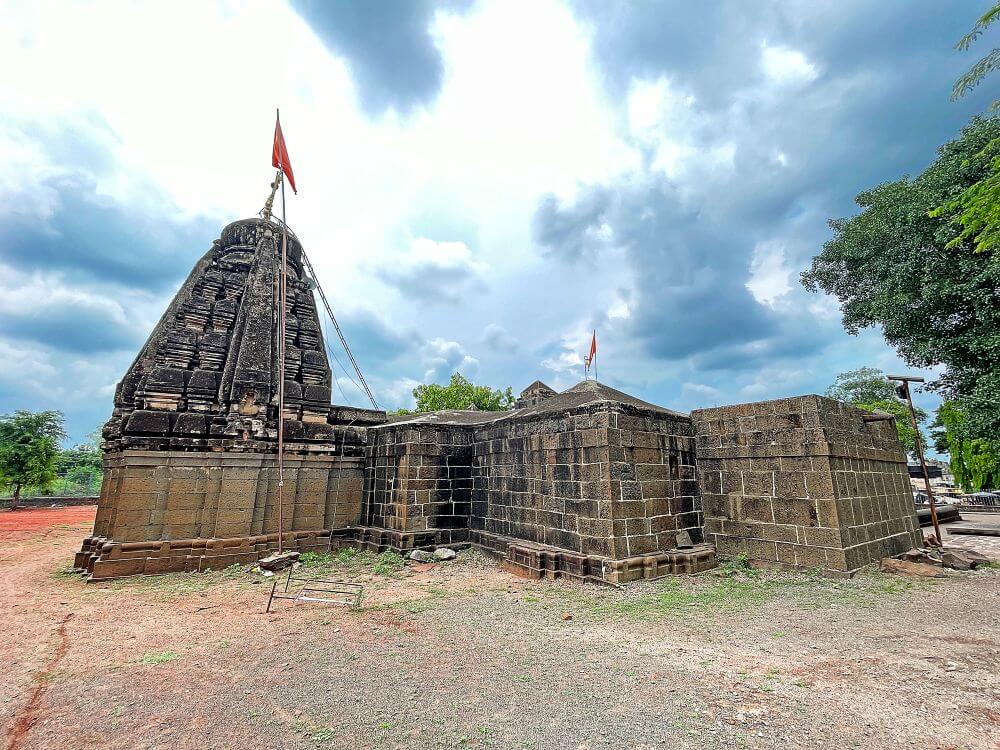
Shop Photo FramesThe ancient Ekachakranagar, which flourished during the reign of the Yadavas of Devagiri, is today known as Velapur. Here stands the sacred Harnahareshwar Mahadev Temple, revered as the Ardhanarinateshwar Temple. Constructed in the Hemadpanti architectural style, this temple dates back approximately seven hundred and twenty-five years. Within this holy shrine, the divine forms of Shiva and Shakti are found in a unified Lingam. This temple is a site of immense religious significance, and many ancient hero stones (viragals) from its vicinity are now housed in a nearby museum built by the Department of Archaeology. A remarkable feature of some of these viragals is that when one runs a hand over them or taps them, they produce the seven musical notes (saptasur).
Velapur village is situated on the Palkhi Marg (pilgrimage route) of Sant Dnyaneshwar Maharaj, which stretches from Alandi to Pandharpur. The region around this village was part of the Dandakaranya forest during the Ramayana period. In ancient times, it served as a sacred land for penance (tapobhumi) for many revered sages and hermits (Rishimunis). It is said that Sage Shandilya performed his austerities here. Evidence from the Yadava period, specifically the thirteenth and fourteenth centuries, has been found in this area. Regarding the origin of the village’s name, it is believed that ‘vel’ can also mean ‘boundary’ or ‘border’. As this village was located on the southern border of the Yadava’s Devagiri empire, it might have been named Velapur during that era. To keep watch over the Manadesh region and other areas, Velapur served as a military outpost for the Yadavas, akin to a sub-capital. This outpost was administered on behalf of the Yadavas by Brahmadevarana and his brother, Baidevarana.
These brothers are recorded to have renovated the original Ardhanarinateshwara temple here between 1300 and 1305 CE. Three inscriptions regarding this are available. From these inscriptions, it becomes clear that during that period, the Mahadeva in this temple was addressed not as Ardhanarinateshwara, but as Vateshwara. ‘Maharashtra and Goa Information about these inscriptions is provided in Dr. Shā. Bhā. Deo’s esteemed work, ‘A Descriptive Reference List of Inscriptions and Copper Plates’. One of these sacred inscriptions is located near the steps of the well in front of the temple. This inscription, dated ‘Shaka 1227, Vishvāvasu Samvatsara, Mārgaśīrṣa Shuddha 5, Monday, 22 November 1305’, reverently states that ‘Brahmadevarāṇā erected a magnificent temple, like unto Malayāchala, over the small shrine of Vaṭeśvara in Veḷāpur. Furthermore, he brought harmony between the deities and the Lokapālas, performed the Kalasha Pratiṣṭhāpanā, and hoisted the divine flag upon the temple.’ The inscription also mentions the sacred donations received by the Vaṭeśvara temple, with the names Bāideva and Chāruguḍā listed as the devout donors.
The second inscription is dated ‘Shaka 1222, Sharvari Samvatsara, Margashirsha Vadya 9, Monday, December 5, 1300’. It mentions that Baideva exempted the Vateshwara matha from taxes. An inscription of the same date was carved on a stone in the temple. It states that ‘Brahmadevarana, the Niroopita (Mutalik) of Joideva, the Sarvadhikari of Yadav King Ramachandradeva, and his brother Baidevarana, have’ It is mentioned that ‘a portion of the Vateshwar-Jogeshwar temple in Velapur was newly constructed and donated.’ Lord Mahadev in this temple, referred to as Vateshwar in the inscriptions, is also known as Harnareswar. This temple is registered under the name Harnareswar in the Solapur District Gazetteer.
In the third chapter of the ‘Shatarudra Samhita’ of the ‘Shiva Purana’, the sacred narrative of the creation of Ardhanarinateshwara is recounted. According to this account, Lord Brahma was deeply concerned because creation was not expanding. He resolved to bring forth creation through union, but until then, the lineage of women had not yet originated from Lord Shiva. Therefore, Lord Brahma performed severe austerities to propitiate Lord Shiva and His Divine Shakti. Pleased by Brahma’s penance, Lord Shankara appeared before him in the form of Ardhanarinateshwara and separated the divine feminine aspect from His own body. Thereafter, Lord Brahma worshipped Her. Delighted by his devotion, the Divine Shakti manifested another Shakti, who was born as a daughter in the house of Daksha. She was none other than Sati. Yes, indeed.
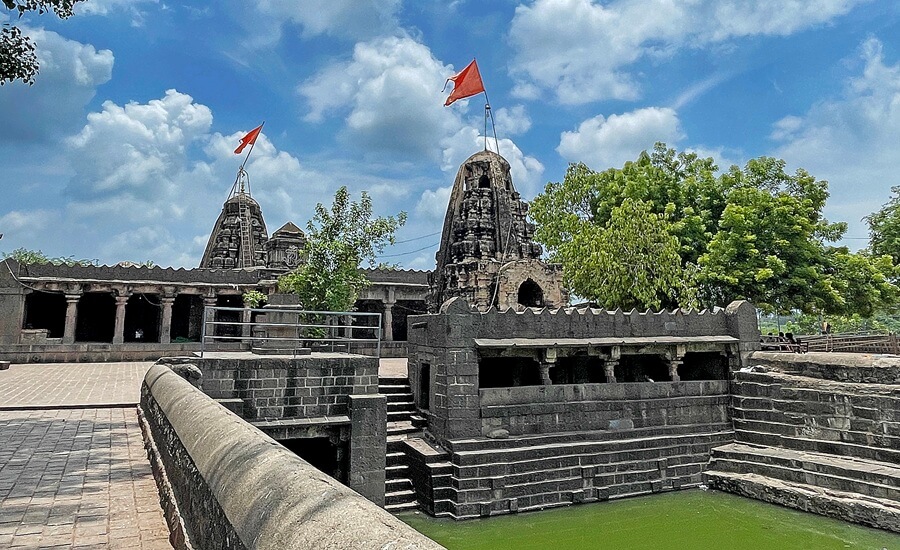
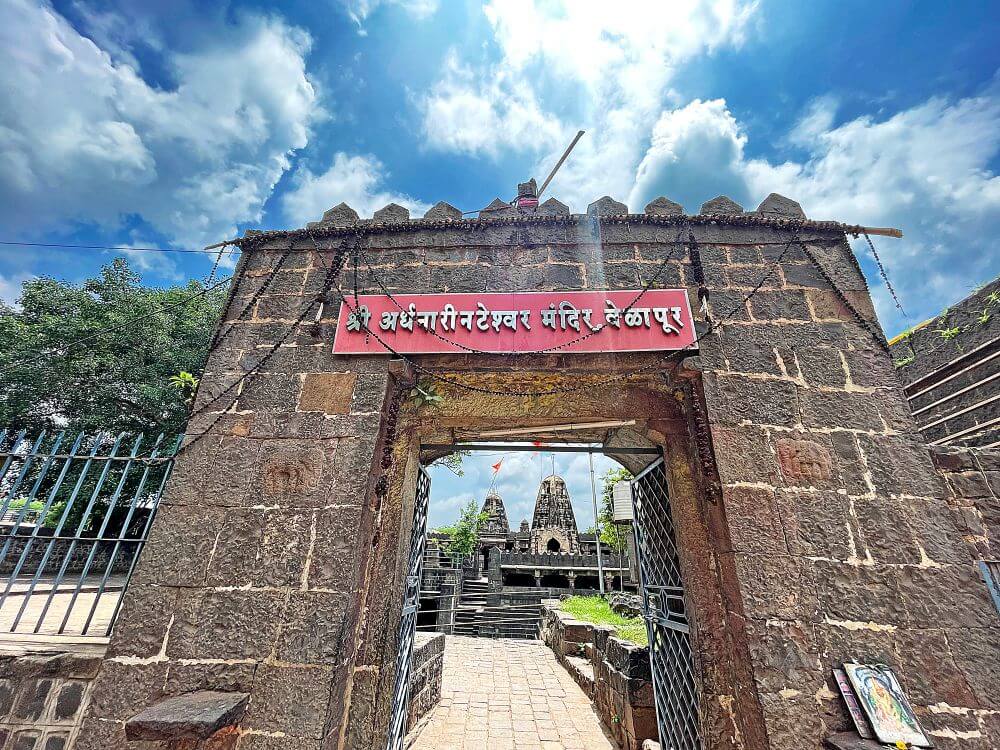
The Ardhanari Nateshwar Temple, the village deity of Velapur, is located in the central part of the town. To the right of the temple’s entrance, in a small shrine, there is an idol of Shri Ganesha. Through this entrance, one steps into the temple courtyard. On the left side of the courtyard stands an ancient Deepmal (lamp pillar). Adjacent to this Deepmal is a sacred Pushkarani (temple tank/stepwell). It is said that because this Pushkarani is fed by springs from all sides, it never dries up, no matter how severe the drought. In the southwest direction of the Pushkarani, there is a small temple. Within it are two Shiva Lingams, representing Kashi Vishwanath and Rameshwar. Both these sacred Pindis are submerged in water. During the monsoon, as the water level in the stepwell rises, they become completely submerged. Hence, this holy site is considered exceptionally sacred.
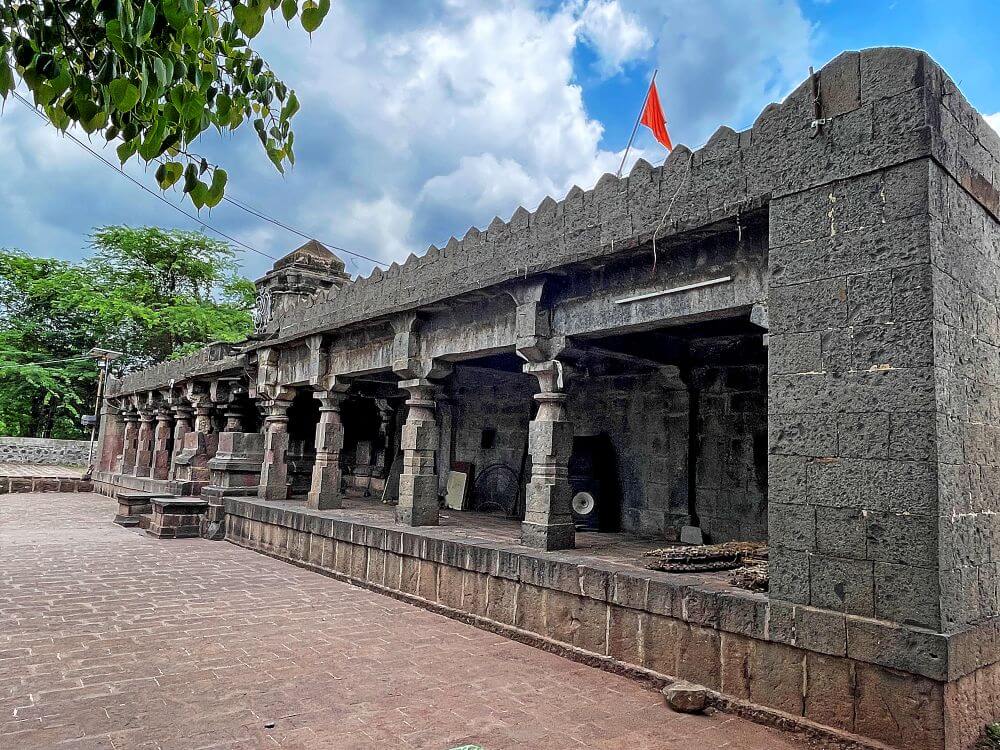
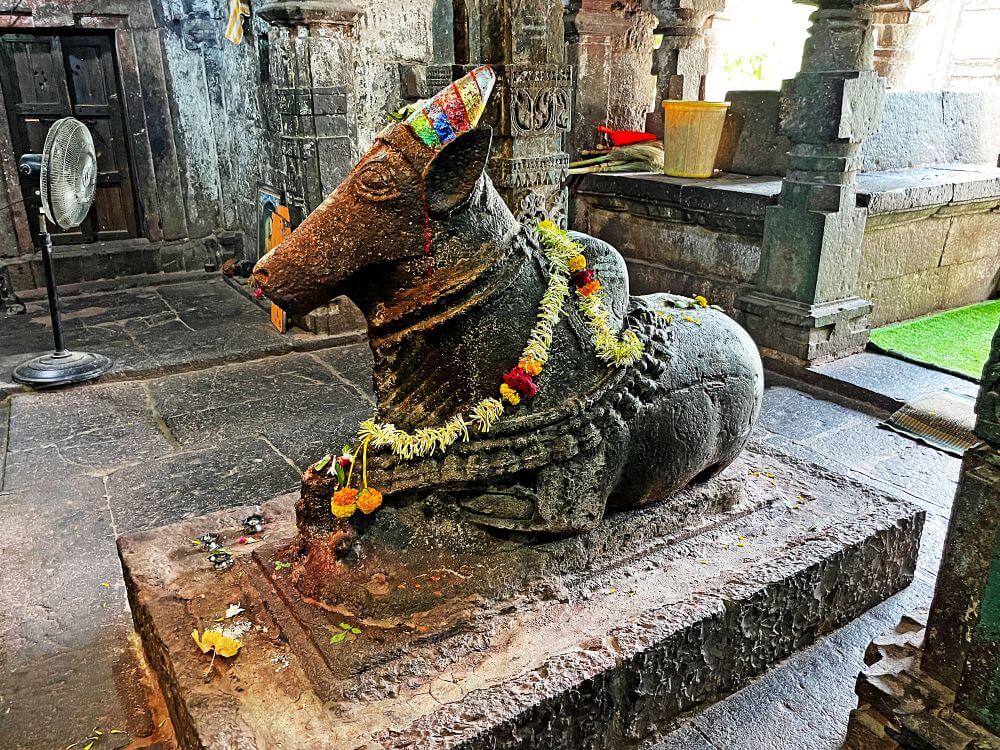
Adjacent to this Pushkarini, in the northwest direction, is the Baliweshwar Temple. The entire structure of the Baliweshwar Temple is built of stone. This temple appears as if it is situated underground, in front of the main temple. At the entrance of the sanctum sanctorum of this temple, Near the wall, on a high pedestal, is an idol of Lord Ganesha. Within the sanctum sanctorum (garbhagriha) are an ancient Nandi and two Shiva lingams. From this temple, one can ascend a few steps to reach the main temple. The Ardhanarinateshwar Temple is structured with a Nandi Mandapa, Mukha Mandapa, Sabha Mandapa, the main Garbhagriha, and two subsidiary Garbhagrihas. In the Nandi Mandapa, which is entirely built of stone, a large idol of Nandi rests on a platform. When one gazes through the horns of this Nandi, one is blessed with a darshan of the temple’s spire (kalasha). As it is situated on a high jagati (platform) above the ground, there are three steps leading from the Nandi Mandapa to the Mukha Mandapa of the temple. The semi-open Mukha Mandapa features stone pillars and stone seats (kakshasanas). From here, one enters the Sabha Mandapa of the temple.
On the walls of the sabhamandapa are the South-facing Ganesha idol and the Saptamatrikas. In the centre of the sabhamandapa, on a large platform, rests a magnificent Nandi. Besides these, in the sabhamandapa, there is a somewhat broken idol facing North with a hamsa (swan) as its mount, and another idol seated on a lion, holding various weapons in its hands. Here, one finds the divine forms of the Goddess as Mahishasuramardini (the slayer of Mahishasura), a Ganesha idol without a trunk (Nirsondecha Ganapati), and the revered Chamunda Devi. In this assembly hall (sabhamandapa), among the two sub-shrines (upamandapas) on either side, the one to the left houses the sacred Shiva Lingam representing the great devotee of Shiva, Sage Shandilya. To the right, in the sub-sanctum (upagarbhagriha), is the Lord’s resting chamber (shejghar), where a teakwood bed is prepared for the Deity’s repose.
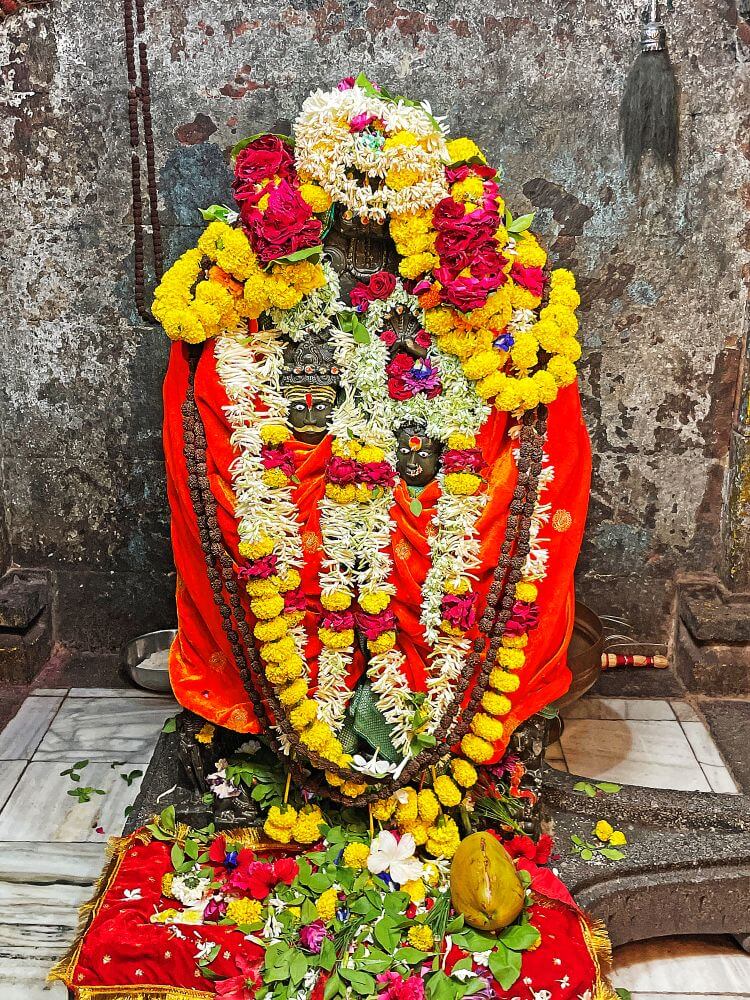
Outside the main sanctum sanctorum of the temple, there is a beautiful idol of Shri Gajalakshmi Devi. On both sides of this idol are elephant sculptures. In the center of the sanctum sanctorum, atop the Shivalinga, are unique idols of Lord Shiva and Devi Parvati. On Lord Shiva’s four-armed idol, the sun is carved on the right side of His matted locks (jata), and the moon on the left. Above His forehead, beneath the jata, are carved a garland of skulls (mundamala), earrings (kundala) in His ears, and various ornaments from His neck down to His feet. In one of Shiva’s left hands is a trident (trishula), and in the other, a rosary (japamala). In one of His right hands is a five-hooded serpent, and the other hand rests on Parvati’s waist. Devi Parvati’s idol has a delicate face. She wears earrings (karnaphule), has her hair tied in a bun (ambada) on her head, her right hand rests on Shiva’s shoulder, and in her other hand, she holds a lotus and a noose (pasha). Both her hands are adorned with bangles, her fingers with rings, her neck with various ornaments, and her feet with toe-rings (jodavi) and anklets (paijan). There is also a small hole in Parvati’s nose for wearing a nose-ring (nath). Behind these idols is a stone aura (prabhaval). In its upper part, above Shiva’s trident, an idol of Lord Brahma is carved. Additionally, this prabhaval features Ashtadevata (eight deities) and a Kirtimukha in the center.
Within the temple premises are the Sanjeevan Samadhis of some revered Sadhus and Saints. These samadhis are adorned with Shivapindis. Similarly, to the left of the temple are ancient samadhis, built like small temples, dedicated to three great spiritual personalities (Satpurushas). The annual festival of the Ardhanarinateshwar Temple commences on Gudi Padwa. During this, the Haldi and Lagna Utsav (turmeric and wedding ceremony) takes place on Chaitra Shuddha Panchami and continues until Ashtami. Besides this, a large number of devotees visit for darshan on Mahashivaratri and Shravani Somvar.
This sacred temple stands as a testament to deep spiritual devotion, ancient architectural grandeur, and rich local cultural traditions.
The sanctum sanctorum houses the divine idol consecrated according to ancient Vedic traditions, surrounded by serene courtyards and traditional temple architecture.
Navratri, Maha Shivratri, Annual Temple Jatra & Deepotsav
Compare and book flights, secure top-rated local hotels near the temple, hire reliable guides, and rent cars instantly.
Extend your pilgrimage by visiting other highly sacred temples located nearby.


Add ₹999 more to unlock FREE SHIPPING!
Your sacred cart is currently empty.
Shop Photo FramesFill in your delivery details below to place your order.
Add comment