
Add ₹999 more to unlock FREE SHIPPING!
Your sacred cart is currently empty.
Shop Photo FramesThe Godavari River is renowned as the longest river in India after the Ganga. For this reason, this river is called the Ganga of the South. The river originates from the Brahmagiri mountain in Trimbakeshwar, Nashik district. From there, traveling about 1465 kilometers through the states of Maharashtra, Telangana, Chhattisgarh, Andhra Pradesh, and Odisha, the river meets the Bay of Bengal near Rajahmundry in Andhra. The Simhastha Kumbh Mela is held every twelve years at Nashik and Rajahmundry. Many famous pilgrimage sites are situated on the banks of this river. The historical site of Chakradhar Swami Dattasthan and Atmatirtha Temple is located in the riverbed of this very river in Georai taluka of Beed district.
Special mentions of this site are found in the ‘Leelacharitra’, the foundational scripture of the Mahanubhava sect, as well as in many other religious texts. Many ancient legends and myths are prevalent regarding this pilgrimage site. This place is about five thousand years old and is directly linked to the Treta Yuga. In those times, there was a city named Kusumavati in this area. In this city, Sage Devashrava lived with his son named Atmashrava. They were devotees of Lord Dattatreya. Pleased by their devotion and merit, Lord Dattatreya appeared in his saguna form at their residence. At that same time, King Panchal, a disciple of Sage Devashrava, had arrived there to meet his guru. There, he had the direct vision of Lord Dattatreya. This vision created a deep sense of detachment in the King’s mind, and he asked Lord Dattatreya for liberation. While accepting the King’s request, Lord Dattatreya told him, “Some divine tasks are yet to be accomplished through you in the future.”
During that era, Sage Pulastya had two sons named Kumbha and Nikumbha. Due to the influence of Kali on their intellect, demonic tendencies grew within them. They began to harass the common people and the sages and ascetics. Distressed by this torment, Sage Atri ordered the King of Panchal to rescue his subjects from this crisis. Following the Guru’s command, the King slew both demons, Kumbha and Nikumbha, and liberated the people from their tyranny. However, due to this killing, the King incurred the sin of Brahmahatya (the sin of killing a Brahmin). To be freed from the sin of this Brahmahatya, Lord Dattatreya ordered the King to strike the ground with an arrow and draw water, known as Agrodaka, from the netherworld. As per the command of Lord Dattatreya, as soon as the King struck the ground with his arrow, the Patalganga manifested from there. Sage Atri washed the feet of Lord Dattatreya with the water of this Ganga and gave the Charanamrita to the King of Panchal to consume. Upon consuming this Charanodaka, the King of Panchal was completely freed from the sin of Brahmahatya. This water stream, sanctified by the touch of Lord Dattatreya’s feet, later came to be known as ‘Atmatirtha’. Furthermore, the entire village came to be known as ‘Panchaleshwar’ after the name of the King of Panchal. In later times, this place became directly associated with the founder of the Mahanubhav Panth, Shri Chakradhar Swami, and his Guru, Shri Govind Prabhu. This is a rare sacred site sanctified by the presence of three of the five incarnations of God revered in the Mahanubhav Panth: Lord Dattatreya, Shri Govind Prabhu, and Shri Chakradhar Swami. Consequently, this is considered a primary and revered place for the followers of the Mahanubhav Panth.
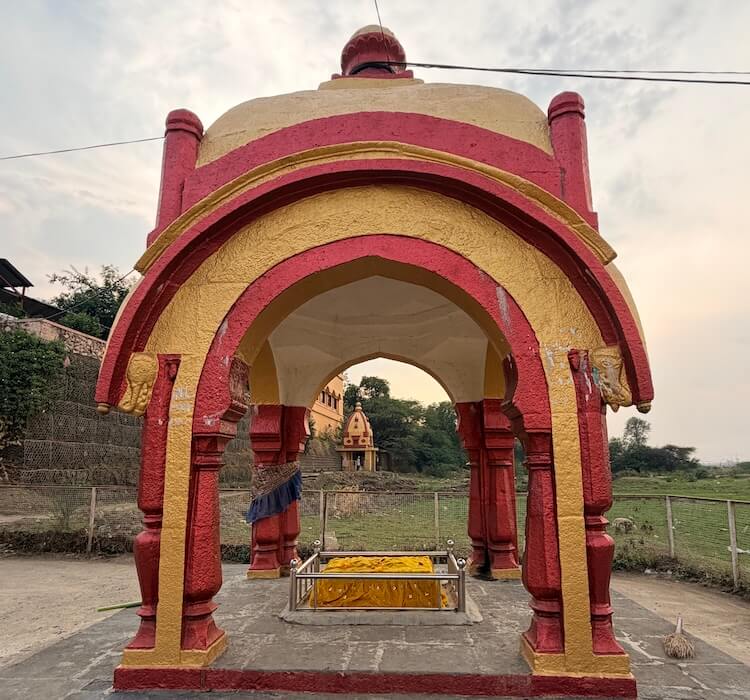
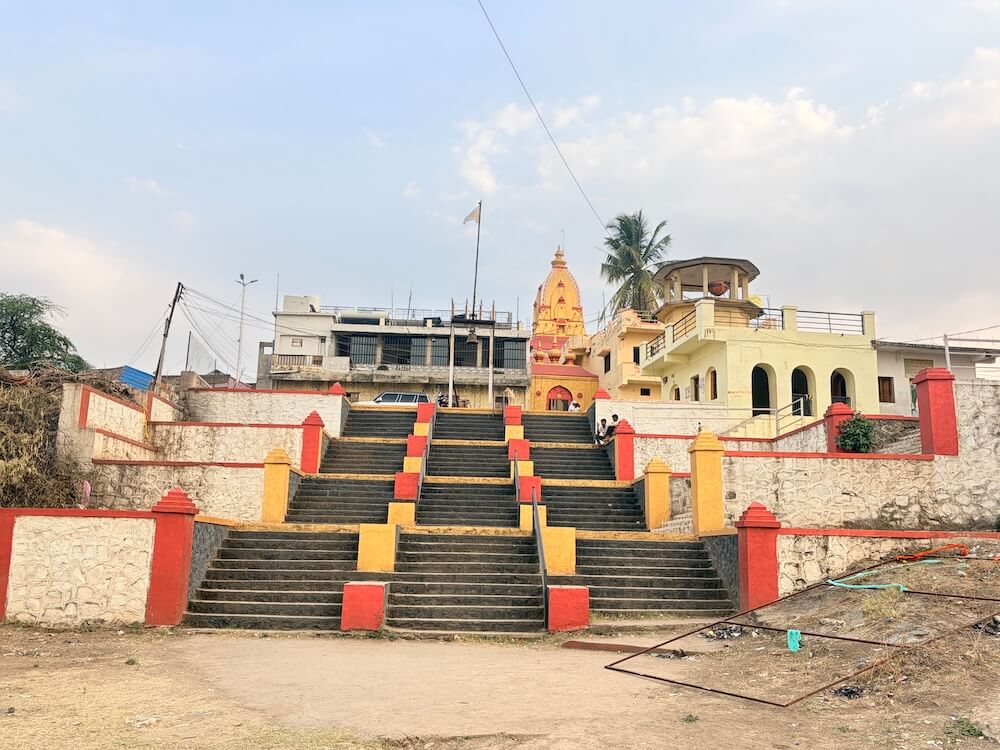
This historic Atmatirtha site is situated right within the riverbed of the Godavari near Panchaleshwar village. There is a paved road leading up to the riverbank and a parking area for vehicles. From here, a footpath leads towards the temple. Standing right in the middle of the Godavari riverbed is a semi-open octagonal temple, which is the Atmatirtha Temple. This wall-less temple features eight circular stone pillars erected at the eight corners, supporting an octagonal roof balanced on beams. Inside this temple are the foot-imprinted sites of Shri Chakradhar Swami. The temple roof is crowned with a dome-shaped shikhara. A shelter pavilion has been constructed next to the temple. Several other samadhi temples can also be seen in the riverbed surrounding this temple.
According to records and legends in various religious texts of the Mahanubhava sect, it was at this very place that Atmarishi performed the service of the feet of Lord Dattatreya with the tirtha, and King Panchal created the tirtha by shooting an arrow. According to references in these texts and local tradition, devotees have deep faith that Lord Dattatreya visits this site every afternoon for his meal. Furthermore, according to records in the Lilacharitra, the foundational text of the Mahanubhava sect, it was at this location that Lord Dattatreya granted darshan to Shri Govindaprabhu, and Shri Chakradhar Swami also sat in meditation here. It was from this site that Shri Chakradhar Swami later departed in the direction of Balegaon.
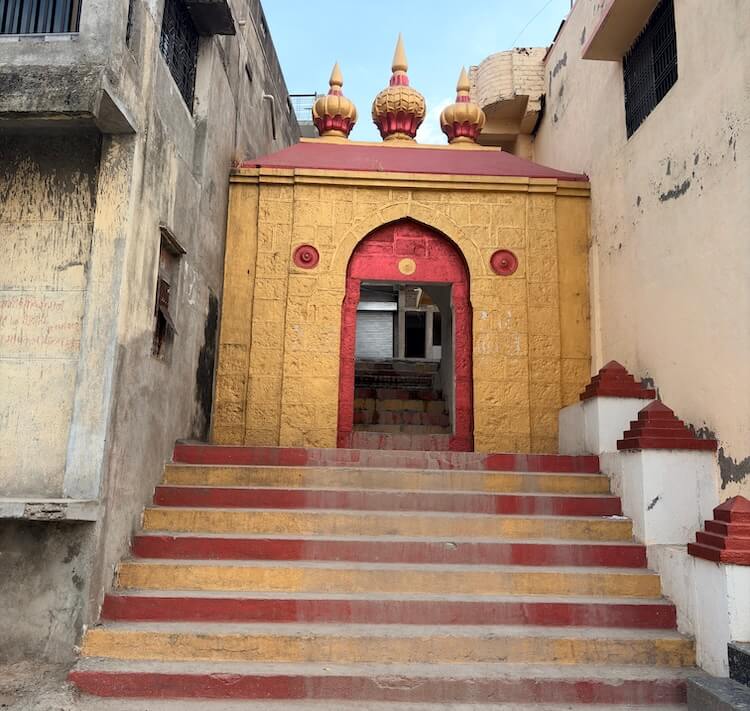
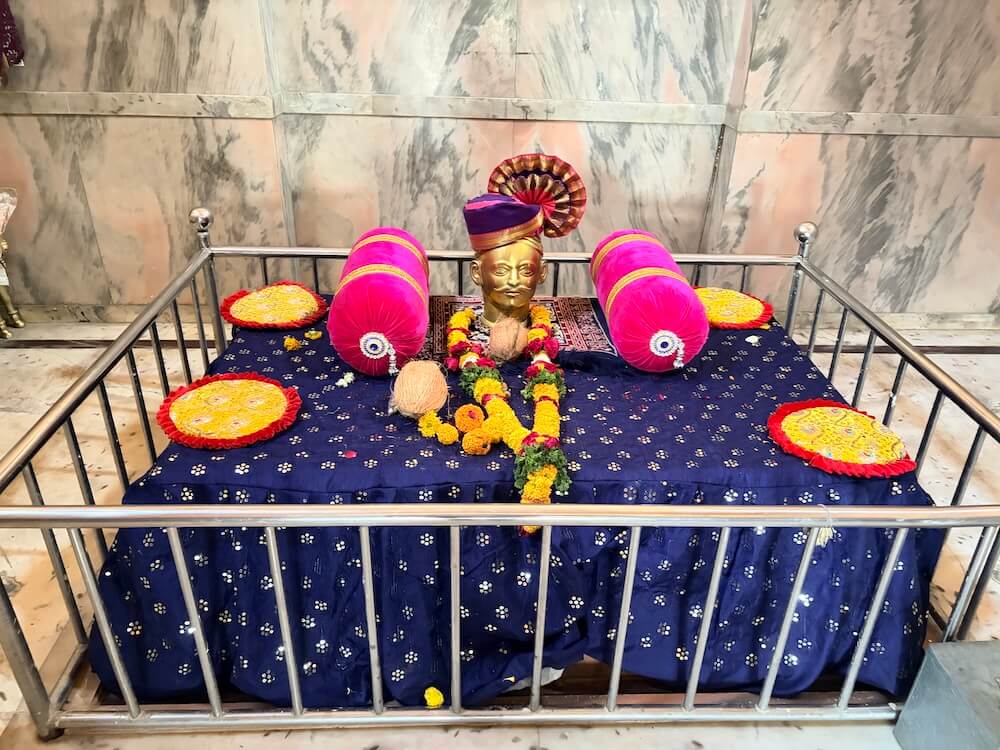
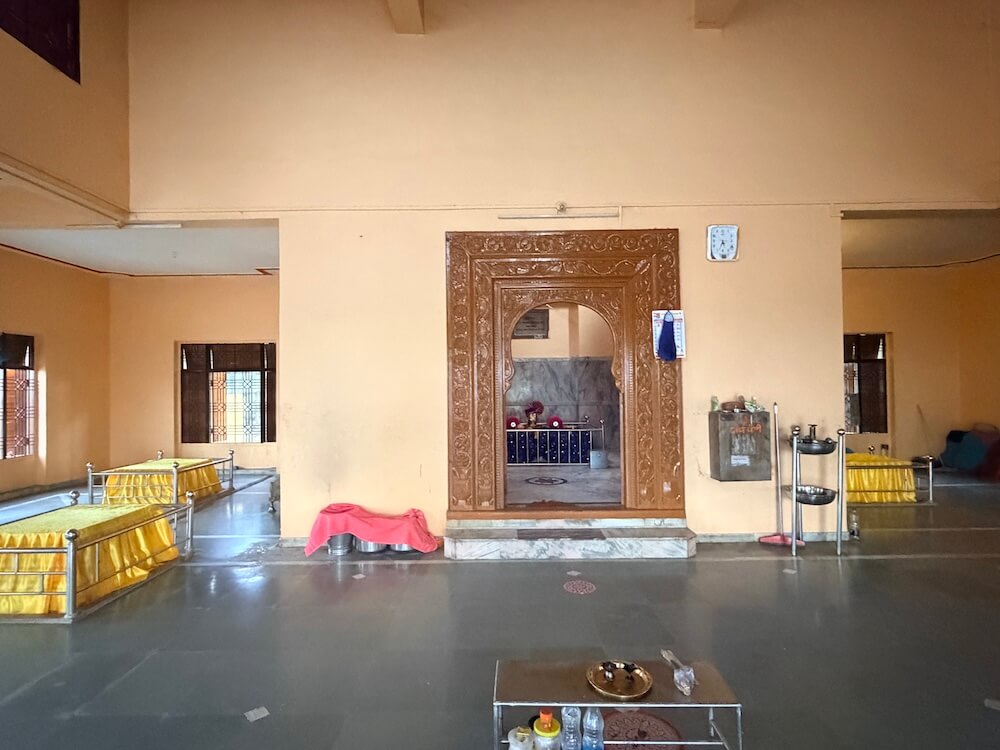
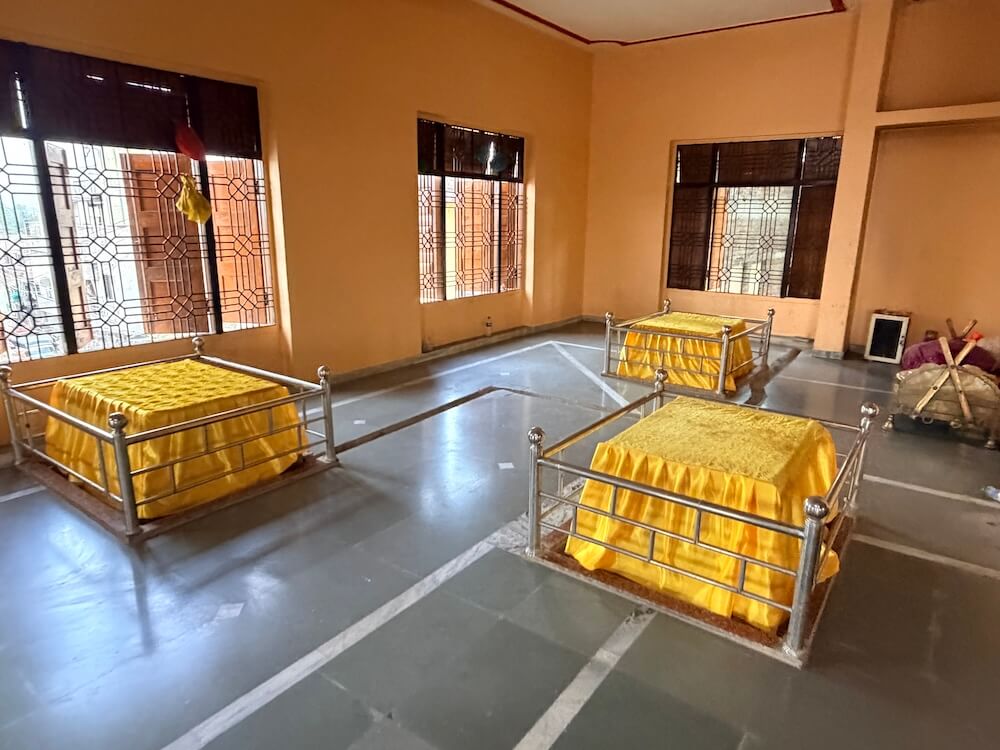
On the banks of the Godavari River, in this very area, the ‘Gufasthan Mandir’ is situated. According to the narratives in the ‘Leelacharitra’ and other hagiographical texts of the Mahanubhava sect, Shri Chakradhar Swami had this cave constructed by a Brahmin from Apegaon to liberate him from the sin of adultery. The temple is surrounded by a sturdy fortification wall featuring a large entrance gate. The architectural layout of the temple primarily consists of a Mukhamandapa (front porch), Sabhamandapa (main assembly hall), Antarala (vestibule), and Garbhagriha (sanctum sanctorum). Since the Mukhamandapa is situated at a slightly higher elevation than the front courtyard, there are three steps to enter it. Beyond the Mukhamandapa lies an enclosed Sabhamandapa. At the entrance of this assembly hall, there are four stone pillars. The roof of the Sabhamandapa is supported by the pillars in the front and by walls on the other three sides. In front of this assembly hall is the entrance to the sanctum sanctorum. Inside the sanctum, the foot-imprinted site of Shri Chakradhar Swami is worshipped. A protective railing has been installed around the roof of the temple. Above the sanctum, there is a tall, square-shaped spire that tapers towards the top. At a short distance from this temple, within the village of Panchaleshwar, is the ‘Avatarabhimukh Mandir’, also known as the ‘Avasthan Mandir’. Shri Chakradhar Swami resided at the site of this temple for five consecutive days. Due to the Swami’s stay here, many of his foot-imprinted sites are worshipped. These primarily include the Avasthan, Vedikasthan, and Puja Aarohan Sthan. In this Dattatreya site, many religious festivals and celebrations are observed with great enthusiasm throughout the year. Shri Datta Jayanti is considered the main annual festival here. On the day of this festival, there is a tradition of placing a brass idol of Lord Dattatreya in a cradle and singing traditional cradle songs. On Chaitra Shuddha Chaturdashi, the incarnation day of Shri Chakradhar Swami is celebrated as ‘Davanaparva’. Apart from this, the Shri Krishna Janmotsav is celebrated here on Shravan Vadya Ashtami. There is an old tradition of celebrating the festival of ‘Akshaya Tritiya’ in the month of Vaishakh as a special occasion. The birth anniversary celebration of the prominent saint of the Mahanubhav sect, Shri Govind Prabhu, is also organized on a large scale in this temple. During all these festivals and celebrations, various religious programs such as Mahanubhav devotional songs, continuous reading of the ‘Leelacharitra’—the scripture describing the divine plays of Shri Chakradhar Swami—and distribution of Mahaprasad are organized in the temple. Thousands of devotees come to Panchaleshwar for darshan during these special occasions. Apart from festival days, there is a special rush of devotees at the temple on the full moon and new moon days of every month. In this temple, collective recitation of the Mahanubhav sect’s scriptures, the Shrimad Bhagavad Gita, and the Sutrapath is performed regularly.Every day from 5 o’clock in the morning until 9 o’clock at night, devotees can have darshan and perform puja-archana at the charankit sthan (footprint sites) of Chakradhar Swami.
This sacred temple stands as a testament to deep spiritual devotion, ancient architectural grandeur, and rich local cultural traditions.
The sanctum sanctorum houses the divine idol consecrated according to ancient Vedic traditions, surrounded by serene courtyards and traditional temple architecture.
Navratri, Maha Shivratri, Annual Temple Jatra & Deepotsav
Compare and book flights, secure top-rated local hotels near the temple, hire reliable guides, and rent cars instantly.
Extend your pilgrimage by visiting other highly sacred temples located nearby.


Add ₹999 more to unlock FREE SHIPPING!
Your sacred cart is currently empty.
Shop Photo FramesFill in your delivery details below to place your order.
Add comment