
Add ₹999 more to unlock FREE SHIPPING!
Your sacred cart is currently empty.
Shop Photo FramesThe village of Maroli is situated along the coast of the Arabian Sea in the Umargam Taluka. Within this village, close to the shore, stands an ancient temple dedicated to Lord Kalbhairav. Kalbhairav, a fierce manifestation of Lord Shiva, is revered as the primary regional protector deity (‘Kshetrapal’). The tradition of worshipping Bhairav in India traces its roots to the pre-Aryan era. Consequently, temples dedicated to Kalbhairav, the guardian deity of the land, are found in numerous villages across the country. The Mahakal shrine in Ujjain is also considered a manifestation of Kalbhairav. Kalbhairav is famously addressed as the ‘Kotwal’ (Chief Warden) of Kashi. Devotees undertaking the pilgrimage to Kashi never return without first seeking his divine blessings. It is the firm belief of devotees that the Kalbhairav at Maroli is a ‘Jagrut’ (awakened) deity who unfailingly grants the prayers of those who seek his divine blessing.
There is no surviving written history or ancient documentation regarding the exact establishment of this temple. According to the oral traditions of local villagers, the temple is approximately five to six centuries old. It is widely believed that the temple was established at the same time as the original settlement of Maroli village. In Indian social life, Kalbhairav is tasked with protecting village boundaries and land. The villages of Maroli and Kalgam are situated on the Arabian Sea coast. Kalbhairav serves as the primary presiding deity for the local fishing communities, specifically the Koli and Kharwa tribes.
Ancient Hindu Puranas contain detailed accounts regarding the genesis of the deity Kalbhairav. References to Kalbhairav are primarily found in the ‘Shatarudra Samhita’ of the ‘Shiva Purana’, the ‘Kashi Khanda’ of the ‘Skanda Purana’, as well as the ‘Kurma Purana’ and the ‘Matsya Purana’. According to these scriptures, a dispute once arose concerning the supremacy of the creation. During this confrontation, Lord Brahma insulted Lord Shiva, igniting the Lord’s uncontrollable fury. To vent his divine wrath, Lord Shiva struck his matted locks (‘Jata’) against the ground. From these locks emerged the fierce form of Kalbhairav. This emanation of Lord Shiva displayed immense valour. He severed the fifth head of Lord Brahma—who had insulted Lord Shiva—with the sharp nail of his finger. Having decapitated the creator of the universe, Kalbhairav became burdened with the sin of killing a Brahmana (‘Brahmahatya’). Because of it, the severed head of Lord Brahma remained firmly stuck to the nail of Kalbhairav.
To seek liberation from this grave sin, Kalbhairav, acting upon the counsel of Lord Shiva, journeyed to various sacred lands for ritualistic ablutions. Lord Shiva had instructed him to observe the ‘Kapalika Vrata’ (an ascetic vow) as penance and to visit various holy sites. In accordance with this directive, Kalbhairav spent many years bathing in diverse rivers and lakes across the earthly realm. After traversing all the major pilgrimage centres, Kalbhairav arrived in Kashi to bathe in the holy waters of the River Ganga. Upon entering the Kashi region and bathing in the Ganga, the head of Lord Brahma, which was clinging to his nail, fell to the ground. Consequently, Kalbhairav was liberated from all manifestations of sin. The severed head fell at a specific location in Kashi, which subsequently became known as ‘Kapalmochan Tirth’. Following this event, as per the instructions of Lord Shiva, Kalbhairav became the ‘Kotwal’ of Kashi. He settled there permanently, becoming the supreme guardian of the city of Kashi.
Religious texts describe the ‘Ashtabhairavas’ (eight Bhairavas) as the guardians of the eight cardinal directions : Asitanga Bhairav, Ruru Bhairav, Chanda Bhairav, Krodha Bhairav, Unmatta Bhairav, Kapala Bhairav, Bhishana Bhairav and Samhara Bhairav. All these Bhairavas perform the duty of protecting the various directions of the universe. According to Tantra Shastra and theological principles, the leader of these eight Bhairavas is known as Kalbhairav. He is addressed as Mahakal Bhairav. This form is regarded as the highest manifestation, holding sovereign control over ‘Kala’ (Time). Beyond these scriptural accounts, numerous local legends surround this deity. A well-known local myth claims that at night, the Kalbhairav of Maroli rides a white horse to patrol the village and ensure the safety of its inhabitants.
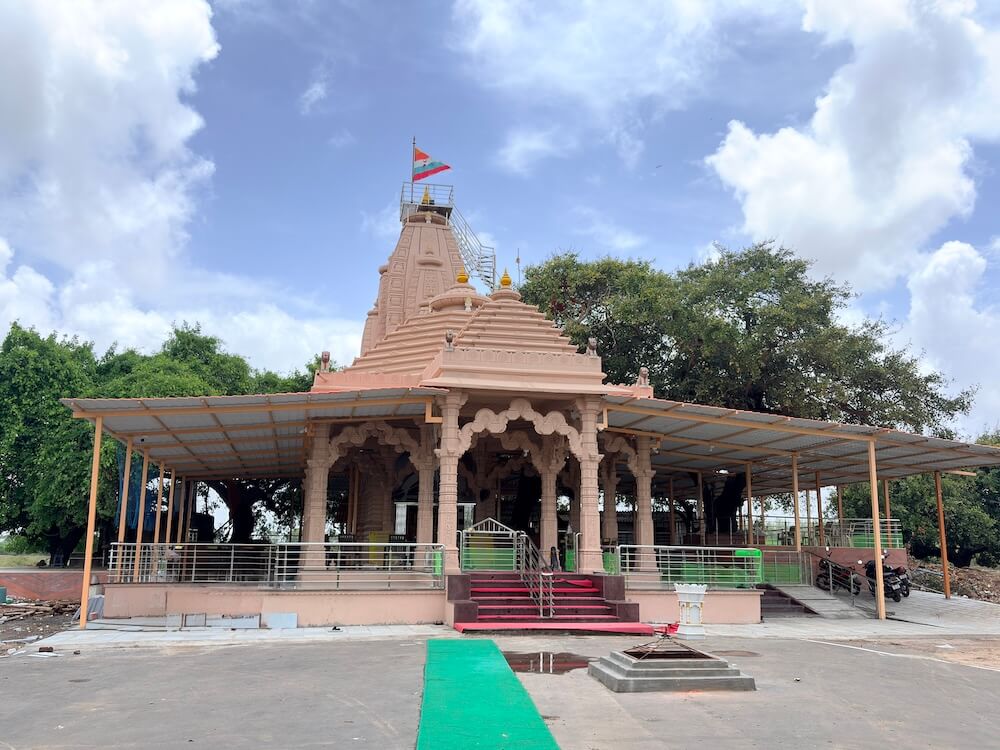
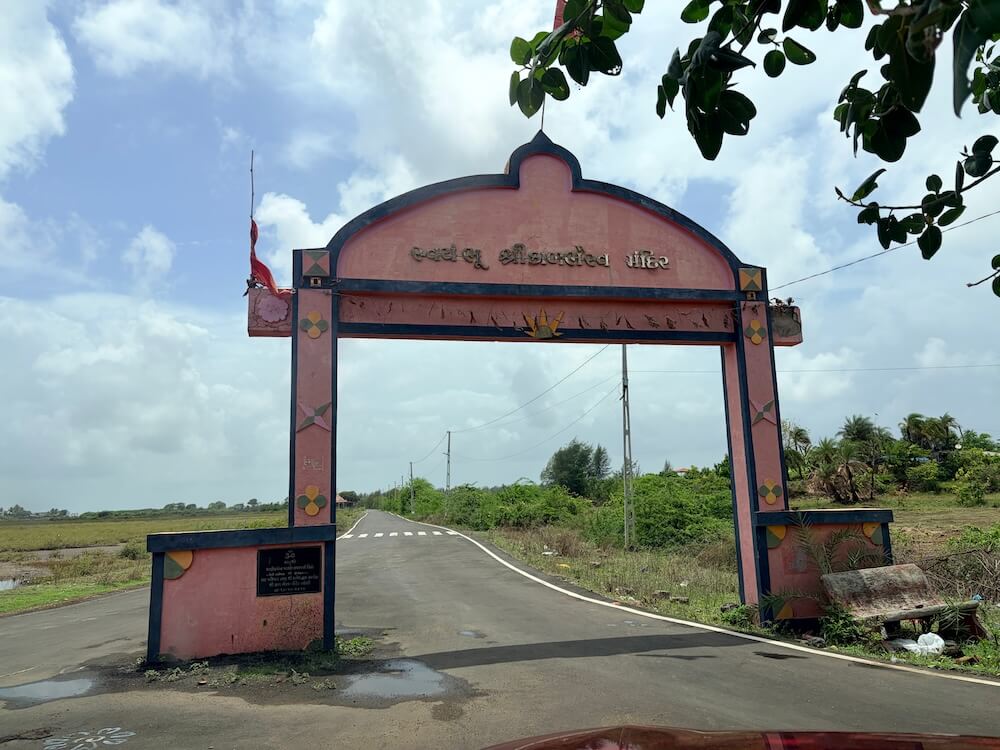
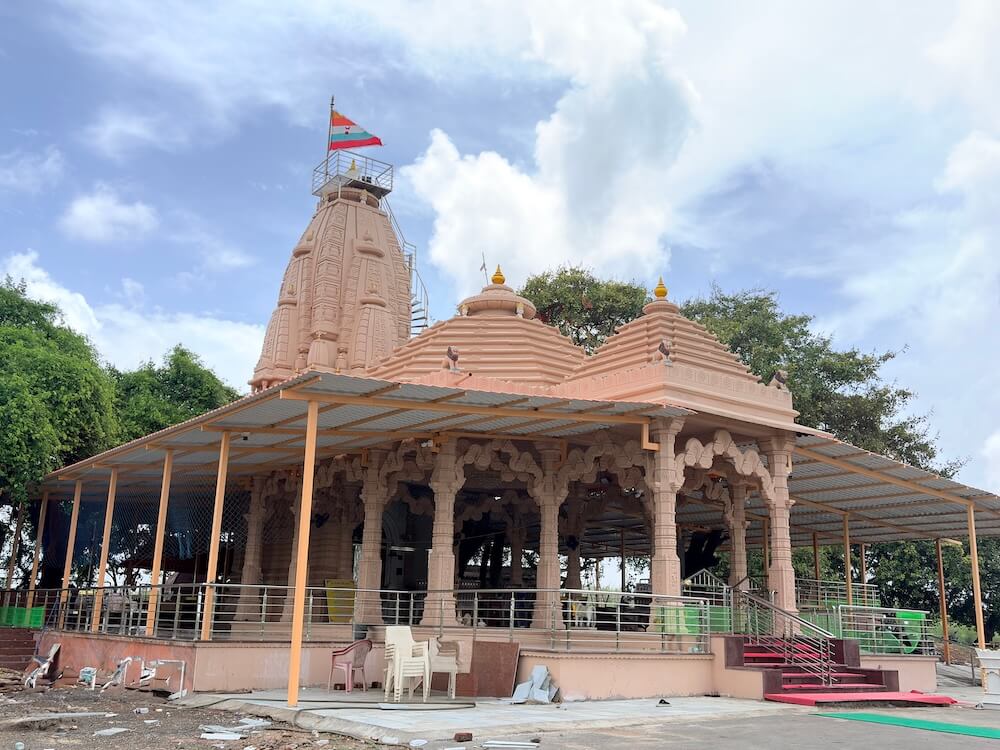
This temple is situated on an islet near the seashore, just outside the village of Maroli. In bygone times, one had to travel by boat during high tide and on foot during low tide to reach the shrine. However, a permanent road has now been constructed leading up to the temple. Outside the village, a decorative welcome arch has been erected along this road. The archway features two square pillars on either side and the beam above these pillars is adorned with a crescent-shaped crest. The temple is fronted by a spacious courtyard surrounded by numerous trees, with a sacrificial fire pit (‘Yagnakunda’) positioned at the front. The temple has undergone extensive renovation in recent times and is constructed entirely using Dholpur stone sourced from Rajasthan.
The temple stands upon a raised platform (‘Jagati’) approximately four feet above the ground level. The structure comprises a Mukhamandapa (front porch), Sabhamandapa (assembly hall), Antarala (antechamber) and a Garbhagriha (sanctum sanctorum). Seven steps lead up to the front porch, which is elevated above the courtyard and flanked by stone railings for safety. The front porch features four pillars, while the semi-open assembly hall is supported by eight intricately carved pillars, all connected by decorative arched beams. Every element—including the pillar bases, shafts, capitals, handrails, beams and ceiling canopy—is embellished with varied intricate carvings. An extended assembly hall has also been constructed by installing a roof supported by iron pillars on the left and right sides of the main assembly hall. Beyond the assembly hall lie the antechamber and the inner sanctum. The doorway to the sanctum is flanked by sculptures of Bhairav gatekeepers. The door jambs feature pillar-carvings and a central deity sculpture on the lintel, with a crescent-shaped arch (‘Torana’) mounted above the entrance.
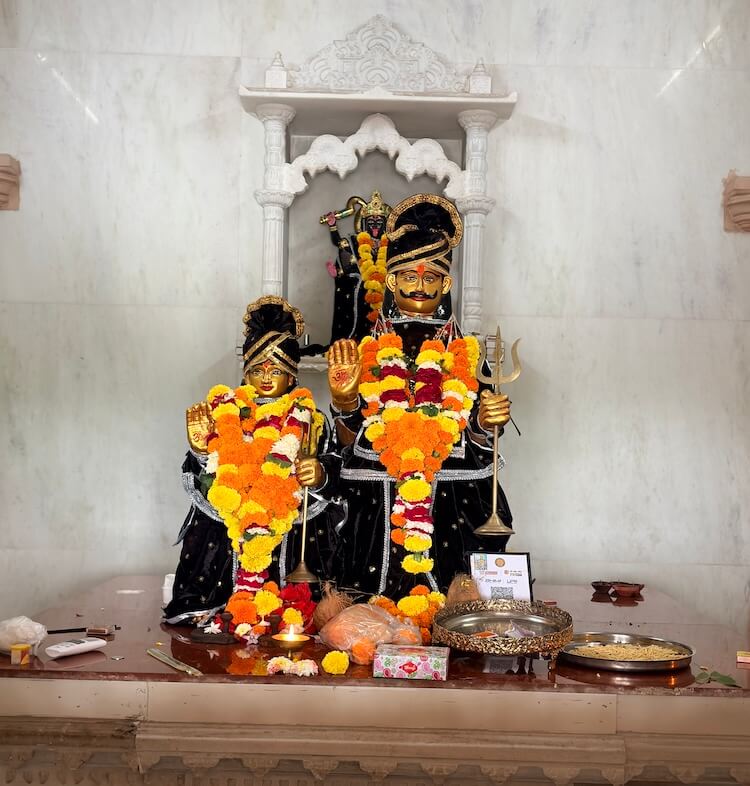
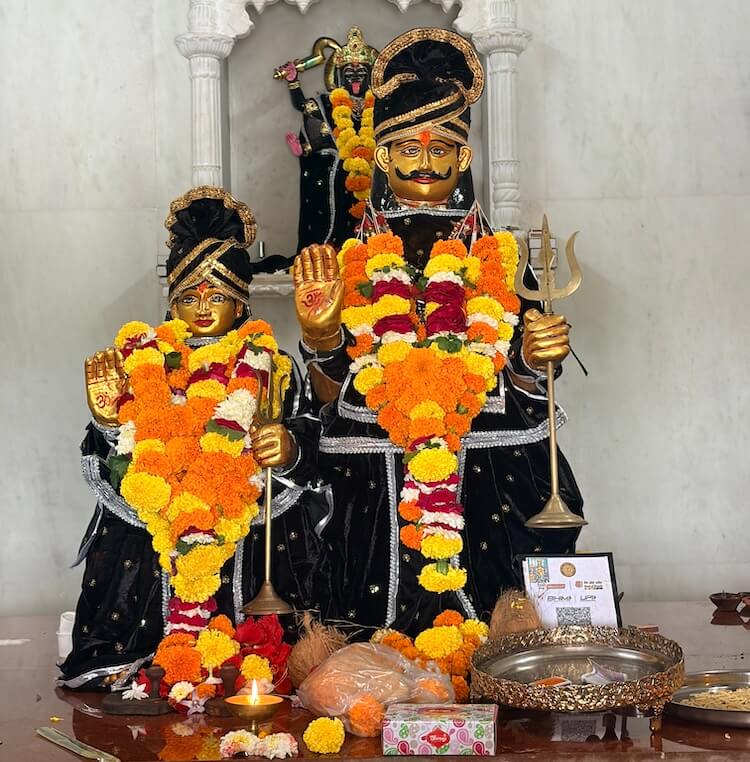
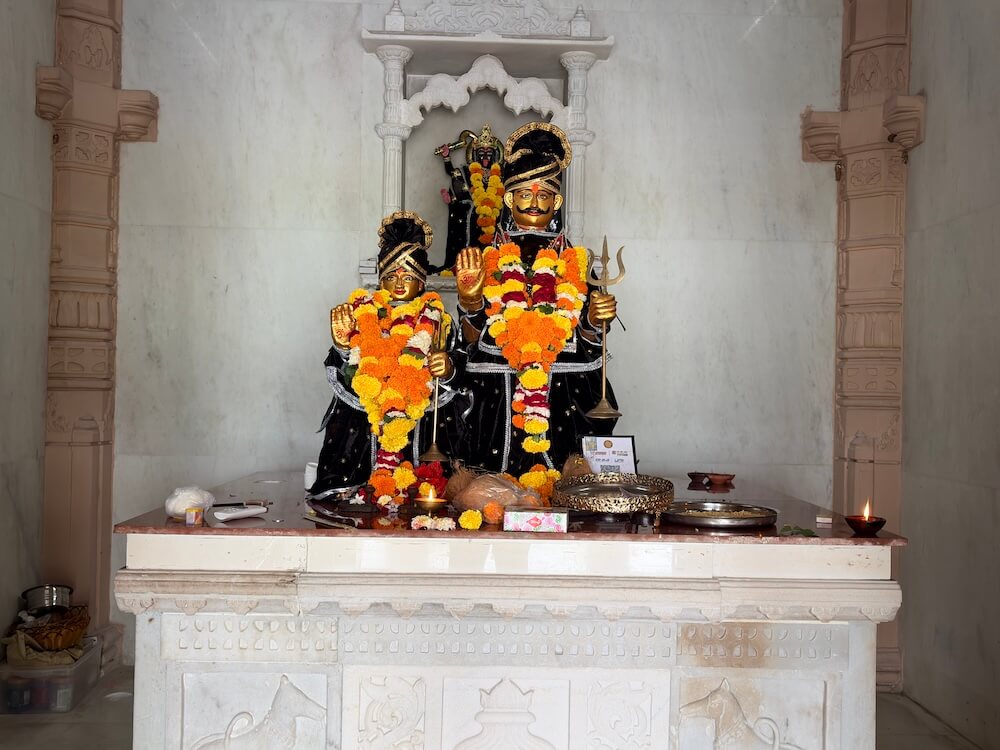
Inside the sanctum, residing upon a raised stone pedestal, are the two-armed idols of Kalbhairav and Jogeshwari Devi. Both idols hold a trident in their left hands, while their right hands are raised in a gesture of benediction. The idols are adorned with silver crowns. A divine niche in the rear wall of the sanctum houses an ancient idol of Goddess Kalika. The roofs of the front porch and the assembly hall are crowned with hexagonal, stepped spires. The roof of the sanctum features a square, tapering spire approximately twenty feet in height, adorned with base mouldings and numerous smaller secondary spires (‘Angashikharas’) on all four walls.
Situated behind the temple is the Khiroy Mata Temple. The local populace also refers to this Goddess as ‘Pangali May’. It is a firm belief that children who are delayed in learning to walk, or those who suffer from any walking infirmity, are brought to seek the blessings of this Goddess. Devotees believe that such children begin to walk properly after being brought here for darshan.
Chaitra Purnima and Kalbhairav Jayanti are the primary annual festivals celebrated at this shrine. During these festivities, thousands of devotees from the border regions of Gujarat and Maharashtra congregate to seek the blessings of the deity and fulfil their religious vows. On these occasions, a grand sacrificial ritual (‘Mahayagna’) is organised at the temple. At the break of dawn, a ‘Mahabhisheka’ is performed over the idol, followed by religious programmes throughout the day, including devotional bhajans, kirtans, scriptural narrations and the distribution of Mahaprasada. Aside from these, festivals such as Mahashivratri, the holy month of Shravan, Dussehra and Diwali are observed with great zeal. Furthermore, a steady stream of devotees is observed every Sunday and on Krishna Ashtami, Purnima and Amavasya. The temple remains open for devotees to obtain darshan daily from 6:00 am to 9:00 pm.
Navratri, Maha Shivratri, Annual Temple Jatra & Deepotsav
Compare and book flights, secure top-rated local hotels near the temple, hire reliable guides, and rent cars instantly.
Extend your pilgrimage by visiting other highly sacred temples located nearby.


Add ₹999 more to unlock FREE SHIPPING!
Your sacred cart is currently empty.
Shop Photo FramesFill in your delivery details below to place your order.
Add comment