
Add ₹999 more to unlock FREE SHIPPING!
Your sacred cart is currently empty.
Shop Photo FramesThe Satyanarayan Temple stands in the Kathiria locality of Nani Daman, in Daman, a coastal town often described as the ‘Goa of Gujarat’. While people across India worship Lord Satyanarayan on special occasions, here in Daman, he is uniquely revered as the guardian deity of the local fishing community. Before heading out into the Arabian Sea, fishermen always visit this temple to ask for his protection. It is also a deeply rooted local tradition to start any major life event or new venture with a prayer right here. Beyond being a quiet sanctuary, the temple serves as a vital religious, social and cultural hub for Daman’s fishing families and it is equally popular with visiting tourists.
Daman itself has a rich history stretching back more than two thousand years. In ancient times, it was part of the administrative provinces known as the ‘Lata’ or ‘Konkan Vishaya’. Over the centuries, a long line of dynasties ruled the region, including the Mauryas, Satavahanas, Kshaharatas, Abhiras, Traikutakas and Chalukyas. Islamic rule took hold in the fifteenth century and on 2 February 1559, the Portuguese seized control, governing Daman for nearly 450 years. Eventually, disregarding international pressure, the then Prime Minister Jawaharlal Nehru authorised military action in Goa, Diu and Daman. During the campaign known as ‘Operation Vijay’, the 1st Battalion of the Maratha Light Infantry brought Portuguese rule in Daman to an end on 19 December 1961. During Portuguese rule, the local population endured various forms of religious persecution. Yet they steadfastly preserved their faith and cultural traditions. The Satyanarayan Temple remains a living testimony to that resilience. Today, the Union Territory of Daman is split into two distinct parts by the Daman Ganga River : Nani Daman and Moti Daman. The Tandels and Patels are the original inhabitants of this land. Nani Daman, in particular, is home to a large population of the Tandel community—a traditional seafaring people whose lives are completely tied to the sea. In 1901, the ‘Shri Machhi Mahajan Samaj’, a welfare organisation established to support and advance the fishing community, founded the Satyanarayan Temple.
The sacred lore of Lord Satyanarayan comes from the ‘Revakhanda’ section of the ancient ‘Skanda Purana’. As the text goes, a group of sages led by Shaunaka gathered in the Naimisharanya forest and asked the narrator, Sage Suta, if there was a spiritual practice that could fulfill the deepest desires of the human heart. Suta shared that Sage Narada had once asked Lord Vishnu the same question. Vishnu replied, ‘I will reveal to you a sacred vow, unknown both in heaven and on earth, that brings immense merit. Whoever observes it will find happiness throughout life and ultimately attain liberation. It lifts sorrow and grants prosperity, good fortune and children. This is the ‘Sri Satyanarayan Vrat’.’
Because of this, the ritual is viewed as a sacred practice passed down directly from the Divine. The ‘Revakhanda’ includes several parables showing its power. Among them are the stories of a poor Brahmin from Kashipur and a destitute woodcutter, both of whom found wealth and comfort after performing the vow. Another story tells of a king named Ulkamukha who was blessed with a child after keeping the fast. These very stories are still recited today during the Satyanarayan prayers.
The most famous of these legends involves a merchant named Sadhu, who forgot his promise to perform the ritual after his prayers were answered. The merchant had a daughter named Kalavati. One day, while she was deeply involved in a Satyanarayan prayer service, she heard that her long-absent husband’s boat had finally returned. In her rush to welcome him, she left the prayers without eating the consecrated ‘prasad’. Angered by this sudden neglect, Lord Satyanarayan caused the ship to capsize. It was only after Kalavati returned to the altar, took the ‘prasad’ with true devotion and finished the service that the vessel miraculously rose from the water completely unharmed. Local folklore links this miracle to Shuklatirth, a village in Gujarat’s Bharuch district. The fishermen of Daman firmly believe that Lord Satyanarayan shields their boats from sudden storms and natural disasters. Because of this, it is an everyday custom for them to make solemn vows at this altar, praying for safety and good fortune before the fishing season begins.
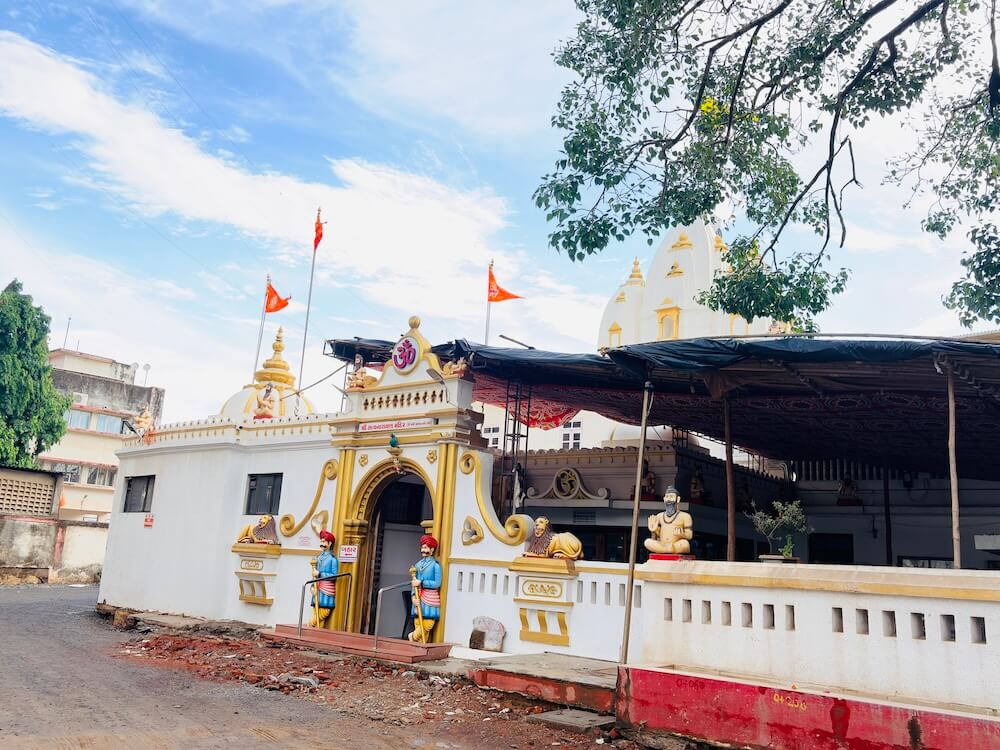
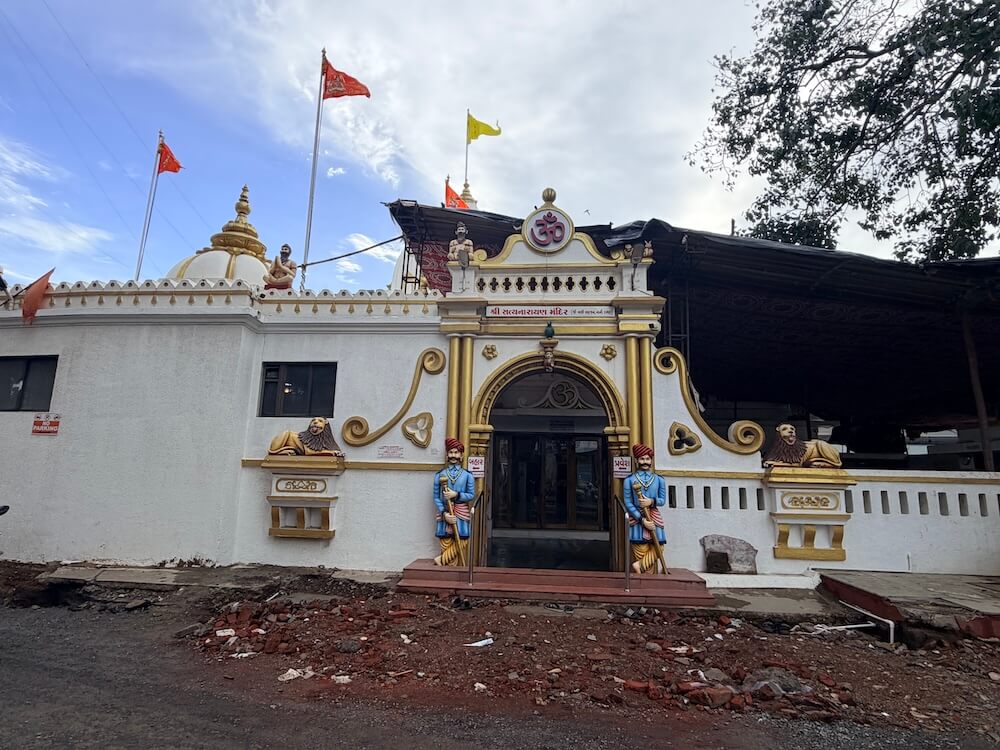
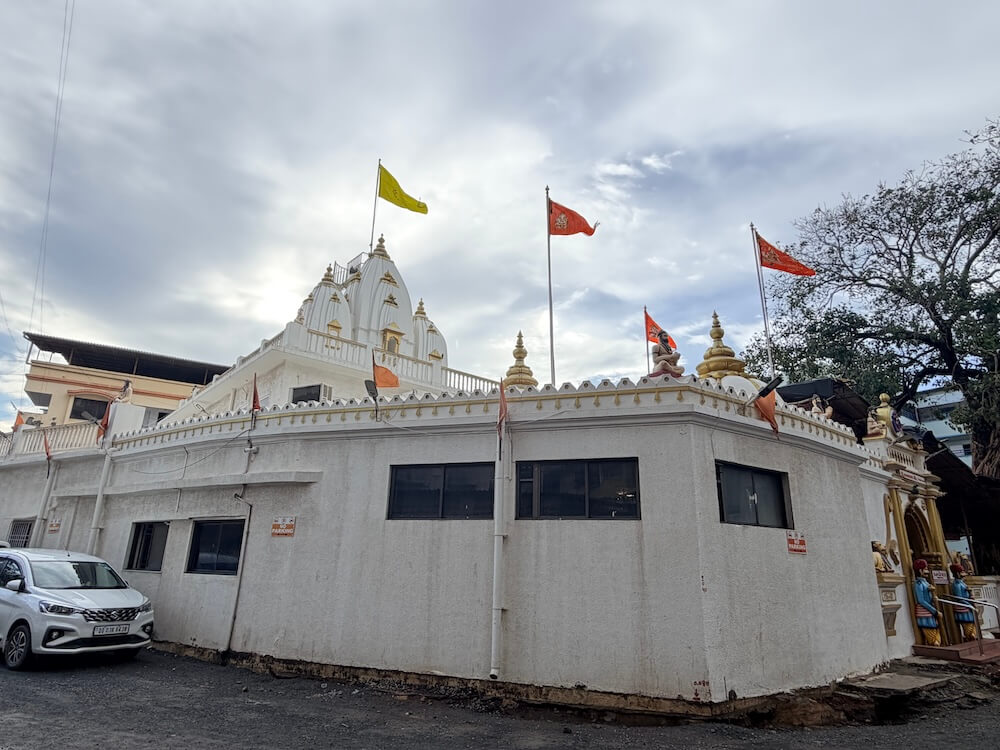
With a history spanning more than 125 years, the temple has taken on its current look through generations of careful restoration. Visitors enter through a grand gateway set into a fortified boundary wall, which is adorned with stone sculptures of ancient sages at regular intervals. Finely carved guardian figures (‘Dwarpalas’) stand watch on either side of the entrance. Above the door is the sacred symbol ‘Om’, topped with a small finial and flanked by reliefs of meditating ascetics.
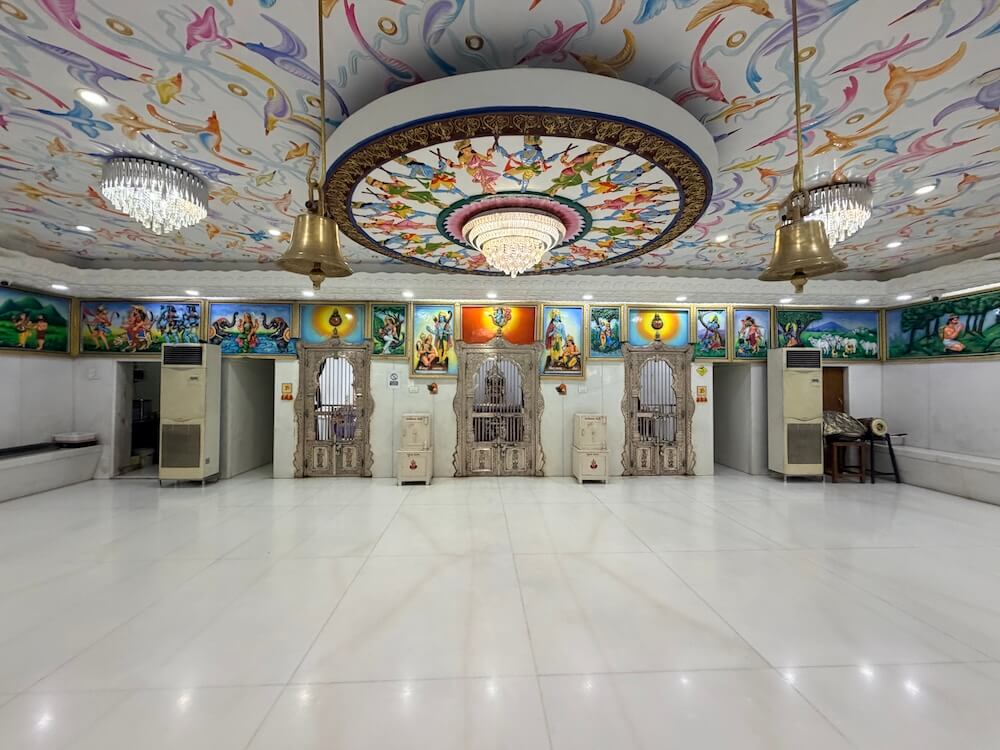
From the gate, devotees walk through a spacious courtyard and into the main assembly hall (‘Sabhamandapa’). The interior walls are decorated with detailed relief panels that bring scenes from the Satyanarayan story to life. Past the hall, surrounded by a shared circumambulatory path, are three separate inner sanctums (‘Garbhagrihas’). The central, main shrine holds the beautifully adorned idol of Lord Satyanarayan, a manifestation of Lord Vishnu. The smaller shrines on either side house Goddess Lakshmi and the divine couple Radha-Krishna.
Directly across from the main shrines, on one side of the assembly hall, sits an additional open sanctuary. In front of it, resting on a polished marble platform, are stone sculptures of Nandi and the sacred tortoise. On the altars (‘Vajrapeethas’) flanking the shrine are images of Lord Ganesha and Hanuman. At the center of this open inner chamber, a sacred ‘Shiva Linga’ is encased in ornately patterned silver sheeting, beneath the protective canopy of a copper serpent. A stone niche in the back wall holds an idol of Goddess Parvati. Architecturally, the assembly hall is crowned by a large dome, while the main sanctum is topped by three distinct spires built in the clustered ‘Urushringa’ style.
The temple is open for public viewing (‘Darshan’) every day from 7:00 am to 12:00 noon and again from 4:00 pm to 8:30 pm. Every morning, right after the doors open, a ritualistic worship service is performed, followed by the early dawn prayers (‘Kakad Aarti’). The main prayer services (‘Aarti’) take place twice a day, once at noon and again at sunset.
Throughout the year, the temple observes a variety of traditional festivals from the Hindu calendar with deep devotion. The most important monthly event is the Satyanarayan Maha Puja, held on every full moon day (‘Poornima’). On this day, the temple organises large collective worship services, where hundreds of devotees gather together to listen to the reading of the sacred ‘katha’.
The grandest annual celebration for the fishing community is ‘Narali Purnima’, celebrated during the holy month of Shravan. On this day, members of the Koli community arrive at the temple dressed in their finest traditional attire. After offering a special Satyanarayan prayer, they march to the shore to offer coconuts to the sea. This ceremonial blessing of the ocean officially marks the start of the new maritime fishing season. In addition to these major events; Diwali, Kartik Purnima and every single Thursday are marked by special religious services and the distribution of blessed community meals (‘Mahaprasad’).
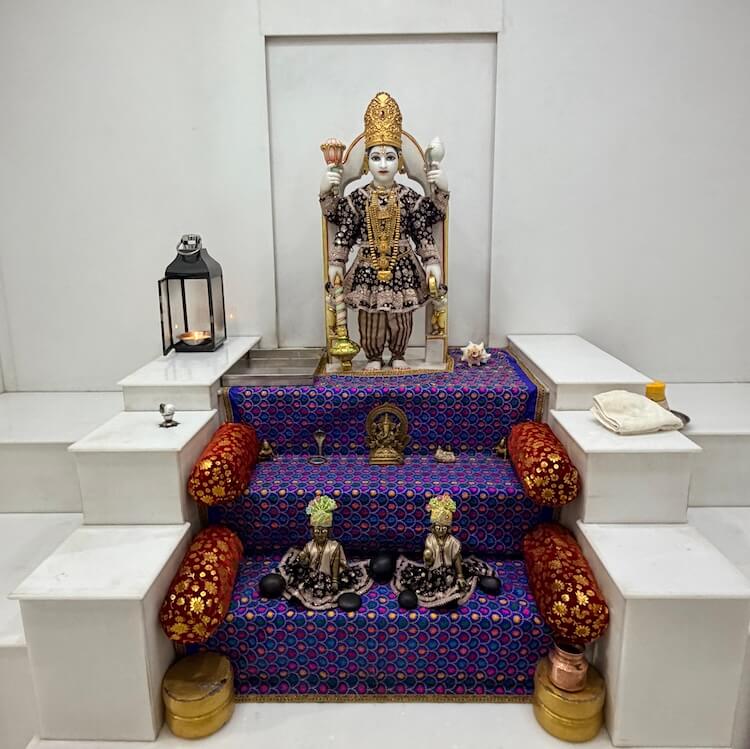
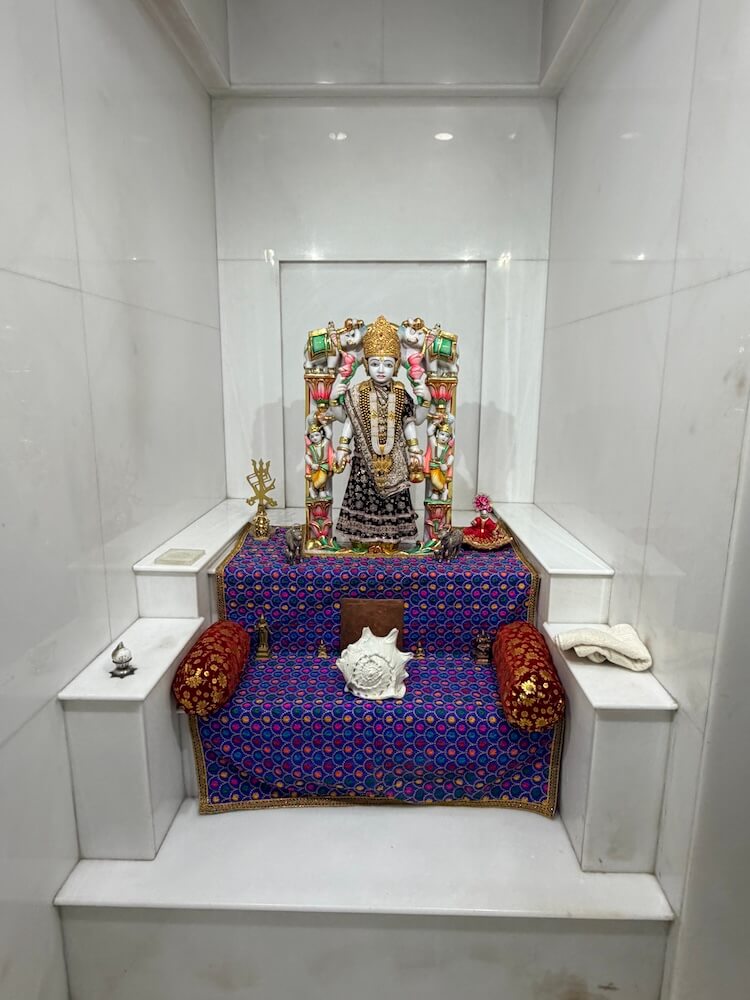
Navratri, Maha Shivratri, Annual Temple Jatra & Deepotsav
Compare and book flights, secure top-rated local hotels near the temple, hire reliable guides, and rent cars instantly.
Extend your pilgrimage by visiting other highly sacred temples located nearby.


Add ₹999 more to unlock FREE SHIPPING!
Your sacred cart is currently empty.
Shop Photo FramesFill in your delivery details below to place your order.
Add comment