
Add ₹999 more to unlock FREE SHIPPING!
Your sacred cart is currently empty.
Shop Photo FramesAlthough Panvel has emerged as a modern city today, its ancient temples preserve the existence of the city’s historical roots. The Khandeshwar Shiva Temple in Mota Khanda village, Panvel, is renowned. Devotees believe that the self-manifested (Swayambhu) Mahadev here is highly awakened and grants the wishes of those who pray with faith. The local railway station has also been named Khandeshwar after this sacred shrine. About two lakh devotees attend the annual fair held here on Mahashivratri.
The history of the temple’s construction is documented in the autobiography ‘Majhi Jeevangatha’ by Prabodhankar Thackeray. According to the account, Khanda village was then a small hamlet of 20-25 huts. On the Mumbai-Panvel road, two miles from Panvel, there is a pond right by the main road. Often in the evenings, the city’s famous lawyer, Baba Patki, and his peers and professional friends would come to the vicinity of this pond for a stroll. While chatting in a quiet spot, they decided as a hobby to dig the ground where they sat using a pointed stone. Within a few days, a pit was formed at this spot.
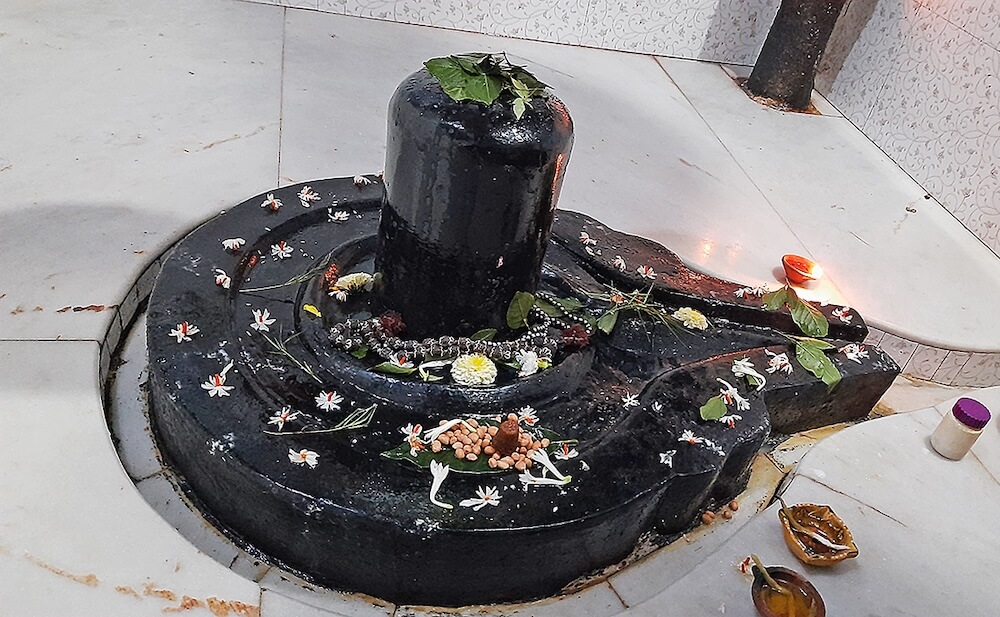
While digging this pit one day, a circular stone became visible. Baba Patki, a devout worshipper of Shiva, felt it must be a Shiva Linga and began chanting “Har Har Mahadev.” Hearing these shouts, the villagers from nearby Khanda village arrived. Following Baba’s instructions, the villagers brought pickaxes and shovels. It was getting dark, but the villagers lit torches made of dry leaves, and in that light, they dug waist-deep around the stone. Baba’s intuition proved correct; there was a Shiva Linga with a Shalunka (base) in the ground. Since the discovery happened on a Monday, everyone was filled with immense joy. They began to dance, chanting “Har Har Mahadev.”
As news of Baba Patki finding the Swayambhu Shiva Linga in Khanda village spread throughout the surrounding areas, thousands of devotees gathered. Baba cleared the area around the Shiva Linga and erected a pavilion of palm fronds. Within a day or two, a small temple with bamboo walls and a tin roof was built. Baba appointed a Gosavi (ascetic) at his own expense for the worship of Mahadev. He began visiting daily with his friends for the Aarti. Meanwhile, a merchant from Mumbai came to Panvel to seek Baba’s advice regarding a civil lawsuit. Many lawyers from Mumbai used to send their clients to Baba for his counsel in complex civil cases. The merchant’s case involved an inheritance dispute worth lakhs of rupees.
Baba Patki held the merchant’s hand, stood him before the Shiva Linga, and said, “This Shri Khandeshwar Yashwant will resolve your work. I will take up your case only if you vow before the Lord that if you win the lawsuit, you will build a stone temple for Khandeshwar.” The merchant accepted Baba’s condition and vowed to build the temple. Within a year, the merchant won the case based on the legal points provided by Baba, and by the time of the third Mahashivratri fair since the discovery of the Linga, the Khandeshwar temple was built. During this time, he also had a well and a Dharamshala (pilgrim rest house) constructed through other donors.
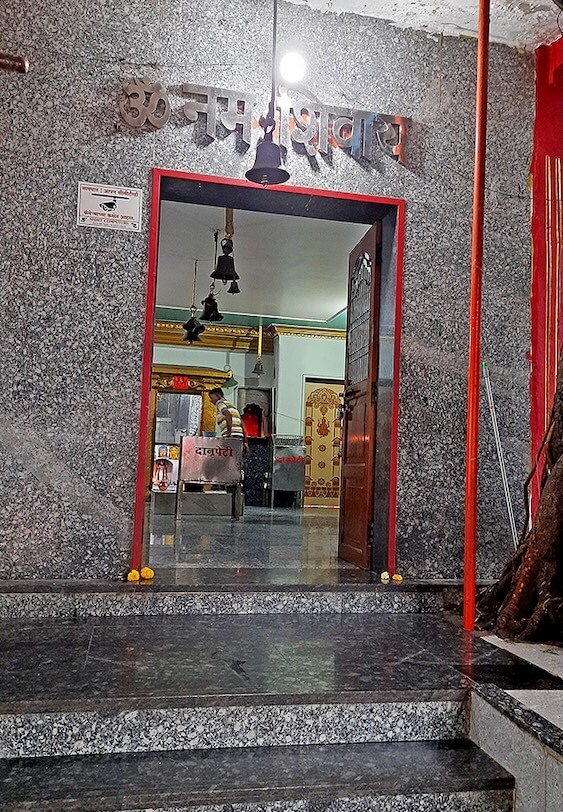
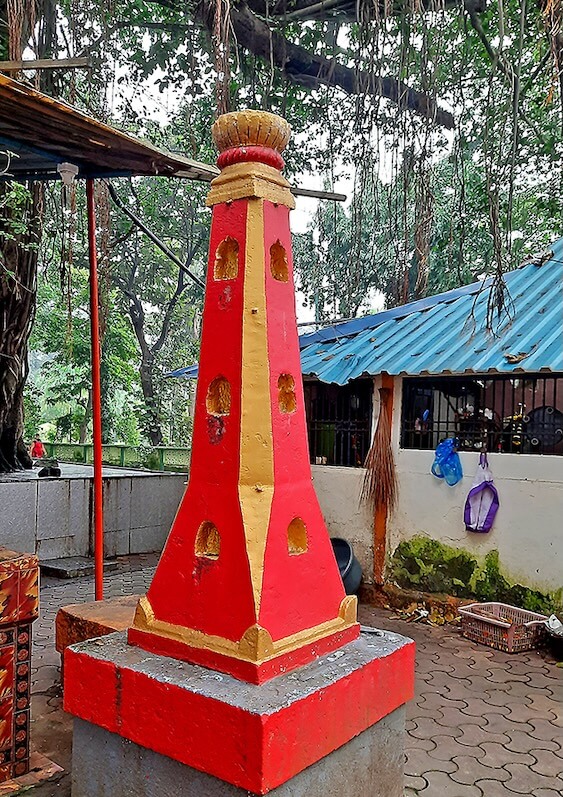
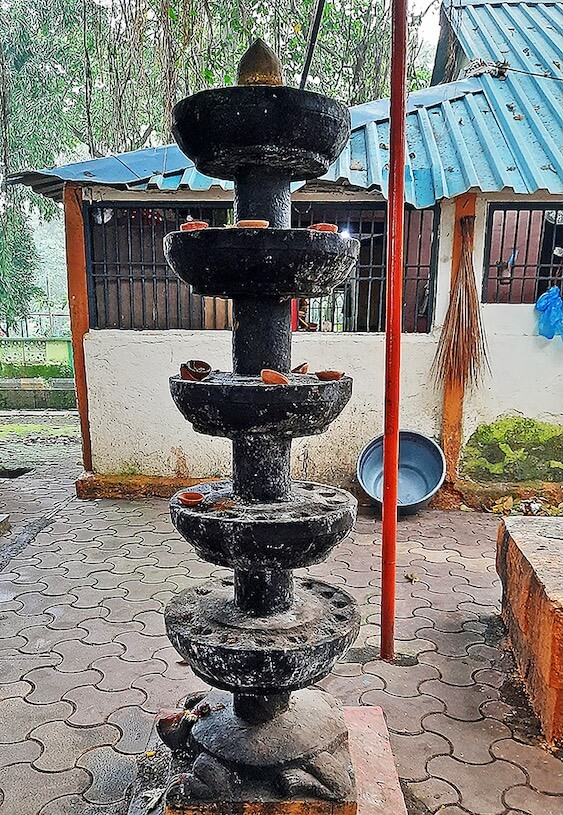
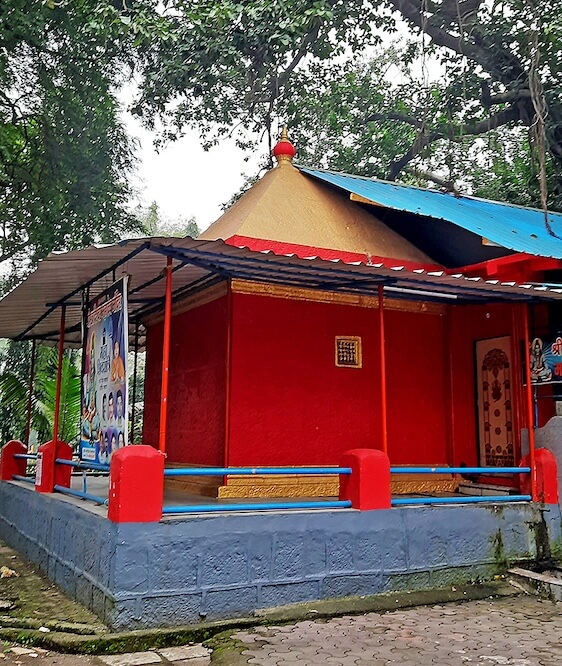
The CIDCO has now beautified the Khandeshwar pond and temple premises. Beautiful gardens have been developed around the temple, with seating arrangements placed throughout. In front of the temple stands a distinctive Deepastambha (lamp pillar). This pillar rests on the back of a tortoise. Next to the Deepastambha is a Tulsi Vrindavan and another newly constructed lamp pillar. The temple is situated on a high plinth, and one must climb six steps to reach the Sabha Mandap (assembly hall). To the right of the steps is an ancient sacred tree with a large platform built around it. On this platform are idols of Mahadev and other deities. To the left of the steps, attached to the outer wall of the temple, is a pavilion with a tin roof. During festivals, programs like Bhajans, Kirtans, and discourses are organized here.
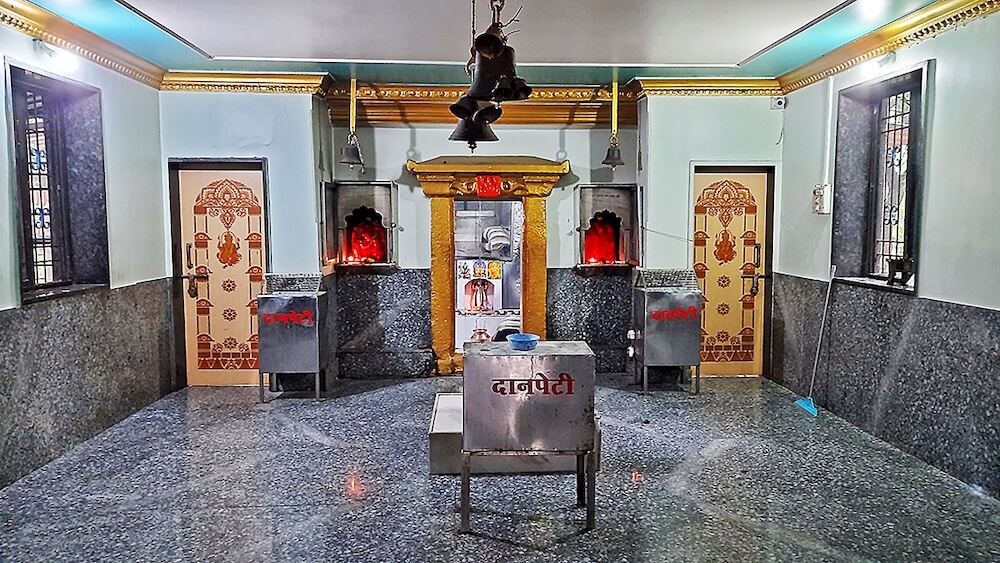
The temple structure consists of a Sabha Mandap, Antarala (vestibule), and Garbhagriha (sanctum sanctorum). The Sabha Mandap is enclosed. It has windows for light and ventilation, and many brass bells, offered as part of fulfilled vows, hang from the ceiling. In the center of the Sabha Mandap is a platform with an idol of Nandi and a brass tortoise in front of it. Further ahead is the narrow Antarala. On both sides of the entrance to the Garbhagriha in the Antarala are niches. The right niche contains a four-armed Ganesha, and the left contains a vermilion-smeared idol of Maruti (Hanuman).
The door frames of the Garbhagriha feature vertical carvings, and there is an idol of Ganesha on the lintel. The lintel strip has floral carvings, and there is a Chandrashila near the threshold. The Garbhagriha, which is slightly deeper than the Antarala, houses the Shiva Linga in the center. A brass serpent with a canopy covers the Shiva Linga. In a wall niche in front of the Shiva Linga is a four-armed idol of Parvati. The exterior of the Garbhagriha is surrounded by a platform with a safety railing. The roof of the Garbhagriha features a square, pyramid-like Shikhara.
Due to the spacious temple premises, there is ample room for religious rituals. Along with Shiva Puja, various rituals such as Kalsarpa Yoga, Narayan Nagbali, Shraddha, Janan Shanti, wedding ceremonies, collective Dugdhabhishek, Abhishek, Rudrabhishek, Pradosh Pujan, collective Pradosh Pujan, and Deep Archana are performed here. Mahashivratri is the main annual festival celebrated with great enthusiasm. A large fair is held on this day. For seven days before Mahashivratri, a Harinam Saptah is organized, featuring Bhajans, Kirtans, and discourses. Thousands of devotees visit for Darshan and to fulfill their vows on Mahashivratri. Mahaprasad is organized for the visiting devotees. Devotees can have Darshan from early morning until late at night.
This sacred temple stands as a testament to deep spiritual devotion, ancient architectural grandeur, and rich local cultural traditions.
The sanctum sanctorum houses the divine idol consecrated according to ancient Vedic traditions, surrounded by serene courtyards and traditional temple architecture.
Navratri, Maha Shivratri, Annual Temple Jatra & Deepotsav
Compare and book flights, secure top-rated local hotels near the temple, hire reliable guides, and rent cars instantly.
Extend your pilgrimage by visiting other highly sacred temples located nearby.


Add ₹999 more to unlock FREE SHIPPING!
Your sacred cart is currently empty.
Shop Photo FramesFill in your delivery details below to place your order.
Add comment