
Add ₹999 more to unlock FREE SHIPPING!
Your sacred cart is currently empty.
Shop Photo FramesThe Kshetrapal Hanuman Temple is among the ancient temples of Surat, boasting a history of approximately 400 years. The temple houses self-manifested idols of Kshetrapal Hanuman, Kalabhairav and Batukbhairav, making it unique in Surat as the only temple where these three avatars of Lord Shiva reside together. Devotees believe that Hanuman safeguards the region, heals chronic ailments and resolves life’s challenges; Kalabhairav offers protection from the forces of time, while Batukbhairav ensures the safety of children. This strong faith attracts devotees from distant places and the temple is particularly bustling on Tuesdays and Saturdays.
According to the Surat Gazetteer, the suburb of Sangrampura was established by an Anavil Brahmin, a sect of Brahmins known for their role as landowners rather than traditional priests. The Gazetteer also mentions that Gopi, the merchant credited with founding Surat, was an Anavil Brahmin. As per mythological accounts, after Lord Rama defeated Ravana, he was afflicted with the sin of Brahmahatya (killing a Brahmin). To atone for this sin, Lord Rama performed a Mahayajna at Anadipur (modern-day Anaval). It is believed that Hanuman brought Brahmins from Ayodhya to conduct the yajna. The Kshetrapal Hanuman Temple is situated in Sangrampura, a settlement established by these Anavil Brahmins.
As per folklore, around 450 years ago, the Surat region faced turmoil due to Muslim invasions. In 1573, Emperor Akbar’s army conquered Surat. During this period, in Sangrampura, a tantric (mystic) was performing intense penance near a palm tree. His severe austerities had granted him supernatural powers. Using this siddhi (spiritual mastery), he attempted to transport the palm tree through the skies back to its original location. Witnessing this miraculous event, a few priests knowledgeable in mystical arts invoked Goddess Tripuri Sundari and Kalabhairav. Their invocation compelled the tree to descend to the ground. Following this event, the divine manifestations of Kshetrapal Hanuman, Kalabhairav and Batukbhairav appeared at the site. Devotees believe that the Kshetrapal Bhairav deity also exists here in a subterranean form.
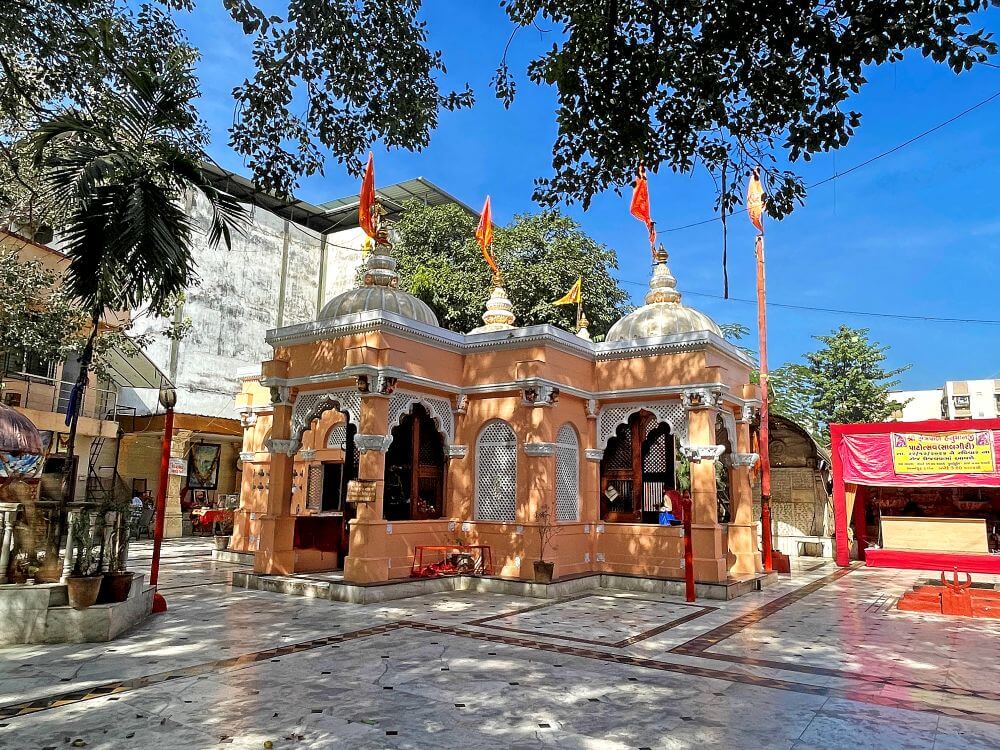
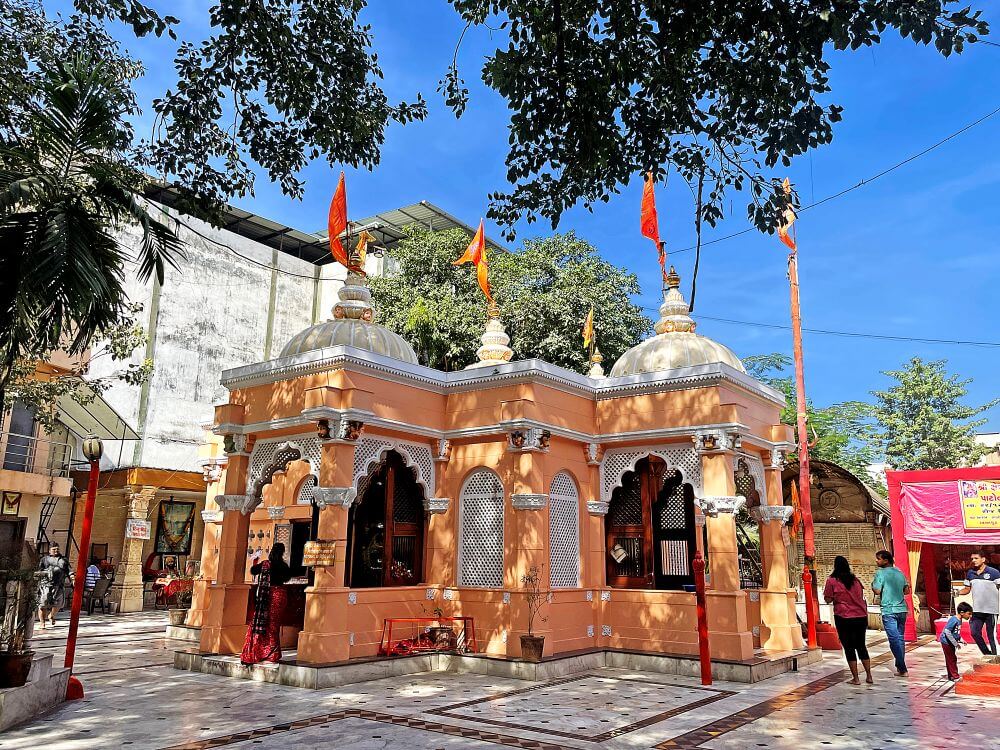
Initially, the temple stood amidst dense forests. About 250 years ago, the temple underwent its first renovation. Over the years, periodic restorations have been carried out. The present-day temple, constructed entirely in stone, is notable for its iron-free architecture, demonstrating the enduring craftsmanship of the time.
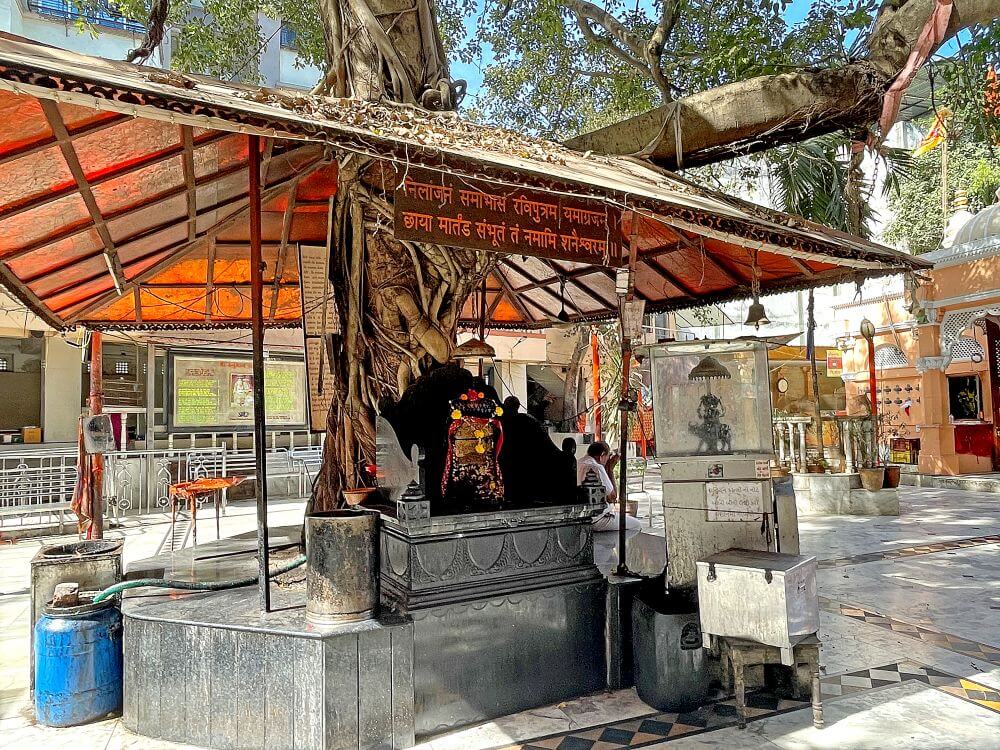
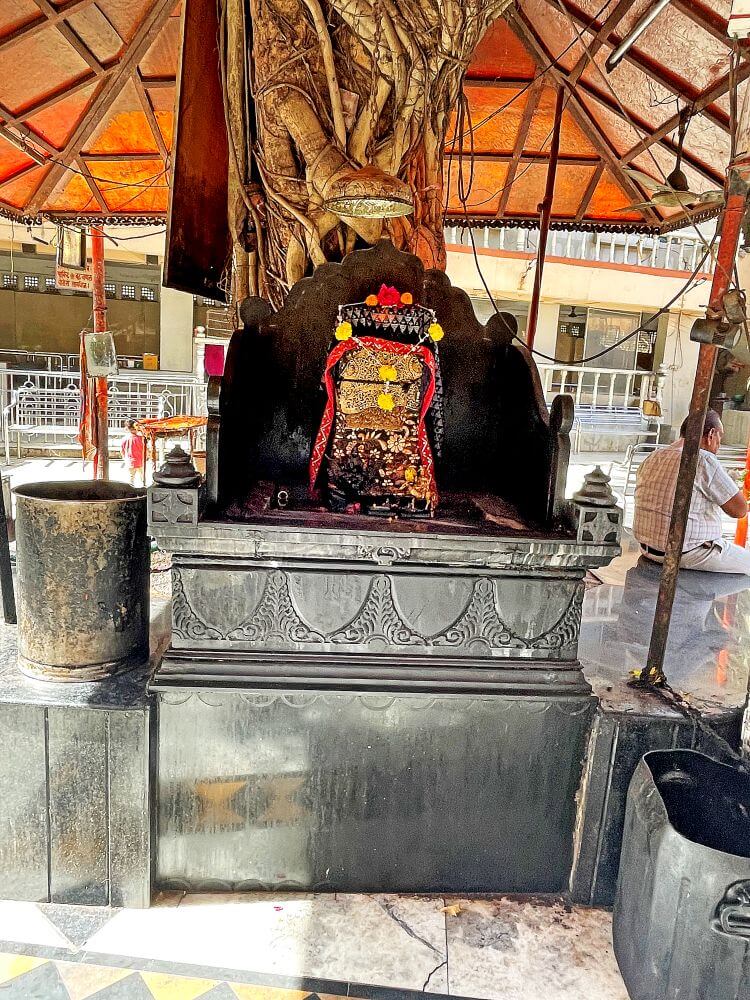
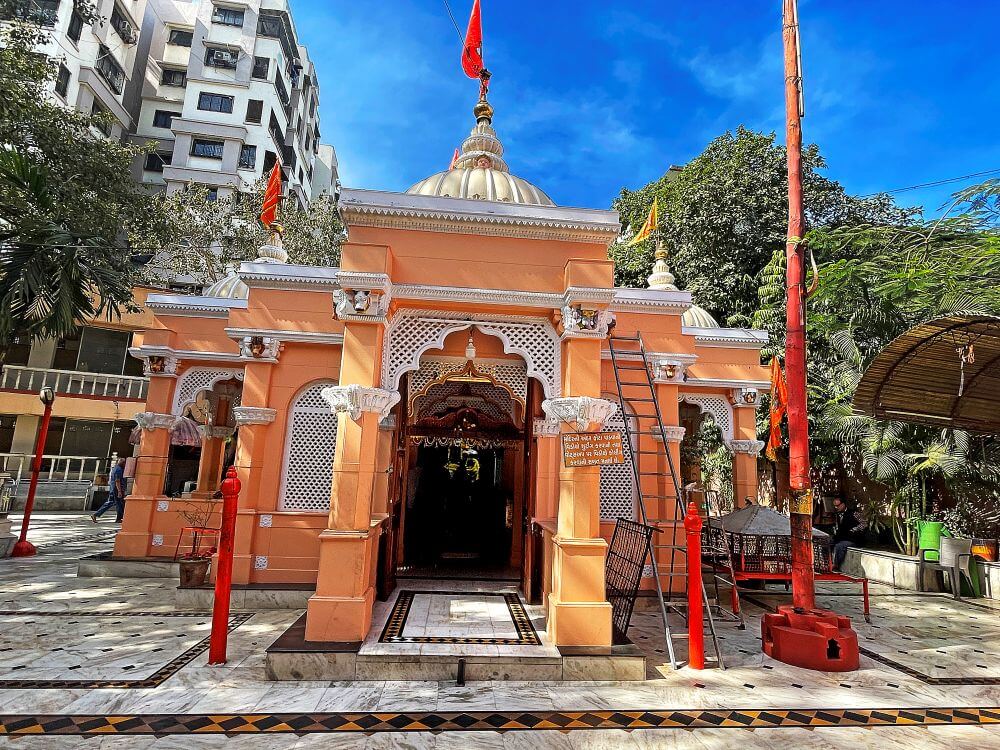
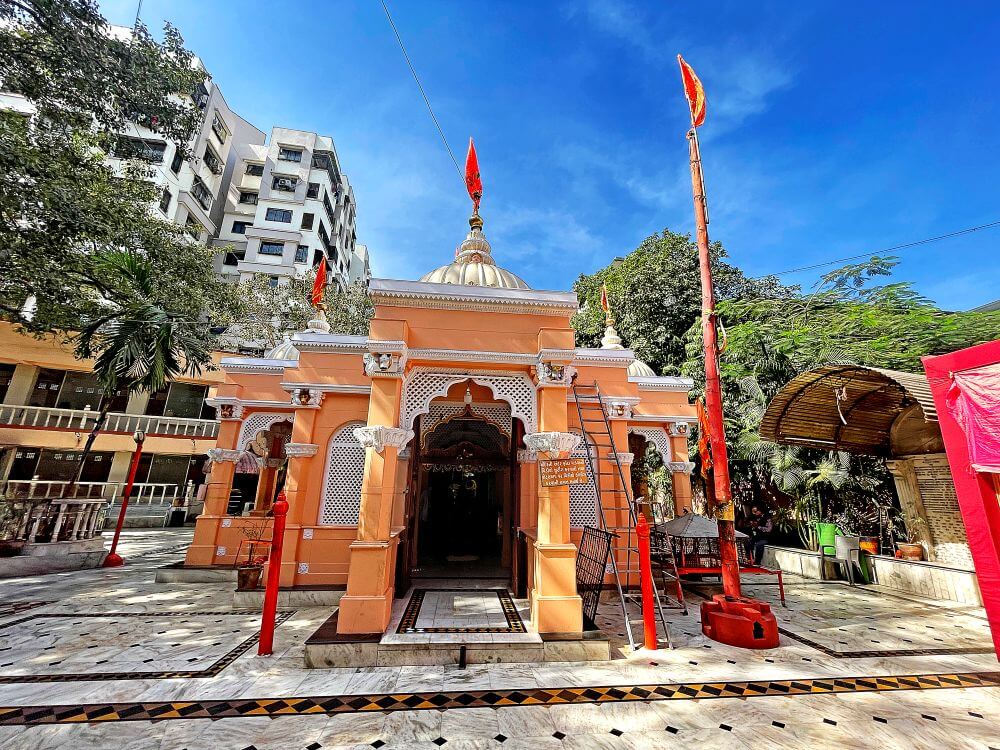
Located along a bustling street in Sangrampura, the temple is marked by a grand archway that leads into a spacious courtyard. Within the courtyard, several shops sell puja items and offerings. The stone-paved precinct houses significant features. On the right side, there is a two-storey building. On the left side, shrines of Baliyadev and Mahalakshmi can be found. In the centre, beneath a tree, lies a platform dedicated to Shani (Saturn), with a Shani shila (stone) and a small statue depicting Shani seated on his vahana (vehicle), the crow.
The temple comprises a mukhmandap (porch), sabhamandap (assembly hall), garbhagriha (sanctum) and additional porches flanking the sabhamandap on both sides. Architectural highlights include – Dome-shaped spires atop the mukhmandap, sabhamandap and garbhagriha. Three-tiered kalasha (crowning spires) adorning each dome and a tall flagstaff near the main entrance, symbolising the temple’s sanctity.
In the temple’s sanctum, the self-manifested (swayambhu) deities of Hanuman, Kalabhairav and Batukbhairav reside. What sets this temple apart is the extraordinary feature of these three deities being carved from a single stone, a sight that leaves devotees awestruck.
Located directly opposite the Kshetrapal Hanuman Temple, the Kashi Vishwanath Mahadev Temple stands prominently in a two-storey structure. The entrance leads to seven steps that ascend into the temple. The architectural layout includes a mukhmandap (porch), sabhamandap (assembly hall), antaral (antechamber) and garbhagriha (sanctum). The mukhmandap features a dome-shaped small spire. The sabhamandap boasts a tall uru-shring spire, characterised by miniature replicas of the main spire adorning its surface.The temple ceiling features intricate carvings, showcasing the artistry and cultural heritage preserved within the temple.
A white marble statue of Nandi is placed within the sabhamandap. To manage the crowd, stainless steel railings are installed around the Nandi statue. Niches within the sanctum house idols of Hanuman and Ganesh. The garbhagriha houses a shivling, covered by a protective naga (snake) canopy. Above it is a silver galantika (water vessel) from which drops of water flow continuously on the shivling. Behind the shivling stands a statue of Parvati.
The temple is open to devotees from 5 AM to 8 PM. Daily rituals, bhajans and aarti are performed. On Tuesdays and Saturdays, special bhajans and aarti are held. The eighth day of the lunar fortnight is considered auspicious for Kalbhairav and hence, havan (fire ritual) is performed on both Ashtami days. On Kartik Shuddha Pratipada and Margashirsha Shuddha Ashtami, devotees flock to witness special rituals dedicated to Kshetrapal Bhairav. On these days Annakut (a grand feast) is also arrranged here, which is followed by evening bhajans and aarti.
The temple celebrates numerous Hindu festivals with enthusiasm. On Margashirsha Krishna Ashtami, the temple marks its foundation day with grandeur. The anniversary celebrations include – Ritualistic yagna-havan performed amidst the chanting of Vedic hymns by learned priests, Annakut Mahotsav (grand feast), special aarti, bhajan programmes and collective chanting of the Hanuman Chalisa. The temple premises house a library, offering a collection of books related to Hindu religion and culture, providing knowledge and inspiration to visitors.
This sacred temple stands as a testament to deep spiritual devotion, ancient architectural grandeur, and rich local cultural traditions.
The sanctum sanctorum houses the divine idol consecrated according to ancient Vedic traditions, surrounded by serene courtyards and traditional temple architecture.
Navratri, Maha Shivratri, Annual Temple Jatra & Deepotsav
Compare and book flights, secure top-rated local hotels near the temple, hire reliable guides, and rent cars instantly.
Extend your pilgrimage by visiting other highly sacred temples located nearby.


Add ₹999 more to unlock FREE SHIPPING!
Your sacred cart is currently empty.
Shop Photo FramesFill in your delivery details below to place your order.
Add comment