
Add ₹999 more to unlock FREE SHIPPING!
Your sacred cart is currently empty.
Shop Photo FramesThe Old Ambaji Mata Temple, located in the Gopipura area of Surat, is an ancient shrine believed to be over 450 years old. It is said that the idol of Goddess Ambaji housed in the temple was brought from Gabbar Hill, a sacred site in Gujarat. According to local lore, Chhatrapati Shivaji Maharaj visited this temple to seek the blessings of Goddess Ambaji during one of his campaigns in Surat. Devotees hold strong faith in the temple’s divine powers. It is widely believed that childless women who perform rituals and prayers here are blessed with children. Similarly, children with delayed speech development are brought to the temple and many believe that the Goddess’s blessings help them speak sooner.
One of the temple’s distinct traditions is observed during Navratri, the nine-night festival dedicated to Goddess Durga. Here, coconuts are broken using a tool called mogri, a wooden implement made from the wood of the babul tree, resembling a mace. On the occasion of Dussehra (Vijayadashami), the idol of Ambaji Mata is taken out on a grand silver chariot for a procession through the town. Thousands of devotees gather to catch a glimpse of the Goddess’s palanquin, creating an atmosphere of spiritual fervour and devotion.
According to the Surat Gazetteer, Surat (previously known as Suryanagar) was once a small village, while nearby Rander was a prominent trading hub. Between 1496 and 1521, a wealthy Hindu merchant named Gopi played a pivotal role in bringing traders to the region, leading to Surat’s prosperity. The establishment of modern Surat is credited to Gopi, who also developed the area now known as Gopipura. In 1573, the Mughal Emperor Akbar captured Surat and it was during this era that the Old Ambaji Mata Temple is believed to have been founded.
This temple stands as a testament to Surat’s rich cultural and spiritual heritage. Its deep-rooted connection with history, including its association with Chhatrapati Shivaji Maharaj and its unique customs, draw devotees and history enthusiasts alike. The rituals and festivals celebrated here, particularly during Navratri and Dussehra, reflect the vibrant traditions of the region.
The origins of the Old Ambaji Mata Temple are steeped in legend. Approximately 450 years ago, a devout follower of the Goddess named Premji Bhatt from central Gujarat is believed to have received a divine vision. In this vision, Goddess Ambaji instructed him to bring her idol from Gabbar Parvat (Gabbar Hill) and establish it in Surat. Gabbar Hill, located in Banaskantha district, about 450 kilometres from Surat, is considered the original abode of Ambaji Mata. According to ancient lore, even Lord Krishna’s mundan sanskar (the first hair-cutting ceremony) was performed on this sacred hill.
Following the Goddess’s command, Premji Bhatt, along with his wife, embarked on a journey to Gabbar Hill, travelling by a camel. Upon reaching the hill, they discovered the idol of the Goddess inside a wooden box. Carrying the idol with reverence, they began their return journey to Surat. As they approached Surat and attempted to cross the Tapi River by boat, a gatekeeper (or sentinel) stopped them, suspecting that the box contained stolen goods. Despite Premji’s explanation of the divine vision and the sacred contents of the box, the gatekeeper refused to believe him and confiscated it. Disheartened, Premji Bhatt returned home and began fervently praying and fasting to seek the Goddess’s intervention.
Meanwhile, the gatekeeper’s household fell into chaos. A series of misfortunes befell his family, culminating in the tragic death of his son. Recognising this as the Goddess’s displeasure, the gatekeeper repented and returned the box to Premji Bhatt, granting him entry into Surat.
On Paush Purnima (the full moon day in the Hindu month of Paush), Premji Bhatt erected a wooden shrine at the current site on Ambaji Road and installed the idol of Ambaji Mata. News of the temple’s divine power and the Goddess’s blessings spread rapidly, drawing devotees from nearby regions. In no time, the temple became a revered site, with countless devotees visiting to seek the Goddess’s grace. This humble shrine laid the foundation for what is today celebrated as the Old Ambaji Mata Temple, a cornerstone of Surat’s spiritual and cultural heritage.
Chhatrapati Shivaji Maharaj conducted two expeditions against Surat in 1664 and 1670. According to English records, on 6th January 1664, at 11 a.m., Shivaji Maharaj established his camp half a mile outside Surat. However, there is no documented evidence of Shivaji Maharaj entering the city during these raids. Despite this, local lore recounts that during one of these campaigns, Shivaji Maharaj visited the Ambaji Mata Temple. It is said that he offered a garland to the Goddess during his visit. A painting depicting this event can be found in the temple, displayed in the inner sanctum where the Goddess rests.
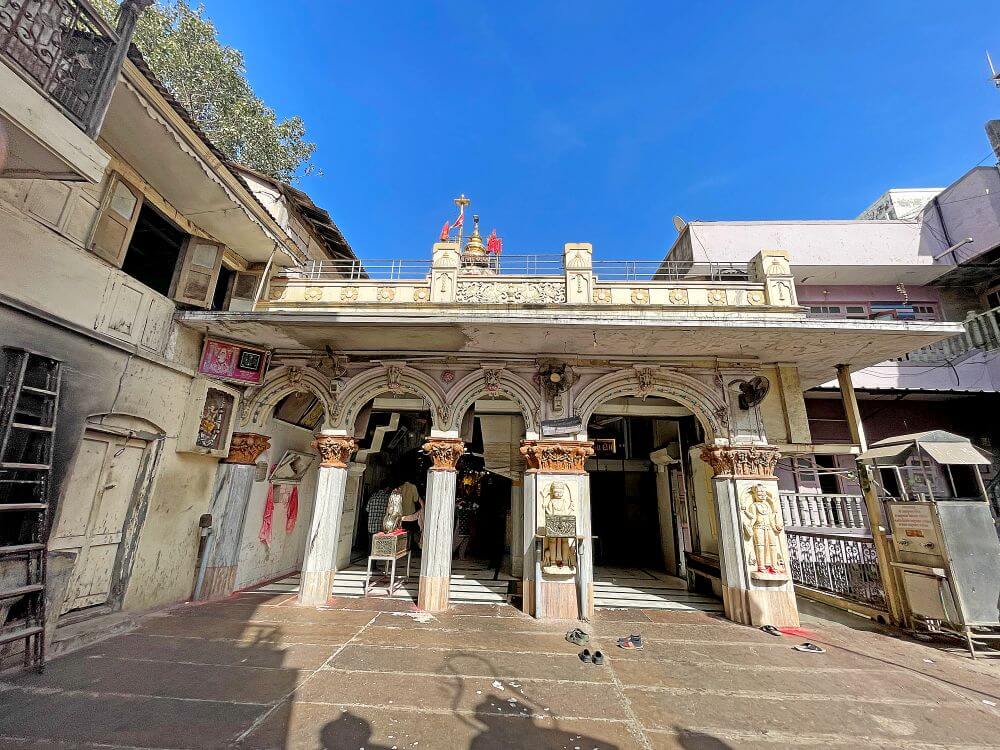
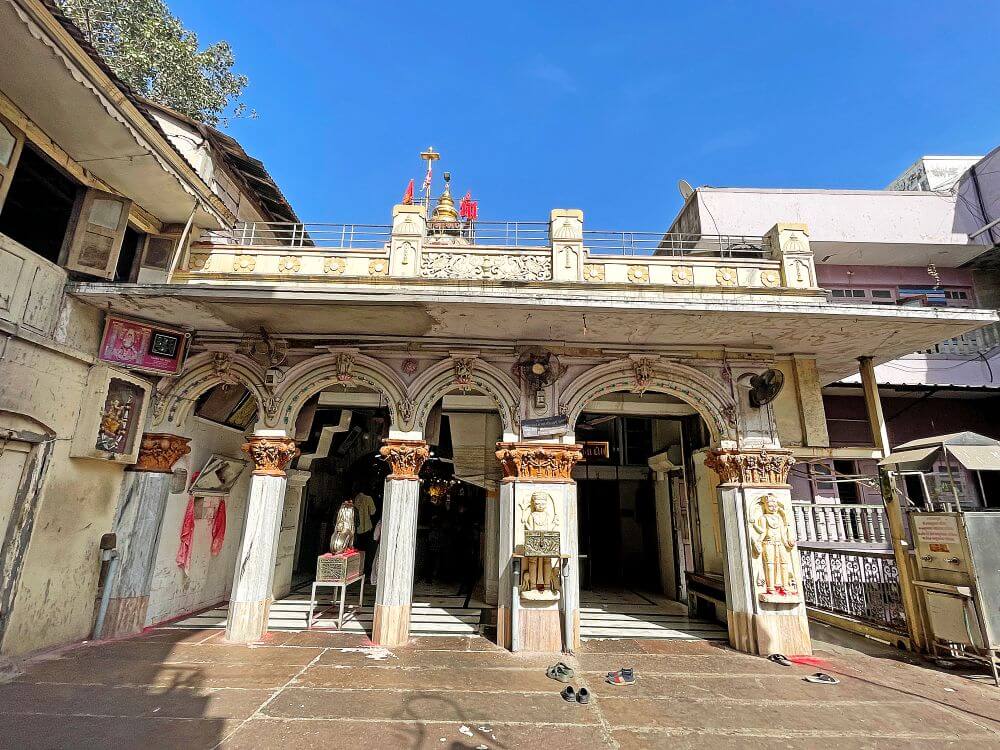
Located on Ambaji Road, the temple welcomes visitors through a grand entrance arch. As one steps inside, the first sight is a row of shops selling prayer materials. The temple itself is situated on an elevated platform, adding to its aura of sanctity. Above the shops lies a courtyard wall, designed in the style of a devli (a traditional shrine structure). This wall features a vivid relief sculpture of the Bhatt couple carrying the sacred idol of the Goddess from Gabbar Hill. From the base of the shops, a few steps lead to the temple’s main entrance. The gateway is designed with tall rectangular pillars, crowned by an arch. At the centre of this arch rests an idol of Lord Ganesha, symbolising auspiciousness.
The temple, reflecting its historical origins, is an exemplar of old-style construction, with extensive use of wood. Its structure consists of Mukhamandapa (a small entrance porch), Sabhamandapa (the assembly hall) and Garbha-griha (the inner sanctum where the deity resides). The Mukhamandapa of the Ambaji Mata Temple is a fine example of traditional craftsmanship. It features one large archway flanked by three smaller ones. The pillars supporting these arches are adorned with a combination of marble tiles at the base and intricate wooden carvings on the upper sections. The wide columns at the main entrance showcase exquisite relief sculptures of dvarapalas (temple guardians). The pillar tops are intricately carved with scenes from the life of Lord Krishna. One pillar features depictions of Yashoda churning butter, Krishna asking for it and Yashoda lovingly feeding him. Another pillar illustrates Krishna’s Rasa Nritya (divine dance with the gopis). Beneath the wooden arches are intricate carvings, including a sculpture of two children hanging from a chandelier-like structure, showcasing the attention to detail and creative artistry of the time. The arches’ front medallions feature images of Kartikeya, Ganesha and Trimukhi Dattatreya. Within the Mukhamandapa stands a striking idol of the lion, symbolising the divine vehicle of Goddess Ambaji.
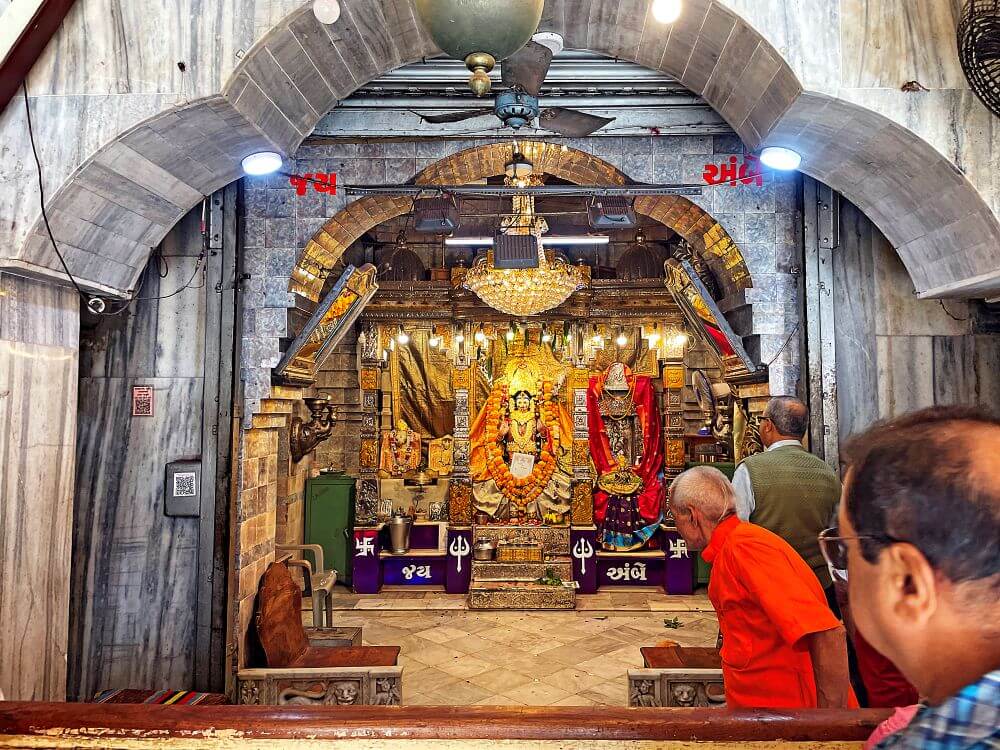
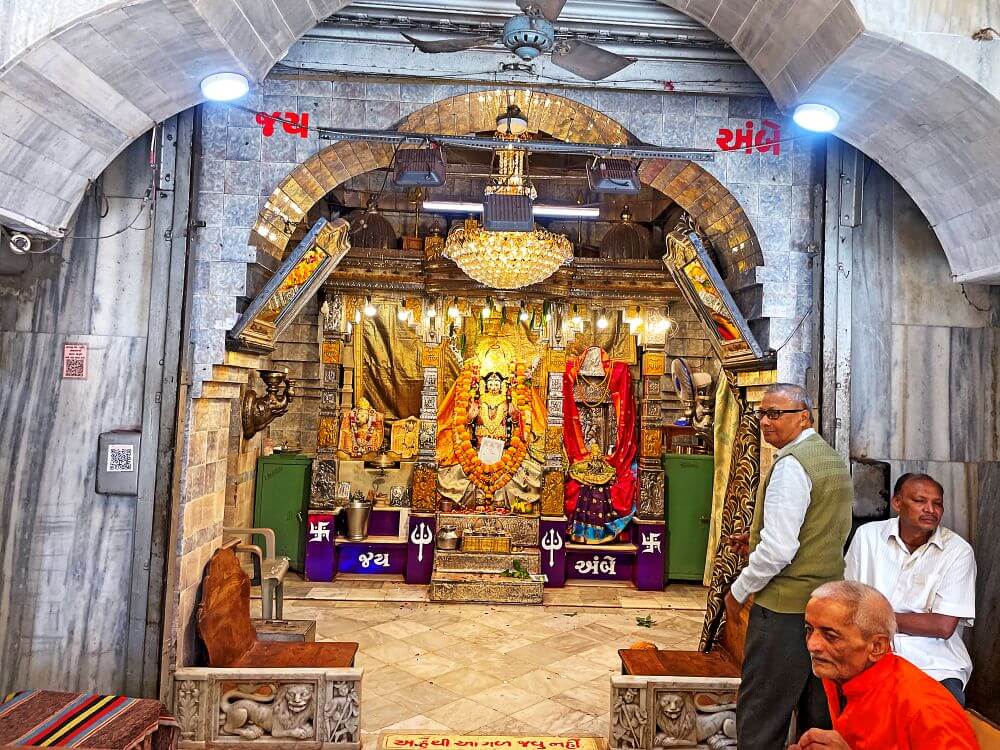
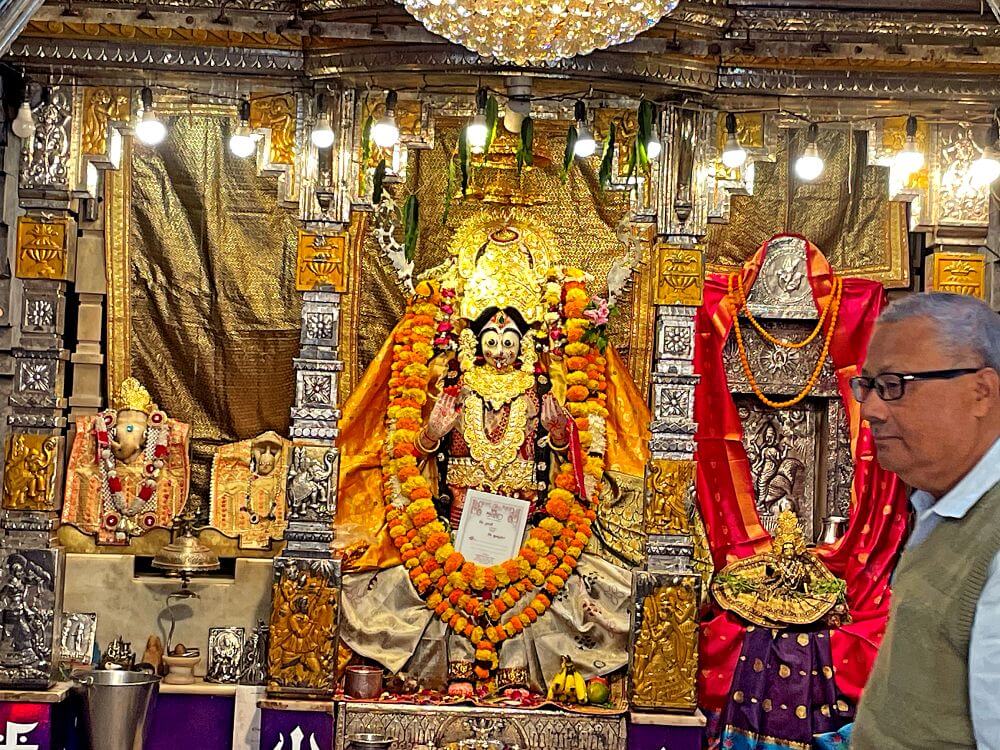
The Sabhamandapa (assembly hall) of the temple is adorned with beautiful paintings of Goddess forms from Indian tradition, including Tripurasundari, Bhuvaneshwari, Shodashi, Kali, Chhinnamasta, Kamala, Martanda, Baglamukhi and Dhumavati. In the Garbha-griha, the idol of Goddess Ambaji sits majestically on a high pedestal, enclosed in a grand ornamental canopy (makhara). The pillars of the canopy are covered with silver sheets, intricately carved with auspicious symbols such as elephants, lotuses and ceremonial pots (kalash). Every day, the Goddess is dressed and decorated in a different form.
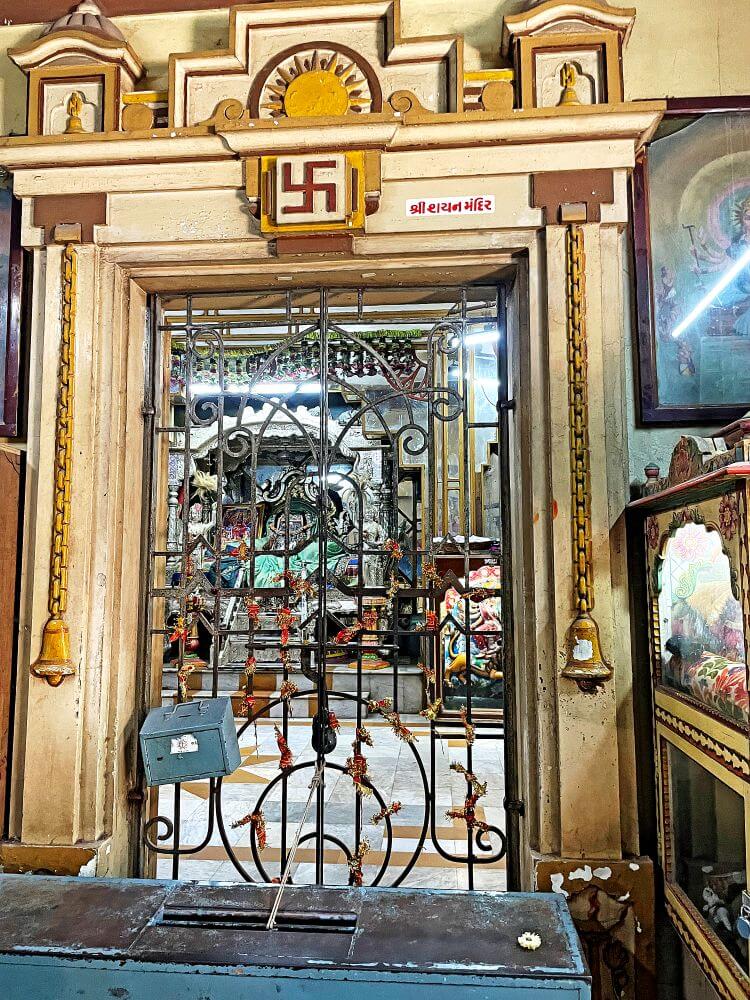
Adjacent to the assembly hall is a room displaying various depictions of the Goddess. Among these is a striking oil painting of Chhatrapati Shivaji Maharaj, hands folded in reverence before the Goddess, symbolising his devotion to her. Connected to this room is the Shayan Kaksha (resting chamber) of the Goddess. Here, a beautifully crafted silver-plated bed and swing, adorned with fine engravings, are placed for the deity. Within this chamber, a small silver idol of the Goddess, used during festive processions, is displayed on a platform.
The temple performs the Nitya Puja (daily worship) of Goddess Ambaji with great devotion. Major festivals and religious ceremonies are celebrated with enthusiasm and splendour. During the Chaitra Navratri festival, various religious programmes, including homa and havan (fire rituals), are conducted. Devotees participate in these ceremonies to seek the Goddess’s blessings. The Ghatsthapana (installation of the sacred pot) ritual is performed in the sanctum during Sharad Navratri. The idol of the Goddess is adorned with special decorations daily, each representing a unique aspect of her divine form. The temple premises are illuminated with lights, creating a festive and spiritual atmosphere.
Devotees believe that drinking the sacred water from the ghat (pot) placed in the sanctum helps dispel sorrow and suffering. As a result, many devotees queue up to partake in this holy water. Additionally, sorghum grains (jowar) grown in the ghat are distributed as prasada (blessed offering) to the devotees.
Thousands of devotees offer coconuts (shrifal) to the Goddess during Navratri. Instead of using iron tools like knives or sickles to break the coconuts, the temple uses a traditional wooden implement called a Mogri, crafted from babul wood. This unique tradition sets the temple apart, with devotees claiming it is the only temple in India that follows this practice. In earlier times, devotees would fulfil vows by offering sacrifices of cockerels or other animals. However, recognising the sattvic (pure and non-violent) nature of the Goddess, this practice has been discontinued.
Devotees hold a strong belief that children with delayed speech development begin to speak clearly within a few days of visiting the temple. As a result, many families bring such children to seek the blessings of the Goddess. After their wishes are fulfilled, it is a common practice for devotees to release cockerels in the temple premises as an act of thanksgiving. Additionally, couples struggling with infertility come to the temple to perform rituals, as it is believed that the Goddess blesses childless couples with progeny. Such rituals require prior registration at the temple.
On the auspicious day of Dussehra, the idol of the Goddess is paraded through the city on a grand silver chariot. During this event, homes along the procession route are often beautifully decorated in her honour.
This sacred temple stands as a testament to deep spiritual devotion, ancient architectural grandeur, and rich local cultural traditions.
The sanctum sanctorum houses the divine idol consecrated according to ancient Vedic traditions, surrounded by serene courtyards and traditional temple architecture.
Navratri, Maha Shivratri, Annual Temple Jatra & Deepotsav
Compare and book flights, secure top-rated local hotels near the temple, hire reliable guides, and rent cars instantly.
Extend your pilgrimage by visiting other highly sacred temples located nearby.


Add ₹999 more to unlock FREE SHIPPING!
Your sacred cart is currently empty.
Shop Photo FramesFill in your delivery details below to place your order.
Add comment