
Add ₹999 more to unlock FREE SHIPPING!
Your sacred cart is currently empty.
Shop Photo FramesThe Samadhi temple of Narsing Maharaj, known as the ‘Physician of Vitthal of Pandharpur’, is located in Akot. Narsing Maharaj, who was like a brother to Gajanan Maharaj of Shegaon, is revered by countless devotees in Vidarbha. A famous legend tells of him bringing his mother back to life while she lay on her funeral bier, and of him bestowing the Ashtasiddhi (eight supernatural powers) he possessed upon Gajanan Maharaj before taking Samadhi. Narsing Maharaj was laid to rest in Samadhi in the presence of many saints, including Gajanan Maharaj. During the month of Kartik, the longest-running fair in Vidarbha, lasting for one and a half months, is held in the temple premises.
Jalgaon Nahate, located nine kilometers from Akot, is the ancestral village of Narsing Maharaj. Punyaji Patil, from a landlord family in this village, had two wives, Yamabai and Rajubai. Narsing Maharaj was born to Rajubai in 1805. From childhood, he would go on pilgrimages to Pandharpur, Dehu, and Alandi. He worshipped stones, considering them to be God. He was married to Mohanabai and they had three children. A large butter market used to be held in the village of Umra in the taluka. Narsing Maharaj would go there to sell butter. There, he met a Muslim saint named Kuwat Shahali Miya. Narsing Maharaj accepted him as his Guru. He stood on one leg before his Guru for 21 days without food or water. It is said that the Guru then gave him the Guru-upadesha (initiation).
While serving his Guru, Narsing Maharaj learned that his mother, Rajubai, had passed away in the village of Sirsoli. Following his Guru’s command, he went to Sirsoli for his mother’s final darshan. Upon reaching the funeral bier, he applied sacred ash (Angara) to his mother’s lifeless body, saying, “I am hungry, give me something to eat; you fulfilled all my demands, why are you angry now?” The legend states that Rajubai came back to life at that moment. The ‘Akola Gazetteer’ mentions a legend that Narsing Maharaj also healed a wound on the foot of Lord Vitthal of Pandharpur. It is said that once, an atheist tried to break the idol of Vitthal in Pandharpur, causing blood to flow from the deity’s foot. Seeing this, the devotees were distressed. Upon hearing this, Narsing, who had arrived at the temple, applied medicine and a bandage to the idol’s foot. In a short time, the wound on the idol’s foot healed, and the atheist died simultaneously.
Narsing Maharaj performed penance in a hut in the village. Gajanan Maharaj often visited him there, and they would engage in spiritual discussions. One day, Gajanan Maharaj came to Akot to meet Narsing Maharaj. At that time, Narsing Maharaj was sitting on the bank of a village well. When Gajanan Maharaj looked into the well, springs burst forth from the water, rising like a fountain. Saying that the confluence of the Ganga, Yamuna, and Saraswati had occurred here, Gajanan Maharaj bathed in this water and is said to have named the well ‘Manikarnika’.
Before taking Samadhi, Narsing Maharaj began the construction of his own Samadhi temple. On 28 January 1887, on the day of Magh Shuddha Purnima, he passed away in the hut where he resided. His mortal remains were then brought in a procession to the site of the Samadhi. The body was placed in the prepared Samadhi and covered with salt and vermilion (Gulal). Thereafter, the Samadhi was performed in the presence of saints. His disciple, Maruti Naik Asalkar, later completed the construction of this Samadhi temple.
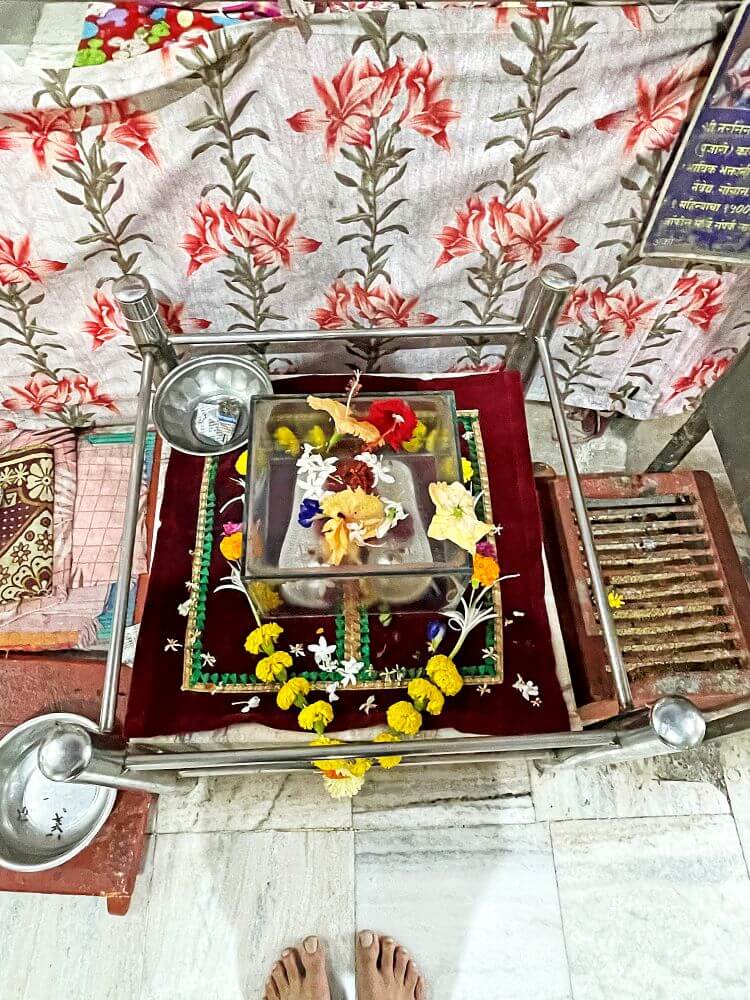
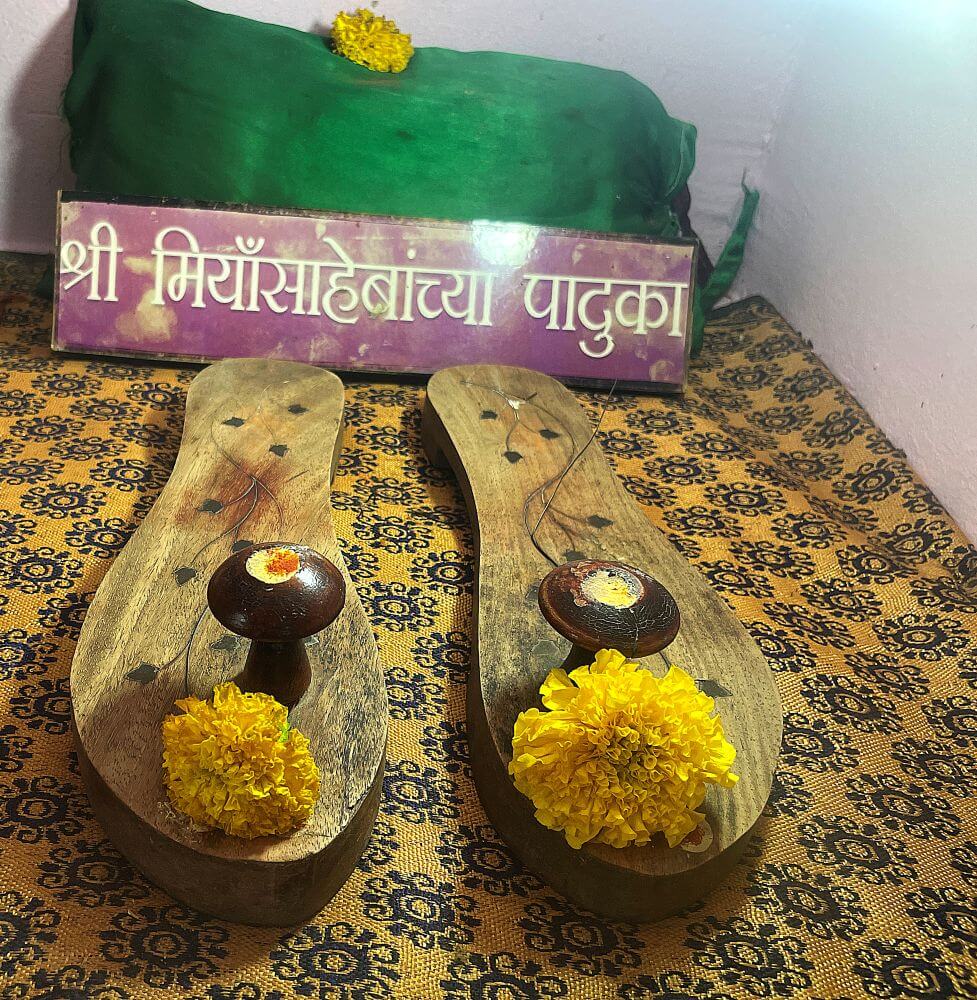
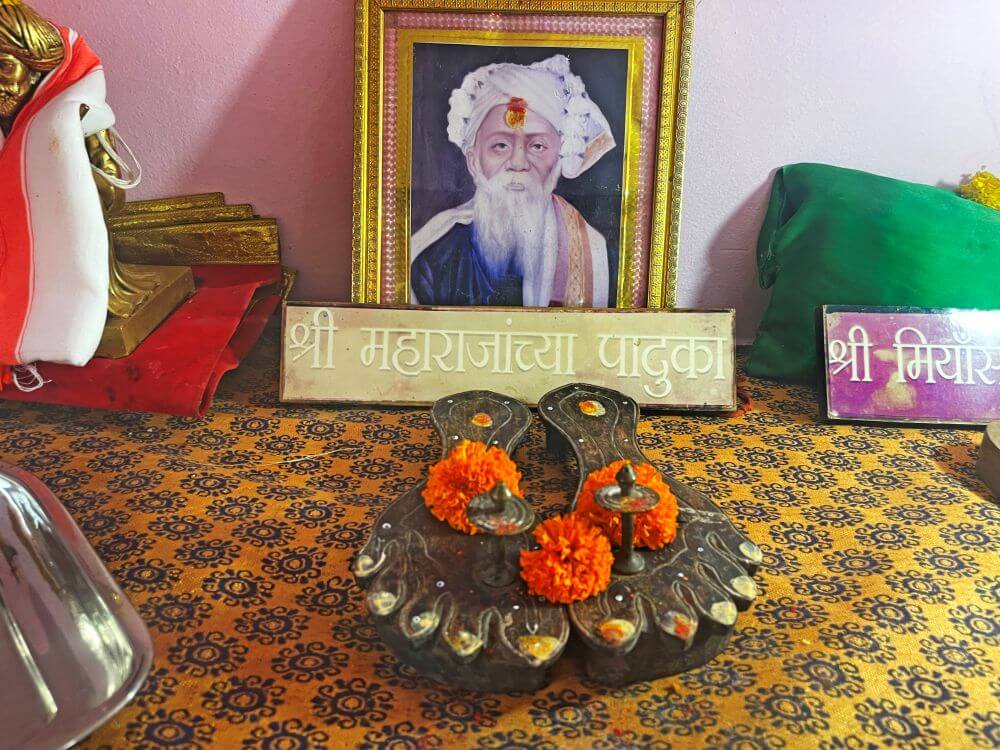
The temple is located in the heart of Akot city. One enters the paved courtyard through a gateway in the fortification. The temple in the center of the courtyard resembles a mosque in appearance. The structure consists of a Sabhamandap (assembly hall) and a Garbhagriha (sanctum sanctorum). Except for the side facing the sanctum, there are entrances to the assembly hall from all directions. All the pillars in the outer walls of the assembly hall are connected to each other by arched gateways. Built on a high plinth, this Samadhi temple has a circumambulation path (Pradakshina marg) on the plinth itself. One enters the assembly hall by climbing three steps from the courtyard. On all the walls of the assembly hall, near the ceiling, are portraits of many saints and sages. A glass case here contains the Padukas (footwear) of Narsing Maharaj, along with his turban, staff, and other personal belongings.
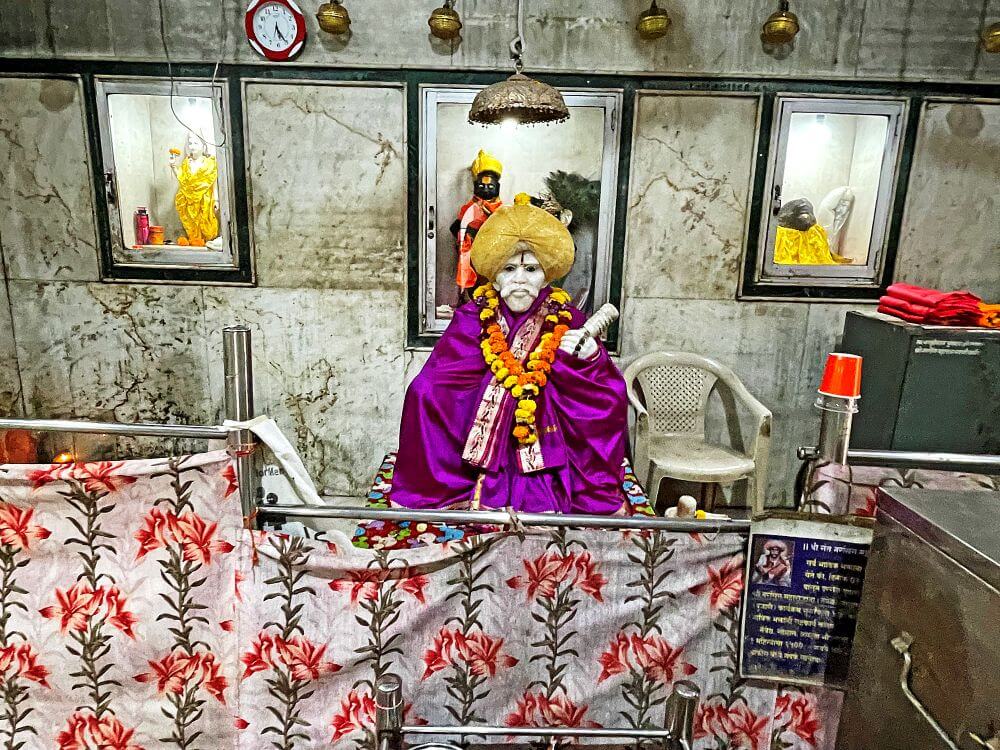
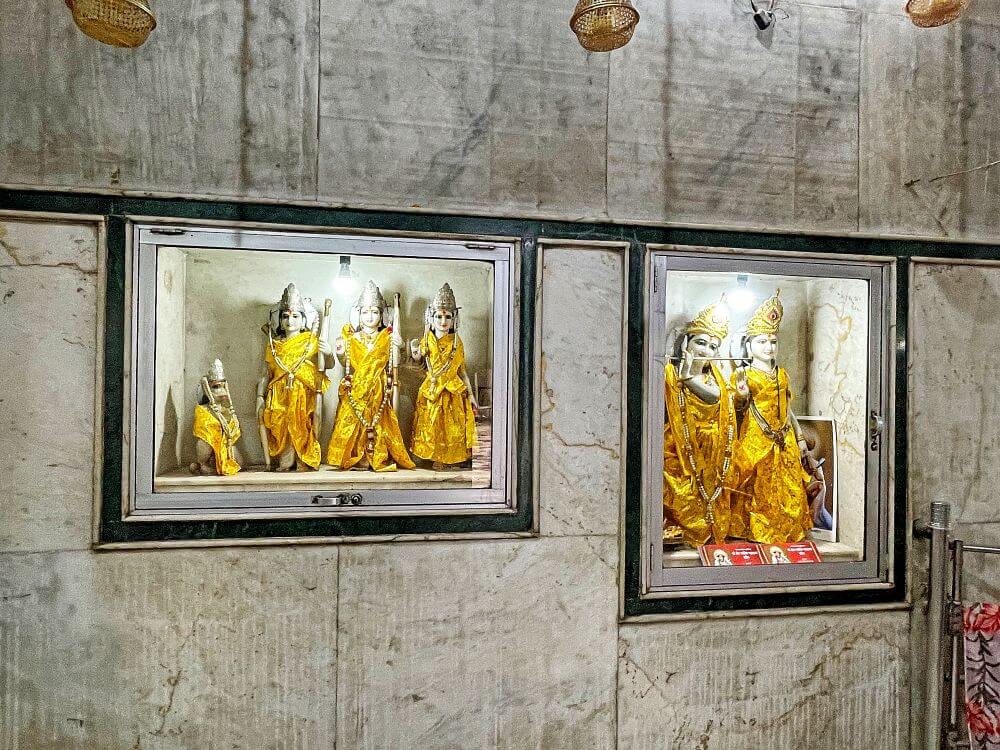
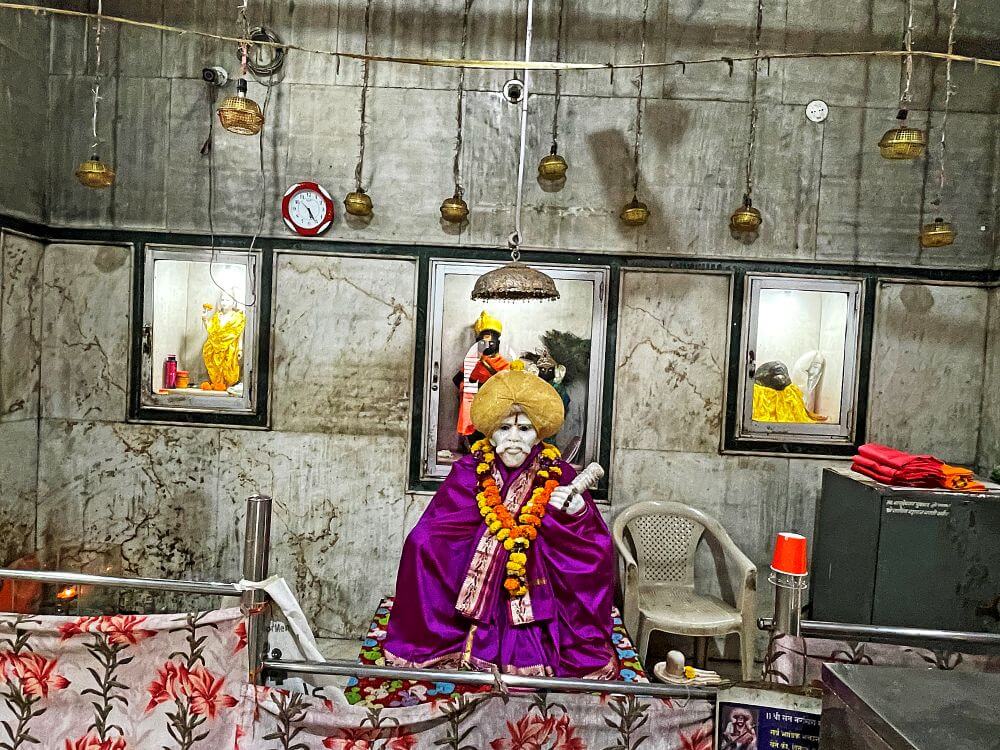
The doorframe of the sanctum features beautiful carvings, and there is an image of Lord Ganesha on the lintel. Inside the sanctum, there is a marble idol of Narsing Maharaj on a pedestal. The idol wears a turban, holds a staff in its hand, and has Padukas placed in front of it. In a niche on the wall behind the idol are the idols of Vitthal-Rukmini. Additionally, the sanctum houses idols of Radha, Krishna, Shriram, Lakshman, Sita, Maruti, and Shridatt. The sanctum is topped by a dome-shaped spire (Shikhara). There are minaret-like structures on all four sides of the spire. In the temple premises, there are also the Samadhis of Narsing Maharaj’s mother Rajubai, his wife Mohanabai, and his disciple Khidajibua. The hut where Narsing Maharaj performed penance has also been preserved by the villagers.
Hundreds of devotees visit this temple daily for darshan. The women of the village who return to their maternal homes also have immense faith in Narsing Maharaj. Every year in the month of Ashadh, a Palkhi (palanquin) procession goes from Akot to Pandharpur. In the month of Kartik, the largest fair in Vidarbha is held in the temple premises. It is said that Narsing Maharaj started this fair in the name of his Guru during his lifetime. During the one-and-a-half-month-long fair, various religious programs are held for fifteen days. On Kartik Vadya Purnima, the pilgrimage is established in the temple. The Guru’s turban is placed at the pilgrimage site. On the second and third days (Dwitiya and Tritiya), the Guru’s turbans are installed on a throne. On the fourth day (Chaturthi), the Palkhi of Narsing Maharaj goes to Umra for Guru-puja (Sandal). When this Palkhi returns to Akot at night, dry fruit prasad is distributed to those present. The fifth and sixth days (Panchami and Shashthi) are the main days of the fair. On Panchami, Bhajans and Kirtans are held throughout the night. On the morning of Shashthi, the Palkhi of Narsing Maharaj and Jhanji Maharaj is taken around the village. In the afternoon, after the Palkhi returns to the temple, Gopal-kala is performed. Thereafter, Bhandara (community feast) is distributed to the devotees. From the seventh to the eleventh day (Saptami to Ekadashi), religious programs such as Abhishek, Bhajans, and Kirtans are held in the temple. On the thirteenth day (Trayodashi), after the Gopal-kala is performed before the Guru’s throne, there is a Bhajan at night. The fair then concludes. Various programs are also held here on the occasion of Narsing Maharaj’s death anniversary. Devotees can visit this temple for darshan daily from 6:00 AM to 9:30 PM.
This sacred temple stands as a testament to deep spiritual devotion, ancient architectural grandeur, and rich local cultural traditions.
The sanctum sanctorum houses the divine idol consecrated according to ancient Vedic traditions, surrounded by serene courtyards and traditional temple architecture.
Navratri, Maha Shivratri, Annual Temple Jatra & Deepotsav
Compare and book flights, secure top-rated local hotels near the temple, hire reliable guides, and rent cars instantly.
Extend your pilgrimage by visiting other highly sacred temples located nearby.


Add ₹999 more to unlock FREE SHIPPING!
Your sacred cart is currently empty.
Shop Photo FramesFill in your delivery details below to place your order.
Add comment