
Add ₹999 more to unlock FREE SHIPPING!
Your sacred cart is currently empty.
Shop Photo FramesSati was the name of Lord Mahadeva’s consort. Wherever the pieces of Sati’s mortal remains fell, Shakti Peethas or Sati Peethas were established. Sati, the daughter of Prajapati Daksha, had offered herself into the sacrificial fire (Yajna Kunda) as a protest against the insult of her husband. Following the thread of this Puranic legend, women who sacrificed their lives on the funeral pyre for the sake of their husband’s honor came to be called Sati. Their temples were built, and they began to be worshipped as Shakti Peethas. The original Shakti Peetha of Rani Sati is in Jhunjhunu, Rajasthan. Its sub-shrines have been established across the country, and the temple in Hingoli is one of them.
According to a legend, a Rajput maiden named Narayani was married to a brave chieftain named Thandan Das. Within a few days of the marriage, Thandan Das died in battle. After her husband’s demise, Narayani Devi performed Sati. Her temple was built in Jhunjhunu, Rajasthan. Later, she came to be addressed as Rani Sati Devi and also as Dadiji. This Goddess is the family deity (Kuldevi) of many families in the Marwari community. The original ancient temple of Rani Sati is in Jhunjhunu, Rajasthan. Wherever the Marwari community migrated for trade and business, they built temples. They installed their Kuldevi, Rani Sati, in the form of a Trishul. Rani Sati Devi has a total of thirteen names: Sita Sati, Mahadoi Sati, Manohari Sati, Manbhavan Sati, Yamuna Sati, Gyani Sati, Pura Sati, Piragi Sati, Jeevani Sati, Tili Sati, and Krishna Sati. She is worshipped by different names according to the location.
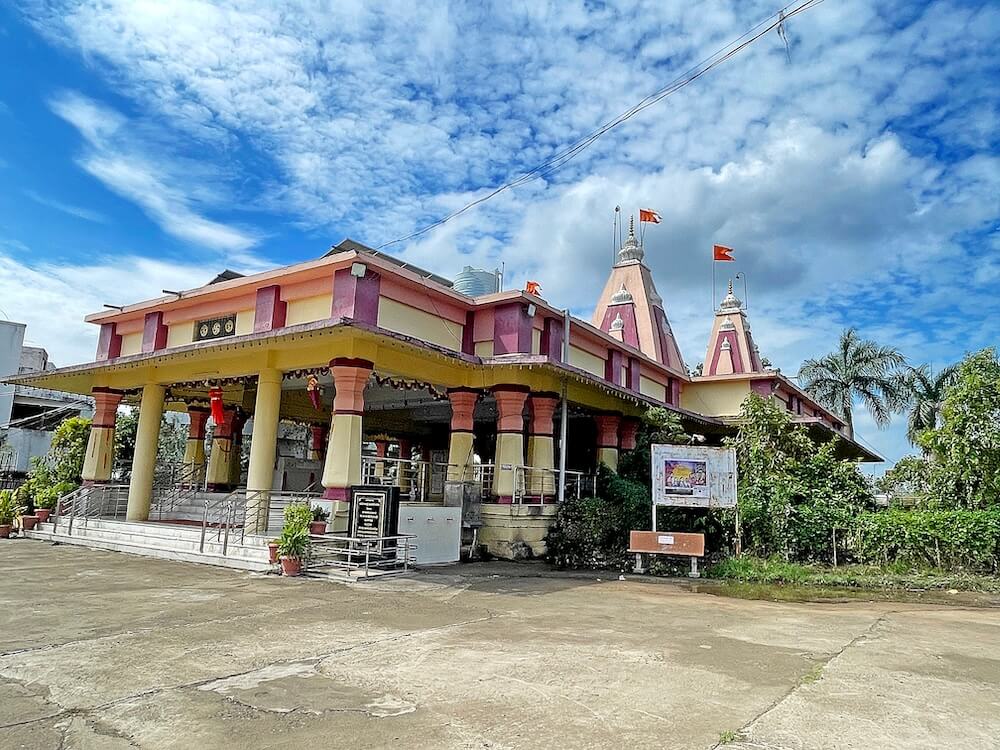
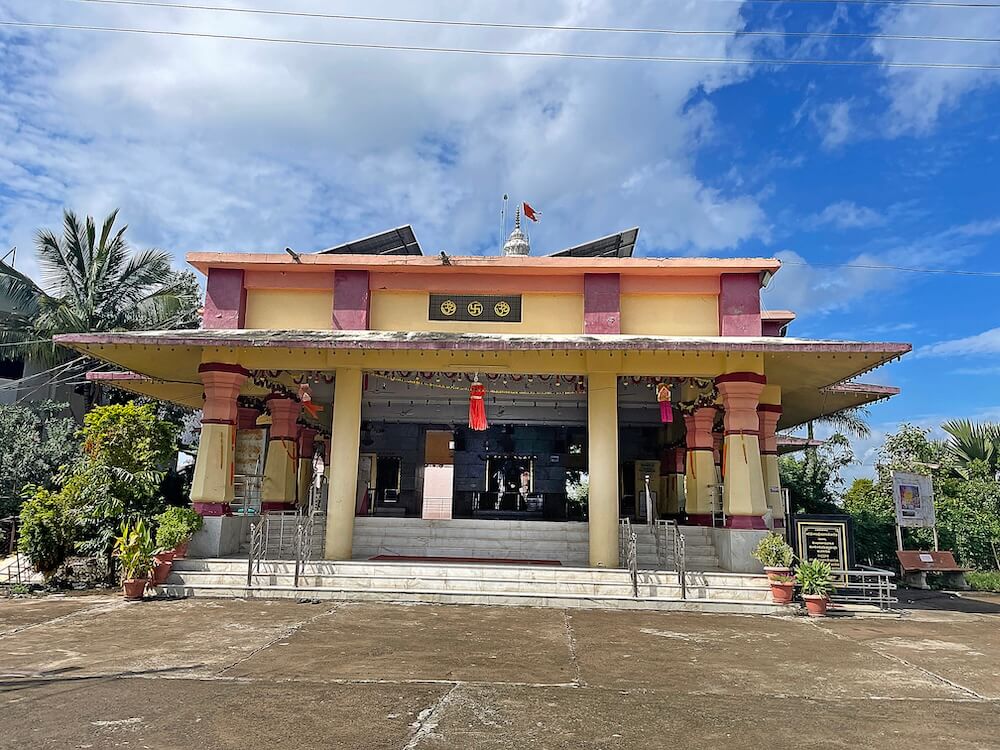
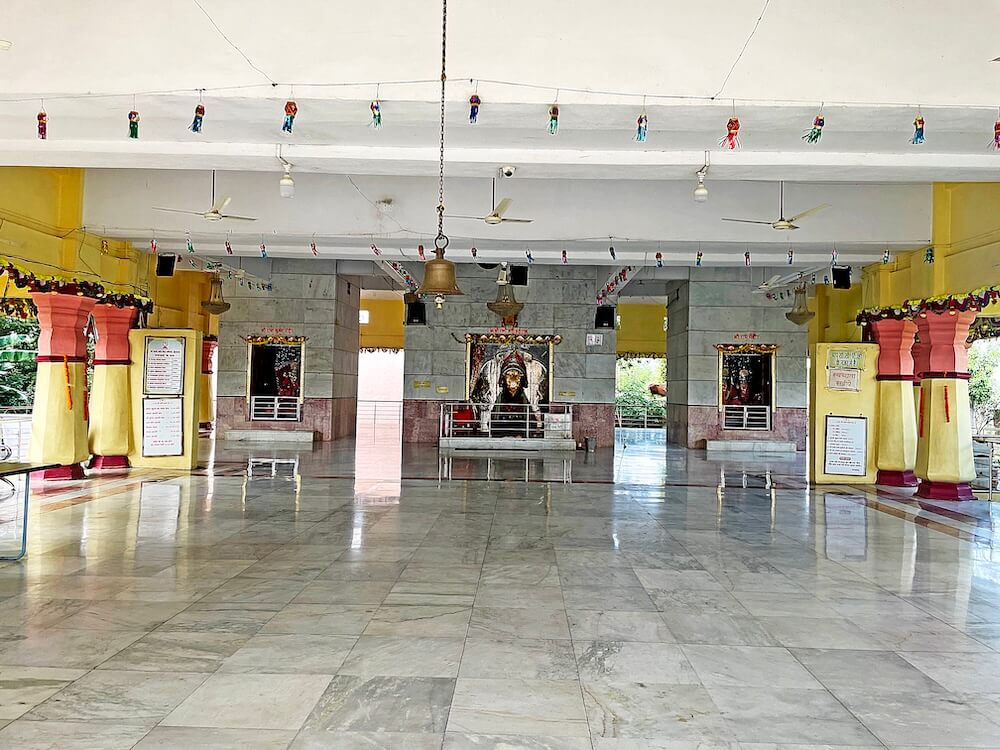
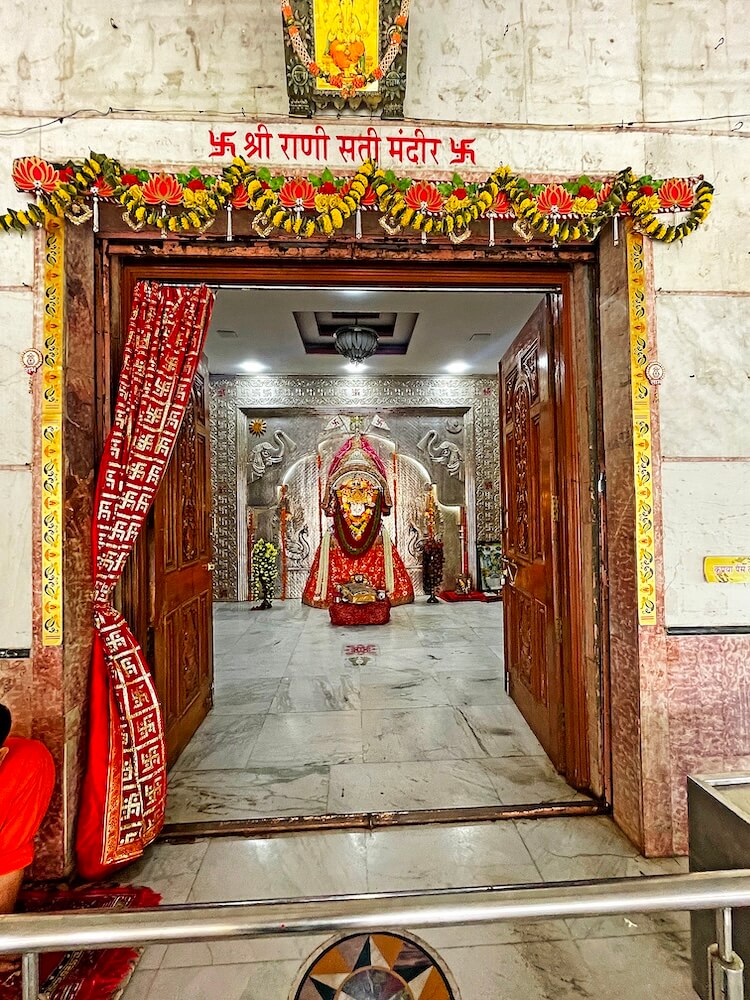
This temple is situated along the Hingoli-Akola road. The temple is surrounded by a fortification wall, which contains the entrance gate. There are various types of trees in the spacious temple courtyard. There are seats for devotees to sit. Near the temple in the courtyard, there is a community hall (Mangal Karyalaya) and a children’s park. The park has various equipment for children to play. The structure of this temple consists of a front porch (Mukhamandapa), an assembly hall (Sabhamandapa), and three sanctum sanctorums (Garbhagrihas). The front porch is at a higher level than the courtyard, with three steps at the entrance. In the front porch, there are two circular pillars at the front, which support the roof. The assembly hall is higher than the front porch; one enters the assembly hall by climbing four steps. There are seats for devotees in the assembly hall. The assembly hall is semi-open in nature and has ornate circular pillars on the exterior. The pillars feature vertical fluted carvings. Beautiful glass chandeliers are hung from the ceiling of the assembly hall. In the front part of the assembly hall, there are three independent sanctum sanctorums. The central sanctum is that of Rani Sati Devi. In front of the entrance to this sanctum, there is a platform a few inches high. A stainless steel railing has been installed on the platform to create a designated space. There is intricate carving on the wooden entrance and the door frames of the sanctum. There is an image of Lord Ganesha on the ornate lintel and the central decorative block.
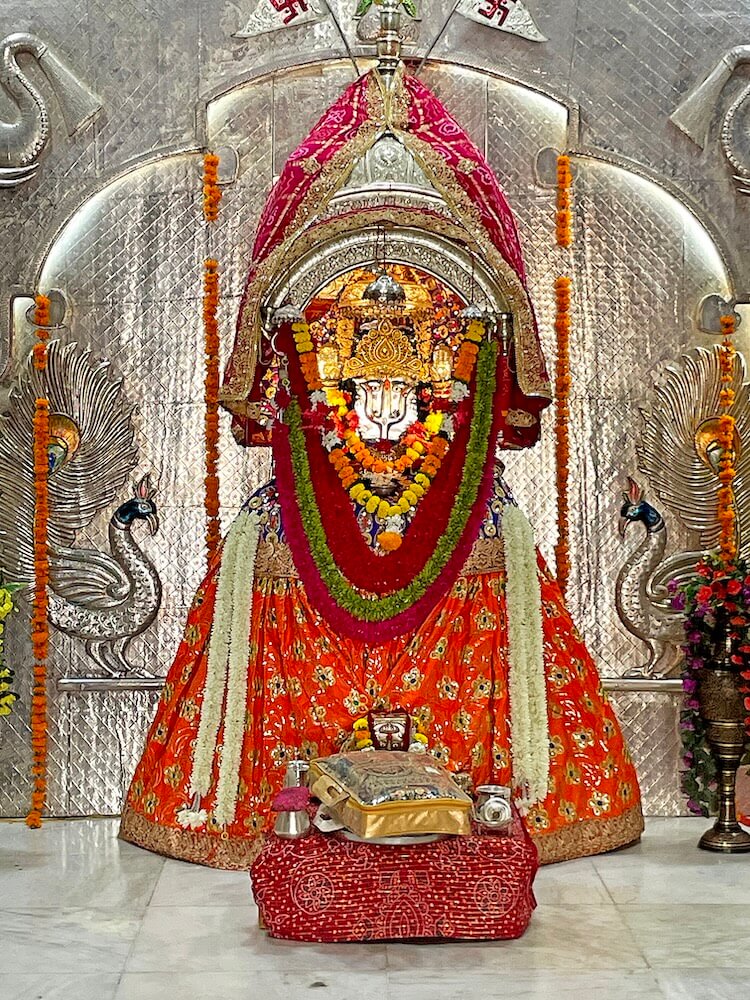
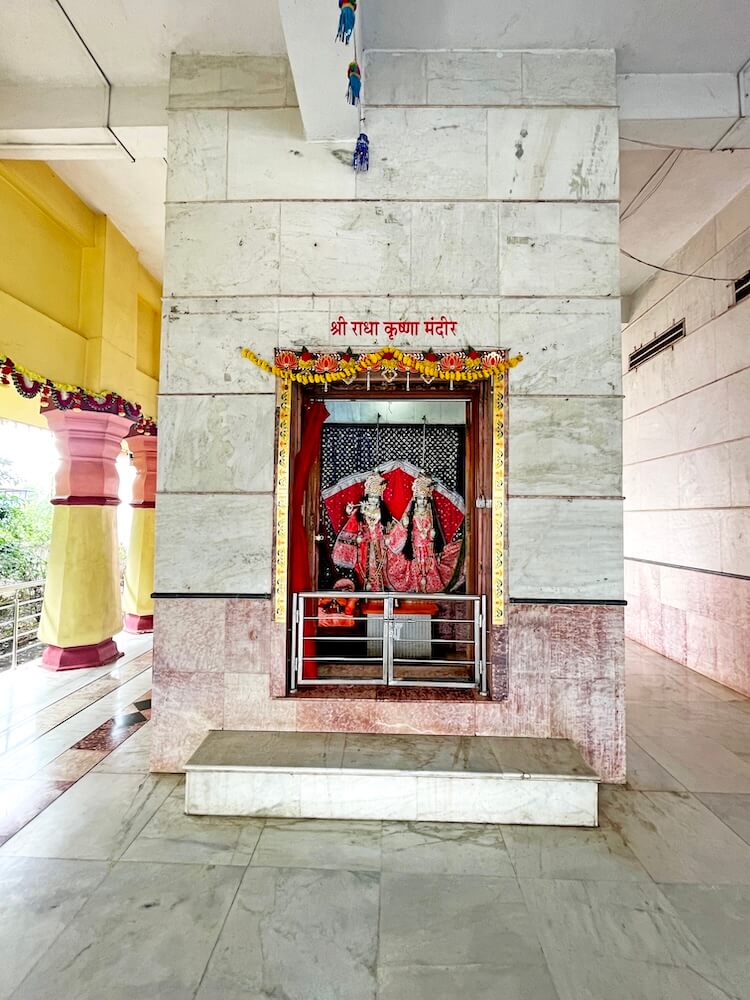
Inside the sanctum, there is an idol of Sati Devi in the form of a Trishul. The idol, adorned with various garments and ornaments, has a silver mask. There is a golden crown on the head of the idol. Behind the idol, in a silver halo, are depictions of foliage, floral vines, a peacock arch, and elephants performing an abhisheka. In both upper corners, there are images of the Sun and the Moon. To the left and right of Sati Devi’s sanctum are two sanctums with almost identical structures. In the left sanctum, there are idols of Rama, Lakshmana, and Sita on a pedestal (Vajrapitha). In front of them, on a separate pedestal, is the idol of Dasa Maruti. All the idols have silver crowns on their heads. In the right-side sanctum, there are idols of Radha-Krishna on a pedestal, and they also wear silver crowns. There are circumambulation paths (Pradakshina Marga) around the exterior of all three sanctums.
There is a safety railing around the roof of the assembly hall. On the roofs of all three sanctums, there are square, tapering spires (Shikharas). The spire of Sati Devi’s sanctum is taller than the other two. At the top, there are two Amalakas and a pinnacle (Kalash) stacked one above the other. The other two spires each have one Amalaka and a pinnacle at the top. A short distance from the Sati Mata temple is the Jagrut Mahadeva temple. In front of the temple, in the Nandi Mandapa, there is an idol of Nandi made of black stone on a pedestal. The structure of this temple consists of a semi-open assembly hall and a sanctum in the center. There is a Shiva Linga in the sanctum.
Bhadrapada Amavasya, also known as Sarvapitri Amavasya, is the main annual festival here. It is celebrated with great enthusiasm. During this time, the temple is illuminated with electric lights. Floral rangolis are drawn in the temple premises. On this occasion, devotees offer Puran Poli and curd-rice as Naivedya to the Goddess. Programs such as Bhajans, Kirtans, music, storytelling, dance, and Mahaprasad are organized in the temple. The Sharadiya Navaratri festival is the second most important festival here. During this time, various religious programs are organized in the temple for ten consecutive days. From the sixth day of Navaratri, Kanya Pujan is performed to conclude the vows. A Yajna is organized on Ashtami. Apart from this, Dussehra, Diwali, and other festivals throughout the year are also celebrated here. During all festivals, hundreds of devotees come to the temple for the Goddess’s Darshan and to fulfill their vows. There is a rush of devotees for Darshan on Tuesdays, Fridays, Shashthi, Ashtami, Purnima, and Amavasya. Devotees can have Darshan of the Goddess in this temple every day from 6 in the morning to 9 at night.
This sacred temple stands as a testament to deep spiritual devotion, ancient architectural grandeur, and rich local cultural traditions.
The sanctum sanctorum houses the divine idol consecrated according to ancient Vedic traditions, surrounded by serene courtyards and traditional temple architecture.
Navratri, Maha Shivratri, Annual Temple Jatra & Deepotsav
Compare and book flights, secure top-rated local hotels near the temple, hire reliable guides, and rent cars instantly.
Extend your pilgrimage by visiting other highly sacred temples located nearby.


Add ₹999 more to unlock FREE SHIPPING!
Your sacred cart is currently empty.
Shop Photo FramesFill in your delivery details below to place your order.
Add comment