
Add ₹999 more to unlock FREE SHIPPING!
Your sacred cart is currently empty.
Shop Photo FramesOnce, a severe famine struck the area surrounding Achirne, a village of twelve hamlets in Vaibhavwadi Taluka. Consequently, nothing—neither grain nor vegetables—would grow there. At that time, the people prayed to the Goddess for help. The Goddess responded to their call and relieved them of their distress. Vegetables grew again in the region, and grain became abundant. The villagers then installed the Goddess in the village on the day of Paush Purnima and named her Rasai, meaning the Goddess who sits upon a heap of grain. Devotees believe in this folklore and hold the faith that this Goddess fulfills their vows.
Rasai Devi is the Kuladevi (family deity) of the Yadavas of Devgiri. At the foothills of the Devgiri fort, there is a Swayambhu (self-manifested) temple of Rasai inside a cave. A mythological legend there narrates that Rasai Devi lifted the Devgiri mountain on her little finger. Another legend regarding this Goddess states that after the fall of the Yadava empire of Devgiri, a grand temple of Rasai existed in the capital of the Vijayanagara Empire, established by the brothers Harihara and Bukka. This Goddess was the Kulaswamini (patron deity) of the kings of Vijayanagara. Rasai Devi is mentioned in Mahipati’s text ‘Bhaktavijaya’ (Chapters 42-46). It is stated there that when a Brahmin from Pandharpur went to Vidyanagar, that is, Vijayanagara, with a desire for wealth, King Krishnaraya informed him about the Rasai (Rajai) temple. It is said there, “There is no deity like Rajai to be found in the three worlds; I have neither heard of nor seen such a one,” says Krishnaraya. The ‘Devikosha’ suggests that the form of Rasai Devi might be similar to that of Shitala or Jyeshtha Devi.
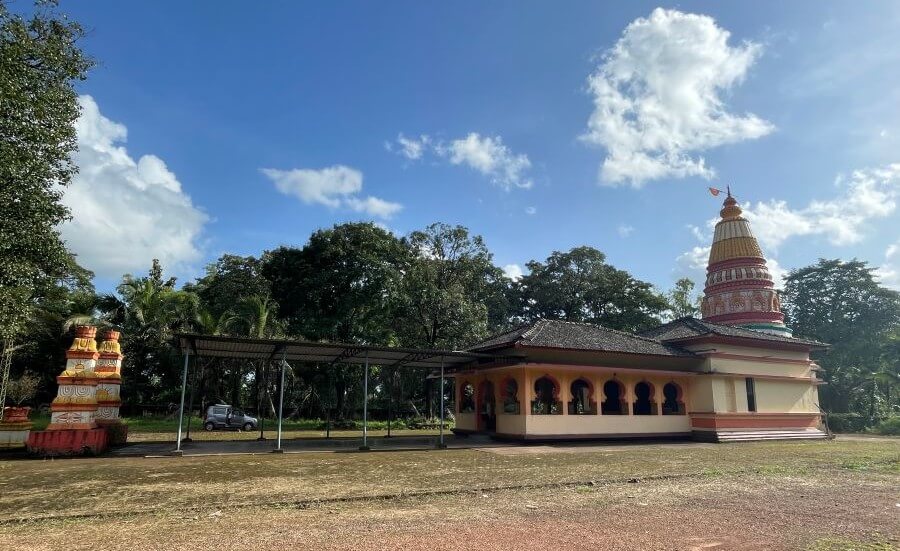
The deity Rasai Devi is worshipped in Maharashtra as well as in Karnataka. There are temples of Rasai Devi in Vadgaon Rasai (Taluka Shirur) and Nangaon (Taluka Daund) in Pune district, as well as in the waters of the dam on the Bhima River. Similarly, there are temples of Rasai in Asandoli (Taluka Gaganbawada), Shendur (Taluka Kagal), Savardi (Taluka Amravati), Chafed (Taluka Devgad), Keloshi Budruk (Taluka Radhanagari), and in the village of Rasai Shendur in Karnataka. This Goddess is considered the Gramadevata (village deity) of Achirne village and a Jagrut Devasthan (awakened sacred site). A temple for the Goddess has been erected here. This temple is situated in a large, ground-like space.
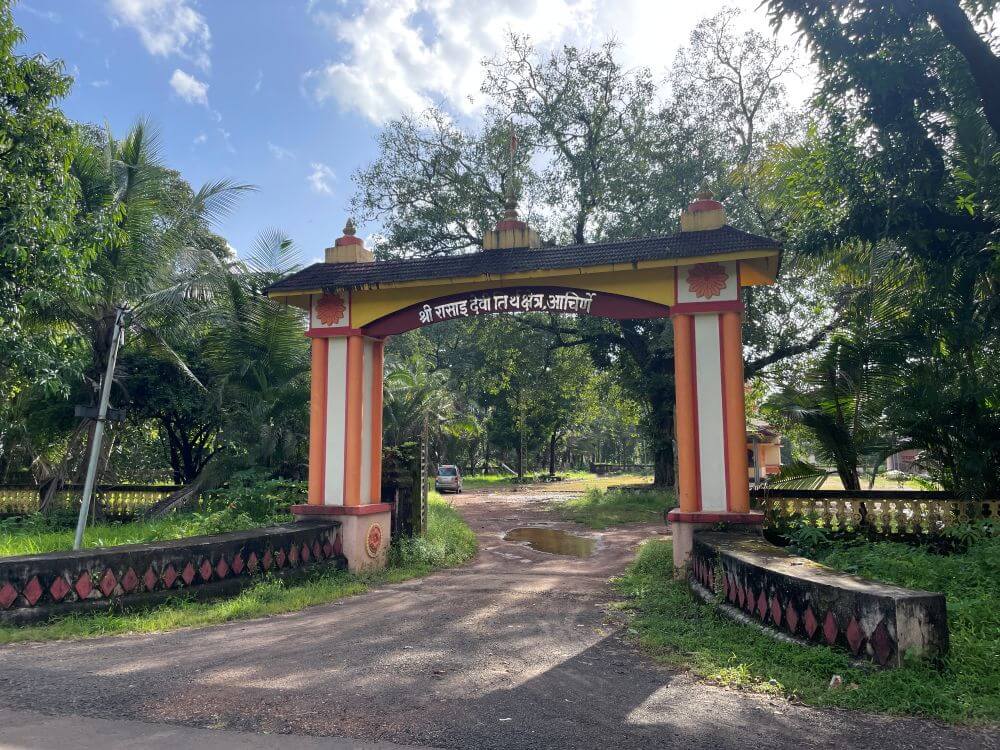
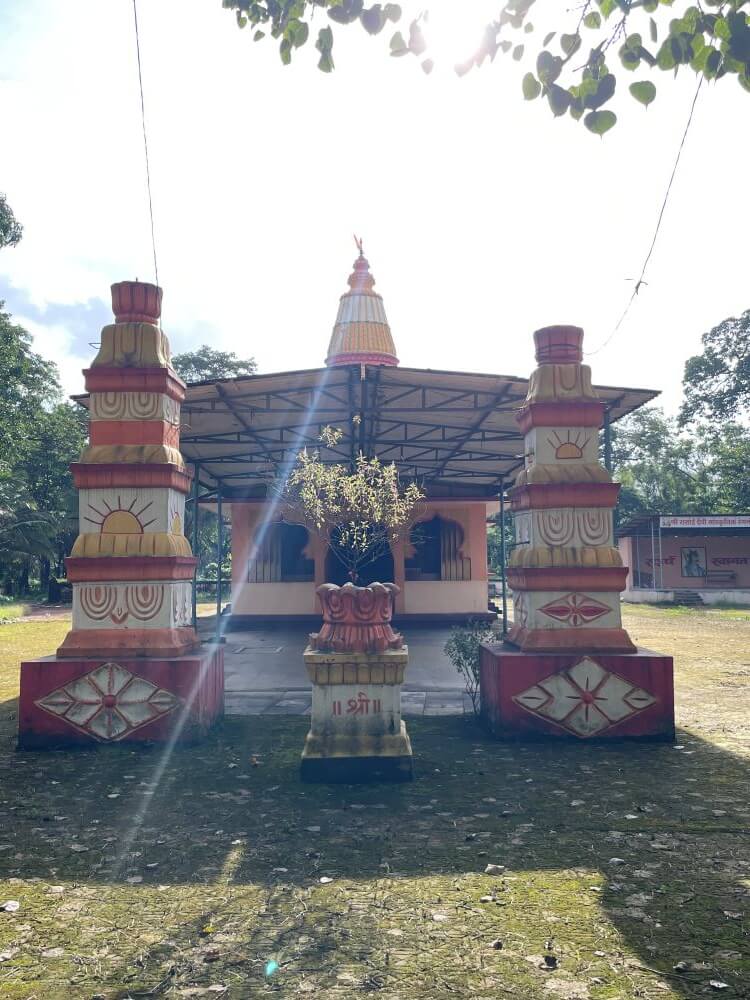
The temple is enclosed by a perimeter wall on all four sides. One enters the temple courtyard through a high entrance arch built of cement concrete. In the courtyard, in front of the temple, stands an ancient Ashvattha tree with a large platform built around it. A short distance away, there are four-tiered lamp pillars (Deepastambhas) erected on two pedestals. Between them is a small Tulsi Vrindavan. In front of this, a large tin shed has been constructed to provide shade for devotees and to host various programs and festivals. From here, one enters the Sabhamandap (assembly hall) of the temple. The temple structure consists of a Sabhamandap, Antaral (vestibule), and Garbhagriha (sanctum sanctorum).
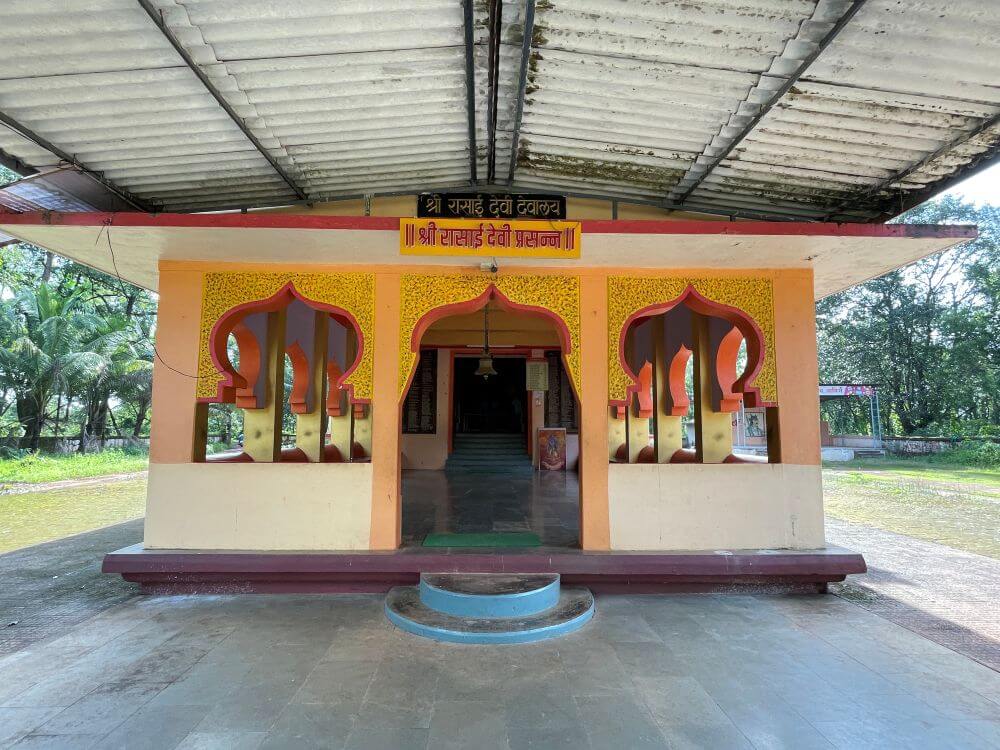
The Sabhamandap is of a semi-open type. It has an arched entrance and large windows. There are stone benches (Kakshasanas) on both sides of the Sabhamandap. Here, on the left side, at the base of a pillar and raised from the ground, one can see a Pindi-like shape. It is called the ‘Baracha Chavhata’. A Chavhata is a place where justice is administered if something goes wrong in the village, or if immoral acts or crimes occur. When establishing this Chavhata, people of all castes in the village come together and pledge to abide by the decisions made here.
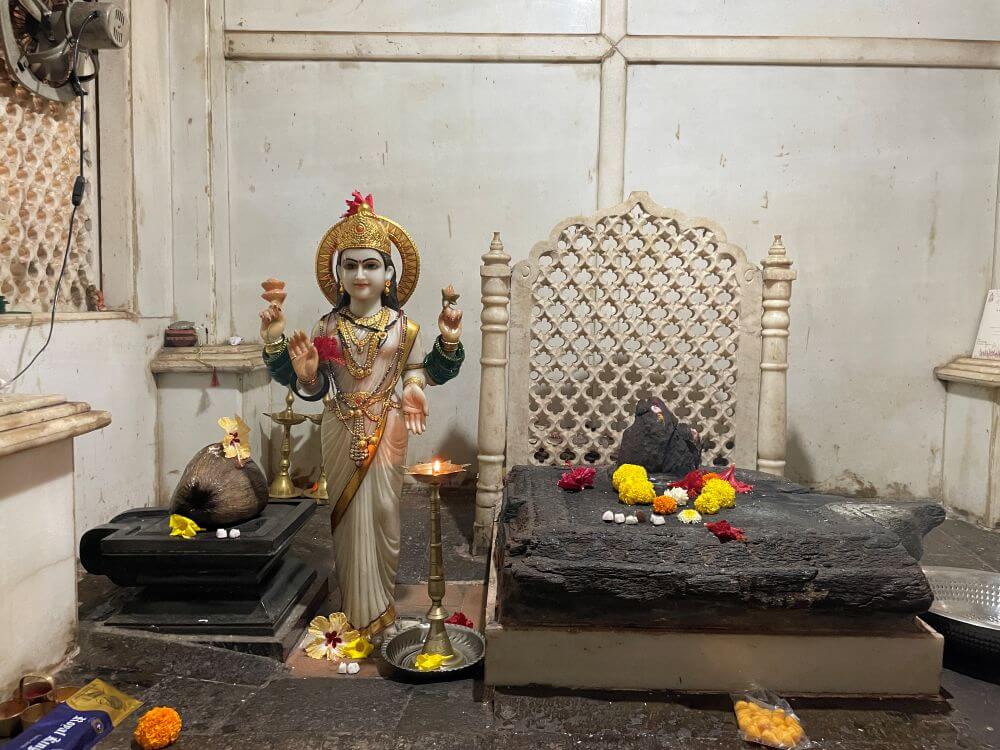
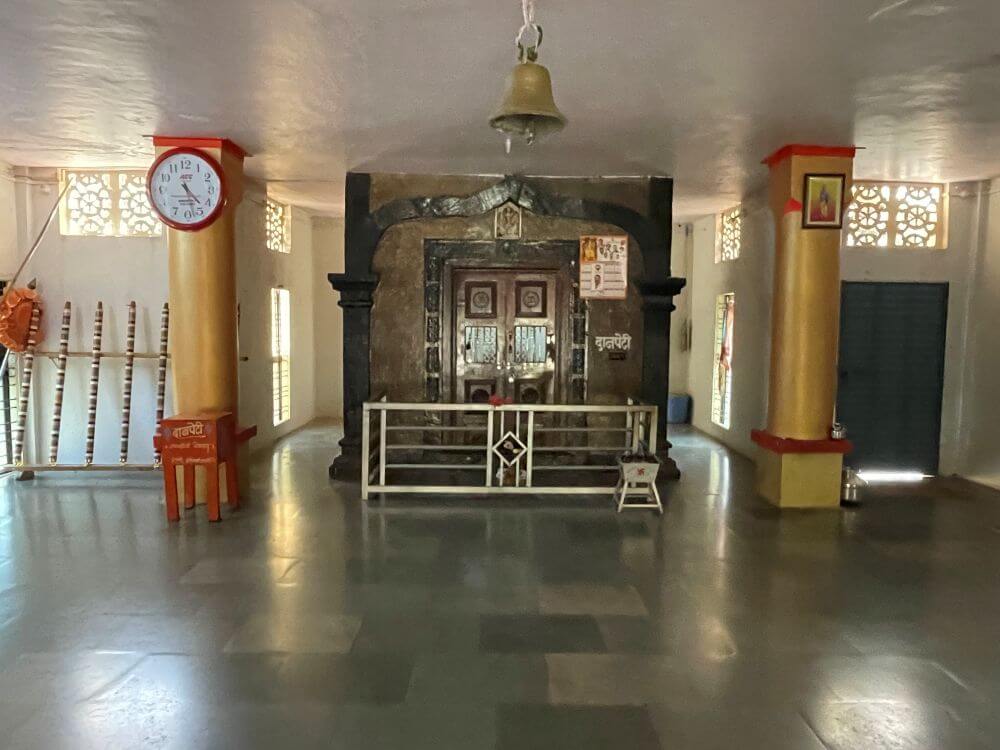
From the spacious Sabhamandap, one climbs seven steps to enter the Antaral. The temple’s Antaral is also large and has a door at the back. Leaving a circumambulation path (Pradakshina Marg) on the sides of the Antaral, there is the stone sanctum of the Goddess in the middle. The entrance to the sanctum is wooden, and the frame is made of stone. This frame is single-branched. On the lintel of the door frame, there is an image of Ganesha. Inside, in the center, on a Vajrapitha (diamond pedestal), stands the four-armed Samapada idol of Rasai Devi, along with the Goddess in the form of small stone slabs. Beside her, on another stone Vajrapitha, is the Tandala (aniconic stone) of the Goddess. In the Antaral, on one side, six staffs (Kathya) of six deities, an Abdagiri (ceremonial umbrella), and a palanquin are kept. When the Goddess’s palanquin procession is taken out, these staffs and the Abdagiri are danced.
Above the Antaral is a tapering Shikhara (spire). On its lower level, there are small shrines on all four sides. The upper part of the Shikhara is also intricately carved. It is topped by a two-tiered Amalaka and a Kalasha. A Sati-shila (memorial stone) is placed against the outer wall of the sanctum. This stone has three panels. The bottom panel shows the figures of two women, and the topmost panel shows a husband and wife worshipping a Shiva Linga. In the same panel, the arm of the Sati, bent at the elbow, is also depicted. There is also a stage in this temple complex. During the Yatra (fair) period, Dashavatari plays and other programs are held here. A short distance away, there is also an ancient stone-built well.
Every year in the month of Paush, on Shakambhari Purnima, the Goddess’s Yatra takes place. It is considered one of the major Yatras in Vaibhavwadi Taluka. Those who have settled elsewhere for work, as well as Maherwashini (village daughters who have married into other villages), make it a point to attend. During this time, vows made to the Goddess are fulfilled. The Maherwashini offer Oti (a ritual offering) to the Goddess with a blouse piece and a coconut. This Yatra lasts for three days. On the third day, the Goddess’s palanquin is taken to the Devrai (sacred grove) located in the mountains far from the village. Locals say that this Devrai is the original seat of Rasai Devi. One has to go through a forest path to reach this Devrai. Here, the shrine is under the open sky. There is an arch with a plaque reading ‘Shri Dev Gango Hango Brahman Rameshwar Nandi Prasanna’. Near that entrance, there is a large, old anthill. Further ahead, on a stone platform, are the circular stones of the Goddess, known as Tandale. Behind this sacred site, there are some Sati-shilas.
This sacred temple stands as a testament to deep spiritual devotion, ancient architectural grandeur, and rich local cultural traditions.
The sanctum sanctorum houses the divine idol consecrated according to ancient Vedic traditions, surrounded by serene courtyards and traditional temple architecture.
Navratri, Maha Shivratri, Annual Temple Jatra & Deepotsav
Compare and book flights, secure top-rated local hotels near the temple, hire reliable guides, and rent cars instantly.
Extend your pilgrimage by visiting other highly sacred temples located nearby.


Add ₹999 more to unlock FREE SHIPPING!
Your sacred cart is currently empty.
Shop Photo FramesFill in your delivery details below to place your order.
Add comment