
Add ₹999 more to unlock FREE SHIPPING!
Your sacred cart is currently empty.
Shop Photo FramesThe approximately 200-year-old ancient Ambabai Temple, located in Narkarwadi, Kokisare, in Vaibhavwadi Taluka of Sindhudurg District, is renowned as the ‘Temple of the Vatandars’ (hereditary landholders). This temple is also famous for the festivals celebrated here. Furthermore, donations received by this temple are utilized for the education of children in the local Zilla Parishad Primary School and Anganwadi. This school in Narkarwadi, run by the temple, has become the first school in the district to adopt the ‘e-learning’ system. Additionally, children here are taught English education based on the ‘Finland Pattern’.
It is said that the Narkars, who were the Vatandars here, founded the village of Kokisare. While establishing the village, they created the village customs and traditions (Gavarhati) here. Kokisare village is three kilometers away from this temple. In Kokisare village, there are a total of 12 temples, including the Gramdevata Mahalakshmi Temple. It was not always possible for the Vatandars residing in Narkarwadi to visit the Mahalakshmi Temple in Kokisare village. Therefore, after seeking the divine consent (Kaul) of Mahalakshmi, they constructed the Ambabai Temple in Narkarwadi. Since then, it has been renowned as the Temple of the Vatandars. The idol of Goddess Ambabai in this temple bears a resemblance to the idol of Ambabai in Kolhapur. Consequently, all festivals celebrated at the Kolhapur Ambabai Temple are also observed here. These festivals have been celebrated in Narkarwadi since ancient times.
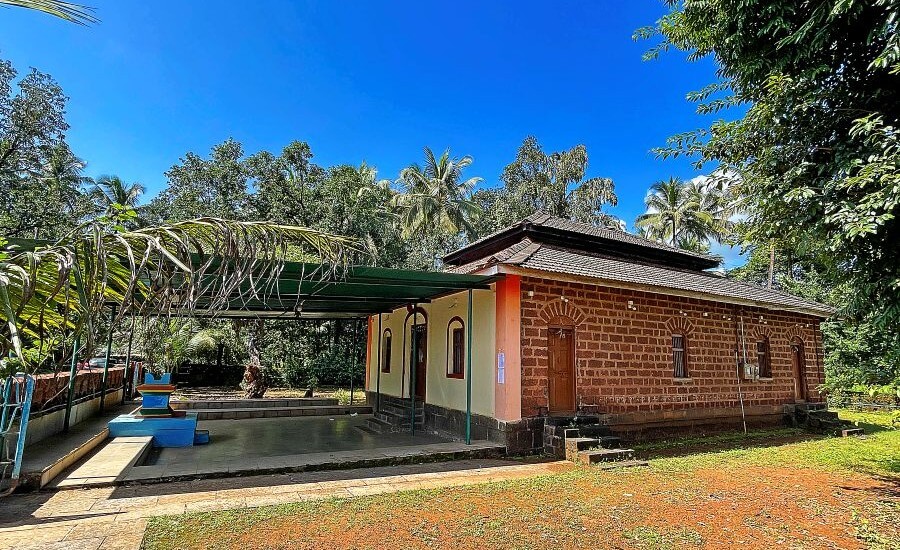
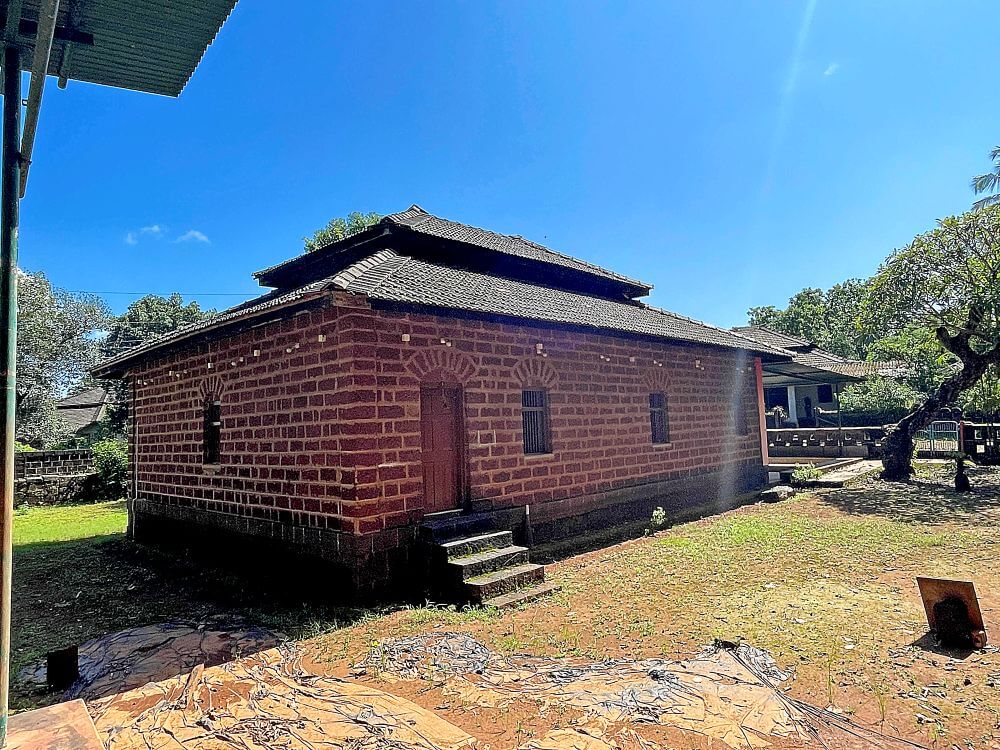
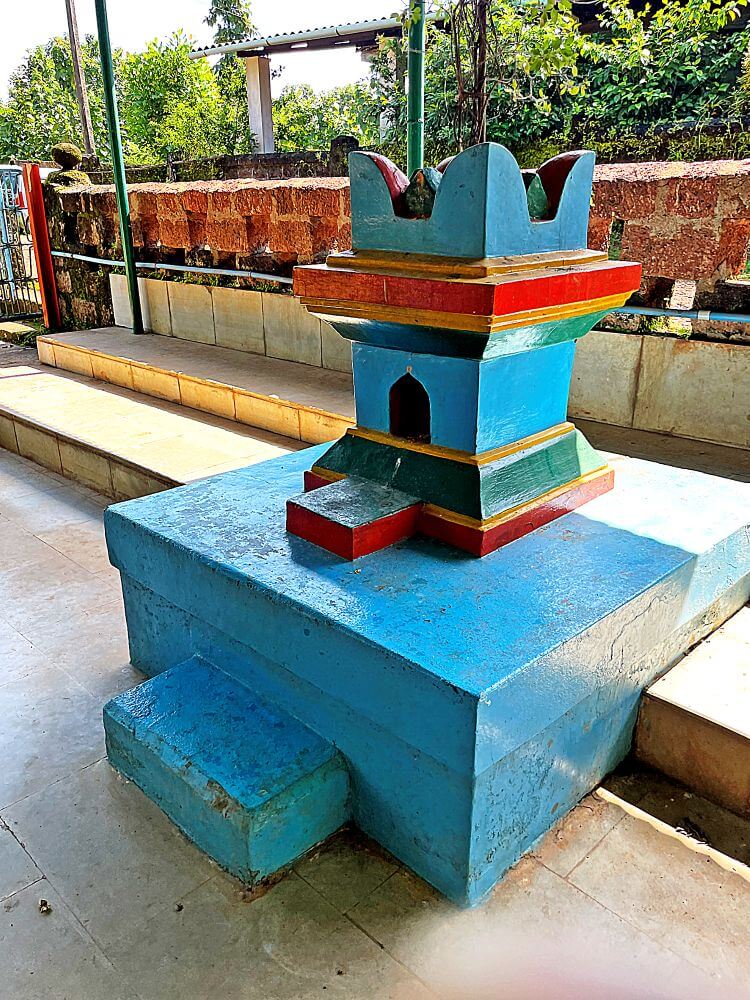
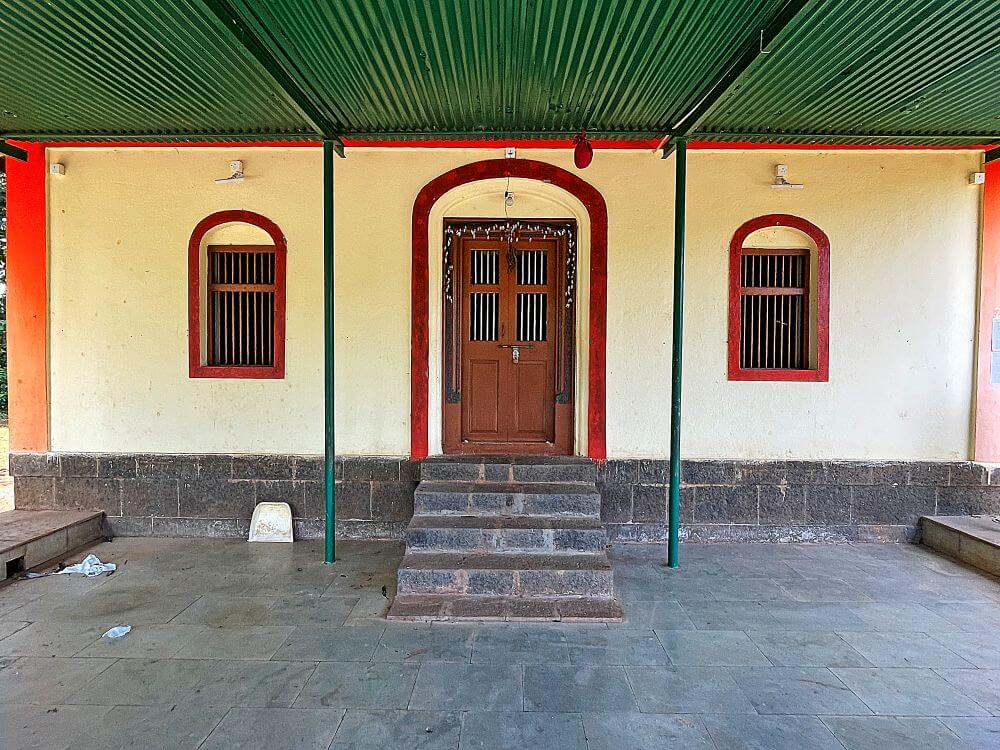
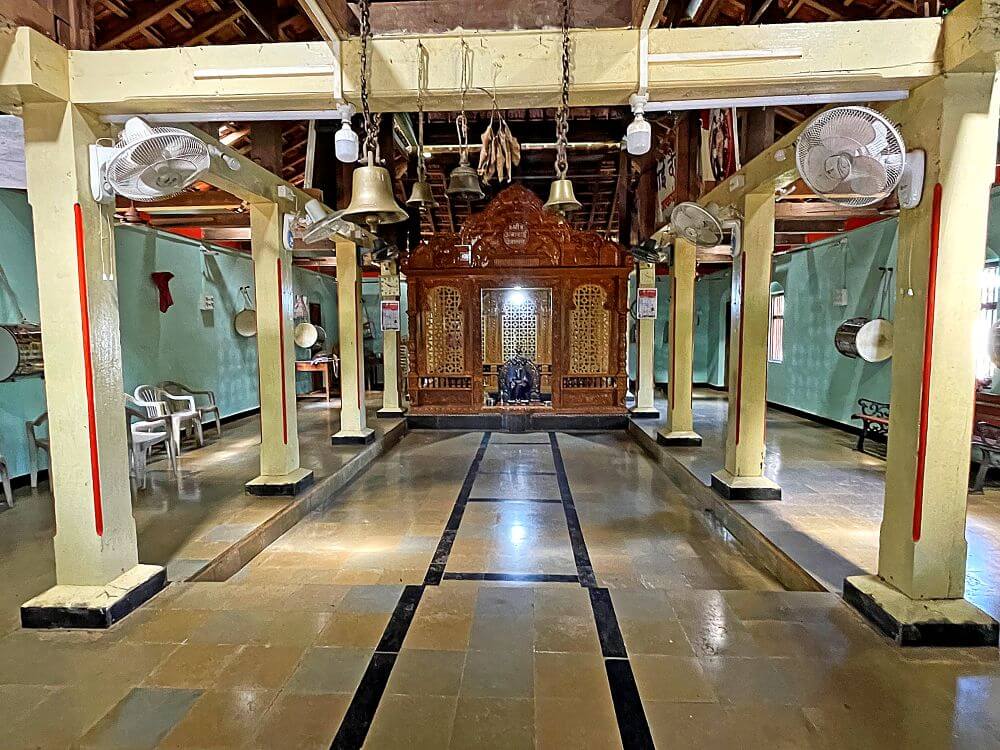
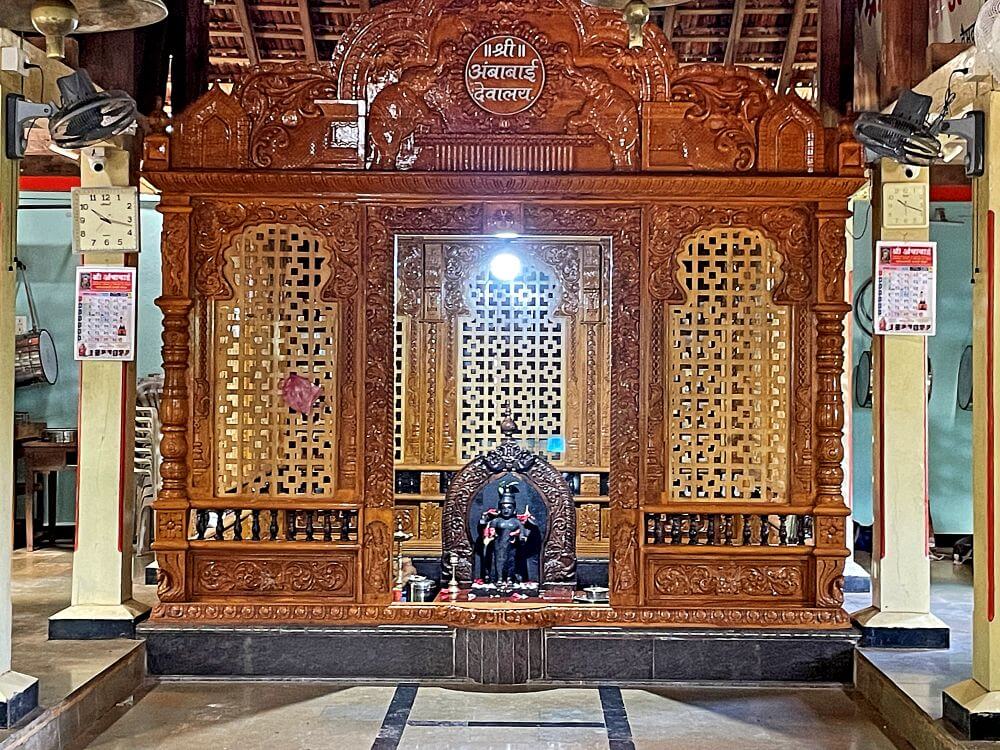
The Ambabai Temple in Narkarwadi is a two-storied structure with a tiled roof, built in the Konkani style. The outer walls of this temple are made of laterite stones, while extensive use of wood has been made for all interior work. In front of the temple, there is an open courtyard. Within this courtyard, there is a Tulsi Vrindavan (sacred basil plant enclosure). This temple stands three feet above ground level. One enters the temple’s assembly hall (Sabhamandap) by ascending four steps. The Sabhamandap is enclosed. Inside, at some distance from the outer walls, there are square wooden pillars on both sides, supporting sturdy beams. According to Konkani architectural style, the central rectangular part of the Sabhamandap is a few inches lower than the surrounding floor. Beyond the Sabhamandap, leaving space for a circumambulatory path (Pradakshina Marg), is the structure of the sanctum sanctorum (Garbhagriha). This Garbhagriha resembles an exquisite wooden shrine. The Garbhagriha features carved pillars on all four sides, with latticed windows (Gavakshas) in between. Its entrance is single-branched, and the doorframe (Dwarapatti) is adorned with floral scrollwork. On the Dwarapatti, at the Lalatabimba (central lintel), there is a facial image of a dwarf (Batu), while at the bottom, on both sides, are the doorkeepers (Dwarapalas) Jaya and Vijaya. Above the Dwarapatti, there is an arch-like (Makhara) shape. In its center, within a circle, the words ‘Shri Ambabai Devalaya’ are carved. On both sides of these words, elephants (Gajraj) fanning with whisks (Chavaris) are carved in wood. On both sides of the Garbhagriha’s door, there are tall latticed windows with wooden grilles. The delicate wooden pillars (Kashtastambha) of this Garbhagriha are exceptionally beautiful. On their upper parts, images of lions standing on two legs are carved. This entire Garbhagriha is an excellent example of wood carving (Kashtashilpa).
Inside the Garbhagriha, on a Vajra Pitha (diamond pedestal), rests the four-armed idol of Goddess Ambabai, carved from a single stone. This idol bears a resemblance to the idol of Ambadevi in Kolhapur. On the head of the idol, there is a Shivling (Pindi of Shankara) with Sheshnag (divine serpent) above it. In the Goddess’s hands are a shield, a mace, a pumpkin-like fruit, and a betel leaf (Panpatra). Behind the idol, there is a wooden Prabhaval (aura/halo) carved with floral scrollwork. Above this Prabhaval, at the center, there is a Kalasha (finial).
The festivals celebrated in this temple are renowned throughout the district. The festivals here commence on Gudi Padwa and conclude on Holi Pournima. After the Gudi is erected on Gudi Padwa, Bhajan programs are held here every Monday, Friday, and Saturday during the month of Shravana. On Margashirsha Shuddha Ekadashi, an Akhand Harinam Saptah (uninterrupted week-long chanting of Hari’s name) is organized here. This is the biggest festival of this temple. Bhajan groups from 30 to 35 villages in the surrounding area participate in this Saptah. This includes Warkari Bhajan and Dindi Bhajan. This Saptah continues day and night. On the last day of the Saptah, Satyanarayana Puja is performed. At that time, Mahaprasad is offered to the devotees and villagers who attend. On Tripurari Pournima, thousands of lamps are arranged here. Every Friday evening, the Mahā-Āratī of the Goddess is performed, with hundreds of villagers participating.
A significant feature of this temple is its connection with the Zilla Parishad Primary School and Anganwadi in Kokisare Narkarwadi. In this sense, the relationship between Ambabai and Saraswati is evident here. Donations received by the temple are utilized for the bright future of the students studying in this school. The school is equipped with projectors, large-screen LEDs, television sets, modern laptops, and computers. Additionally, students here are provided English education based on the ‘Finland Pattern’. The education system in Finland is considered one of the best in the world. In this method, children are introduced to educational skills from a young age, even before formal education begins. It includes a ‘day care’ program for children in the nursery class. At the age of six, they are enrolled in pre-primary school, followed by 11 years of compulsory comprehensive basic education. Emphasis is placed on children’s self-assessment, and the school environment is kept very open and informal. Using this education system, children in the school are made into learners rather than mere examinees. This school has e-learning facilities. It is the first school in Sindhudurg district to provide such facilities. Children here are taught to prepare project reports and create PPTs on computers as early as the fourth and fifth grades. Young children in this school easily operate laptops and computers. While many Zilla Parishad schools in the district are closing down, many children are on the waiting list to gain admission to this school.
The temple organizes various activities and workshops for the children studying in this school, according to their interests. These include workshops on becoming a radio jockey, cameraman training, and narration workshops for a career in presenting. All necessary state-of-the-art equipment for these activities is available at the school. The school and temple administration diligently endeavors to cultivate essential life skills in the children. All the children who receive their education here hail from humble farming families. The necessary funds for all these children are graciously provided by the local residents of Narkarwadi, as well as by the devoted individuals who have moved away for employment or business. All the villagers of Narkarwadi, wherever they may reside across the globe, unfailingly contribute a fixed portion of their earnings towards these sacred religious and educational endeavors. Thus, this village stands as a beacon of inspiration and an ideal for other communities.
Beyond the revered Gramdaivat Mahalakshmi Temple of Koksare village and the sacred Ambadevi Temple in Narkarwadi, Koksare village is also distinguished as the largest village in Vaibhavwadi Taluka in terms of population. This blessed village is nestled at the foothills of the historic Salwa Hill, a veritable treasure trove of natural resources. Salwa Hill is renowned as the jewel of Vaibhavwadi and stands as the highest among the plains hills in the Sindhudurg district. This majestic hill, standing proudly on the borders of six villages including Koksare, is also reverently known as ‘Palkhicha Dongar’ (Palanquin Hill). Within Koksare village, there are various hamlets such as Bambarwadi, Bauddhawadi, Gavthanwadi, Sutarwadi, Palkarwadi, Sonarwadi, Guravwadi, Koksare-Nevarekarwadi, Kumbharwadi, Kudalkarwadi, Morewadi, Zorewadi, Ozarwadi, Narkarwadi, Khambalwadi, Borchiwadi, Bandhwadi, Khambalwadi-Nevarekarwadi, and Belekarwadi.
This sacred temple stands as a testament to deep spiritual devotion, ancient architectural grandeur, and rich local cultural traditions.
The sanctum sanctorum houses the divine idol consecrated according to ancient Vedic traditions, surrounded by serene courtyards and traditional temple architecture.
Navratri, Maha Shivratri, Annual Temple Jatra & Deepotsav
Compare and book flights, secure top-rated local hotels near the temple, hire reliable guides, and rent cars instantly.
Extend your pilgrimage by visiting other highly sacred temples located nearby.


Add ₹999 more to unlock FREE SHIPPING!
Your sacred cart is currently empty.
Shop Photo FramesFill in your delivery details below to place your order.
Add comment