
Add ₹999 more to unlock FREE SHIPPING!
Your sacred cart is currently empty.
Shop Photo FramesThe Warkari tradition holds a place of utmost importance in the spiritual and cultural history of Maharashtra. Dehu is the place of spiritual practice (Karmabhumi) of the principal saint of this tradition, Jagadguru Tukaram Maharaj. This region is known for devotion and renunciation. Situated on the banks of the Indrayani River, this village possesses a historical heritage more than three hundred and fifty years old. Every structure here is imbued with devotion to Vitthal and bears witness to the life journey of Tukoba. Devotees consider this region to be the very form of Vaikuntha. The Vitthal Temple, the birthplace, the Shila Temple, and the Vaikuntha-gaman (ascension) site are the significant religious places in Dehu.
Sant Tukaram Maharaj was an extremely influential saint and poet of the sixteenth century in Maharashtra. He was born in the village of Dehu in Pune district. Although there are differences among historians regarding the year of his birth, the year 1608 is considered his birth year. His full name was Tukaram Bolhoba Ambile. His family had been engaged in the grocery trade and money-lending business in Dehu for generations. His father, Bolhoba, and mother, Kanakai, were both supreme devotees of Lord Vitthal of Pandharpur. Tukaram Maharaj spent his childhood in a prosperous and happy family. His family held great respect in society and their financial condition was excellent.
At the age of eighteen, events occurred that brought a major change in his life. At that time, a great famine had struck Maharashtra. It is known as the ‘Dashman Famine’. During this severe famine, a mountain of sorrow collapsed upon Tukaram Maharaj’s family. His first wife, Rakhumabai, and his eldest son died due to starvation. There was a great loss in business, and poverty entered the household. Due to these successive crises, Tukaram Maharaj’s mind turned away from worldly life. To repay the debts of the people, he immersed his share of the money-lending documents into the Indrayani River, thereby freeing many poor farmers from debt. After this, he began going to the Bhamchandra Hill near Dehu for self-reflection. In the solitude of the hill, he contemplated God and chanted His name. It was there that he received the inspiration for poetry. He composed thousands of Abhangas based on devotion to Vitthal. His Abhangas are not merely poetry; they contain the essence of human life and strikes against the wrongdoings in society. Through words such as ‘He who calls the afflicted and downtrodden his own’, he established the religion of humanity.
The work of Tukaram Maharaj was not only religious in nature but also one of social reform. He rejected discrimination based on caste and status. The influence of his thoughts on the people of that time was immense. The founder of Swarajya, Chhatrapati Shivaji Maharaj, was also inspired by the thoughts of Tukaram Maharaj. Shivray had invited him for a meeting and had also sent gifts. However, Tukaram Maharaj humbly declined them, setting an ideal of detachment.
According to the information given in the ‘Bhaktivijay’ text by Saint-poet Mahipati and the book ‘Tukaram Darshan’ by Dr. Sadanand More, the tradition of the Pandhari Wari and the rituals of Vitthal devotion were rooted in this family since the ancestor of Sant Tukaram Maharaj’s lineage, Vishwambhar Baba. According to historical records, Vishwambhar Baba, who was Tukoba’s eighth ancestor, was a staunch devotee of Vitthal. When it became difficult for him to perform the Wari to Pandharpur due to old age, Pandurang appeared to him in a dream. The Lord told him to excavate in a mango orchard in Dehu village where Tulsi leaves and flowers would be found. At that place, Vishwambhar Baba obtained extremely beautiful and self-manifested (Swayambhu) idols of Vitthal and Rakhumai. He built the first Vitthal temple in Dehu at this very sacred spot, and this Deulwada later became the main foundation of Tukoba’s spiritual journey.
The most faith-inspiring event in Tukoba’s life is the immersion of his Abhanga manuscripts in the Indrayani River and their emergence, dry and intact. People of the orthodox mindset of that time denied Tukoba the right to compose Abhangas and gave him the harsh punishment of immersing his Gatha in the river. Renouncing his literature, Tukoba performed penance on a stone slab on the banks of the Indrayani for 13 days, abstaining from food and water. It is believed that by the grace of Vitthal, the manuscripts floated on the water in a dry state and surfaced.
According to the beliefs of the Warkari tradition, Sant Tukaram Maharaj did not die; rather, he ascended to Vaikuntha in his physical form on Phalguna Vadya Dwitiya. Devotees believe that when he departed from the banks of the Indrayani River towards his eternal abode, a chariot of Lord Vishnu descended to take him. For this reason, one does not find a Samadhi of Tukoba in Dehu. Only the Vaikuntha-gaman temple has been built here. In historical times, various Maratha rulers granted lands and royal decrees (Sanads) for the maintenance and Prasad of these temples. Significant political records from the periods of Chhatrapati Sambhaji Maharaj, Chhatrapati Rajaram Maharaj, and Maharani Tarabai are found in this regard. After Tukoba’s physical ascension to Vaikuntha, his youngest son, Narayan Maharaj, greatly expanded this temple and completed the construction of the current grand stone temple in 1723.
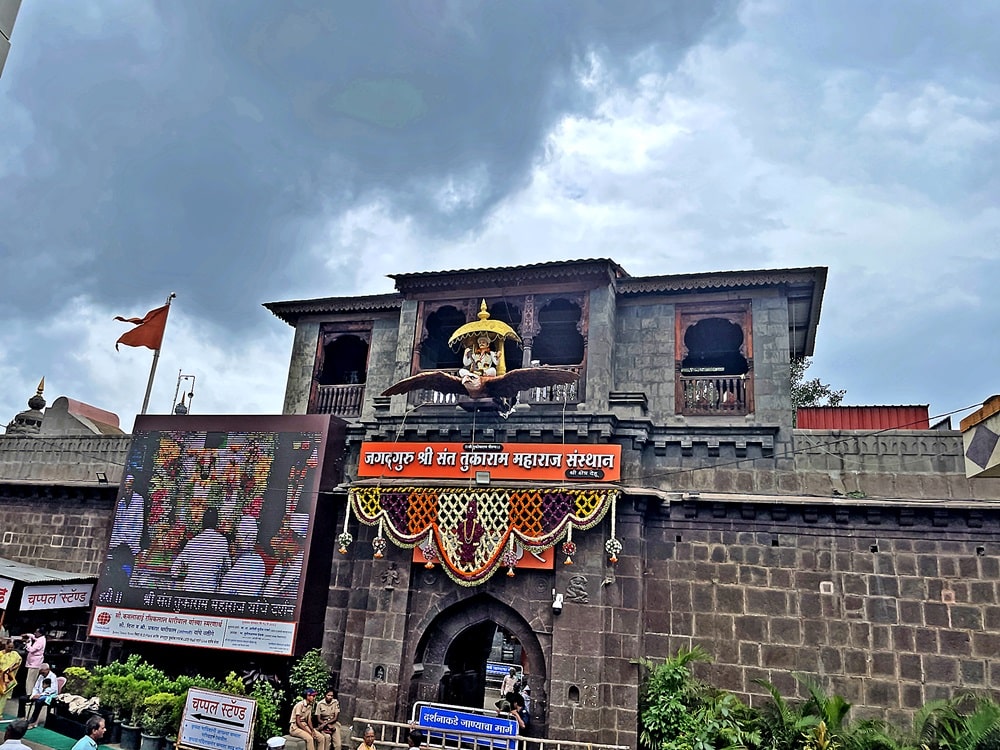
At the entrance of Dehu village, there is a grand gateway about fifty feet high. This gateway, which has three pavilions and eight pillars, features a total of twelve arched entrances. The middle pavilion of the gateway is the tallest. In the canopy (Meghdambari) on the roof of this pavilion is the idol of Sant Tukaram Maharaj. While going from the main road towards the Indrayani, one encounters the ‘Fourteen Talkari Gateway’. The gateway is characterized by square pillars on both sides and three continuous canopies on the projections above the pillars. All the pillars in the canopy are connected to each other by arched entrances. There are spires on the roof of the canopy. There are niches on the square pillars of the gateway, which contain sculptures of the fourteen Talkari saints.
While approaching the main temple, there are shops on both sides of the road selling worship materials, food items, clothes, toys, utensils, and metal goods. After walking some distance, one enters the Deulwada premises. Although the Deulwada was renovated a few years ago, its form is ancient. The two-storied entrance of this walled Deulwada is vast. On the front walls on both sides of the entrance, sculptures of Garuda and Hanuman are carved. In front of the entrance, there are stone railings on both sides, and guard rooms are located inside. On the floor above the entrance is the Nagarkhana (drum house). Here, the sculpture depicting Sant Tukaram Maharaj’s ascension to Vaikuntha is installed in such a way that it appears to be suspended in mid-air.
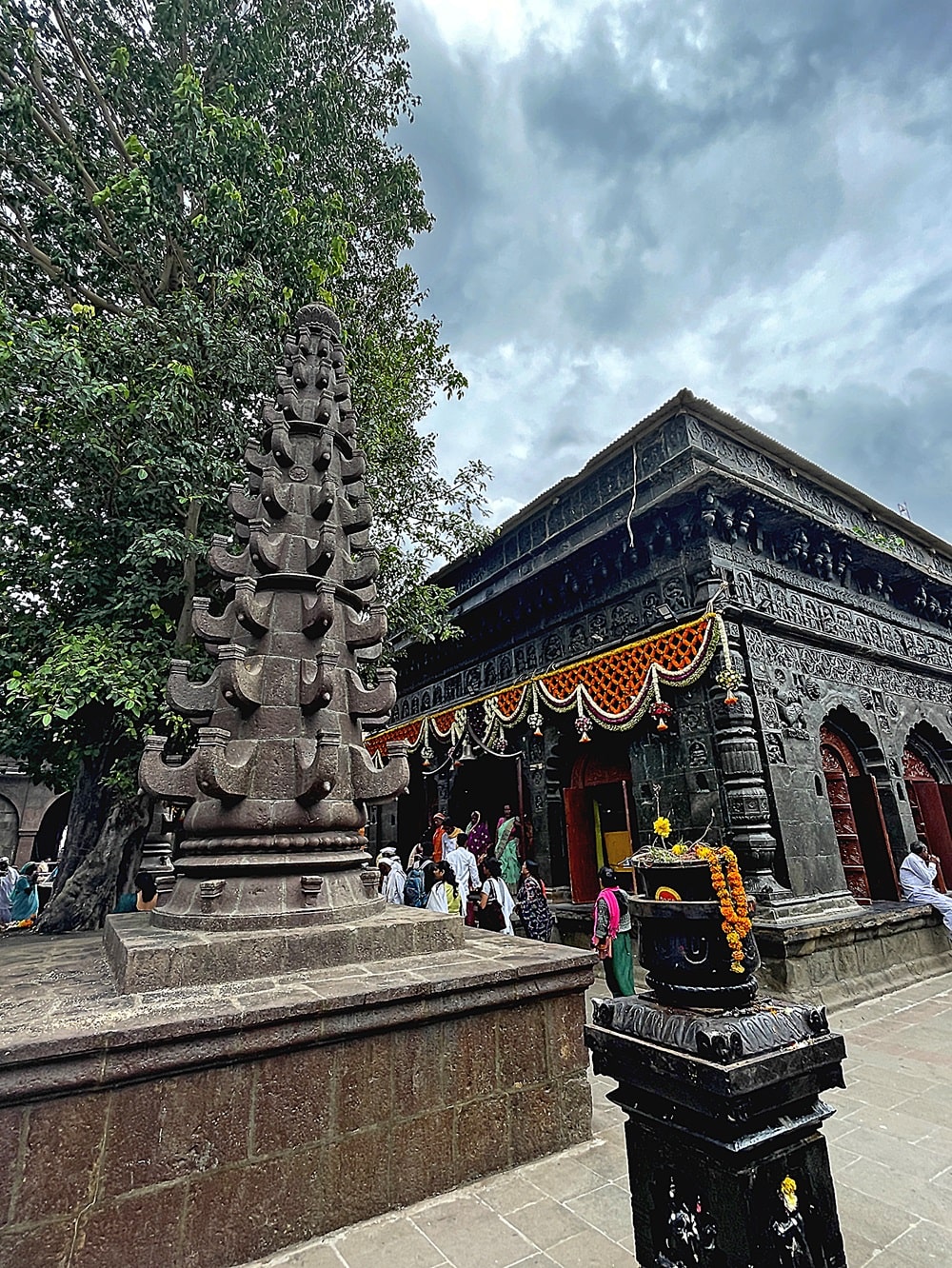
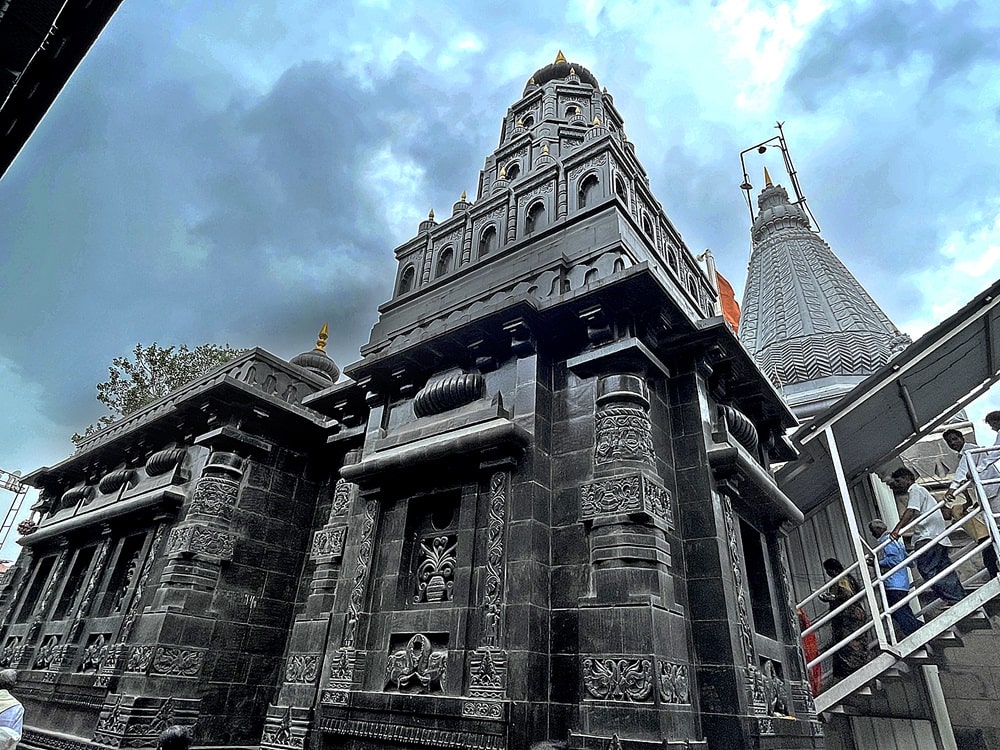
In the paved courtyard of the temple, there are two lamp towers (Deepmalas). Along the fortification walls in the courtyard, there are spacious corridors. The fortification also has entrances in other directions. In the center of the courtyard stands the temple of Sant Tukaram Maharaj. This Palkhi temple, which consists only of a Sabha Mandap (assembly hall), has three entrances on each of its four sides. The entire temple is adorned with carvings on the exterior. The Palkhi (palanquin) of Sant Tukaram Maharaj is housed in the Sabha Mandap, along with the utensils and other items used by him in his daily life. The roof of the temple features a dome-shaped Shikhara (spire) topped with a Kalash.
Beside this temple in the courtyard is the Vitthal-Rukmini temple. In front of the temple, on the right and left sides, are two small shrines containing idols of Garuda and Hanuman. The Vitthal-Rukmini temple is structured with a Sabha Mandap and a Garbhagriha (sanctum sanctorum). The Sabha Mandap has doors at the front, left, and right. The carved door frames of the entrance are covered with brass plating. Above the door is a sculpture of Ganpati, and on the exterior wall is a Kirtimukha. On both sides of the entrance are fish sculptures, and in the niches on the front walls on both sides are idols of Ganpati. The Sabha Mandap has pillars attached to the walls. In the Garbhagriha, idols of Vitthal and Rukmini made of black stone are placed on a Vajrapitha (pedestal). The roof of the Sabha Mandap features a dome-shaped Shikhara topped with two Amalakas placed one above the other and a Kalash. The roof of the Garbhagriha has a tall, circular Shikhara that tapers towards the top. In front of the temple, on a lotus-shaped pedestal, stands the Warkari flag pole.
Next to the Vitthal-Rukmini temple is the Shila (stone) temple. It is said that after Sant Tukaram Maharaj’s Gatha (collection of devotional poems) was immersed in the Indrayani river, he sat there in a meditative state for thirteen days. Both sides of the temple entrance feature peacock carvings. The entire temple is intricately carved with animals, birds, leaves, flowers, and deities, both inside and out. In the Garbhagriha, there is a black stone idol of the Maharaj in a meditative posture, holding a Veena. Beside the Tukaram Maharaj temple is the temple of Sant Bahinabai.
There is also a Shriram temple in the courtyard. Since all the temples are built on high platforms, there are steps in front of the entrances. This temple, consisting of a Sabha Mandap and a Garbhagriha, houses idols of Shriram, Lakshman, Janaki, and Hanuman on a Vajrapitha in the sanctum. Beside the main temple complex (Deulwada) is the Samadhi temple of Narayan Maharaj, the second son of Sant Tukaram Maharaj. This semi-open octagonal temple, with a roof supported by eight pillars and topped with a Shikhara, is enclosed by iron grilles on the outside. In the center of the temple is the Samadhi platform, topped with Paduka (footprints), and behind it, on a Vajrapitha, is the idol of Narayan Maharaj. Narayan Maharaj initiated the Palkhi procession, which is why he is known as the father of the Palkhi tradition. A short distance from here, on the banks of the Indrayani, is the temple of Sant Chokhamela. The temple houses an idol of Sant Chokhamela in a yogic posture on a Vajrapitha.
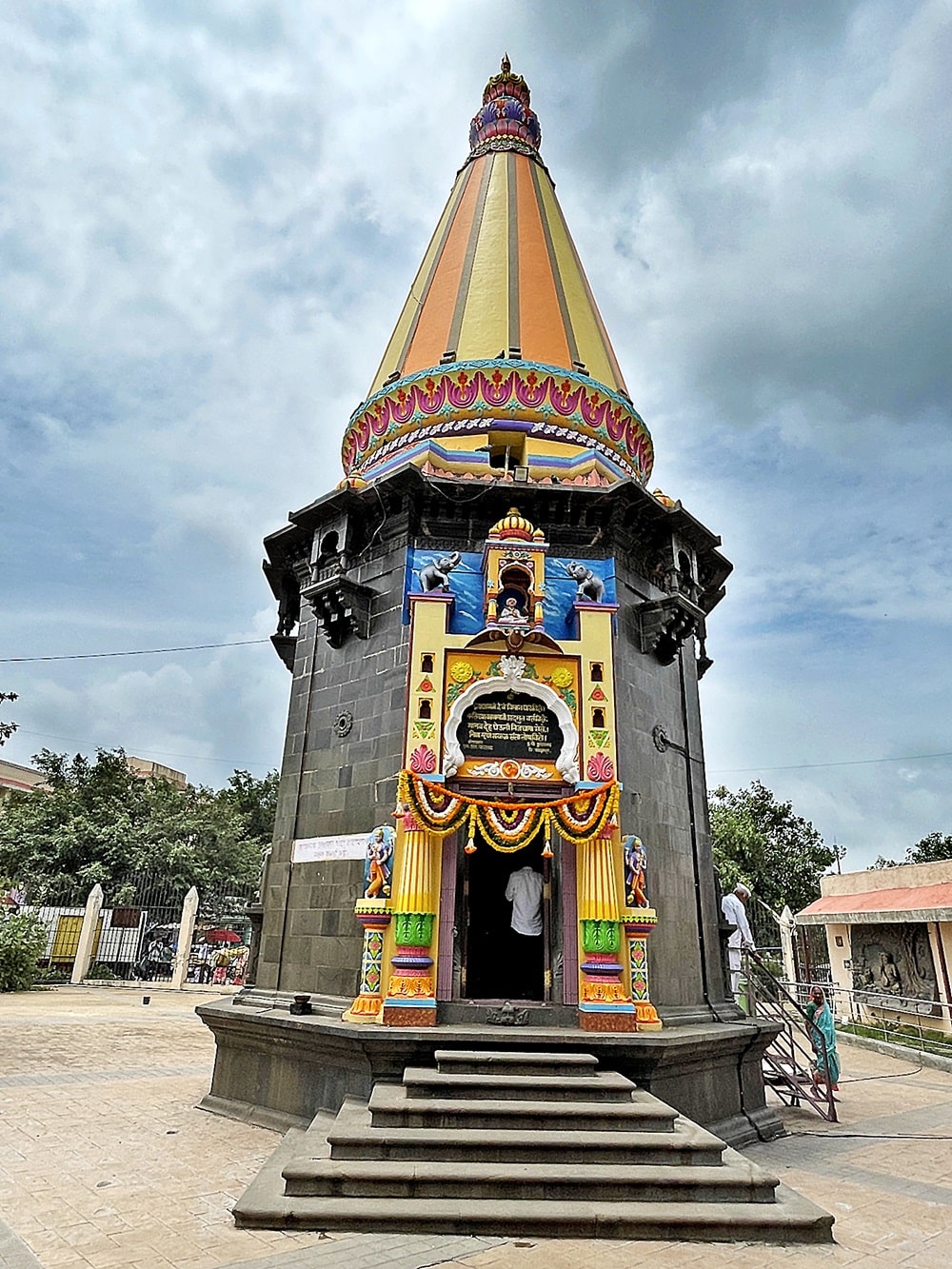
Nearby is the Sant Tukaram Maharaj Vaikuntha Gamana Smriti Mandir (Memorial Temple of the Ascension to Vaikuntha). This temple, with its carved door frames and Torana (archway), houses an idol of Tukoba, with idols of Vitthal and Rukmini behind it. The roof has a circular, tapering Shikhara topped with an Amalaka and a Kalash. The courtyard surrounding the temple features sculptures depicting important events from the life of Tukaram Maharaj. In this same courtyard, under a Nandurki tree, is the site of his ascension. Devotees believe that it was from here that Sant Tukaram Maharaj ascended to heaven in his physical form via a celestial chariot (Pushpak Vimana). It is said that on the day of Tukaram Beej, at twelve o’clock in the afternoon, this tree trembles.
A short walk from the Deulwada is the ancestral house (Wada) where Sant Tukaram Maharaj was born. Although this two-story house has been renovated in recent times, its original structure remains intact. The wooden pillars of the house support the ceiling, which in turn supports the balcony of the second floor, and the pillars on the balcony support the roof. The walls here are adorned with images of various saints. The verses from the Maharaj’s Abhangs are inscribed here. In an inner room of the house, there is a black stone idol of Sant Tukaram Maharaj on a Vajrapitha. In another room of the same house is an idol of his wife, Jijabai. Next to the birthplace of Tukaram Maharaj is the Inamdar Wada, where some of the Maharaj’s descendants reside. This Wada holds the honor of being the first stop of the Palkhi.
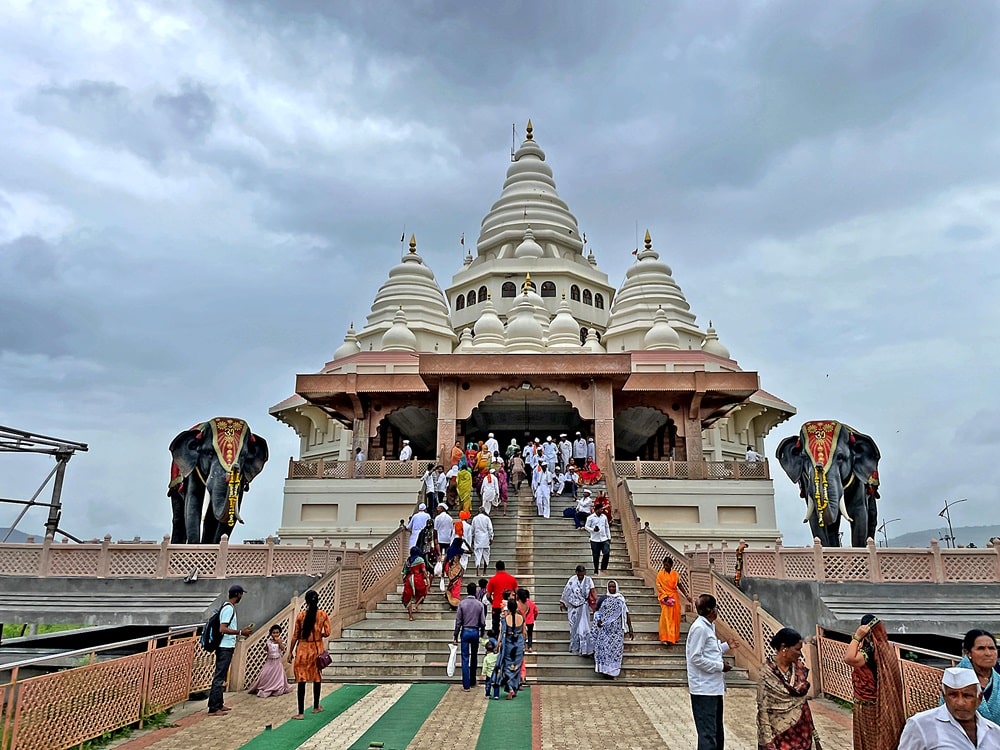
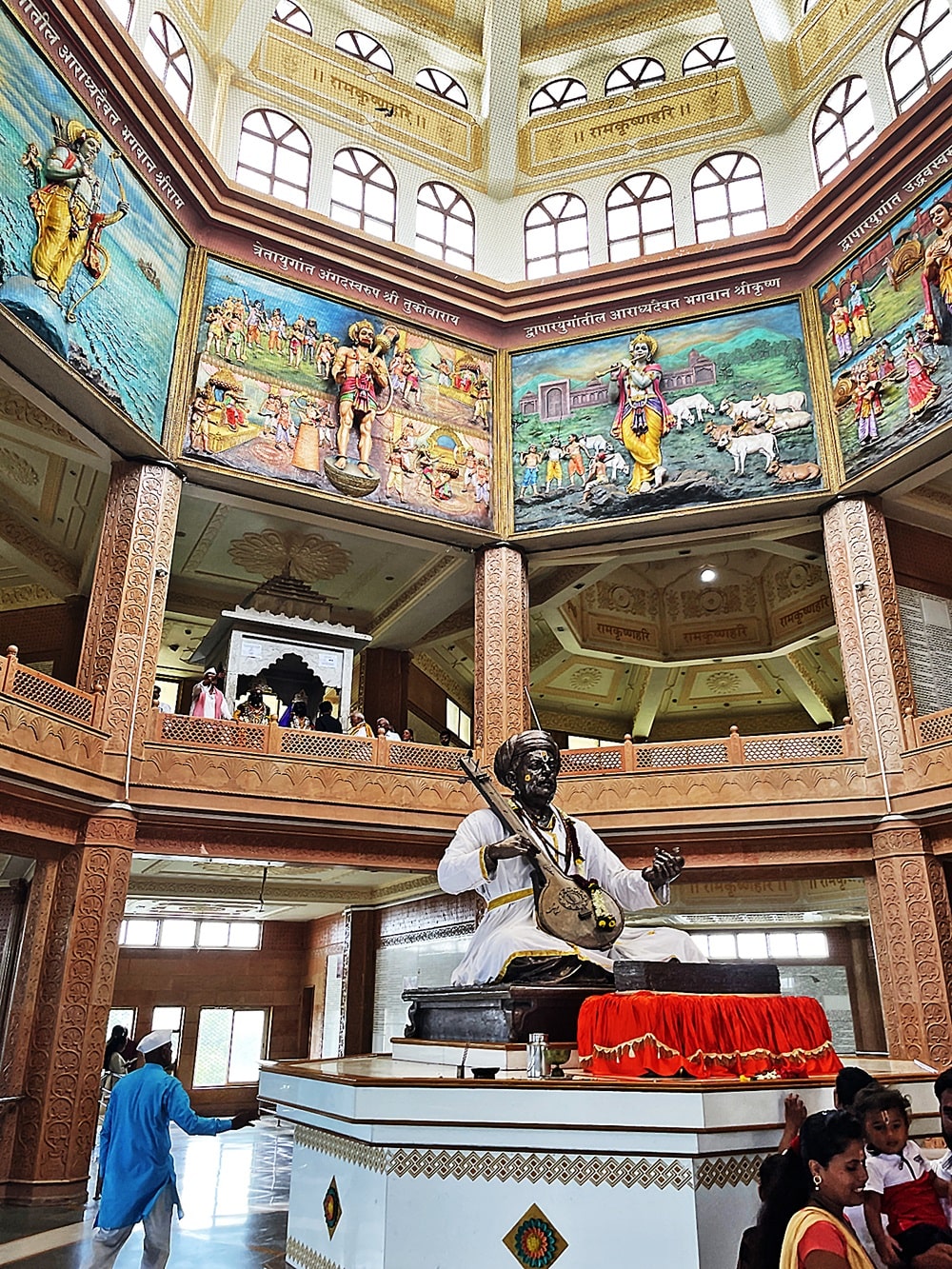
One kilometer from the Deulwada, on the banks of the Indrayani river, stands the newly constructed, magnificent Gatha Mandir. It features a spacious courtyard, beautiful fountains, and a multi-story structure, with about forty steps leading to the main temple. The Gatha Mandir is a grand edifice with sculptures of caparisoned elephants on both sides of the staircase, a spacious Sabha Mandap, dome-shaped Shikharas on the roof, and a Kalash atop the spire. The marble walls of the temple are engraved with about 4,500 Abhangs and the life story of the Maharaj in the form of sculptures. The temple houses an idol of Tukaram Maharaj. On Ashadhi Ekadashi, the Palkhi of Tukaram Maharaj departs from this very place for Pandharpur. Behind the temple, a Ghat has been developed on the banks of the Indrayani. This is the site of the Indrayani Doh (pool), where Tukoba’s Gatha was immersed in the river.
Various religious festivals and celebrations are held with great enthusiasm in Dehu throughout the year. Tukaram Beej, celebrated on the second day of the waning moon of the month of Phalguna, is considered the biggest festival here, and lakhs of devotees flock to Dehu for Darshan on this day. The Vaikuntha Gamana ceremony takes place in the afternoon, and long queues form for the Darshan of the Nandurki tree. It is said that even today, at 12:02 PM on the day of Tukaram Beej, this Nandurki tree actually moves. The Ashadhi Wari Palkhi procession, which departs from Dehu in the month of Jyeshtha, is considered an important event in the cultural life of Maharashtra. Carrying Tukoba’s Paduka in the Palkhi, the Warkaris depart for Pandharpur to meet Lord Vitthal. This Palkhi tradition was started by Tukoba’s son, Narayan Maharaj, and continues uninterrupted to this day. On Magh Shuddha Panchami, also known as Vasant Panchami, the birth anniversary of Tukoba is celebrated in the traditional manner at the birthplace temple in Dehu. Large fairs are held in Dehu on Ashadhi Ekadashi and Kartiki Ekadashi, during which continuous programs of Bhajan and Kirtan are organized. The Sansthan makes arrangements for the accommodation and meals of the devotees.
This sacred temple stands as a testament to deep spiritual devotion, ancient architectural grandeur, and rich local cultural traditions.
The sanctum sanctorum houses the divine idol consecrated according to ancient Vedic traditions, surrounded by serene courtyards and traditional temple architecture.
Navratri, Maha Shivratri, Annual Temple Jatra & Deepotsav
Compare and book flights, secure top-rated local hotels near the temple, hire reliable guides, and rent cars instantly.
Extend your pilgrimage by visiting other highly sacred temples located nearby.


Add ₹999 more to unlock FREE SHIPPING!
Your sacred cart is currently empty.
Shop Photo FramesFill in your delivery details below to place your order.
Add comment