
Add ₹999 more to unlock FREE SHIPPING!
Your sacred cart is currently empty.
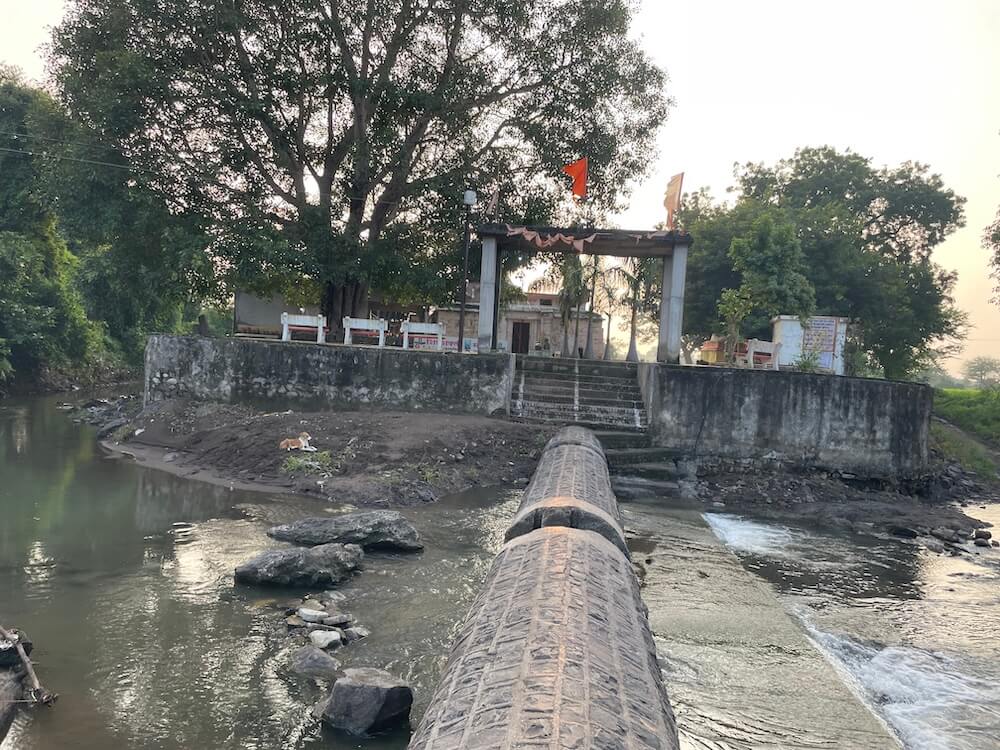
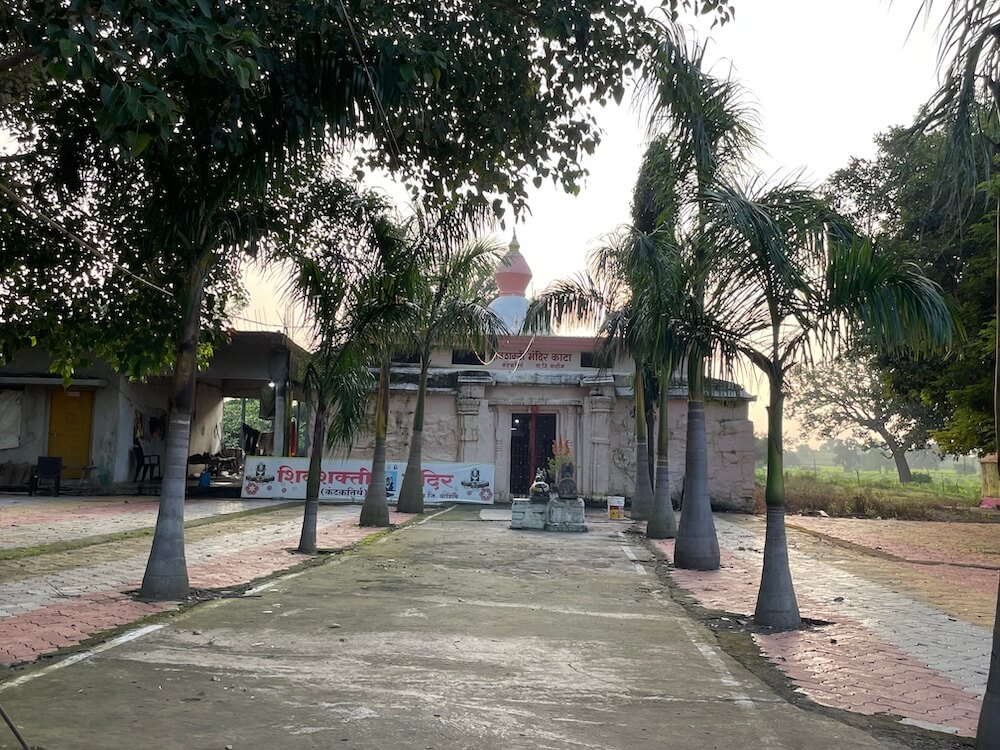
Shop Photo FramesThe ancient scripture ‘Vatsagulma Mahatmya’ includes 108 sacred pilgrimage sites. One of them is ‘Kantaktirtha’, which is the Shiv-Shakti temple at Kata. This temple is situated near the source of the Katepurna River, a northward-flowing tributary of the Purna River that flows through the central part of Akola district. In this temple, which is a seat of Shiva and Shakti, the five-faced (Panchamukhi) Lingam of Kantakeshwar Mahadeva is enshrined. It is said that this ancient temple, built in the Hemadpanti architectural style, was established by the Yadava kings. Because of this, the temple is considered significant not only from a religious perspective but also from a historical one.
Washim was one of the sixteen Mahajanapadas that existed in ancient India. It was known as Vatsa Janapada. The name Vatsagulma for Washim appears in many ancient texts. This was the capital of the Vakatakas. According to mythological legends, this was a part of the ancient Dandakaranya. The hermitage of Sage Vatsa was located here. His intense penance even struck fear into the hearts of the gods. They all gathered here and began to reside in the vicinity of Sage Vatsa’s hermitage. Sage Vatsa was a devotee of Lord Shiva. Therefore, Lord Shankara went alone to Sage Vatsa. Seeing his severe penance, tears welled up in the eyes of Shankara. Those tears filled a dry well beneath his feet, and from it, a river began to flow. Because it was created by the tears of compassion, this river was named Karuna.
This Karunatirtha is also known as Kantakatirtha. Thereafter, at the request of Sage Vatsa, Lord Shankara resided here in the form of a Linga. At that time, all the gods gathered (gulma) there and told Sage Vatsa that they too would reside in this region in their partial forms. Since then, this region came to be known as ‘Vatsagulmehi Panchakoshi’. This story is narrated in the following verse from the eighth chapter of the Vatsagulma Mahatmya: ‘Gulmatvena sthita deva vatsashramapadam prati. Atosya chabhavannama vatsagulamamiti prabho.’ Vatsagulma is also mentioned in Vatsyayana’s ‘Kamasutra’.
During the twelfth and thirteenth centuries, this region was ruled by the Yadavas of Devagiri. In the Dnyaneshwari, Saint Dnyaneshwar wrote, “There shines the glory of the Yadava dynasty, the abode of all arts, the king who nurtures justice, Shri Ramchandra.” King Ramadevaraya, who has been glorified in such words, built this Shiva-Shakti temple at Kantaktirtha in the year Shake 1227 (1305 CE). Notably, in 1294 CE, Alauddin Khilji attacked Devagiri via Achalpur in Varhad and defeated Ramadevaraya. At that time, he carried out massive looting in Devagiri and extracted a heavy tribute from Ramadevaraya. Following this defeat, Ramadevaraya accepted the suzerainty of Delhi. Even in such circumstances, within about a decade, Ramadevaraya constructed this Shiva-Shakti temple here. This temple has been built in the Hemadpanti architectural style, which was popularized by Hemadri, also known as Hemadpant, the Prime Minister (Karnadhipati) of Ramadevaraya. The date of the establishment of this temple is inscribed in the Shake era at the base of the idol of the Goddess in the temple.
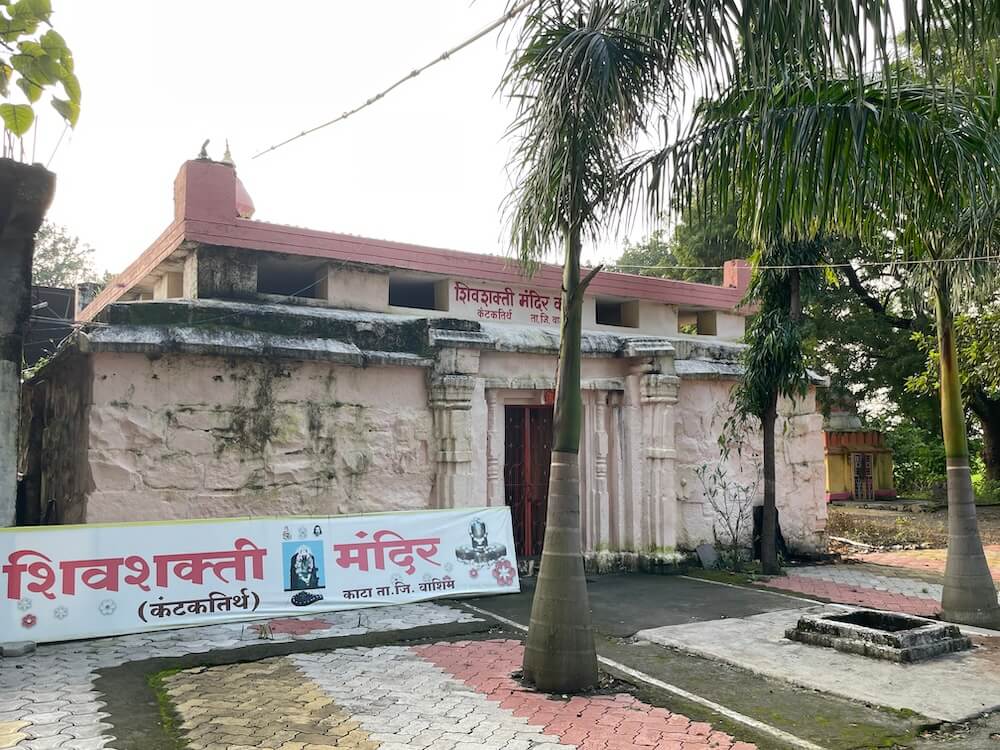
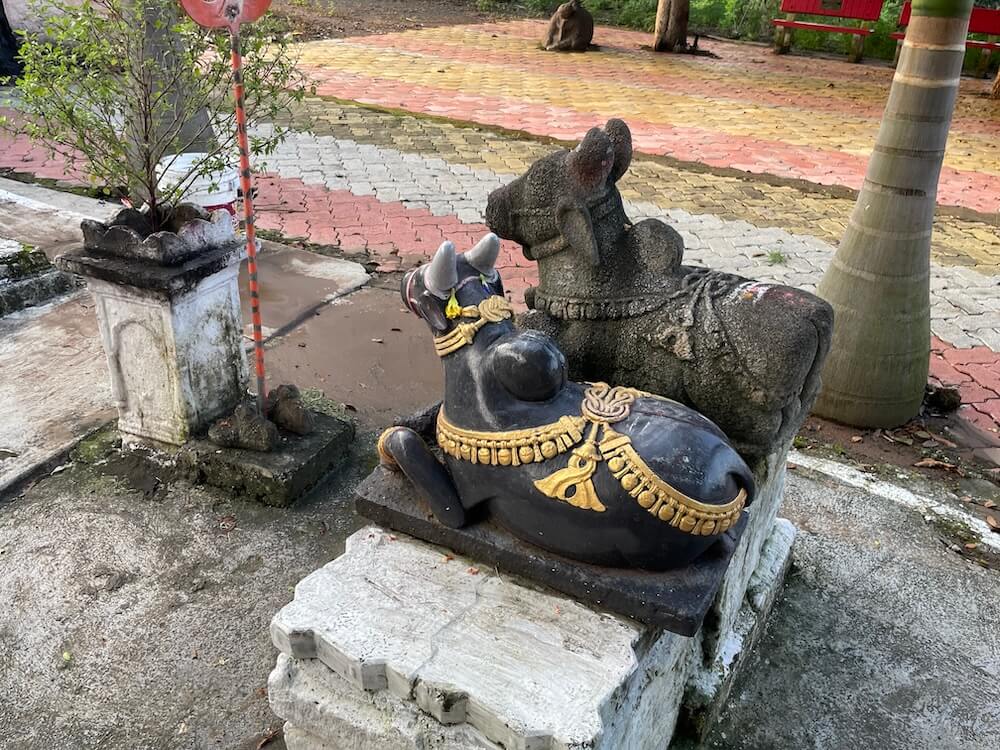
This temple is situated on a high elevation in a region surrounded by dense forests along the banks of the Katepurna River. In front of the temple, two idols of Nandi are installed on a platform. One of these idols is ancient. In front of it stands an iron trident and a traditional Tulsi Vrindavan. Beyond that is the Homa Kund. This ancient temple, built in the Hemadpanti architectural style, had fallen into disrepair over the passage of time. Therefore, it has been renovated. The temple is structured into a Sabhamandapa (assembly hall), Antarala (vestibule), and Garbhagriha (sanctum sanctorum). A cement slab has been laid over the Sabhamandapa, while a modern conical-shaped Shikhara (spire) has been erected over the Antarala and Garbhagriha. However, the original structure inside the temple has not been disturbed.
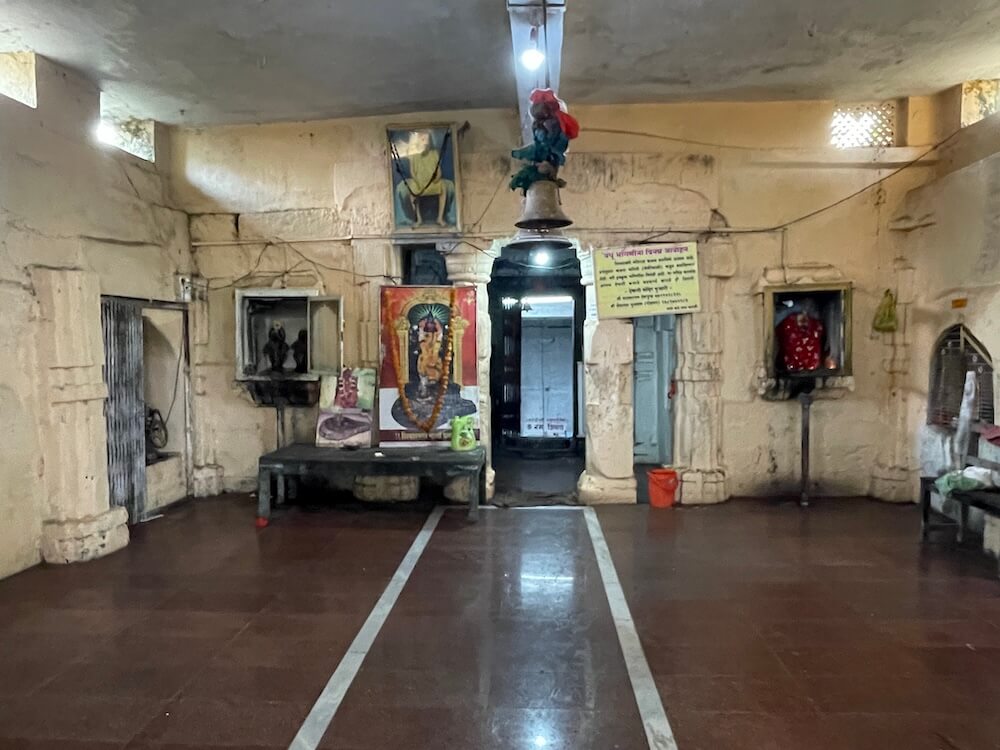
The entrance of the temple is constructed of stone. There are carved pillars on the sides of the door frame. An idol of Lord Ganesha is carved on the lintel of the door frame. Inside, the assembly hall has a newly constructed cement roof. There are stone semi-pillars in the walls inside. The base of these pillars is square-shaped, while the middle section of the pillar is octagonal. Above this, a carved garland and the Kumbha symbol are engraved on the circular section. In the niches here, there are idols of Vitthal Rukmini and Fursungi Maharaj of Dhamangaon. A photograph of the saint Pitambar Baba is placed on the wall of the assembly hall.
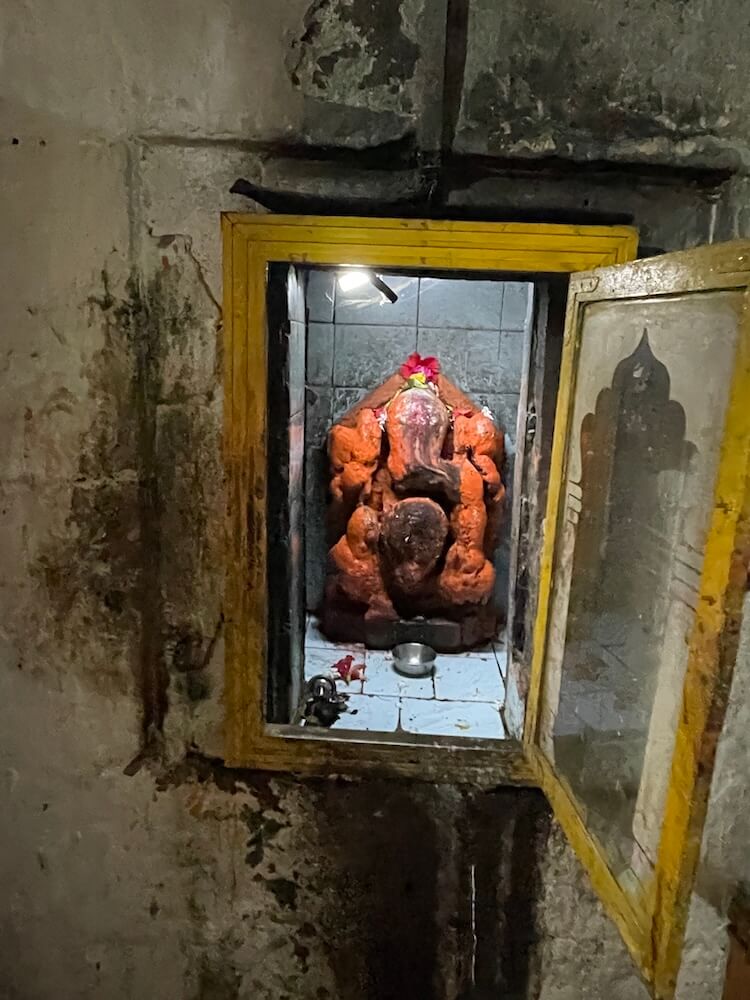
One enters the sanctum through the space between two pillars in the assembly hall. Here, in the niche on the left side, the ancient idol of Lord Ganesha is enshrined. The interior of this niche in the Hemadpanti temple is lined with marble tiles. The entrance to the sanctum sanctorum of this temple features exquisite carvings that captivate temple scholars. This doorway is of the five-branched (panchashakhiya) style. The five branches consist of the leaf branch (patrashakha), celestial musician branch (gandharvashakha), pillar branch (stambhashakha), mythical creature branch (vyalashakha), and the scrollwork branch (svalpashakha). On each of these frames, sculptures such as leaves and celestial musicians are carved accordingly. In the lower sections of the pillars, figures of the goddesses Ganga and Yamuna, along with attendants holding whisks, are carved. A Kirtimukha is carved on the lintel of the doorway, flanked by floral motifs on both sides. In the center lies a crescent-shaped stone (ardhachandrashila), and the image of Lord Ganesha is positioned at the center of the lintel (lalatabimba).
The sanctum sanctorum here is deep below ground level and square in shape. One enters the sanctum by descending nine steps. In the center, there is a Shiva Linga. The base of this Shiva Linga is quite large. In its center stands a five-faced Linga. Above it is a brass canopy shaped like a serpent’s hood, topped by an abhisheka vessel. In a niche on the back wall, a four-armed idol of the Goddess, carved from black stone, is enshrined. Adorned with various ornaments, the idol wears a crown featuring a carved Shiva Linga. Near her feet, on both sides, are carved figures of two attendants holding weapons. She is revered as a Shakti deity. Additionally, there is an ancient idol of Shiva and Parvati in the sanctum. In this depiction, Parvati is seated on the left side of Mahadeva. Beside Shiva’s feet, Ganesha is positioned on the left, and Kartikeya is on the right. Similarly, an ancient idol of the Goddess is also enshrined here.
Within the temple premises, there is a temple of Chintamani Mahadeva. There is also a large hall, which is used during programs. It contains a Shiva Linga made of black stone. In this area, there is a stepwell named Brahmakund, and it is said that this is the source of the Katepurna River.
In this temple, an Abhisheka is performed for Kantakeshwar Mahadeva every day at 4 o’clock in the morning. Aarti is conducted here at 6 o’clock in the morning and evening. Festivals such as Mahashivratri and Navratri are celebrated here with great enthusiasm. During these times, there is a large gathering of devotees in the temple premises.
This sacred temple stands as a testament to deep spiritual devotion, ancient architectural grandeur, and rich local cultural traditions.
The sanctum sanctorum houses the divine idol consecrated according to ancient Vedic traditions, surrounded by serene courtyards and traditional temple architecture.
Navratri, Maha Shivratri, Annual Temple Jatra & Deepotsav
Compare and book flights, secure top-rated local hotels near the temple, hire reliable guides, and rent cars instantly.
Extend your pilgrimage by visiting other highly sacred temples located nearby.


Add ₹999 more to unlock FREE SHIPPING!
Your sacred cart is currently empty.
Shop Photo FramesFill in your delivery details below to place your order.
Add comment