
Add ₹999 more to unlock FREE SHIPPING!
Your sacred cart is currently empty.
Shop Photo FramesSince ancient times, the element of water has been worshipped across various cultures. Rivers, lakes, and oceans have attained a significant place in the religious rituals of diverse civilizations. In India, rivers are revered as mothers, while the ocean is worshipped in the form of Sagardev or Samudri Mata. Among the Koli community of Maharashtra, the ocean is primarily considered a masculine element. In Gujarat, the ocean has been worshipped as Samudradevi for hundreds of years. An important temple of this Samudri Mata is situated in the Phanaswadi area of Mumbai. As the Goddess is mounted on a tiger, she is also addressed as Vyaghrambari.
Since ancient times, Gujarat has had maritime trade relations with countries like Persia, Arabia, and Egypt. About five thousand years ago, during the Indus Valley Civilization, ships sailed from the port of Lothal to Western Asia and Africa. The ocean deity was worshipped by these traders and seafaring communities who engaged in maritime commerce. The ocean deity also held great importance for fishermen who ventured into the sea to catch fish. The underlying sentiment is that by worshipping this deity, she provides them with protection. In Gujarat, the sea goddess ‘Sikotar’ has been worshipped with this same sentiment for centuries. Because of the belief that she ensures merchant ships, which are her vehicles, reach their desired destinations safely, she is addressed as ‘Vahanvati Mata’. In some places, Samudri Mata is also known by the name ‘Sundari Bhavani’.
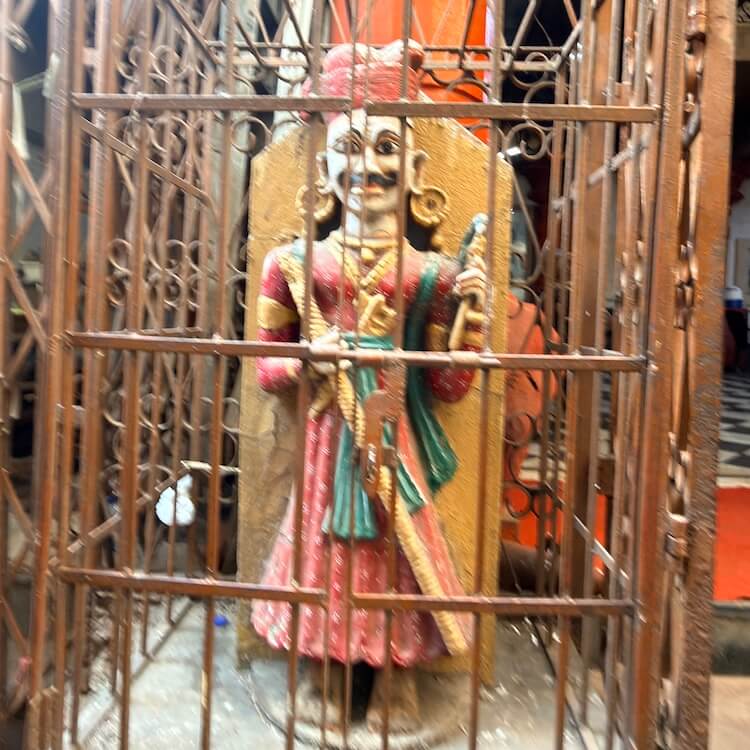
Jetha Harkisan, from the Kapol Bania community that migrated from Gujarat to Mumbai, established this temple around the years 1840 to 1845. K. Raghunathji, also known as Krishnarao Raghunathji Navalkar, the author of the book ‘The Hindu Temples of Bombay’, visited this temple in the year 1895. At that time, it was a very simple temple. It had a small assembly hall (sabhamandap) measuring approximately 9 by 6. It had four round wooden pillars. It had a roof made of wooden planks. Four simple glass lamps were attached to the ceiling, and a chandelier hung in the center. On both sides of the sanctum sanctorum door, there were two brightly painted statues of mace-bearing guards (chopdars) wearing red turbans, tightly bound white tunics, and trousers like Rajput guards. He provided information that live goats and chickens were offered to this Goddess. This mode of worship highlights the Goddess’s original nature as a folk deity. After the renovation carried out in October 1969, this simple temple attained its current form.
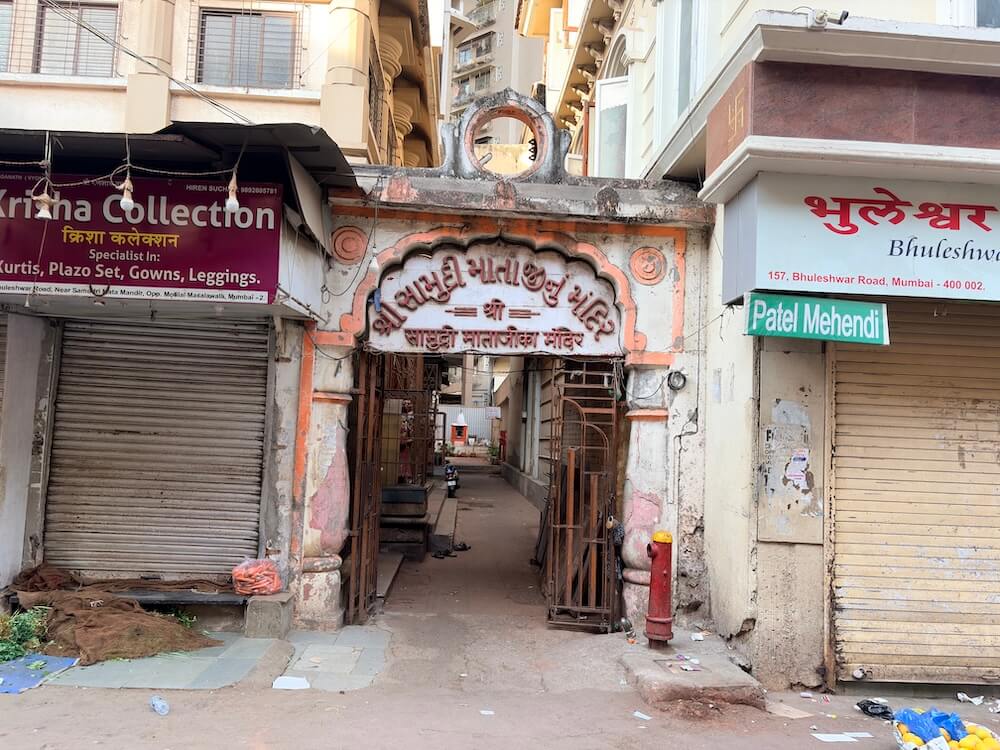
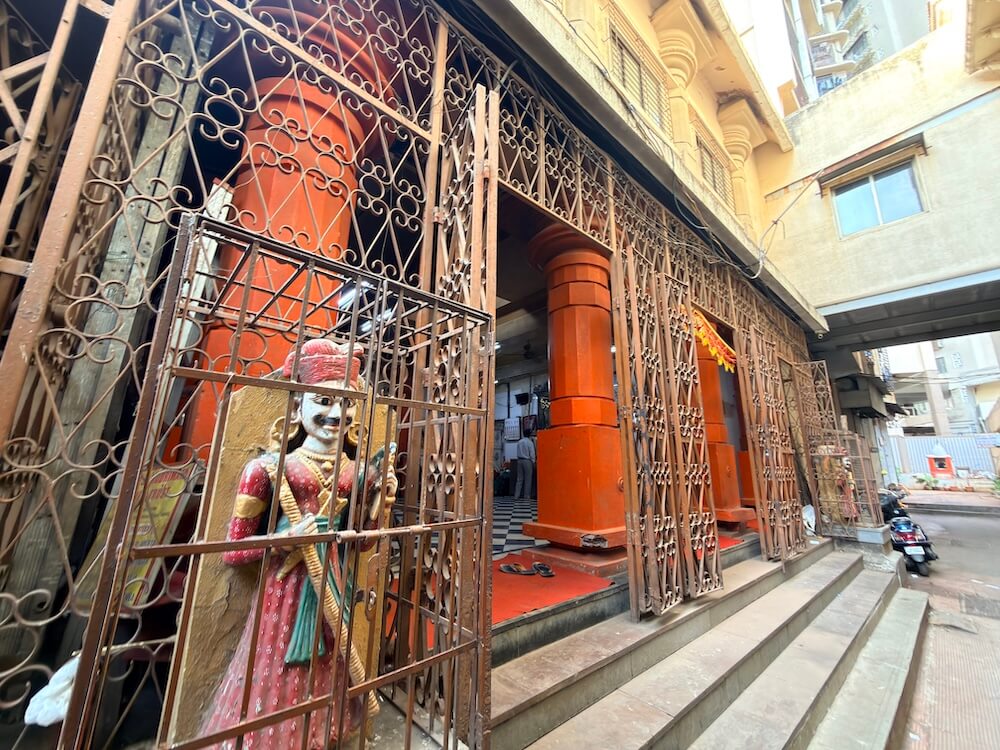
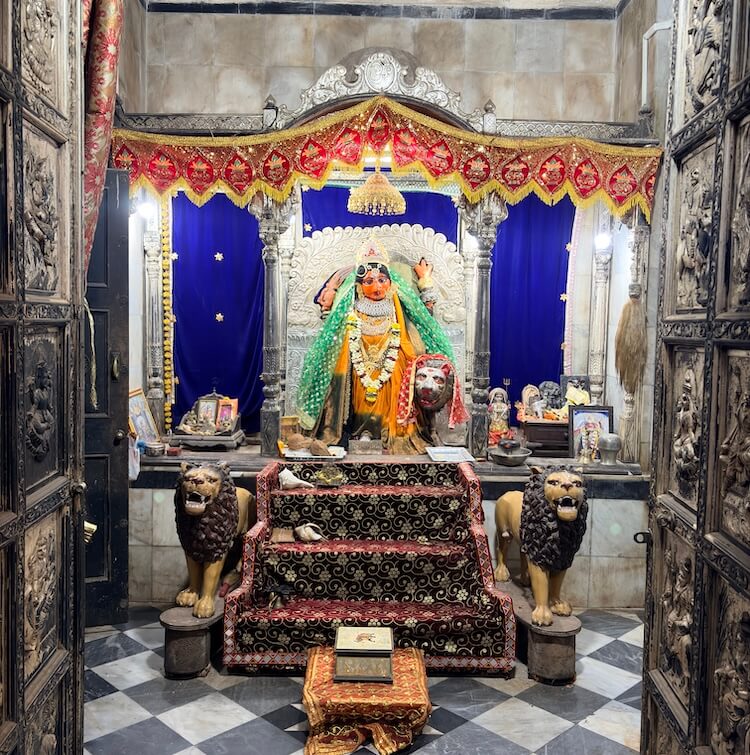
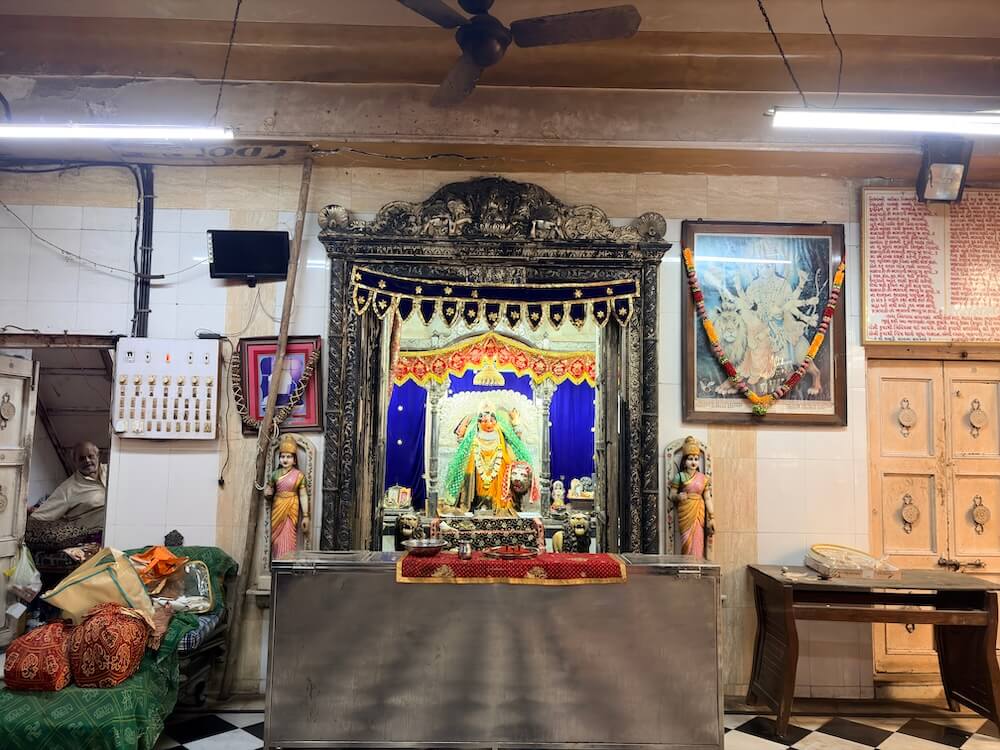
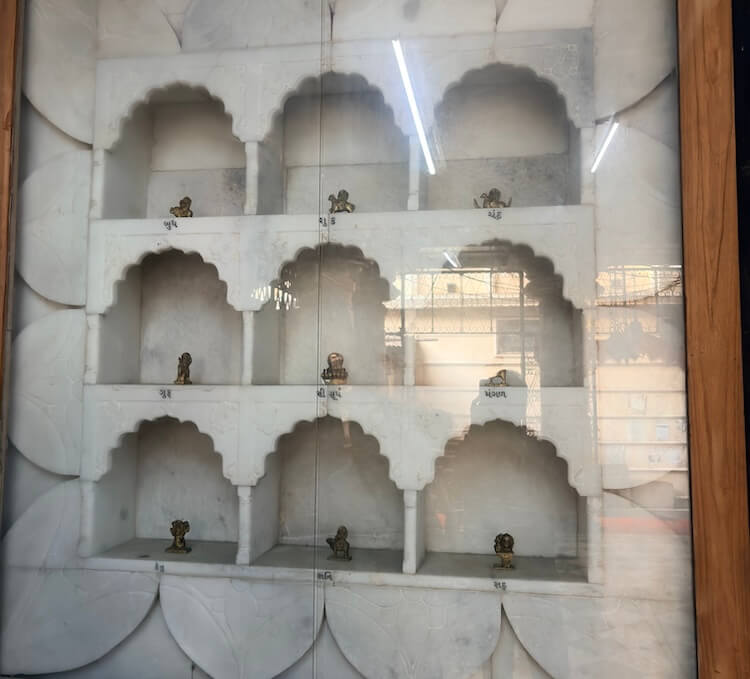
This two-story temple is nestled amidst the crowd of old buildings in the Bhuleshwar area, which still preserves the old market of Mumbai. The small lane leading to this temple has an old arched entrance. A few steps from here is the entrance to the temple’s assembly hall. One enters the assembly hall by climbing four marble steps. On both sides of these steps are statues of gatekeepers (dwarpalas). These statues wear Gujarati-style turbans, large earrings, long tunics, daggers in their waistbands, staffs in their hands, and a parrot on their left shoulder. This assembly hall, which is open from the front, has wide pillars. On the front wall of the assembly hall, small brass idols of the Navagrahas are kept in nine marble niches. These idols are placed in the order of Budh, Shukra, Chandra, Guru, Surya, Mangal, Ketu, Shani, and Rahu. Similarly, there are marble idols of Ambamata, Ganesh, and Hanuman in other niches. There is a large sacrificial altar (havankund) in the assembly hall. Near it is a Tulsi Vrindavan and a cylindrical lamp pillar (deepstambh) as tall as a man, with a kalash at the top. After entering the assembly hall, on the left side, the idol of the Goddess is seated on a high pedestal inside a silver arch (makhar). Here, the Goddess is in a four-armed form. Mounted on a tiger, this Goddess is a bearer of weapons. Behind the idol of the Goddess is a silver halo. On both sides of this arch are statues of the Goddess’s sword-bearing attendants. A large image of the eight-armed Durga Devi is placed on the back wall.
In this temple of Samudri alias Vyaghrambari Devi, the Goddess is worshipped three times a day. The evening Aarti of the Goddess takes place here. A large number of devotees visit this temple for darshan on Sundays, Tuesdays, and Fridays. The Ashwin Navratri festival is celebrated with great enthusiasm in the temple. During that time, the temple is decorated with lights. During this festival, a sacrificial fire (hom) is performed in the temple on Ashtami.
This sacred temple stands as a testament to deep spiritual devotion, ancient architectural grandeur, and rich local cultural traditions.
The sanctum sanctorum houses the divine idol consecrated according to ancient Vedic traditions, surrounded by serene courtyards and traditional temple architecture.
Navratri, Maha Shivratri, Annual Temple Jatra & Deepotsav
Compare and book flights, secure top-rated local hotels near the temple, hire reliable guides, and rent cars instantly.
Extend your pilgrimage by visiting other highly sacred temples located nearby.


Add ₹999 more to unlock FREE SHIPPING!
Your sacred cart is currently empty.
Shop Photo FramesFill in your delivery details below to place your order.
Add comment